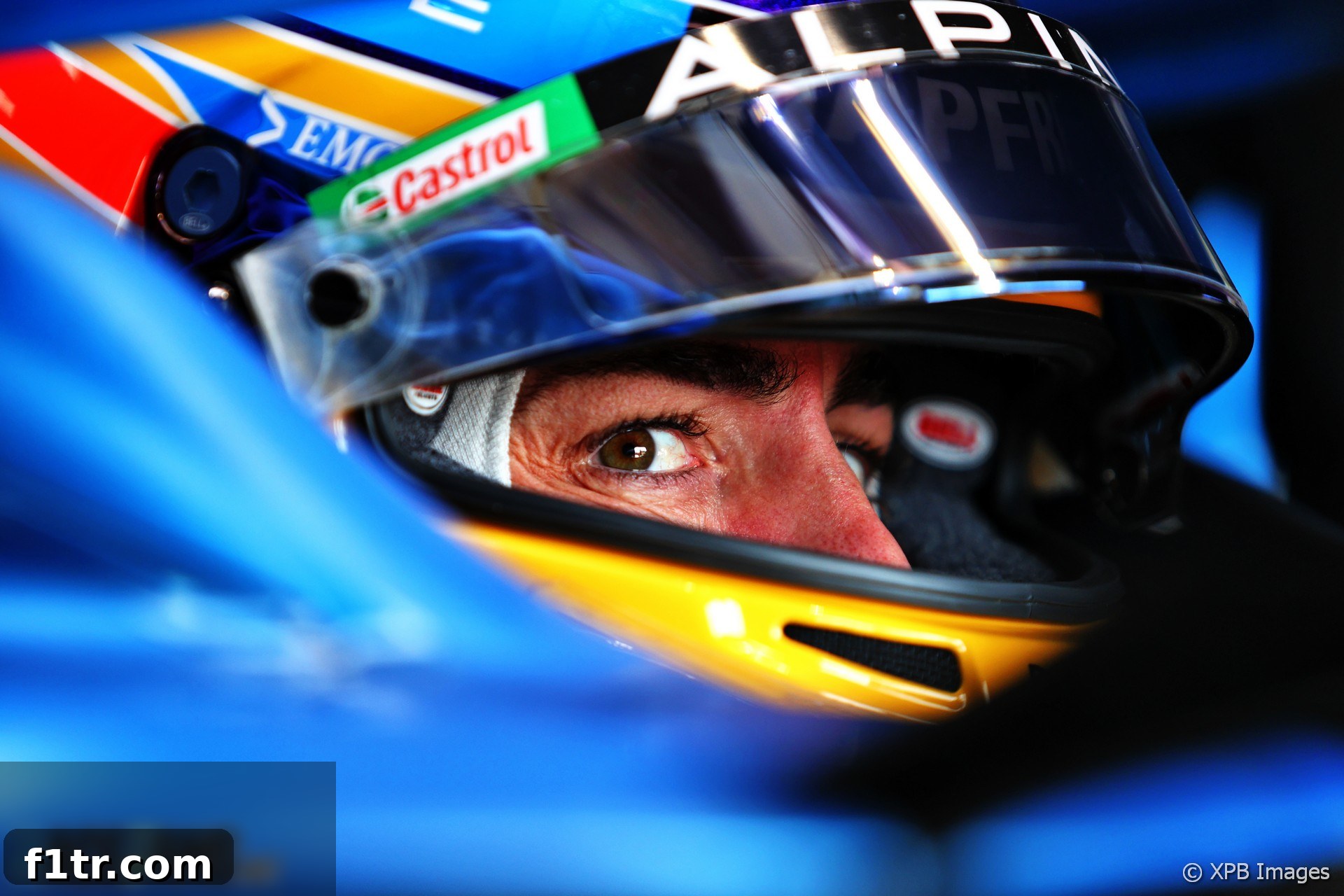
After a two-year hiatus that saw him explore diverse motorsport disciplines, two-time Formula 1 world champion Fernando Alonso has made a triumphant return to the grid. His comeback with Alpine, the rebranded Renault team, carries a familiar aura. The deeper shade of blue on his A521 car, combined with his iconic bright yellow helmet, instantly evokes memories of his championship-winning seasons in 2005 and 2006. This powerful visual callback reminds fans of the driver-car pairing that famously dethroned the legendary Michael Schumacher and Ferrari dynasty some 15 years ago, igniting hopes for another thrilling chapter in his illustrious career.
Alonso’s initial performances have offered a glimpse into his formidable talent and the challenges of adapting to a new era of Formula 1. At the season opener in Bahrain, it was as if he had never left. He skillfully guided his Alpine A521 into Q3, demonstrating his raw pace and potential. He looked poised for a strong points finish in the race itself, before an unfortunate technical problem prematurely ended his efforts. This early promise, however, was quickly followed by a trickier weekend at Imola. Like several other seasoned drivers adjusting to new teams this year – including Sebastian Vettel at Aston Martin and Daniel Ricciardo at McLaren – Alonso found it challenging to extract maximum performance from an unfamiliar car on a circuit known for its unforgiving nature and minimal margin for error. This period of adaptation is a natural part of any driver’s transition, especially after a significant break from the sport’s pinnacle.
The difficulties at Imola were underscored by a dramatic moment during the reconnaissance lap when rain began to pelt down, causing Alonso to momentarily lose control and slide into a barrier. Despite this pre-race incident, a testament to his resilience, he managed to recover and secure his first point of the season, aided partly by Kimi Raikkonen’s penalty. However, throughout the weekend, he notably lagged behind his junior teammate, Esteban Ocon, sparking early media chatter and concerns about his comeback form. Such scrutiny is typical in the high-stakes world of Formula 1, where every performance is dissected and analysed.
Speaking to select publications, including RaceFans, at Autodromo do Algarve before the Portuguese Grand Prix, the 39-year-old maestro remained unfazed, deftly playing down the growing concerns over his performance. He suggested that the media’s focus on his early-season form “is getting bigger than what it is,” indicating a calm and measured perspective on his return. Alonso, ever the pragmatist, was the first to openly acknowledge his struggles: “I was the first to admit that I was not 100 percent in Imola and not comfortable and probably underperforming,” he stated. However, he quickly added, “But it was one race and in one race that with that underperformance, I finished two tenths of a second behind my team mate. So it cannot be a big thing.” This self-assessment highlights his meticulous understanding of his performance and the fine margins in Formula 1. He emphasized the need for patience: “At the end of the year we’ll talk. If I underperform the whole season and everything was more difficult than expected, okay, maybe there is a point to really discuss and go deep into the questions of why it is more difficult than previously or something.”
Alonso pointed out the exaggerated perception created by the two-week gap between races, a factor he believes amplified the negative commentary. “But in Bahrain I was happy and probably overperforming. In Imola, underperforming. But we need a couple of races to settle down everything.” He reflected on his personal state, stating, “I am at a point in my life where I feel good and I feel capable of driving better than ever. But that doesn’t mean that you don’t find difficulties while entering a new adventure or in this comeback.” He lamented the nature of F1 media, saying, “At the same time, I had one weekend where I was not totally comfortable in Imola and the problem that in Formula 1 there are a lot of media, a lot of articles and unfortunately two weeks between races, because if it was back to back from Imola to [Algarve], there would’ve been much less talk.” His comments underscore the intense scrutiny and rapid narrative shifts that characterize the sport, often magnifying minor setbacks.
Alonso’s words found vindication at the Algarve weekend. While he again missed out on Q3 alongside Ocon, his race performance was stellar. He skillfully climbed to eighth position, scoring valuable points in what proved to be a significantly improved weekend for Alpine overall. This performance demonstrated his consistent race craft and ability to deliver when it matters. Despite this positive step, the team, which competed as Renault last season, acknowledges that it has started the 2021 season at a slightly lower performance level compared to where it finished the previous year. “I’m aware it’s a challenge and it’s [especially] a challenge this year also, because the midfield has been always a challenge,” Alonso acknowledged. He highlighted the intense competition in the current F1 midfield: “Where your team or your position was quite defined, and a supreme weekend would be doing it at 105 percent but we can perform in 90 percent, normally you can be between ninth or eleventh. This year, with the midfield as it is, you can be seventh or 15th in two tenths [of a second] if you don’t perform perfectly. So we [must] go for that perfection every weekend.” This illustrates the razor-thin margins and the absolute need for flawless execution in every session.
This heightened level of competition is precisely what lured Fernando Alonso back to the thrilling world of Formula 1. During his two-year sabbatical, he embarked on a remarkable journey across various motorsport disciplines. He experimented with the grueling endurance racing in the WEC (World Endurance Championship) and IMSA series, navigated the high-speed oval single-seaters in IndyCar, and tackled the challenging off-road rallying terrain of the Dakar Rally. These diverse experiences broadened his racing horizons and kept his competitive spirit sharp. As F1’s delayed 2020 season commenced amidst the global pandemic, Alonso closely observed the evolving state of competition, finding it increasingly compelling. Just a month after F1 resumed racing last year, he made the decisive move, putting pen to paper for his return.
Alonso articulated his reasoning for choosing F1 over other series, explaining, “Right now, I think especially after the pandemic, it’s a series that is more capable to produce a good show and to produce a good competition.” This sentiment clearly indicates that the sport’s renewed dynamism and competitive balance were significant factors in his decision. It’s also evident that the promise of a more competitive seat, compared to the options he might have had in 2019, played a crucial role. He drew a clear parallel to his departure: “In 2018, when I left the sport, I was very honest with everybody, saying that I had better feelings or ideas elsewhere than Formula 1 and I had more attractive challenges in WEC or in Indy or in Dakar than what Formula 1 offered me at the time,” he elucidated. Now, the situation has reversed: “Now it’s exactly the same point; in 2020 when I made the decision to come back, there were other series on the table and I thought that Formula 1 was the best challenge in that moment and the best competition.”
Beyond the allure of competition, Alonso feels that Formula 1 currently holds a more stable and robust position compared to other series he considered. He observed, “Even with the pandemic, the teams are still very strong and in good health, economically and on the performance side to produce fantastic cars and a good show while some other series, maybe they’ve been more affected by the pandemic and by the sponsorship and by everything.” This financial and operational resilience of F1, even in challenging times, provided an added layer of attraction. Delving deeper into his reasoning for not pursuing other categories, he elaborated: “Obviously with IndyCar I did only one race, it felt good and it’s going to always be a nice championship. But maybe I was more attracted by F1. Dakar is still one thing that I can do in the future and has no problem of having more years in other categories. And WEC, I think is in a transition period at the moment with the Hypercar until all the manufacturers, they don’t come until 2023.” He concluded, “So I thought that Formula 1 was the best thing on the table, like it was not in 2018. But this is obviously only a personal opinion and a personal motivation that drives you to choose the next challenge.”
Liberty Media, the commercial rights holder of Formula 1, can undoubtedly claim a significant share of the credit for Alonso’s return. The Spanish champion clearly approves of the strategic direction the sport has taken since their acquisition. “From the arrival of Liberty Media the sport went into having a better knowledge of what the fans needed, what the show means about the sport itself and the performance and the engineering war that is inside Formula 1,” he asserted. He believes Liberty Media has successfully reoriented F1 towards its audience, balancing the technical brilliance with engaging entertainment. “We need also to listen to fans and we need to put a good show on Sundays and I feel Liberty understood this from day one. They just needed a couple of years to settle down and to produce new ideas.” Alonso highlighted specific innovations that contribute to this enhanced appeal: “I think the cost cap, the 2022 rules, the sprint [qualifying] races, they are all things that are there just to produce better racing and better entertainment for everybody. So I’m happy with all the things that I see in the sport.” Alonso, however, appears to be among the cautious supporters of the Sprint Qualifying format, backing it more out of hope for its success than absolute conviction. “I hope the sprint races are a success this year and we can make it even better for the future,” he stated. “Maybe we will see things that are good, we will see things that they are not so good.” This pragmatic approach reflects his vast experience and understanding that not all innovations succeed immediately.
In more ways than one, Fernando Alonso views his first season back in Formula 1 as an interim year, a vital preparatory phase. From the moment his return deal was sealed, he openly communicated his desire for Alpine to prioritize the development of their car for the 2022 F1 season and its groundbreaking new technical regulations, which were strategically delayed by a year due to the global pandemic. “On the overall picture, yes, 2021 is a preparation year, it’s no doubt,” he affirmed. “I think everybody on the grid, after the delay of the 2021 rules into 2022, we understood and we accepted that 2021 is preparation year, is a post-Covid season with more or less similar cars of last year.” He sees this season as a crucial testing ground for various aspects: “It’s a season to test things like the sprint races. It’s a test season in a way for many things.” Looking ahead with clear ambition, he anticipates “a revolution in 2022,” adding, “and that’s what we will want in terms of fighting for the championship and other possibilities.”
Alonso first arrived in Formula 1 with Minardi two decades ago, a raw talent whose superb, if often unheralded, performances hinted at the immense success that would follow. His career, marked by two world championships, at one stage seemed destined to yield the kind of multi-title dominance later enjoyed by drivers like Sebastian Vettel and Lewis Hamilton. As is frequently remarked, a few critical points swinging his way in 2007, 2010, or 2012 could realistically have seen him become a three, four, or even five-time champion long before now, adding further layers to his already legendary status. Despite these missed opportunities, he remains utterly convinced that he still possesses the innate speed required to win another title. Moreover, with the invaluable benefit of two decades of experience, that raw speed is now seamlessly allied with a superior understanding of how to effectively harness his team’s advice, data, and expertise, transforming him into a more complete and formidable competitor.
Reflecting on his evolution as a driver over the past 20 years, Alonso noted, “I think you are maybe more mature now and you are working closer with your team.” He contrasted this with his early days: “When you come into Formula 1 and you are young you listen to everyone, yes, you try to understand what they are trying to tell you. But when it comes to your instinct of driving, when you close the visor, you are just racing hard. Because your background until that point was only karting and younger formulas that you have to survive by yourself only, you didn’t have that amount of people just helping you. So you are still driving and feeling like that.” This deep insight reveals the transformation from a purely instinct-driven racer to a meticulously collaborative and strategic competitor. He concluded, “But then with time – you still rely on your instinct, yes – but you are driving as a part of the team and try to optimise things. So it’s not that you lose the speed, but you are driving in what you believe is the most efficient way of driving the car and maybe sometimes even against your instinct of what you will do if you were out on track. But eventually you understand and you believe and you trust that you are doing the best way for the overall performance.”
The difficulties experienced drivers have faced adapting to new teams and cars is already one of the defining narratives of the 2021 season. While Alonso hasn’t consistently shown outright qualifying performance at the very front of the midfield so far, his metronomic consistency and strategic brilliance in the races remain his indisputable trademark. In that fiercely contested midfield, he demonstrated his exceptional race craft by climbing an impressive five places in each of the last two races. As the season progresses and Alonso continues to fully integrate with Alpine’s machinery and team dynamics, expect to see the iconic blue car with the bright yellow helmet fighting ever nearer the front, reminding everyone why Fernando Alonso is a legend of the sport.
2021 F1 Season Insights & Related Articles
- Masi ‘basically gifted the championship’ to Verstappen says 2021 FIA steward Sullivan
- Las Vegas race backers looking to extend F1 deal beyond 2025
- Why Mercedes put ‘a reminder of joy and pain’ on display in their factory lobby
- Verdict on error in GT race suggests Mercedes would have lost 2021 Abu Dhabi GP appeal
- Title ‘stolen’ from Mercedes made us ‘underdogs people cheer for’ – Wolff
Browse all 2021 F1 season articles