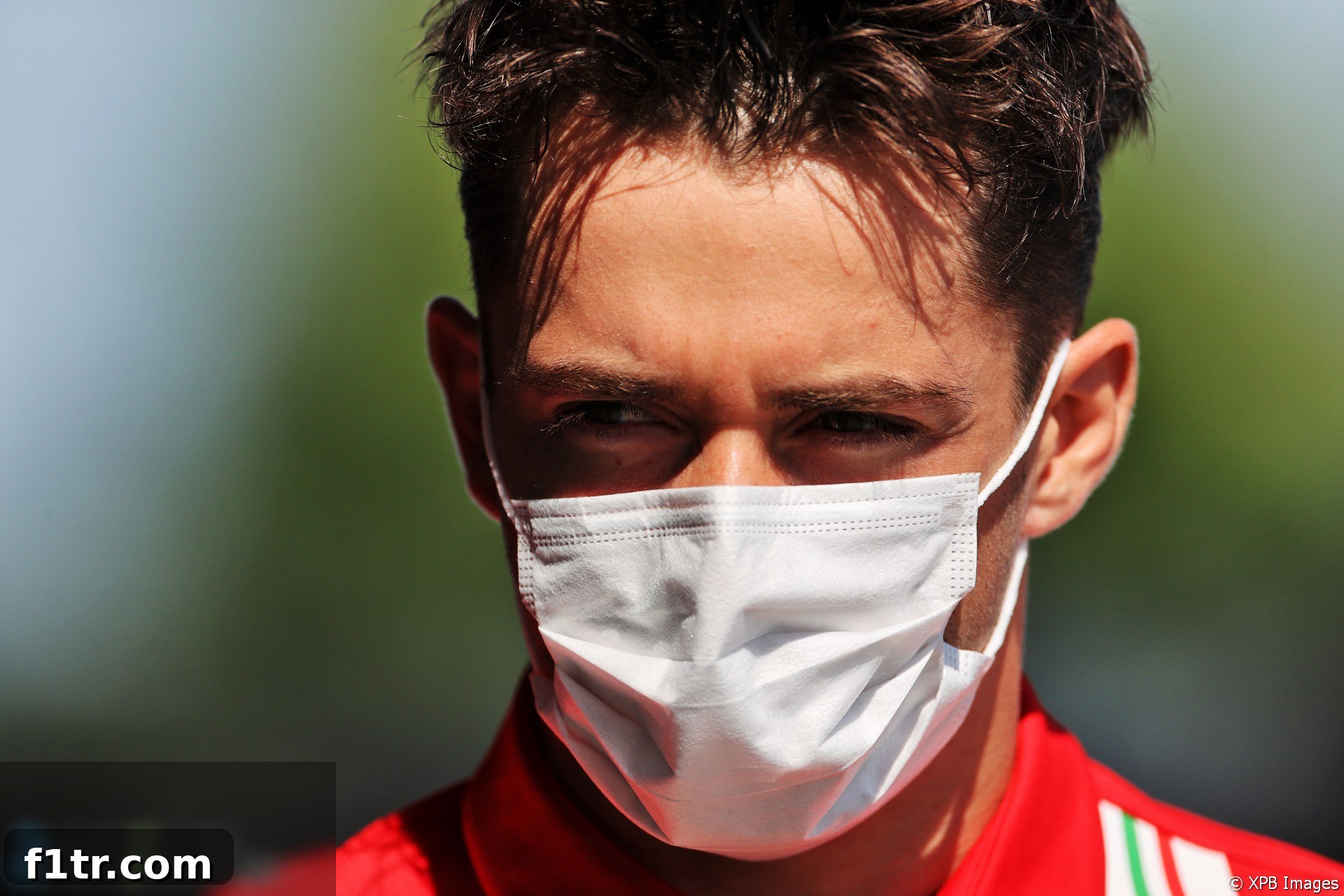
As the Formula 1 season approaches its crucial summer break, all eyes turn to the Hungaroring for the Hungarian Grand Prix. This technical and demanding circuit often presents unique challenges, and for Scuderia Ferrari’s star driver, Charles Leclerc, it represents a personal battleground. Despite a season marked by flashes of brilliance and impressive pole positions, Leclerc approaches this weekend with a cautious optimism, acknowledging that the twisty nature of the Hungaroring hasn’t historically played to his strengths. His candid assessment sets the stage for what promises to be an intriguing final race before the mid-season pause, where both driver and team will be eager to solidify their position and carry positive momentum into the latter half of the championship.
Advert | Become a Supporter & go ad-free
The Monegasque driver has undeniably enjoyed a commendable start to his third full season with the iconic Italian team. He has consistently demonstrated his raw speed and exceptional talent, particularly evident in his qualifying performances. Leclerc notably secured pole position in the challenging street circuit of Monaco, a testament to his precision and car control, where the margins for error are virtually nonexistent. He followed this up with another stunning pole in Azerbaijan, showcasing Ferrari’s improved package on circuits that demand high-performance characteristics and strong engine capabilities. These early-season highlights offered thrilling glimpses of Ferrari’s potential and Leclerc’s capability to fight at the very front of the grid when the conditions align perfectly with the car’s strengths. The momentum continued into the previous race at Silverstone, the British Grand Prix, where Leclerc produced a masterclass performance, leading for a significant portion of the event and tantalizingly close to securing what would have been a long-awaited victory for Ferrari, a triumph that ultimately eluded them.
Reflecting on the team’s prospects for the upcoming Hungarian Grand Prix, Leclerc expressed a pragmatic outlook, grounded in the realities of the current Formula 1 pecking order. He believes Ferrari should still be “strong” at the Hungaroring, a circuit that typically rewards high-downforce setups, but he wisely tempered expectations regarding their performance peak compared to their Monaco form. “I don’t think we will be at the level of performance as we’ve seen in Monaco, but I hope we can at least be on top of the midfield, which is the realistic fight we are fighting this year,” he stated with a clear understanding of their objectives. This perspective highlights Ferrari’s ongoing intense battle in the constructor’s championship, where consistency and maximizing points in every race are paramount. The “top of the midfield” target indicates a fierce rivalry with other competitive teams, such as McLaren, Alpine, and AlphaTauri, all vying for valuable points in what has become an incredibly tight and unpredictable season. Achieving this goal would be a significant accomplishment for the team heading into the summer break, providing a crucial boost of confidence and valuable data for future development and strategic planning.
Despite the team’s overall confidence in their package, Leclerc openly admitted that the Hungarian circuit is not one where he typically performs at his absolute best, adding a layer of personal challenge to the weekend. “It’s not a particularly strong track for myself as a driver, but I’ll try to make the best job possible,” he conceded with characteristic determination. This self-awareness is characteristic of Leclerc’s meticulous approach to his craft and his continuous quest for self-improvement. A deeper dive into his past performances at the Hungaroring reveals a mixed record, which supports his assessment. In his three previous Hungarian Grand Prix appearances, he has only managed to out-qualify his team mate on one occasion. This notable instance occurred during the 2019 season when he impressively lined up ahead of four-time world champion Sebastian Vettel, demonstrating flashes of brilliance even on a challenging circuit. Such statistics underscore the specific challenges this unique circuit presents for him, prompting him to dedicate extra effort to master its nuances and extract maximum performance from his Ferrari SF21.
The Hungaroring is renowned for its unique characteristics, making it one of the most technically demanding circuits on the Formula 1 calendar. Leclerc elaborated on these complexities, explaining, “It’s a very difficult track, very technical. You need to be very, very smooth.” Unlike many modern tracks with sprawling run-off areas, long straights, and fast, sweeping corners that favor pure power, the Hungaroring is often likened to a large-scale karting circuit. It features a relentless succession of tight, medium, and slow-speed corners, with hardly any opportunity for drivers to relax or for the engine to breathe on long straights. Overtaking is notoriously difficult, primarily confined to the main straight, placing immense pressure on qualifying performance and strategic execution during the race. Success at the Hungaroring requires a car with exceptional downforce, precise steering response, and excellent mechanical grip, particularly through its winding sector two and three. Drivers must exhibit supreme patience and a delicate touch on the throttle and brakes to avoid costly errors, making smoothness a critical attribute for lap time optimization and tire management.
Leclerc further elaborated on his personal struggle, connecting it directly to his natural driving style, which often leans towards a more aggressive approach. “I tend to have a bit more of an aggressive driving style, and it looks like I’m struggling a bit more here compared to my team mates in the past,” he revealed with an honest self-assessment. An aggressive driving style, characterized by late braking, sharp turn-in, and often managing oversteer to rotate the car, can be highly effective on tracks that reward daring maneuvers and rapid changes of direction. This style can extract maximum raw pace in certain scenarios. However, on a circuit like the Hungaroring, which demands a flowing, rhythmic approach and minimal disruption to the car’s balance, this aggression can paradoxically lead to excessive tire wear, loss of traction at critical moments, and a less efficient path through the numerous corners. Maintaining momentum without scrubbing speed or overheating the tires is paramount. Drivers who can ‘dance’ with the car, smoothly transitioning from brake to throttle and minimizing steering input, often excel here. Leclerc’s acknowledgement of this disparity highlights his commitment to continuous improvement and adapting his technique for specific circuit demands. He concluded, “So I will work on that and try to maximise this weekend,” demonstrating his unwavering determination to overcome personal hurdles and deliver a strong performance for the team.
The memory of the previous race at Silverstone undoubtedly remains fresh in Leclerc’s mind, a poignant reminder of how close success can be in Formula 1. He came tantalizingly close to securing victory, leading the race until a late-race Safety Car period and subsequent strategic decisions ultimately saw him overtaken. Losing a win so close to the end, almost two years since Ferrari’s last triumph, was understandably frustrating and emotionally taxing. “Obviously it was frustrating because the win was so close and to lose a win so close to the end hurts,” he admitted, echoing the sentiment of any competitive athlete who has experienced such a near-miss. However, beyond the immediate disappointment, Leclerc also recognized the immense positives derived from that weekend. “But on the other hand there was plenty of positives being on the pace of the Mercedes, especially on the first stint.” For Ferrari, matching the pace of the dominant Mercedes, even for a significant portion of the race, was a major psychological boost and a clear indication of their progress and potential. The second stint, while less dominant, still aligned with the team’s expectations, solidifying the belief that Ferrari is indeed on an upward trajectory. “But all in all it was a very, very positive weekend for us,” he concluded, underscoring the constructive takeaways from Silverstone despite the missed victory, providing crucial motivation for the challenges ahead.
Advert | Become a RaceFans supporter andgo ad-free
As the Formula 1 circus heads to Hungary, the stakes are high for Charles Leclerc and Scuderia Ferrari. It’s an opportunity not only to secure crucial points for the team in the intense midfield constructors’ battle but also for Leclerc to personally conquer a circuit that has historically tested his limits. His transparent acknowledgment of his struggles and his proactive commitment to adapt his driving style speak volumes about his professionalism, his dedication, and his desire to continuously evolve as a top-tier Formula 1 driver. The team’s aspiration to be “on top of the midfield” is a realistic yet ambitious goal, reflecting the intensely competitive landscape of the current season and the fine margins separating the teams. With the coveted summer break looming, a strong showing in Hungary would provide invaluable momentum, allowing Ferrari to regroup, analyze their performance, and strategize for a powerful assault on the second half of the championship. All eyes will undoubtedly be on Leclerc to see if his meticulous preparation and determined mindset can translate into a breakthrough performance on a track where smoothness reigns supreme, potentially turning a past weakness into a future strength, and giving Ferrari a memorable send-off before the brief mid-season hiatus.
2021 Hungarian Grand Prix
- Ocon congratulated by past French F1 aces after breakthrough win
- Alpine doubt first win signals a performance breakthrough
- Vettel disqualification hearing to take place on Monday
- Why no one received a Grosjean-style race ban for the Hungarian GP pile-up
- Ocon’s “beautiful” late-stint pace was other key to Alpine’s breakthrough win
Browse all 2021 Hungarian Grand Prix articles