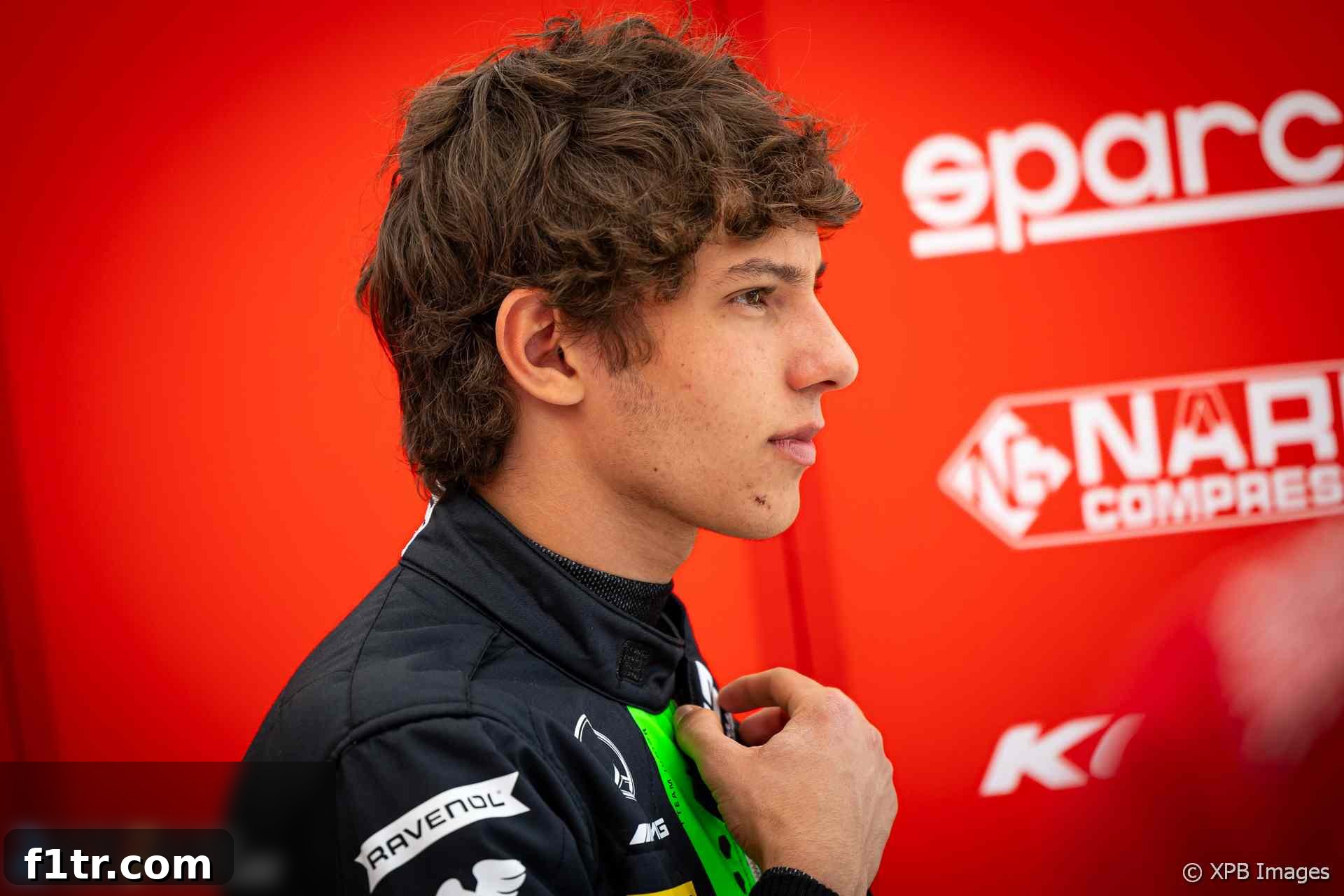
Despite recent adjustments to FIA regulations that now permit drivers under 18 to compete in Formula 1, prodigious Italian talent Andrea Kimi Antonelli will not be making an immediate ascent to the pinnacle of motorsport. This weekend’s Spanish Grand Prix will see all ten Formula 1 teams maintain their established driver lineups, postponing Antonelli’s highly anticipated debut.
The Mercedes-backed junior driver had been widely tipped for an accelerated entry into F1 following a significant softening of the FIA’s superlicence rules just last week. Previously, Antonelli was strictly ineligible to race in Formula 1 until his 18th birthday in late August. The amended International Sporting Code, however, introduces a crucial clause: it empowers the governing body to grant special dispensations for 17-year-old drivers deemed exceptionally suitable for the series. Furthermore, the FIA also removed the requirement for drivers to hold standard road car licences, a prerequisite Antonelli would not meet in Italy until he turns 18.
While no specific team has publicly claimed responsibility for initiating the request that led to the FIA’s rule relaxation, the timing and nature of the change have fueled widespread speculation surrounding Antonelli. He remains a prime candidate for the coveted seat at Mercedes that Lewis Hamilton will vacate at the close of the current season. Before potentially stepping into a works Mercedes, the young Italian is widely expected to gain invaluable experience at one of the team’s customer outfits, with Williams F1 emerging as the most probable destination.
The FIA’s Superlicence Conundrum and Antonelli’s Eligibility
The FIA’s decision to relax its superlicence rules represents a pivotal moment in the discussion surrounding young talent in Formula 1. Historically, the superlicence system, introduced in its current format to ensure drivers possess sufficient experience and maturity, has included a strict age minimum of 18. This barrier was designed to prevent exceptionally young, albeit talented, drivers from entering a highly demanding and dangerous sport without adequate preparation, a concern that grew following incidents in the early 2000s and the rapid rise of figures like Max Verstappen. The previous requirement also mandated that drivers hold a valid road car driving licence, a practical detail that, while seemingly minor, created a bureaucratic hurdle for young prospects like Antonelli who, in many European countries, cannot obtain such a licence until their 18th birthday.
The recent amendments allow for “dispensations” for 17-year-old drivers who meet specific criteria for “suitability.” This includes an impressive junior career track record, extensive testing experience in F1 machinery, and a perceived level of maturity. Andrea Kimi Antonelli undeniably fits this profile. His rapid progression through the junior ranks, marked by championship victories in Formula Regional European and Middle East categories, demonstrates an exceptional aptitude for single-seater racing. Coupled with his significant private testing in older Mercedes F1 cars, he presents a compelling case for an early F1 induction. The rule change, therefore, doesn’t just lower an age barrier; it acknowledges the evolving landscape of driver development, where talents are identified and nurtured at increasingly younger ages, often undergoing rigorous physical and mental preparation long before they reach adulthood.
Antonelli’s Stellar Rise Through the Junior Ranks
Andrea Kimi Antonelli’s motorsport journey has been nothing short of meteoric. Born in Bologna, Italy, in 2006, Antonelli began his karting career at a tender age, quickly establishing himself as a dominant force. His transition to single-seaters saw him continue this winning streak, capturing back-to-back titles in the Italian F4 Championship and ADAC F4 Championship in 2022. This double championship feat immediately drew comparisons to other F1 stars who had excelled in F4. In 2023, he further solidified his reputation by clinching both the Formula Regional Middle East Championship and the highly competitive Formula Regional European Championship by Alpine (FRECA). These successes were achieved with a maturity and speed far beyond his years, showcasing a remarkable ability to adapt to new machinery and circuits.
His impressive performances paved the way for a direct promotion to Formula 2 in 2024 with the prestigious Prema Racing team, bypassing the traditional Formula 3 step. This bold move underscored the belief Mercedes and his management have in his potential. While his F2 rookie season has presented a steeper learning curve, as is often the case for newcomers to the fiercely competitive championship, Antonelli has already demonstrated flashes of brilliance, including strong qualifying performances and points finishes. His ability to learn and adapt quickly, combined with his natural car control and race craft, makes him one of the most exciting prospects in recent memory. The question for many is not *if* he will reach F1, but *when*, and whether he can live up to the immense hype that now surrounds him.
Mercedes’ Succession Planning and the Hamilton Vacuum
The impending departure of seven-time world champion Lewis Hamilton from Mercedes to Ferrari at the end of 2024 has created a significant void at the Brackley-based squad. Hamilton’s decision has initiated a frantic search for a suitable replacement, a task compounded by the need to secure a driver who can not only deliver on track but also align with Mercedes’ long-term vision. As the architect of Mercedes’ junior driver program, Toto Wolff has a vested interest in promoting talent from within, and Antonelli stands out as the crown jewel of this initiative.
Antonelli’s potential promotion is a complex decision for Mercedes. On one hand, placing a rookie directly into a top team carries inherent risks, particularly given the pressure of replacing a legend. On the other hand, denying such a prodigious talent a direct path could lead to him being poached by rival teams, a scenario Mercedes would be keen to avoid. The team has invested heavily in Antonelli’s development, including extensive private testing sessions in older F1 cars to familiarize him with the intricacies of Formula 1 machinery. These tests, often conducted away from the public eye, have allowed Antonelli to gain crucial mileage and experience, further preparing him for the demands of grand prix racing. Mercedes’ strategy appears to be a careful balance of nurturing their talent while also ensuring they make the most strategically sound decision for the team’s future competitiveness, making Antonelli’s progression a central theme in the upcoming driver market.
Williams F1: The Crucial Stepping Stone?
Williams Racing, with its long-standing customer engine deal with Mercedes, is widely regarded as the most logical and likely target for Antonelli’s initial foray into Formula 1. The team, under the leadership of James Vowles, has been working diligently to rebuild its infrastructure and improve its on-track performance. While strides have been made, particularly with Alexander Albon firmly establishing himself as a highly capable team leader, the performance of their second driver, Logan Sargeant, has largely failed to impress since his debut last year.
Sargeant’s tenure at Williams has been marked by a consistent struggle to match Albon’s pace. He has scored points only once in his first 31 Grand Prix appearances, and crucially, has never out-qualified his teammate in a Grand Prix qualifying session. His season hit a particularly low point at the Australian Grand Prix when he was benched after Albon crashed in practice, leaving the team with only a single intact chassis and forcing Williams to prioritize their lead driver. These struggles have placed Sargeant under immense pressure, and his seat is widely considered to be the most vulnerable on the grid. For Antonelli, a move to Williams would offer a precious opportunity to gain race experience in a competitive F1 environment, without the immediate, intense scrutiny of a top-tier team. It would allow him to adapt to the F1 schedule, race procedures, and the unique challenges of managing an F1 car over a full race weekend, all while remaining within the Mercedes ecosystem.
Immediate Future: No Spanish Debut, Eyes on Austria and Beyond
Despite the speculation and the rule change, both Williams and Mercedes have confirmed that their driver lineups will remain unchanged for the Spanish Grand Prix. This means Alexander Albon and Logan Sargeant will once again represent Williams, while George Russell and Lewis Hamilton continue for Mercedes. The next round of the championship, the Austrian Grand Prix, presents a unique challenge as it is a Sprint event. This format significantly reduces practice time, leaving drivers with only a single hour of practice before qualifying. For a rookie making their debut, this compressed schedule would be an incredibly steep learning curve, making it a less than ideal scenario for Antonelli’s first F1 outing. While a debut at a Sprint race isn’t impossible, it significantly increases the risk and pressure on a young driver. This logistical hurdle further suggests that Antonelli’s F1 debut, if it happens mid-season, is more likely to occur at a traditional Grand Prix weekend with a full complement of practice sessions, providing him with maximum track time to acclimatize.
The focus now shifts to potential mid-season opportunities after Austria, or more realistically, a full-time seat for the 2025 season. Mercedes will be carefully evaluating not only Antonelli’s performance in Formula 2 but also his progression during private F1 tests. The decision will be a strategic one, balancing the desire to fast-track a generational talent with the need to ensure he is fully prepared for the immense challenges of Formula 1.
The Broader Junior Driver Landscape: Antonelli vs. Bearman
Andrea Kimi Antonelli is not the only high-profile junior driver making headlines. His Prema team-mate in Formula 2, Oliver Bearman, has already had a taste of Formula 1 action. Bearman, a Ferrari Academy driver, impressively stood in for Carlos Sainz at the Saudi Arabian Grand Prix earlier this season when Sainz fell ill. His performance, where he finished seventh on debut for Ferrari, earned him widespread praise and demonstrated that young drivers, when given the chance, can immediately make an impact. Bearman’s experience serves as both an inspiration and a benchmark for Antonelli.
This weekend, Bearman is once again participating in a Grand Prix, taking over Nico Hulkenberg’s Haas car for the first practice session at the Spanish Grand Prix. These Free Practice 1 (FP1) outings are crucial for junior drivers, offering them valuable track time in current F1 machinery and allowing teams to assess their capabilities in a high-pressure environment. While Antonelli is yet to get an official FP1 session, his private testing program has been extensive, designed to mirror the demands of an F1 weekend. The contrasting paths – Bearman gaining experience through official sessions and race cameos, Antonelli through dedicated testing – highlight the different strategies top teams employ to prepare their future stars. Both drivers represent the next generation of F1 talent, and their respective journeys will be closely watched as the driver market continues to evolve.
The anticipation surrounding Andrea Kimi Antonelli’s Formula 1 debut is palpable. While an immediate step up has been ruled out, the FIA’s rule change has opened the door, and his exceptional talent suggests it is only a matter of time before he graces the F1 grid. The intricate dance of driver market dynamics, team strategies, and the performance of current drivers like Logan Sargeant will ultimately dictate the timing and nature of his highly awaited arrival.
Miss nothing from RaceFans
Get a daily email with all our latest stories – and nothing else. No marketing, no ads. Sign up here:
2024 Spanish Grand Prix: Further Reading
- Russell ensures Norris has still never kept his lead from pole position
- Williams repeatedly switch floors in search for Sargeant’s missing downforce
- “Why’s he not defending?”: How Russell sank to fourth after stunning start
- What radio calls reveal about Verstappen’s controlled pace and Perez’s struggles
- 2024 Spanish Grand Prix weekend F1 driver ratings
Browse all 2024 Spanish Grand Prix articles