Mercedes’ Brazilian GP Qualifying: A Strategic Misstep in Shifting Conditions
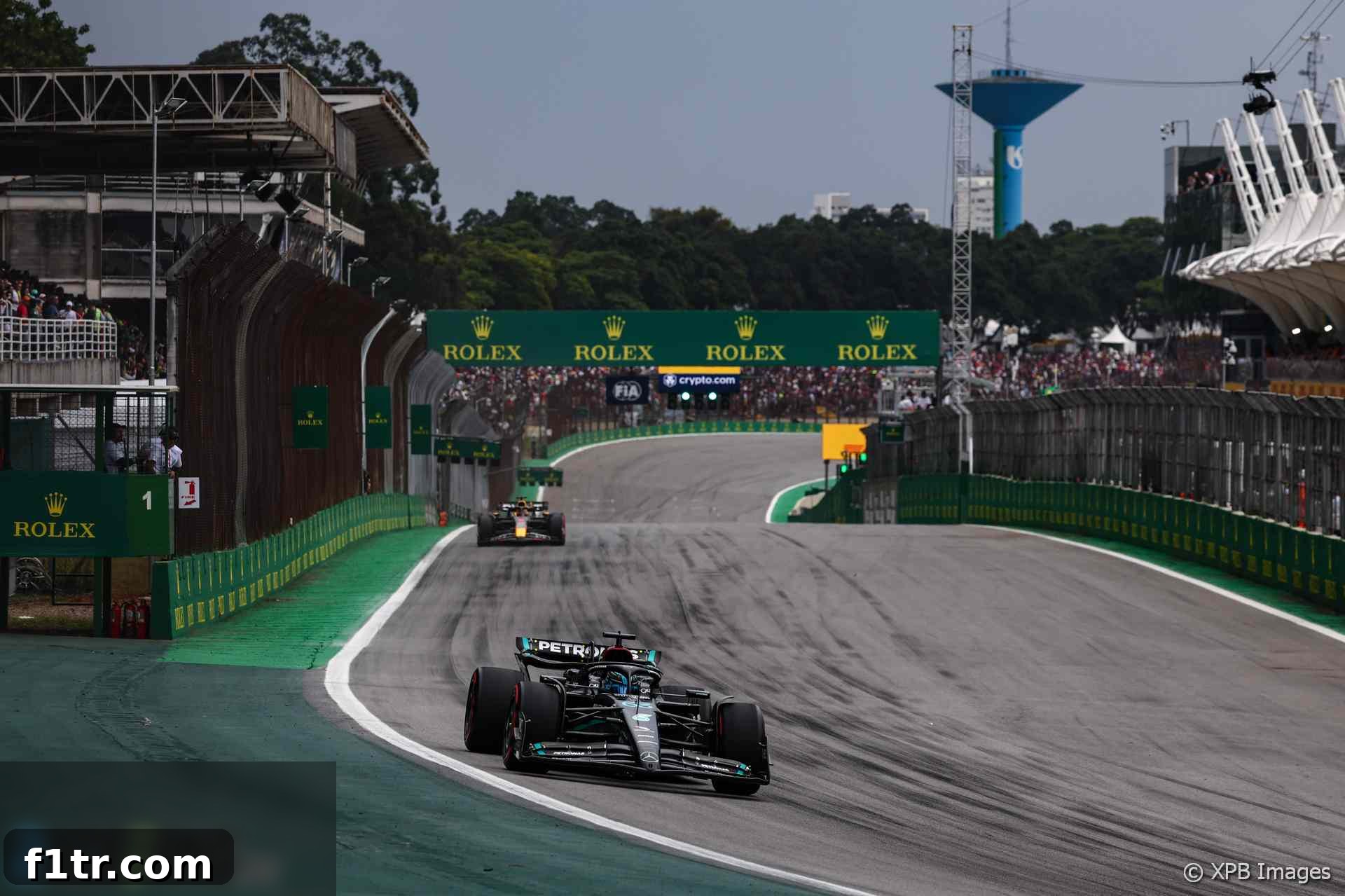
The final stages of qualifying for the Brazilian Grand Prix at Interlagos descended into chaos as a sudden, torrential downpour dramatically altered track conditions, catching several teams off guard. Among those most affected was the Mercedes-AMG Petronas Formula 1 Team, whose principal, Toto Wolff, candidly admitted that the team’s tactical approach simply “did not get their tactics right” amidst the rapidly deteriorating weather. This critical misjudgment saw both Lewis Hamilton and George Russell qualify P5 and P6 respectively for Sunday’s main race, a result that felt below the Silver Arrows’ potential.
Advert | Become a Supporter & go ad-free
The Interlagos Q3 Drama Unfolds
As the qualifying session progressed into the decisive Q3 segment, the threat of rain loomed large over the iconic Interlagos circuit. Mercedes, demonstrating an initial quick reaction to the impending weather front, dispatched both Hamilton and Russell onto the track promptly, aiming to complete their flying laps before the heavens opened. This proactive move initially appeared to be a strategic masterstroke, giving their drivers the best chance to set competitive times on a relatively drier circuit. However, the subsequent events unfolded in a way that exposed vulnerabilities in their execution and real-time adaptability.
Before Q3 officially began, the Mercedes pair positioned themselves at the end of the pit lane, behind the Aston Martin drivers, anticipating the green light. Yet, as the session commenced, the dynamic changed rapidly. Red Bull’s Max Verstappen, displaying his characteristic assertiveness, immediately overtook George Russell to slot in between the two Aston Martins. This seemingly minor alteration in track position would prove significant as conditions worsened with astonishing speed. Despite their early deployment, the Mercedes drivers found themselves unable to match the pace of the Aston Martins, Verstappen, and even Charles Leclerc, who was running behind them, all of whom managed to extract more performance from their cars in the treacherous conditions.
Toto Wolff’s Candid Assessment: A Lack of Adaptability
Speaking to Sky Sports after the session, Toto Wolff was notably reflective and direct in his analysis, acknowledging the team’s strategic misstep. He highlighted the razor-thin margins that often define Formula 1 qualifying, particularly concerning out-laps and crucial tire temperatures. “I think you see how we’re in the marginal differences in terms of out-laps and temperatures,” Wolff explained, underscoring the intricate balance required. His core criticism revolved around the team’s inability to react with sufficient speed and aggression to the rapidly evolving situation. “I think we weren’t adaptive enough,” he admitted, a statement that points to a critical area for improvement.
Wolff contrasted Mercedes’ approach with that of their rivals. He specifically praised the speed with which the Aston Martins launched their attacks on the circuit, storming away to set competitive times. Similarly, Verstappen, exiting the garage with tires already at optimal temperature, demonstrated an immediate and decisive pace that Mercedes could not replicate. “The Aston Martins just stormed away. Max straight out of the garage with warm tyres also stormed away and that was the quickest cars,” Wolff noted. He quantified Mercedes’ deficit, observing they were “a second off the previous time or eight tenths off,” a clear indicator of the lost performance. His concluding thought was a self-reprimand: “it shows you what you should have done,” implying that their drivers should have been instructed to push significantly harder on their preparation laps to maximize the rapidly closing window of opportunity.
Hamilton’s Frustration: Performance Unmet by Result
For seven-time world champion Lewis Hamilton, the qualifying result was a source of undeniable frustration. While he conceded that the W14 had shown “signs of decent performance” throughout the session, the final grid positions did not truly reflect the car’s underlying capabilities. Hamilton acknowledged that Mercedes was generally “a couple of tenths off the top guys” in dry conditions, suggesting a baseline competitive gap. However, he strongly suspected that the sudden change in weather conditions was the primary factor that pushed them further down the grid than they otherwise would have been. “I think the circumstances at the end, the conditions probably have us maybe a little bit further back – maybe, I don’t know,” he mused, hinting at a feeling of what-might-have-been had the strategy been perfectly executed.
Hamilton’s comments highlight the delicate balance between car performance and strategic execution, especially in the notoriously unpredictable environment of Interlagos. A driver of his caliber thrives on precision and optimal conditions, and any deviation from that ideal can significantly impact the outcome. His experience and intuition suggested that the car was capable of more, reinforcing the idea that tactical decisions, rather than raw pace, were the defining elements of Mercedes’ Q3 struggle. The disappointment for Hamilton would stem not just from the grid position, but from the lost opportunity to showcase the car’s true potential and secure a stronger starting position for the race.
Russell’s Wild Ride: From Despair to Unexpected P6
George Russell’s experience in Q3 mirrored that of his teammate, though perhaps with an added layer of disbelief. Like Charles Leclerc, who nearly abandoned his own lap due to extreme conditions, Russell came close to pitting, convinced his lap was futile. His in-car experience was one of utter chaos and a profound lack of control. “It’s absolutely crazy,” Russell exclaimed, describing the unprecedented weather shift. “I’ve never ever seen a change of weather so drastically as that.” This sentiment underscores the extraordinary nature of the conditions, which tested the limits of driver skill and car setup.
Russell vividly recounted his lap: “On my lap I was just sliding around, I had no grip. I didn’t see that much rain on my visor but I was a second off and I actually wanted to pit because I was confident I was going to be last and ended up P6.” His frustration was palpable, rooted in the sensation of having no control and being significantly off the pace. The fact that he ended up P6, despite feeling like he was destined for last place, speaks volumes about the collective struggle many drivers faced in those moments. It was a testament to the sheer unpredictability of the conditions and the fine line between disaster and a salvageable result. While disappointed with the feeling of the lap, Russell found a silver lining in his eventual grid position: “So while it was disappointing and frustrating, P6 is definitely not a bad place to start,” acknowledging the competitive advantage of being on the third row.
The Perilous Dance of F1 Qualifying Strategy
The Interlagos Q3 highlighted the perpetual high-stakes gamble inherent in Formula 1 qualifying strategy, particularly when confronted with volatile weather. Teams are constantly battling not just their rivals, but also the elements, making split-second decisions that can elevate or derail an entire weekend. Mercedes’ dilemma stemmed from the balance between tire preparation and track position. Pushing too hard on an out-lap can overheat tires and compromise the flying lap, yet in rapidly deteriorating conditions, a slow out-lap means missing the critical window of optimal grip entirely. Wolff’s admission of a lack of adaptability points to an area where Mercedes, a team renowned for its meticulous planning and execution, needs to refine its real-time strategic agility.
This incident also underscores the psychological pressure on drivers. When conditions are changing dramatically, and communication from the pit wall is crucial, a driver’s instinct to push or conserve can be heavily influenced by the feel of the car and the limited visibility. Russell’s thought of pitting, despite ultimately securing P6, illustrates this mental battle. The challenge lies in trusting the data and the team’s call, even when personal sensation suggests otherwise. For Mercedes, it’s a valuable lesson in managing both the technical and human elements of strategy under extreme pressure, emphasizing the need for robust communication channels and adaptive protocols.
Interlagos: A History of Unpredictable Weather
Interlagos, officially Autódromo José Carlos Pace, has long been synonymous with unpredictable weather, a characteristic that often throws the form book out of the window and provides some of Formula 1’s most memorable moments. From the dramatic title deciders influenced by sudden rain showers to the chaotic qualifying sessions that reshuffle the grid, the circuit’s microclimate ensures that weather forecasts are often just a loose guide. This particular Q3 at the Brazilian Grand Prix added another chapter to Interlagos’s storied history of weather-induced drama, serving as a stark reminder that even the most advanced simulations and preparations can be rendered obsolete by Mother Nature’s whim.
Teams arriving at Interlagos always prepare for the possibility of rain, yet the sheer speed and intensity with which the weather front hit during Q3 was exceptional. This requires not just flexible strategy but also an ability for both engineers and drivers to react instantly, to make courageous calls, and to trust their intuition. Mercedes’ tactical oversight, in this context, wasn’t a failure of preparation but rather a lapse in real-time responsiveness to a uniquely challenging scenario. This unpredictable element is precisely what makes the Brazilian Grand Prix a fan favorite, consistently delivering thrilling and often surprising results.
Looking Ahead: The Race Day Challenge for Mercedes
Starting from the third row of the grid, P5 for Hamilton and P6 for Russell, presents Mercedes with a significant challenge but also an opportunity for redemption in the main race. While not ideal, these positions are by no means insurmountable, especially at a circuit known for its overtaking possibilities and strategic complexity. The team will undoubtedly spend the hours leading up to the race meticulously analyzing the data, refining their race strategy, and focusing on tire management and potential safety car interventions.
The fact that the W14 showed “decent performance” in drier conditions offers a glimmer of hope. If the race day weather remains more stable, Mercedes has the potential to fight their way through the field. However, they will need to be aggressive and decisive with their pit stop calls and on-track maneuvers. The experience from qualifying will serve as a crucial learning point, hopefully ensuring that Mercedes is better prepared to adapt to any further climatic surprises that Interlagos might have in store. The goal will be to minimize the damage from qualifying and maximize their points haul in the constructors’ championship battle.
Advert | Become a RaceFans supporter andgo ad-free
2023 Brazilian Grand Prix News and Analysis
- Perez’s missed “open goal” in Miami was turning point in title fight – Horner
- F1 drivers insist new rules to prevent impeding in qualifying don’t work
- McLaren surprised by margin over rivals at track Norris thought would be “tough”
- “Follow Fernando’s line” – How Red Bull tried everything to get Perez past Alonso
- Mercedes’ Brazilian GP set-up was “conservative” after US GP disqualification
Browse all 2023 Brazilian Grand Prix articles