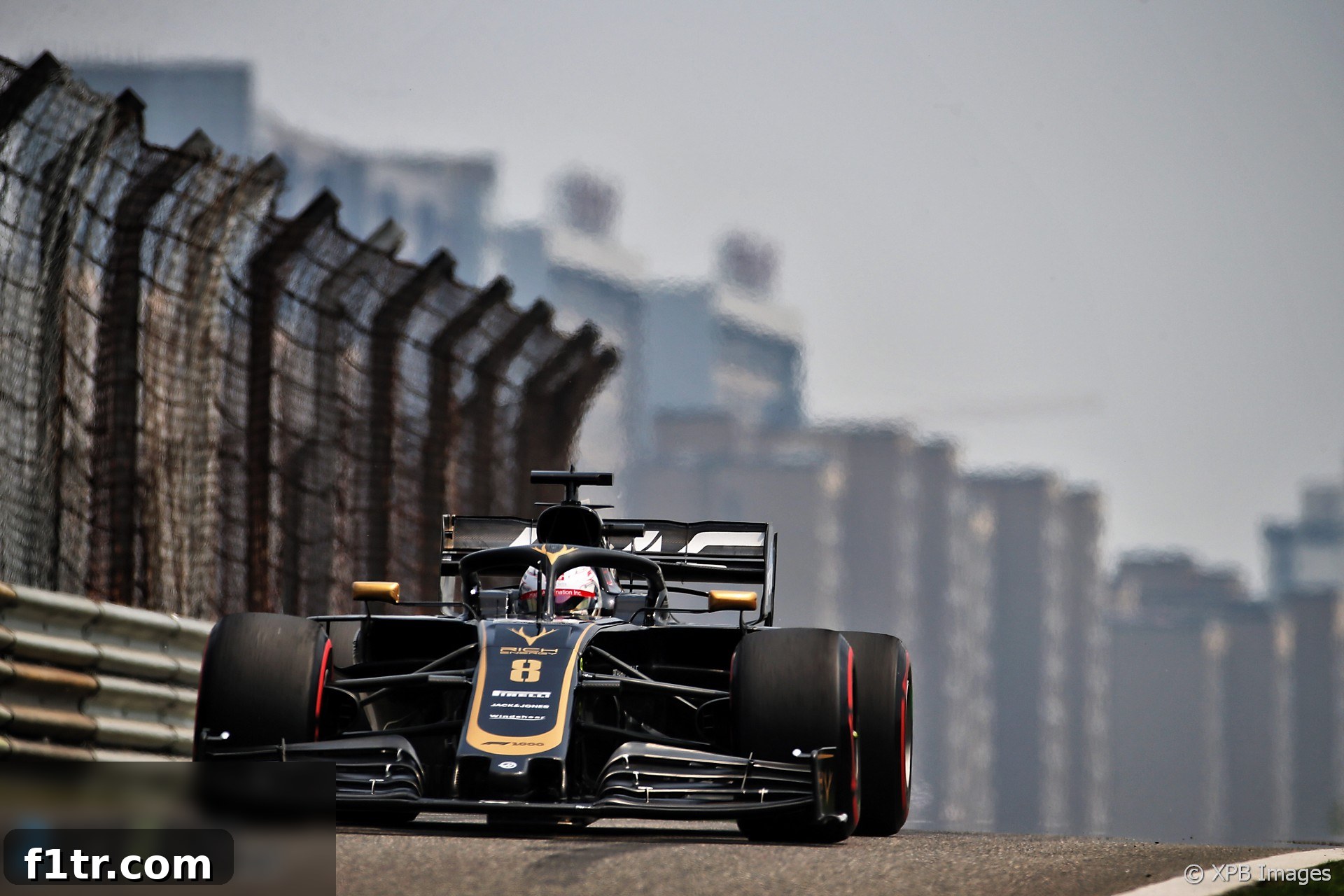
Romain Grosjean Unfazed by Haas Front Wing Failure: A Deep Dive into Aero Reliability in F1
Despite experiencing a front wing failure on his Haas VF-19 during the second practice session, Romain Grosjean conveyed a remarkable lack of concern regarding the incident. The unexpected aerodynamic issue, which occurred during a crucial flying lap, highlighted ongoing challenges for the Haas F1 team concerning component reliability, yet Grosjean’s confidence in his team remained unshaken.
The Unexpected Incident: Front Wing Collapse in Detail
The incident unfolded dramatically during Grosjean’s flying lap at the Shanghai circuit. As the Frenchman navigated Turn 1, the right-hand side of his VF-19’s front wing began to disintegrate. This initial breakage was just the beginning; the structural integrity of the wing continued to degrade later in the lap. By the time Grosjean reached Turn 14, the significant loss of aerodynamic downforce became critical, forcing him to lock up his brakes and run wide off the racing line. Such a failure is not only disruptive to a driver’s session but also raises serious questions about car design and safety.
Grosjean was adamant that the failure was not a result of driver error or contact with trackside elements. “I don’t think I hit any kerb,” he clarified to assembled media, including RaceFans, at the Shanghai paddock. He further elaborated on the sequence of events visible on telemetry and television footage: “It collapsed in Turn 1. It’s quite clear on the TV footage it went in Turn 1 and went a second time, completely, in Turn 13.” This assertion suggests a fundamental design or manufacturing flaw rather than external impact, placing the onus squarely on the team’s engineering department to investigate.
Haas’s Persistent Aerodynamic Challenges: A Recurring Theme
Aerodynamic component breakages have unfortunately been a recurring characteristic of Haas’s car designs since their entry into Formula 1. This isn’t the first time Grosjean has encountered such issues with the team. He recalled, “it started with my first day in the car [at a] filming day in Barcelona in 2016.” This historical context underscores a persistent struggle for the American outfit to consistently produce highly efficient yet robust aerodynamic parts.
The balancing act between lightweight design for performance and structural durability is a constant challenge in Formula 1. Teams strive to push the boundaries of materials science and engineering to shave off every possible gram, believing that lighter components translate directly into faster lap times. However, this pursuit of marginal gains sometimes leads to vulnerabilities. Grosjean alluded to this delicate balance, explaining, “We try things and obviously try to make the car as light as you can and sometimes you overdo it.” He acknowledged that he isn’t a designer and hadn’t delved into the specifics of this particular failure, but the sentiment highlights a known risk within F1 design philosophy.
Grosjean’s Unwavering Confidence and Focus on Performance
Despite the setback, Grosjean’s professional focus remained squarely on extracting performance from the VF-19 rather than dwelling on the wing failure itself. “I’ve just finished the session, I’m more focused on getting the performance out of the car than thinking why the front wing went,” he stated. This pragmatic approach is typical of experienced F1 drivers who understand that their role is to provide feedback and maximize track time, trusting the engineering team to diagnose and rectify mechanical issues.
His confidence in the Haas team’s ability to resolve the issue was palpable. “I’m not worried, the guys always solve the issue,” Grosjean asserted. He expressed deep admiration for the team’s construction capabilities, adding, “The build of the car is really impressive so I think it’s going to be good.” This trust is crucial for team morale and demonstrates a strong bond between driver and engineers, essential for overcoming challenges in the highly competitive world of Formula 1. Such reassurance from a key driver can significantly boost the confidence of the entire team, reinforcing their commitment to excellence and problem-solving.
The Critical Role of Front Wings in Modern F1
The front wing is arguably one of the most vital aerodynamic components on a modern Formula 1 car. It is the first element to interact with the airflow, dictating how air is channeled over, under, and around the car. Its design significantly impacts downforce generation, balance, and tire performance. A failure, even a partial one, can drastically alter the car’s handling characteristics, making it unpredictable and difficult to control, as Grosjean experienced at Turn 14.
Teams invest vast resources into the design, testing, and manufacturing of these intricate components. Advanced computational fluid dynamics (CFD) and extensive wind tunnel testing are employed to optimize every curve and flap for maximum aerodynamic efficiency. The materials used, typically advanced carbon fibre composites, are chosen for their exceptional strength-to-weight ratio. However, even with the most rigorous processes, the extreme forces exerted on these components at high speeds can sometimes expose unforeseen weaknesses, leading to failures like the one seen on Grosjean’s car. The margin for error in F1 aero design is incredibly slim, demanding constant innovation and meticulous quality control.
Investigating and Preventing Future Failures
Following such an incident, the Haas F1 team would immediately initiate a comprehensive investigation. This typically involves several steps: analyzing onboard data from sensors embedded in the car, reviewing high-speed camera footage, and conducting a detailed examination of the failed component itself. Engineers will look for fatigue cracks, material imperfections, or deviations from design specifications. The goal is to understand the root cause, whether it’s a design flaw, a manufacturing defect, or an external factor not immediately apparent.
Lessons learned from these investigations are crucial for iterative design improvements. If it’s a design issue, adjustments will be made to the wing’s geometry or internal structure to enhance its strength without compromising performance excessively. If it’s a manufacturing problem, quality control processes will be reviewed and tightened. Teams often perform non-destructive testing on critical components to detect potential weaknesses before they fail on track. This continuous cycle of design, testing, analysis, and refinement is fundamental to F1 engineering, ensuring that cars evolve not only in speed but also in reliability and safety.
Implications for Haas and the Season Ahead
While Romain Grosjean expressed no long-term concern, an aerodynamic failure, particularly on a crucial component like the front wing, can have broader implications for a team. Such incidents can erode confidence within the engineering department and potentially impact the development schedule if significant re-designs or manufacturing changes are required. For a smaller team like Haas, resource allocation is paramount, and diverting attention to resolve recurring reliability issues can detract from efforts to improve overall performance and climb the constructors’ standings.
The VF-19’s performance throughout the season, and indeed in the years prior, has often shown flashes of brilliance interspersed with periods of inconsistency and reliability woes. Addressing these underlying issues is key to Haas’s ambition to compete more consistently at the sharp end of the midfield. Grosjean’s optimism, however, suggests that the team possesses the capability and determination to overcome these technical hurdles, turning setbacks into learning opportunities that ultimately strengthen their competitive package.
Related Articles: 2019 F1 Season Insights
- Crying in the Melbourne car park at 2019 grand prix was my career low – Ocon
- McLaren Racing reports reduced £71 million loss in 2019
- Kvyat: Hockenheim podium last year was “my biggest achievement” so far
- How the FIA’s new encrypted fuel flow meter targets Ferrari’s suspected ‘aliasing’ trick
- “He smashed my office door”: 23 must-see moments from ‘Drive to Survive’ season two
Browse all 2019 F1 season articles