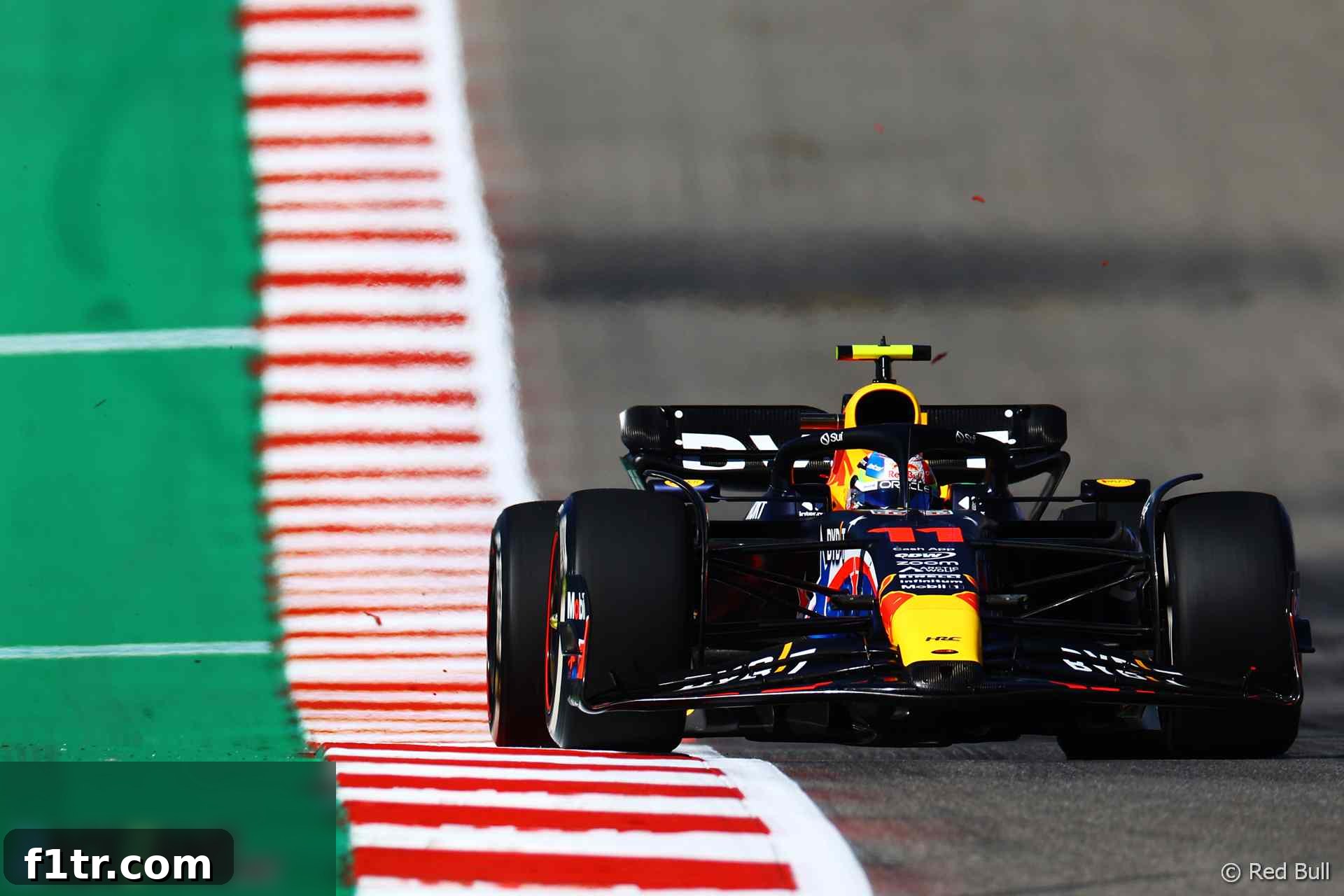
The world of Formula 1 often delivers thrilling on-track action, but sometimes, the real drama unfolds long after the checkered flag waves. This week, the sport is once again buzzing with anticipation as the stewards of the United States Grand Prix prepare to convene, potentially re-evaluating the results of a race concluded over two weeks ago. This unprecedented move stems from a “Right of Review” petition filed by the Haas F1 Team, a development that has sent ripples across the paddock and could significantly alter the Constructor’s Championship standings.
Almost half of the ten teams on the Formula 1 grid will be represented in this crucial hearing, spearheaded by Haas, who believes the outcome of the Austin race was fundamentally flawed. The core of their argument revolves around the inconsistent application of track limits regulations, an issue that has plagued several races this season. What exactly does Haas hope to achieve with this audacious challenge, and what are the realistic prospects of their success in overturning a settled race result?
Advert | Become a Supporter & go ad-free
The Controversial Aftermath of the US Grand Prix
The United States Grand Prix at the Circuit of the Americas (COTA) was, for many, a typical F1 spectacle. Yet, beneath the surface of the on-track battles and podium celebrations, a critical oversight in race management might have occurred. Haas’s petition points to this, claiming that several drivers exceeded track limits without proper penalization, thereby gaining an unfair advantage. Such infringements are commonplace in modern F1, but their consistent and fair enforcement is paramount to sporting integrity.
The FIA’s regulations explicitly define track limits – typically the white lines delineating the edge of the circuit – and dictate that a driver must not gain a lasting advantage by leaving the track. Penalties usually escalate from warnings to time penalties for repeated offenses. Haas’s challenge suggests that these rules were not rigorously applied at COTA, leading to a distorted race classification.
Understanding the “Right of Review” in Formula 1
The “Right of Review” is a powerful, yet rarely successful, mechanism within Formula 1’s sporting regulations. It allows a team to appeal a steward’s decision or a race result if “a significant and relevant new element is discovered which was unavailable to the parties seeking the review at the time of the decision concerned.” This clause is designed to address genuine oversights or new evidence that could not have been considered during the initial judgment. Successfully invoking this right requires meticulous preparation and compelling new information.
The Precedent: Austrian Grand Prix and Aston Martin’s Success
Haas’s current endeavor is not without precedent, and indeed, draws significant inspiration from a similar situation earlier in the 2023 season. Documents issued by the FIA yesterday confirmed Haas’s “petition for a Right of Review” relates to two critical elements: the final classification of the United States Grand Prix and a specific decision not to further penalize Alexander Albon for alleged track limits infringements.
This year, teams have already voiced strong concerns regarding the enforcement of track limits, particularly during the Austrian Grand Prix. Aston Martin, in a highly impactful move, successfully protested the provisional result of that race. They argued that numerous track limits infringements by rival drivers had been overlooked by the stewards during the event.
The aftermath of the Austrian Grand Prix was chaotic. While several drivers were penalized during the race, an additional four penalties were applied after it concluded. Aston Martin’s protest prompted the stewards to undertake a more thorough analysis of potential infringements, which subsequently unearthed a staggering number of previously unrecorded transgressions. The stewards openly admitted, “It was determined that some of these infringements warranted a penalty that was not previously applied when the provisional classification was published. These penalties will be reflected in the final classification.” This intervention by Aston Martin led to an astonishing 12 additional penalties being issued to eight different drivers, fundamentally altering the race results and moving Fernando Alonso up to fifth place.
The message from Austria was clear: a comprehensive review, armed with sufficient evidence, can indeed change established results. This outcome serves as the bedrock of Haas’s belief that if a similar level of scrutiny and rigor had been applied at the Circuit of the Americas, they too would have reaped significant benefits.
Haas’s Bold Move: Seeking Justice at COTA
The decision by Haas to pursue this “Right of Review” is a strategic gamble, driven by the desire to secure crucial championship points. Their argument hinges on the perceived disparity in track limits enforcement between COTA and the Red Bull Ring, hoping to replicate Aston Martin’s success.
The Discrepancy: COTA vs. Red Bull Ring Track Limit Enforcement
A stark contrast in enforcement levels between the two venues forms a key plank of Haas’s petition. At the Austrian Grand Prix, a staggering 84 lap times were deleted due to track limits infringements. In comparison, the United States Grand Prix at COTA saw only 35 lap times deleted, despite breaches occurring at eight different corners across the circuit. This significant numerical difference immediately raises questions about the consistency of stewarding.
Alexander Albon, driving for Williams, emerged as the most frequent transgressor at COTA, with the stewards initially ruling he went off-track five times. Six of his laps were deleted, as one infringement at the final corner resulted in both the current and subsequent laps being annulled. However, in one of the documents challenged by Haas, the stewards themselves conceded a significant limitation: they were “unable to identify every potential infringement.” They specifically noted, “Based on the video footage available (which did not include CCTV), the stewards determine, whilst there might be some indication for possible track limit infringements in turn six, the evidence at hand is not sufficient to accurately and consistently conclude that any breaches occurred and therefore take no further action.”
This candid admission from the stewards presents a clear window of opportunity for any team, including Haas, to request a review. If they can unearth new, compelling footage that reveals additional unpenalized infractions, they stand a chance of succeeding. It essentially highlights a known gap in the initial evidence, which Haas now aims to fill.
The Crucial Role of “New Evidence”
The “right of review” process has, in recent seasons, been successfully leveraged by several teams to alter race or qualifying results in their favor, most notably earlier this year. However, the success of such a petition hinges entirely on the presentation of “a significant and relevant new element” that was genuinely “unavailable to the parties seeking the review at the time of the decision concerned.” This strict criterion is designed to prevent frivolous appeals and ensure the finality of race results.
Haas’s strategy, therefore, must involve presenting video footage, telemetry data, or other forms of evidence that clearly demonstrate unpenalized track limits infringements. This evidence must not have been accessible to the stewards or Haas itself during the original race adjudication. The stewards’ prior admission about the lack of CCTV footage at COTA’s Turn 6, for instance, provides a direct roadmap for Haas on where to focus their investigative efforts.
Drivers and Teams Under Scrutiny: Who Stands to Lose (or Gain) Points?
The FIA’s summoning of specific rival teams to the hearing offers a strong indication of Haas’s primary targets. Red Bull, Aston Martin, and Williams have all been called. Understanding their finishing positions and existing track limit ‘strikes’ from Austin is crucial to assessing the potential fallout:
| P. | Driver | Team | Laps | Deficit | Gap | Strikes |
|---|---|---|---|---|---|---|
| 1 | Max Verstappen | Red Bull | 56 | 0 | ||
| 2 | Lando Norris | McLaren | 56 | 10.73 | 8.505 | 2 |
| 3 | Carlos Sainz Jnr | Ferrari | 56 | 15.134 | 4.404 | 1 |
| 4 | Sergio Perez | Red Bull | 56 | 18.46 | 3.326 | 1 |
| 5 | George Russell | Mercedes | 56 | 24.999 | 6.539 | 2 |
| 6 | Pierre Gasly | Alpine | 56 | 47.996 | 22.997 | 1 |
| 7 | Lance Stroll | Aston Martin | 56 | 48.696 | 0.7 | 1 |
| 8 | Yuki Tsunoda | AlphaTauri | 56 | 74.385 | 25.689 | 2 |
| 9 | Alexander Albon | Williams | 56 | 86.714 | 12.329 | 5 |
| 10 | Logan Sargeant | Williams | 56 | 87.998 | 1.284 | 3 |
| 11 | Nico Hulkenberg | Haas | 56 | 89.904 | 1.906 | 2 |
| 12 | Valtteri Bottas | Alfa Romeo | 56 | 98.601 | 8.697 | 0 |
| 13 | Zhou Guanyu | Alfa Romeo | 55 | 1 lap | 0 | |
| 14 | Kevin Magnussen | Haas | 55 | 1 lap | 4.496 | 4 |
| 15 | Daniel Ricciardo | AlphaTauri | 55 | 1 lap | 0.78 | 0 |
The pattern of penalties for track limits infringements established at the Austrian Grand Prix provides a clear framework for what Haas expects:
- Four strikes: Five-second time penalty
- Five strikes: 10-second time penalty
- Nine strikes: Five-second time penalty (following a ‘reset’ after five strikes)
- 10 strikes: 10-second time penalty
Crucially, stewards generally only count a ‘strike’ if a driver leaves the track unnecessarily, excluding instances where they were forced wide by a rival. This distinction might explain why Kevin Magnussen, with four strikes, received no penalty, and why Albon received a five-second penalty for four strikes during the race, despite having already incurred his fifth – which, based on the Austrian precedent, should have triggered an additional 10-second penalty.
Williams: The Primary Target for Haas’s Ambitions
The Williams drivers, Alexander Albon and Logan Sargeant, appear to be the most direct targets for Haas’s petition. Alexander Albon currently has five recorded strikes. According to the Austrian precedent, an additional single strike should trigger a 10-second time penalty. Such a penalty would be significant enough to promote Haas driver Nico Hulkenberg into the points-scoring positions, a vital gain for the struggling team.
Logan Sargeant’s solitary F1 point, achieved at his home race, is also precariously at risk. Assuming his three existing strikes were not due to a rival forcing him wide, just one additional track limits infringement would lead to a five-second penalty. This would drop him behind Hulkenberg, stripping him of his maiden point. However, if Albon receives a more substantial penalty, Sargeant might retain his 10th place, moving up the order even if he himself is penalized.
These potential shifts could prove enormously significant in the fiercely contested battle for the lower positions in the Constructors’ Championship. Williams currently holds 28 points, a mere seven ahead of AlphaTauri, and scored three vital points in Austin. Haas, having fallen to the bottom of the table, desperately needs points and currently faces a four-point deficit to Alfa Romeo. Every single point gained or lost has massive financial and prestige implications for these teams.
Unlikely, Yet Possible: Red Bull and Aston Martin in the Crosshairs
The inclusion of Aston Martin and Red Bull in the hearing raises eyebrows, given that their drivers finished well ahead of the Haas pair. For Lance Stroll, the sole Aston Martin driver to finish in the points, who crossed the line 41.2 seconds ahead of Hulkenberg, the requirements for a penalty that would drop him behind Hulkenberg are extreme. Based on the Austrian precedent, which included a “reset” of track limits strikes after every five infringements, Haas would need to identify a staggering 14 additional track limits infringements on top of his single acknowledged strike. This would accumulate enough penalties to make a difference.
Sergio Perez, driving for Red Bull, finished over a minute ahead of Hulkenberg and also had only one ‘strike’ for a track limits breach. To see Hulkenberg overtake Perez, Haas would need him to receive over 71.4 seconds in penalties, necessitating the identification of an incredible 24 additional track limits breaches. On the surface, this seems highly unrealistic.
However, the Esteban Ocon example from Austria serves as a stark warning. At the end of the Austrian Grand Prix, Ocon was initially congratulated by his race engineer for having avoided any track limits strikes. Yet, after the stewards’ thorough review, he was found to have committed 10 breaches, resulting in four separate penalties totaling half a minute. This demonstrates that even drivers perceived to have a clean sheet can be found guilty of numerous infringements upon closer inspection, fueled by new evidence. It highlights that no driver, regardless of their position, is entirely safe from such a review.
The fact that Red Bull has been summoned leaves open the theoretical possibility that even race winner Max Verstappen could become a target. However, this remains highly improbable, as he would require a colossal 30 breaches to drop him behind a Haas. While five track limits strikes for Verstappen would translate to a 10-second time penalty, potentially costing him victory to Lando Norris, McLaren has not pursued this path. Lando Norris himself has already admitted to exceeding track limits during the United States Grand Prix, suggesting McLaren is unlikely to tug on this particular thread, lest it unravel their own drivers’ results.
The Risk of a Backfire: Could Haas Face Penalties Themselves?
While Haas has diligently worked to identify potential infringements by rival teams, there is an inherent risk that their own drivers, Nico Hulkenberg and Kevin Magnussen, might also be found guilty of additional track limits breaches. If the stewards’ review leads to further penalties for Haas drivers, their efforts to trigger penalties for rivals could ultimately prove to be in vain, or even detrimental.
Indeed, if the outcome results in penalties for Haas and other teams, it could inadvertently play into the hands of their closest rival in the championship: Alfa Romeo. In the stewards’ original assessment, the Alfa Romeo drivers, Valtteri Bottas and Guanyu Zhou, maintained clean sheets regarding track limits at the US Grand Prix. Any penalties applied to Haas or other struggling teams could automatically elevate Alfa Romeo in the Constructors’ standings without them having to lift a finger, thus widening the gap Haas is trying to close.
The Evidence Game: What Haas Needs to Prove
It is imperative to stress that all of this conjecture regarding penalties and championship shifts will remain purely academic unless Haas can present new evidence that the stewards find sufficiently persuasive. The burden of proof rests squarely on their shoulders, and they must navigate a challenging process to clear the initial hurdle of admissibility.
Overcoming the Burden of Proof: The Stewards’ Stance on Video Footage
The deadline for submitting a “Right of Review” request falls 14 days after the race. Haas strategically waited until the 13th day before submitting their request, indicating they maximized the available time to identify and compile new material. This suggests a thorough and calculated effort rather than a hasty reaction.
Significantly, the stewards have previously indicated that forward-facing onboard cameras from drivers’ cars are not, on their own, considered sufficient evidence to conclusively prove a track limits breach. Lando Norris articulated this point after the Austin race, stating, “The ruling is it has to be clear enough for the FIA and it needs to be basically clear from an actual view that both tyres are off, and an onboard camera doesn’t prove anything.” He elaborated, “If the rear wheel might potentially be in, then you can’t classify it as being out. Which is their point.” This strict interpretation means Haas needs more than just a fleeting glimpse from a driver’s perspective.
However, Haas may have been able to obtain other camera angles that reveal new and definitive information. This has occurred in the past: Red Bull successfully triggered a penalty for Lewis Hamilton at the 2020 Austrian Grand Prix using such alternative angles, and Mercedes attempted to return the favor with new footage from Verstappen’s car following the 2021 Brazilian Grand Prix. These examples highlight that high-quality, irrefutable new visual evidence can indeed sway a review.
Alternatively, and perhaps most crucially, Haas may have been able to source the CCTV footage that the stewards explicitly noted was unavailable to them during their initial review of Turn 6. Access to this comprehensive, fixed-point camera coverage could provide the irrefutable evidence required to prove multiple additional breaches.
Furthermore, footage from rivals’ cars often yields relevant details that might have been overlooked. For instance, Alexander Albon’s first recorded track limits infringement at COTA was timed at 2:38 pm according to the FIA’s documents. However, the onboard camera from Valtteri Bottas’ car appears to reveal Albon having all four wheels off the track at Turn 6 at approximately 2:06 pm, during lap two – a significant discrepancy that could suggest numerous earlier, unpenalized infractions.
The Broader Implications for Formula 1 and Track Limits Enforcement
Regardless of the outcome of Haas’s request for a review, this episode underscores a recurring and challenging issue within Formula 1: the consistent and fair enforcement of track limits. The very existence of such a petition, following a similar successful protest earlier in the season, highlights a systemic problem that the FIA continues to grapple with.
A Call for Consistency: The Ongoing Track Limits Debate
The FIA’s attempts to rigidly enforce track limits this year have presented more challenges at some venues than others. While the intention is to maintain sporting fairness and prevent drivers from gaining an unfair advantage, the practical implementation has proven complex. Circuits with large asphalt run-off areas, like COTA and the Red Bull Ring, inherently invite drivers to push beyond the white lines, making enforcement a monumental task for stewards using limited camera angles.
Following Aston Martin’s successful Austrian Grand Prix protest, the stewards themselves issued a strong recommendation, stating they “very strongly recommend that a solution be found to the track limits situation at this circuit.” This sentiment surely applies equally to the Circuit of the Americas, where the current controversy has erupted. Whether through technological solutions, track modifications, or revised penalty systems, the sport needs a clearer, more consistent approach to avoid these post-race disputes that erode confidence in the results.
Ensuring Sporting Integrity: Why These Reviews Matter
Ultimately, these “Right of Review” petitions, while disruptive, are vital for maintaining the sporting integrity of Formula 1. If clear infractions are overlooked, or if enforcement is inconsistent, the very foundation of fair competition is undermined. Haas’s action, while self-serving for their championship aspirations, forces a re-evaluation of processes and decisions, potentially leading to fairer outcomes for all competitors in the long run. The resolution of this petition will not only impact the 2023 Constructor’s Championship but will also set a crucial precedent for how Formula 1 addresses track limits controversies in the future.
2023 F1 season
- FIA president cleared of alleged interference in two 2023 races
- First week viewing figures for new Drive to Survive season fall again
- Max who? Drive to Survive season six prefers its favourite faces
- RaceFans’ complete 2023 season review
- The F1 drivers who pulled off the 10 biggest charges through the field in 2023
Browse all 2023 F1 season articles