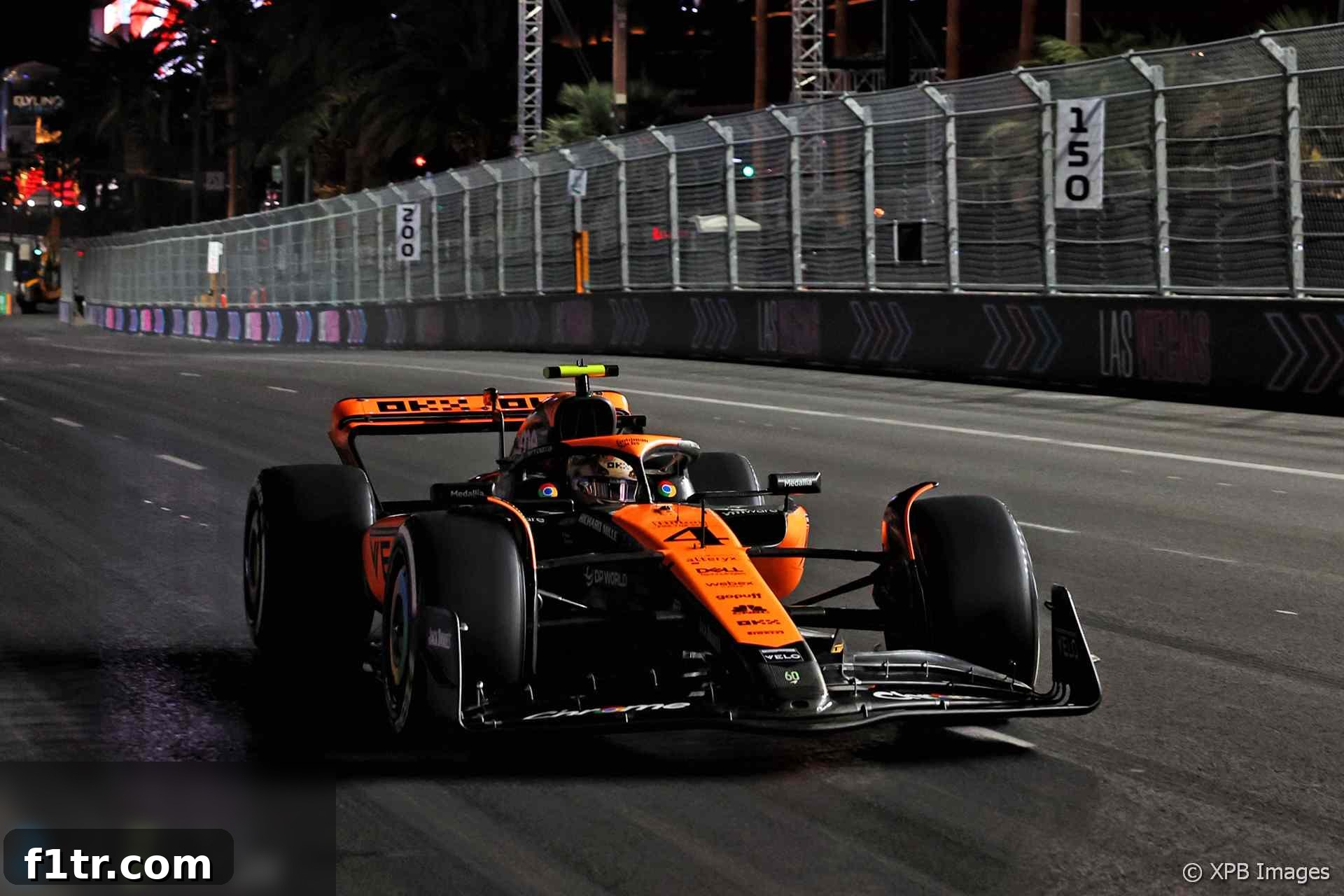
In a dramatic start to the highly anticipated Las Vegas Grand Prix, McLaren driver Lando Norris was involved in a significant high-speed incident on just the second lap of the race. The young British talent experienced a terrifying loss of control in Turn 11, resulting in a heavy impact with the circuit’s barriers. Following the crash, Norris swiftly extended his gratitude to the dedicated medical team at the Las Vegas Grand Prix for their immediate and thorough response.
The incident unfolded as Norris, who was positioned in 13th place, navigated the challenging street circuit. His McLaren MCL60 suddenly snapped out of control at a critical point on the track. The car first made contact with the wall on the outside of the corner before sliding further down to Turn 12, where it sustained a second, jarring impact. The sight of an F1 car, especially at such high speeds, colliding with barriers is always a cause for immediate concern, sending a ripple of anxiety through the paddock and among fans worldwide.
Despite the severity of the crash, Norris was quick to reassure his team over the radio, confirming he was “okay.” This initial communication brought a collective sigh of relief. As per standard Formula 1 protocols, he was promptly transported to the circuit’s medical centre for an initial assessment. Subsequently, and as a precautionary measure, Norris underwent further comprehensive checks at the University Medical Center in Las Vegas. Crucially, he was discharged shortly thereafter, with his team confirming he was in “good condition.” This outcome underscores the incredible safety advancements in modern Formula 1 cars and the rapid, professional response of the medical and marshaling teams.
Recounting the moments leading up to the crash, Norris explained that there was little he could do to prevent the incident once his car became unsettled. “I just bottomed out on the [start], lost the rear and hit the wall,” he stated. The term “bottoming out” refers to the car’s underbelly making contact with the track surface, often caused by compressions or bumps, which can momentarily disrupt airflow under the car, causing a sudden loss of aerodynamic grip and stability. In the high-stakes environment of Formula 1, where margins are razor-thin, such an unexpected jolt can be catastrophic, especially when combined with cold tyres and high speeds.
Norris expressed his disappointment regarding the premature end to his race weekend, particularly in light of the promising pace demonstrated by his teammate, Oscar Piastri. “Not the way we wanted the weekend to end, especially considering the pace looked promising on Oscar [Piastri’s] side,” he reflected. The McLaren team had shown strong signs of competitive form throughout the practice sessions, making Norris’s early exit even more frustrating for both the driver and the team. The incident not only cost Norris valuable championship points but also placed a significant burden on the McLaren crew, who faced the daunting task of repairing the extensively damaged car.
Reiterating his appreciation for everyone involved in his immediate care and the subsequent recovery efforts, Norris added, “Big thanks go to the medical staff for checking me over, and to the team for the work they’ll now put in on the car.” This sentiment highlights the collaborative nature of Formula 1, where the safety net of medical professionals and the tireless efforts of the engineering and mechanics teams are paramount to driver well-being and competitive continuity. The modern F1 driver is acutely aware of the risks involved, and the effectiveness of these support systems is never taken for granted.
The circumstances surrounding Norris’s crash quickly became a talking point among drivers and team principals. Several of Norris’s rivals had reportedly been warned about their cars bottoming out in the same section of the track prior to the incident, indicating a potential underlying issue with the circuit surface. McLaren team principal Andrea Stella provided further insight, suggesting that a particular bump in the track surface, combined with the characteristics of the cold tyres, played a critical role in Norris losing control of his car.
“There’s a bump in that place and you can see all cars sparkle when they go through this bump,” Stella explained. The “sparkling” phenomenon he referred to is a visual indicator of the car’s floor making contact with the track, often producing sparks as the titanium skid blocks scrape against the tarmac. This clearly suggested that Norris’s car was not alone in experiencing track surface interactions in that specific corner. “I think the combination of the bump and the cold tyres might have surprised him. But otherwise, we don’t see any any issue with the car, or of a different nature.” Stella’s analysis quickly ruled out any mechanical failure specific to Norris’s car, placing the focus squarely on the track conditions and tyre temperatures.
Given the specific challenges presented by the Las Vegas track – a street circuit with cooler night temperatures – Stella strongly urged the race promoters to address the bump for future events. “That bump, if we carry on racing at night time, should be fixed because the tyres will always be cold, low grip and it becomes a very tricky corner,” he emphasized. The unique conditions of the Las Vegas Grand Prix, with its evening schedule and relatively low ambient temperatures, meant that tyre warm-up was a constant struggle for all competitors. Cold tyres inherently offer less grip, exacerbating the risk posed by any imperfections in the track surface.
Stella highlighted that the issue was not isolated to Norris’s incident. “Already during the weekend we saw cases in which there was oversteer in that place. So independently of the timetable, we would strongly recommend that this bump is smoothed out.” The observation of other drivers experiencing oversteer – a condition where the rear of the car loses grip – in the same corner reinforced the team principal’s concerns. This collective experience among drivers signifies a systemic issue with the track layout rather than an individual driving error, demanding attention from the circuit designers and organizers to ensure driver safety and fair competition in subsequent editions of the Las Vegas Grand Prix.
While acknowledging the shared challenge, Stella also noted that individual circumstances played a role. “In fairness, it’s the same for everyone,” he added, referring to the presence of the bump. “So it just depends on your speed and the condition of your tyres, potentially just how your car is positioned there, how close you are to the car ahead. So there’s multiple factors.” This perspective underlines the intricate dynamics of Formula 1 racing, where even a seemingly minor track imperfection can have vastly different outcomes depending on a myriad of variables specific to each car and driver at any given moment. A slight variation in line, a fraction of a second difference in tyre temperature, or an unfortunate encounter with the bump at peak compression could be the difference between a clean pass and a race-ending incident.
Ultimately, Stella concluded that the bump represented a significant hazard that needed to be rectified. “Maybe Lando made a kind of assumption that there was enough grip. But it’s a very tricky place. I’m sure all drivers will comment that’s something that needs to be fixed.” His prediction proved accurate, as many drivers later voiced their concerns about the uneven surface and the potential for similar incidents. The consensus among the F1 fraternity was clear: for the long-term success and safety of the Las Vegas Grand Prix, track maintenance and continuous improvement are non-negotiable. Lando Norris’s crash served as a stark reminder that while the glamour of Formula 1 is undeniable, the fundamental safety of its participants must always remain the highest priority.
Further Reading on the 2023 Las Vegas Grand Prix
- Tost blames track inspection oversight for Sainz’s damage in Las Vegas
- Hard to repeat “rare” combination of factors behind Vegas shunt – Norris
- Las Vegas Grand Prix “got a lot more hate than it deserved” – Sargeant
- Williams’ “incredible” Vegas qualifying made us “poor” in race – Vowles
- Piastri is first rookie to take two fastest laps in a season since Hamilton
Browse all 2023 Las Vegas Grand Prix articles