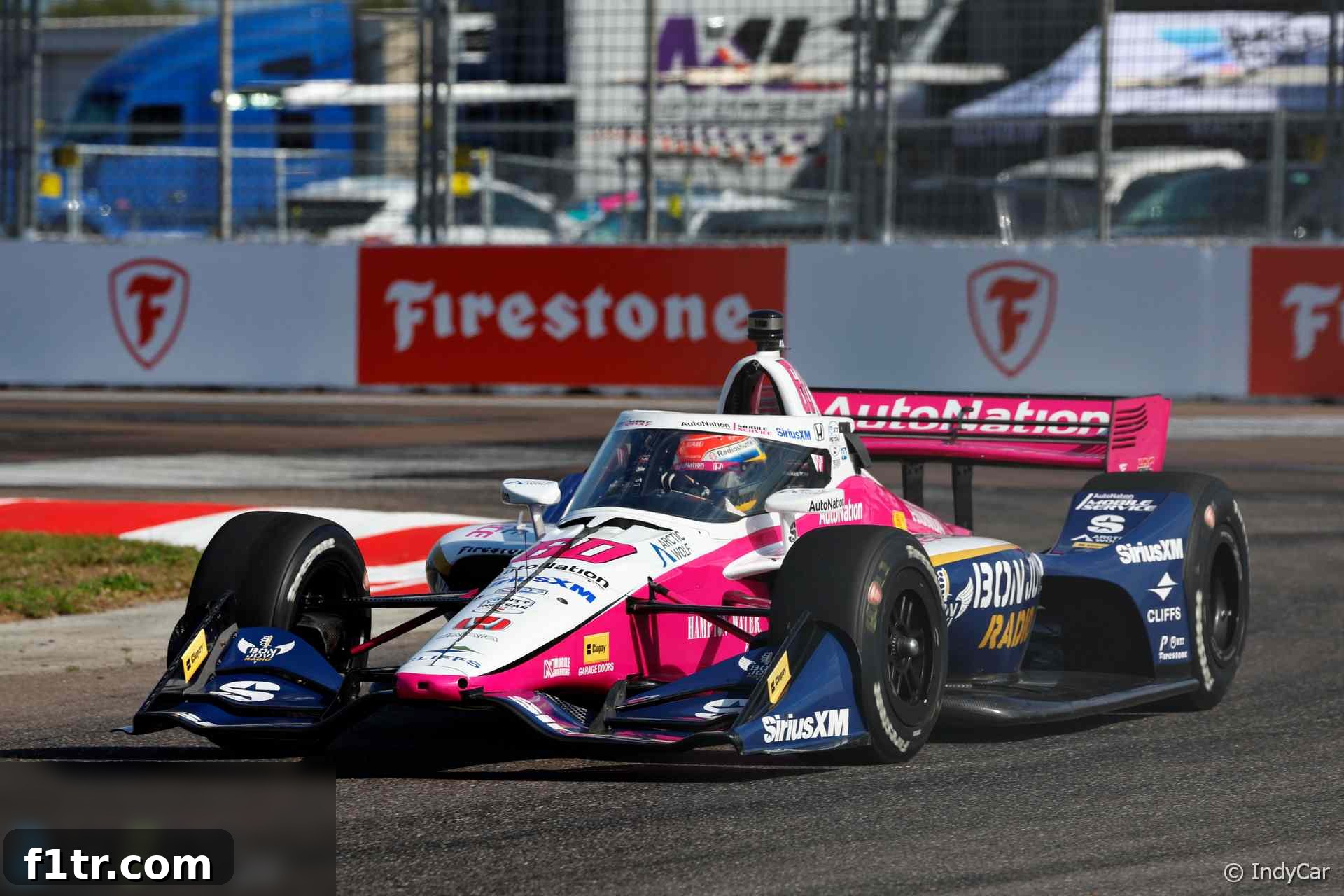
The exhilarating atmosphere of IndyCar racing recently captivated fans at The Thermal Club, a luxurious private circuit designed for high-performance driving. This unique non-championship event, featuring a substantial $1 million prize purse for the winner, adopted a thrilling format of two distinct heat races to determine the starting grid for the grand final. Emerging victorious from their respective poles, Felix Rosenqvist and Alex Palou showcased dominant performances, each securing a crucial win that places them on the front row for the ultimate showdown. Their commanding displays set a formidable tone for what promises to be an unforgettable final, underscoring their readiness and the competitive intensity that defines IndyCar motorsport.
Heat One: Early Drama and Rosenqvist’s Masterclass
The inaugural heat race at The Thermal Club commenced with immediate, high-octane drama, setting a challenging precedent for the event. Before the field could even navigate the first of the challenging 17 turns, an unfortunate incident unfolded involving seasoned veteran Scott Dixon and Romain Grosjean. Dixon’s car made contact with Grosjean, sending the Juncos Hollinger entry sliding sideways into the path of Rinus VeeKay. The resulting collision was severe enough to force both Grosjean and VeeKay out of the race on the spot, highlighting the unforgiving nature of close-quarters IndyCar racing.
The stewards swiftly penalized Scott Dixon with a drive-through penalty, which he served once the race restarted following the cleanup. This early setback effectively extinguished Dixon’s aspirations of progressing to the final, as he was relegated to the back, facing an insurmountable challenge to break into the top six qualifying positions. The incident underscored the fine margins and immediate consequences inherent in this competitive format, where every lap and every maneuver carries significant weight.
Amidst the early chaos and subsequent restart, Felix Rosenqvist, starting from pole position, demonstrated exceptional composure and skill. He faced an initial, stern challenge from Scott McLaughlin at the start, requiring him to assert his position with precision and determination. However, once the race settled into a rhythm after the restart, Rosenqvist proved to be untouchable. Driving the Meyer Shank Racing entry with remarkable control and pace, he progressively extended his lead, never seriously threatened by his rivals. His performance was a testament to both his driving prowess and the car’s setup, allowing him to cruise to a comfortable victory and secure the prime spot on the front row for the final. McLaughlin, despite his initial aggression, maintained a strong pace to finish second, ensuring his progression alongside his Team Penske colleague, Josef Newgarden, who also secured a coveted spot in the final.
The battle for the remaining qualification berths was fiercely contested throughout the race. Christian Lundgaard, Agustin Canapino, and Colton Herta successfully navigated the challenges to claim the final three spots within the crucial top six. Their performances were marked by consistency and strategic driving, essential for advancing in such a high-stakes format. While there were no significant changes in position among the front-runners after the restart, the race saw intense pressure from behind. Rookie Nolan Siegel, making his debut, briefly threatened Herta’s sixth position, showcasing his potential and ambition. However, a minor error saw Siegel fall back, ultimately crossing the finish line as the first driver outside the qualifying spots, a bittersweet outcome for the promising newcomer.
Further down the field, drivers like Santino Ferrucci and Will Power pushed hard in a bid to make up ground. Power, in particular, mounted a spirited charge, overtaking Sting Ray Robb and Kyle Kirkwood after being delayed at the chaotic start. Despite his valiant efforts and impressive overtakes, the early time loss proved too significant to overcome, and he ultimately fell short of reaching the top six. The race concluded with a clear separation between the qualifiers and the rest, highlighting the cut-throat nature of the heat race format at The Thermal Club.
IndyCar Thermal Heat One Result
| P. | No. | Driver | Team | Engine |
|---|---|---|---|---|
| 1 | 60 | Felix Rosenqvist | Meyer Shank | Honda |
| 2 | 3 | Scott McLaughlin | Penske | Chevrolet |
| 3 | 2 | Josef Newgarden | Penske | Chevrolet |
| 4 | 45 | Christian Lundgaard | RLL | Honda |
| 5 | 78 | Agustin Canapino | Juncos Hollinger | Chevrolet |
| 6 | 26 | Colton Herta | Andretti/Curb-Agajanian | Honda |
| 7 | 18 | Nolan Siegel | Coyne | Honda |
| 8 | 14 | Santino Ferrucci | Foyt | Chevrolet |
| 9 | 12 | Will Power | Penske | Chevrolet |
| 10 | 27 | Kyle Kirkwood | Andretti | Honda |
| 11 | 41 | Sting Ray Robb | Foyt | Chevrolet |
| 12 | 9 | Scott Dixon | Ganassi | Honda |
| 13 | 21 | Rinus VeeKay | Carpenter | Chevrolet |
| 14 | 77 | Romain Grosjean | Juncos Hollinger | Chevrolet |
Heat Two: Palou’s Unrivaled Pace and a Tense Mid-Field Battle
Following the tumultuous start to Heat One, the second group of IndyCar drivers delivered a remarkably cleaner and more orderly opening sequence, a stark contrast that allowed for pure racing spectacle from the outset. Pole-sitter Alex Palou, driving with the precision and confidence characteristic of a reigning champion, led the field into the first corner alongside Marcus Armstrong. From that moment, the two Ganassi Honda-powered cars rapidly pulled away, establishing an early and commanding lead. Their blistering pace left the chasing pack struggling to keep up, with third-placed Graham Rahal quickly losing approximately two seconds per lap to the leaders, signifying the sheer dominance at the front.
As Palou and Armstrong disappeared into the distance, the battle for the crucial remaining qualification spots intensified. Linus Lundqvist, holding fourth position, and Pietro Fittipaldi close behind, opted for a more conservative approach, content to bide their time and maintain their positions within the top six. However, further back, the McLaren contingent faced a significant challenge. All three papaya-liveried cars – piloted by Callum Ilott, Alexander Rossi, and Pato O’Ward – found themselves outside the all-important top six after the first lap, creating immense pressure to climb through the field. This immediate struggle underscored the competitive depth of IndyCar and the unforgiving nature of the heat race format.
The tension grew as drivers fought tooth and nail for every position. Tom Blomqvist initially held the final qualifying spot, a position he desperately tried to defend. Callum Ilott, deputizing for the injured David Malukas, led the McLaren charge, demonstrating commendable restraint and clean driving despite the high stakes. He managed to maintain a measured approach when Alexander Rossi, his McLaren teammate, made an aggressive dive to the inside, avoiding contact and ensuring both cars remained in contention. Not long after, Pato O’Ward seized an opportunity to pass Ilott, moving into seventh place. While this was a positive step for O’Ward, it left him agonizingly close, needing to find one more position to secure a berth in the final. The McLarens were clearly pushing to their limits, but the competition for the top spots was relentless.
In the closing laps, Alex Palou continued to assert his authority, gradually increasing the gap to Marcus Armstrong. Displaying masterful control and consistent speed, Palou crossed the finish line a commanding five seconds ahead of his teammate, a clear indication of his superior pace and the potent combination of driver and machine. His victory not only secured him a front-row start for the final but also demonstrated a significant advantage. Behind the leading pair, the next five cars ran in incredibly close formation, creating a thrilling spectacle as drivers pushed for every fraction of a second. Despite the tight proximity, the high-speed nature of the circuit and the defensive driving made clean overtaking incredibly challenging. Ultimately, no one managed to muster a successful pass, allowing Graham Rahal, Linus Lundqvist, Pietro Fittipaldi, and Alexander Rossi to hold onto their positions and claim the final qualification spots for the main event. Their resilience and ability to withstand pressure secured their place in the much-anticipated final, promising another high-octane battle for the coveted prize.
IndyCar Thermal Heat Two Result
| P. | No. | Driver | Team | Engine |
|---|---|---|---|---|
| 1 | 10 | Alex Palou | Ganassi | Honda |
| 2 | 11 | Marcus Armstrong | Ganassi | Honda |
| 3 | 15 | Graham Rahal | RLL | Honda |
| 4 | 8 | Linus Lundqvist | Ganassi | Honda |
| 5 | 30 | Pietro Fittipaldi | RLL | Honda |
| 6 | 7 | Alexander Rossi | McLaren | Chevrolet |
| 7 | 5 | Pato O’Ward | McLaren | Chevrolet |
| 8 | 66 | Tom Blomqvist | Meyer Shank | Honda |
| 9 | 6 | Callum Ilott | McLaren | Chevrolet |
| 10 | 20 | Christian Rasmussen | Carpenter | Chevrolet |
| 11 | 4 | Kyffin Simpson | Ganassi | Honda |
| 12 | 28 | Marcus Ericsson | Andretti | Honda |
| 13 | 51 | Colin Braun | Coyne | Honda |
With Felix Rosenqvist and Alex Palou now firmly planted on the front row, the stage is exquisitely set for the final race at The Thermal Club. Their commanding heat race victories have not only secured them prime starting positions but have also sent a clear message to their competitors: they are the drivers to beat. The blend of seasoned veterans and rising talents that have qualified promises a diverse and unpredictable contest for the significant prize money. This unique pre-season event, with its innovative format and high stakes, has already delivered thrilling moments and showcased the unparalleled excitement that IndyCar racing consistently provides. Fans eagerly anticipate the final, where strategy, skill, and sheer determination will determine who claims victory and the prestigious million-dollar payout.
IndyCar News and Features
- IndyCar driver McLaughlin cleared of injury after crashing through barrier at Barber
- Schumacher says his IndyCar feels like ‘an F2 car, just with better tyres’
- IndyCar “way faster than Formula 1” in some corners, says Grosjean
- FIA to award more F1 superlicence points to IndyCar drivers from 2026
- Schumacher to race full-time in IndyCar with RLL in 2026
Browse all IndyCar articles