Sebastian Vettel’s Unexpected Incident at the 2018 F1 Milan Festival
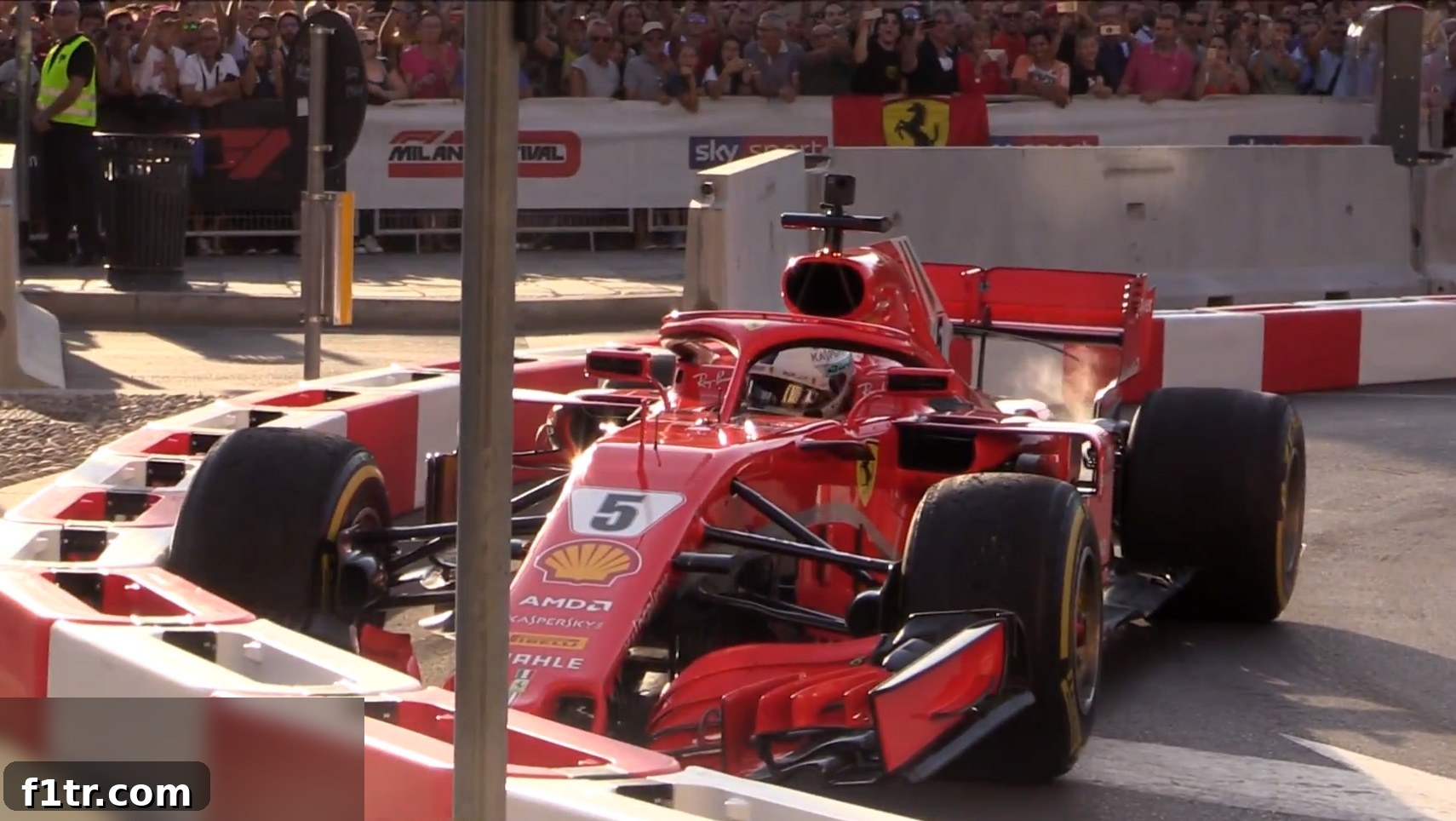
The thrilling world of Formula 1 often brings high-octane drama on the racetrack, but sometimes, unexpected moments unfold even during promotional events. One such incident occurred during the official Formula 1 Milan Festival in 2018, when four-time world champion Sebastian Vettel, behind the wheel of his powerful Ferrari, made contact with a low barrier. This minor mishap, which resulted in damage to his car’s front wing, quickly became a talking point, highlighting the fine line between excitement and precision even in a controlled demonstration environment.
The Incident Unfolds in Milan’s Heart
The F1 Milan Festival, held at Darsena in the vibrant city center, was designed to bring the excitement of Formula 1 closer to the fans. It was a rare opportunity for motorsport enthusiasts to witness iconic F1 machinery and their celebrated drivers up close, away from the traditional Grand Prix circuits. Sebastian Vettel, fresh off a victory at the Belgian Grand Prix and deeply involved in a fierce championship battle during the 2018 F1 season, was one of the star attractions. Driving his Ferrari SF71H, a car renowned for its speed and advanced aerodynamics, Vettel was performing a demonstration run for the eager crowds.
During one of these exhilarating passes, intended to showcase the raw power and agility of an F1 car, Vettel inadvertently clipped a low barrier. The impact, while seemingly minor, was enough to dislodge and break the car’s delicate front wing. The incident was a momentary shock, but Vettel, demonstrating his seasoned expertise, was quickly able to reverse the car away from the barrier. Despite the superficial damage, the moment served as a potent reminder of the inherent challenges and the razor-thin margins in motorsport, even during exhibition events.
The Broader Context of F1 Demonstration Runs
Formula 1 demonstration runs are a vital part of the sport’s outreach strategy. They serve multiple purposes: engaging fans who might not otherwise attend a Grand Prix, promoting upcoming races, and showcasing the technical marvels of F1 cars in unique urban settings. These events often feature drivers performing donuts, speed runs, and controlled manoeuvres in locations ranging from city streets to specially designed temporary tracks. The atmosphere is typically festive, allowing for unparalleled access and interaction between fans and their heroes.
For drivers, these events, while less pressured than a competitive race, still demand a high degree of concentration and skill. The cars are incredibly powerful, and the environments are often tighter and less forgiving than a dedicated race circuit. Cold tires, unfamiliar surfaces, and the close proximity of barriers – even low ones – mean that precision remains paramount. The thrill for spectators comes from seeing these multi-million-dollar machines pushed to their limits just feet away, a spectacle that justifies the occasional, minor hiccup.
The 2018 F1 Milan Festival saw not just Ferrari but also Sauber participate, adding to the spectacle. Alongside Vettel, his then-teammate Kimi Raikkonen, the ‘Iceman’ himself, also took part, thrilling fans with his signature cool demeanor. From Sauber, young prodigy Charles Leclerc, who was making waves in his rookie season and destined for a future Ferrari seat, and Marcus Ericsson were also present. This gathering of talent underscored the event’s significance in bridging the gap between the high-tech world of F1 and its passionate global fanbase.
Previous Incidents of Note: Vettel Not Alone
Sebastian Vettel’s Milan incident, while notable due to his stature and Ferrari’s prominence, is not an isolated occurrence in the history of Formula 1 demonstration runs. The very nature of pushing these sophisticated machines in unfamiliar or restricted environments occasionally leads to minor contact or spins. These incidents, far from detracting from the sport, often become memorable anecdotes that highlight the human element behind the wheel and the sheer power of the cars.
One prominent example involves former Ferrari test driver Kamui Kobayashi. Five years prior to Vettel’s Milan moment, Kobayashi experienced a more significant incident during a wet demonstration event in Moscow. Driving one of Ferrari’s impressive F1 cars, he crashed, underscoring the added challenge that adverse weather conditions pose even in controlled environments. The reduced grip and visibility significantly increase the risk, proving that even experienced drivers can be caught out.
Similarly, the year before Kobayashi’s Moscow incident, Pastor Maldonado, famously nicknamed ‘Crashtor’ by some for his aggressive driving style, crashed his Williams F1 car during a promotional event in the Venezuelan capital, Caracas. These instances, while sometimes embarrassing for the teams and drivers involved, are part of the spectacle. They remind us that Formula 1 is a sport operating at the very edge of performance, where the smallest misjudgment can lead to contact, regardless of whether it’s a Grand Prix or a fan festival.
The Aftermath and Fan Engagement
The immediate aftermath of Vettel’s contact was handled with professionalism. While the front wing of the Ferrari SF71H sustained damage, the car itself remained operational. Such minor incidents are typically quickly addressed by the highly skilled mechanics who accompany the teams to these events. The focus rapidly shifted back to the core purpose of the festival: fostering fan engagement and celebrating the spirit of Formula 1.
Despite the momentary lapse, the Milan Festival was a resounding success in bringing the sport closer to its audience. Seeing a championship-contending car like the SF71H, driven by a legend like Sebastian Vettel, in a non-traditional setting creates indelible memories for fans. It offers a sensory experience – the roar of the engine, the smell of burnt rubber, the sheer speed – that can only be truly appreciated in person. The incident, rather than overshadowing the event, merely added an unexpected layer of human drama, reinforcing that even the best in the world are constantly pushing boundaries.
These events also provide unique marketing opportunities for Formula 1 teams and sponsors. By presenting the sport in an accessible format, they cultivate new fans and strengthen the bond with existing ones. The visual appeal of an F1 car performing in a city landscape is unparalleled, generating significant media coverage and social media buzz. The Ferrari SF71H, a symbol of Italian racing prowess, was particularly at home in Milan, creating a powerful connection with the local and international attendees.
Conclusion: A Glimpse into F1’s Dynamic Nature
Sebastian Vettel’s minor incident at the 2018 F1 Milan Festival serves as a fascinating footnote in a season that was already rich with drama. It perfectly encapsulates the dynamic nature of Formula 1: a blend of cutting-edge technology, incredible driving talent, and the ever-present possibility of the unexpected. Even in a seemingly low-pressure demonstration run, the challenge of controlling these powerful machines in unconventional settings remains real. The contact with the barrier, resulting in a damaged front wing, was a stark reminder of the precision required at all times.
Yet, such incidents rarely deter the enthusiasm for these public showcases. They reinforce the allure of Formula 1, where the spectacle of speed and skill is balanced by the raw, unpredictable nature of motorsport. For fans, witnessing Sebastian Vettel and other drivers like Kimi Raikkonen, Charles Leclerc, and Marcus Ericsson in action at the heart of Milan was an unforgettable experience. The event, despite a small snag, successfully achieved its goal of celebrating Formula 1 and deepening its connection with a passionate global audience, setting the stage for future thrilling encounters both on and off the track.
Related 2018 F1 Season Content
- F1 feared “death knell” for Drive to Survive after Ferrari and Mercedes snub
- McLaren staff told us we were “totally crazy” to take Honda engines in 2018 – Tost
- ‘It doesn’t matter if we start last’: How Red Bull’s junior team aided Honda’s leap forward
- Honda’s jet division helped F1 engineers solve power unit problem
- McLaren Racing losses rise after Honda split
Browse all 2018 F1 season articles