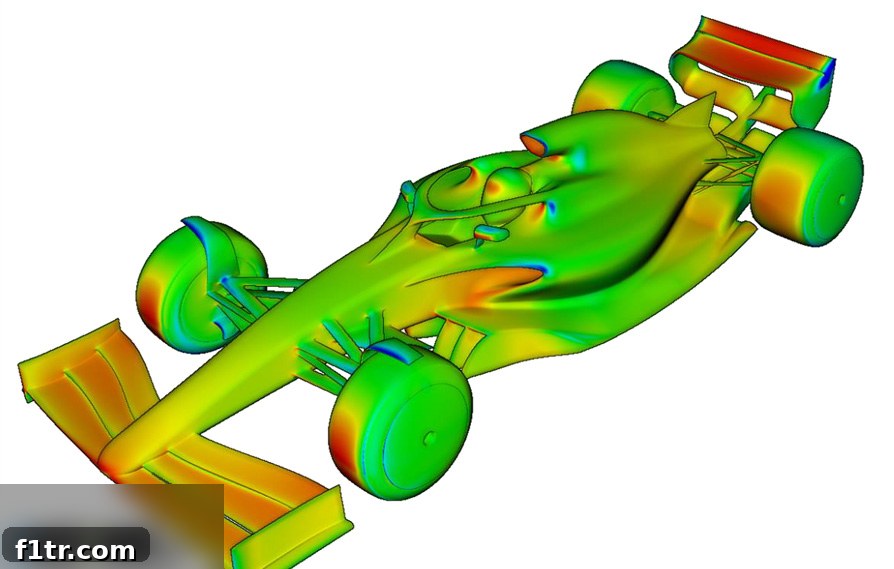
Formula 1, the pinnacle of motorsport, has long captivated audiences with its speed and technological prowess. However, the quality of racing has sometimes been hindered by the very aerodynamics that make these machines so fast. A significant challenge with current F1 cars is the staggering 50% loss of downforce when running closely behind another car. This aerodynamic disadvantage makes overtakes incredibly difficult, often leading to procession-like races.
To address this critical issue and reignite the thrill of wheel-to-wheel combat, Formula 1 embarked on a radical overhaul of its car design regulations, aimed at the 2021 season. Spearheading this ambitious project is F1 motorsport director Ross Brawn, who has revealed groundbreaking concepts indicating that future cars could lose as little as 5% of their downforce in the turbulent wake of a leading car. This dramatic reduction promises a new era of closer, more exciting racing.
The core question that has captivated fans and engineers alike is: How exactly does Formula 1 plan to revolutionize the championship’s racing quality? And what specific design changes are being considered to bring about such a profound transformation? To delve into these questions, we turn to the detailed analysis of Craig Scarborough, who meticulously examined “India,” one of the key concept designs developed for the 2021 F1 season.
The journey towards the 2021 regulations marked a pivotal shift in how F1 rules are formulated. Approaching the public release of the final plans, the FIA, in collaboration with Liberty Media (F1’s commercial rights holder) and FOM (Formula One Management), adopted an unprecedented approach to determining the sport’s technical direction. Under the visionary leadership of Ross Brawn, a dedicated technical research and development group was established. This team’s mandate was revolutionary: for the first time in F1 history, rules would undergo exhaustive research and rigorous qualification before their official release. This data-driven methodology aimed to ensure that the new regulations would genuinely achieve their intended objectives rather than relying on theoretical assumptions.
Brawn’s technical team leveraged sophisticated simulation programs to pursue ambitious goals set by Liberty Media. The paramount objective was unequivocal: to significantly facilitate the ability of cars to follow each other closely, thereby making overtaking easier and more frequent. This primary aim was complemented by several crucial secondary objectives, including equalizing the performance field among teams, substantially reducing operational costs, and enhancing the aesthetic appeal of the cars. The ‘India’ concept car, reportedly the ninth iteration in their research (‘I’ being the ninth letter of the alphabet), emerged from this extensive collaborative effort. F1 teams actively assisted Brawn’s group with advanced Computational Fluid Dynamics (CFD) research, meticulously scrutinizing various car concepts. The ‘India’ model provides invaluable insights into the sport’s intended direction, offering a glimpse into how future F1 aerodynamics might function, even if some final details remain subject to change or refinement.
Revolutionizing Aerodynamics: The Core Philosophy
The fundamental challenge for Brawn’s group involved two often conflicting aerodynamic requirements: firstly, reducing the sensitivity of a car’s downforce-generating surfaces when running in close proximity to another vehicle; and secondly, minimizing the turbulent wake generated by the car ahead. Meeting these dual demands presented a complex engineering puzzle. However, the ‘India’ concept appears to have successfully reconciled these basic aims by implementing a clever strategy. The majority of downforce generation has been strategically shifted to larger, more efficient underfloor tunnels. Concurrently, the wake generated by the car has been significantly cleaned up through a radical simplification of the car’s overall aerodynamic surfaces, further augmented by a few innovative aero solutions designed to produce a much tidier wake. This holistic approach promises to fundamentally alter the aerodynamic interaction between cars.
Creating Downforce: The Underfloor Revolution
While the ‘India’ concept car might, at first glance, bear a superficial resemblance to current F1 machinery, perhaps with some subtle influences from IndyCar designs, its most profound transformation lies beneath the surface. The underfloor has undergone the most significant redesign, becoming the primary source of aerodynamic load. This marks a substantial departure from previous generations, where front and rear wings bore the brunt of downforce generation. Consequently, the influence and complexity of the wings have been deliberately reduced, paving the way for a more ground-effect-centric aerodynamic philosophy.
In contrast to existing F1 floors, which typically feature a central step to lift the diffuser clear and intentionally curb its performance and sensitivity, the ‘India’ car adopts a fundamentally different approach. The floor of the monocoque and sidepods now lie on a single, continuous plane. While a mandatory plank still runs along the centerline, it is accompanied by much larger and more aggressively shaped tunnels. The most striking modification is the leading edge of the floor, which incorporates a raised venturi inlet. Within this inlet, carefully positioned vanes act much like traditional bargeboards, meticulously controlling the airflow entering and traversing the underfloor. This design is engineered to maximize the downforce generated through ground effect, drawing the car closer to the track surface.
To further optimize the efficiency of the underfloor inlet and prevent any disruptive up-wash from the front wing, a precisely sculpted triangular vane has been integrated within the front suspension assembly. This clever element is tasked with redirecting the airflow downwards, ensuring it is channeled cleanly and efficiently into the underfloor tunnels, thereby maintaining consistent ground effect performance.
A significant simplification also involves the deletion of the flat floor section beneath the raised footwell of the monocoque. This design element, a remnant from rules dating back to 1983, originally necessitated the creation of the front splitter, often referred to as the “Tea-Tray.” Its removal on the ‘India’ concept exposes a “V” shape under the monocoque, a change specifically implemented to streamline and clean up the airflow in the crucial area directly ahead of the shaped underfloor, ensuring smoother operation of the primary downforce-generating surfaces.
At the car’s rear, the diffuser section has been designed to be slightly longer and taller than current iterations. However, it intentionally stops short of being a full-length ground effect tunnel, a feature last prominently seen in the early eighties. This design choice leaves a flat floor area situated between the ramped sections of the diffuser, striking a balance between potent ground effect and practical considerations. The underlying principle is that the downforce generated by the underfloor venturi effect is inherently less susceptible to the disruptive wake created by a leading car. Furthermore, this design can be meticulously engineered to produce less wake itself, making it an ideal choice for enhancing raceability. This crucial assumption was rigorously validated through extensive CFD studies conducted by Brawn’s technical group. An additional benefit of this elongated floor design is its ability to generate significant downforce at both the front and rear of the car, contributing to a more balanced and stable aerodynamic platform.
Recalling the pioneering ground effect cars of the 1980s, full-length tunnels proved incredibly effective when sealed by flexible skirts. These skirts, running along the sides of the car and in contact with the track surface, created a virtually enclosed low-pressure area beneath the floor, generating immense levels of downforce. However, this groundbreaking technology came with a significant drawback: cars became extremely sensitive to bumps and kerbs. Any momentary loss of contact between the skirts and the track surface would instantaneously compromise the low-pressure seal, leading to a sudden and dangerous loss of downforce. For safety reasons and to improve handling predictability, skirts were eventually banned.
Given the historical challenges associated with skirts, they have not been reintroduced for the ‘India’ car. Instead, a highly innovative solution has been devised: a pair of strategically positioned vanes flank the rear diffuser tunnel. These vanes are positioned significantly lower than the car’s main floor, specifically designed to help seal the diffuser. What makes this design particularly ingenious is their mounting point: they are attached directly to the rear brake ducts. This means these vanes move in conjunction with the suspension, ensuring they remain in close proximity to the ground at all times, independent of changes in ride height (barring tyre movement). In this configuration, these advanced vanes are expected to be remarkably effective at sealing the underfloor, mimicking the benefits of skirts without incurring their notorious sensitivity drawbacks. This innovative approach promises stable and powerful ground effect downforce, crucial for the new era of F1 racing.
Another persistent aerodynamic challenge with powerful rear diffusers is the phenomenon known as ‘tyre squirt’. This occurs when high-pressure air, spilling off the rotating rear tyres, is inadvertently directed into the low-pressure area within the diffuser. This disrupts the carefully managed airflow, significantly degrading the diffuser’s performance and thus overall downforce. Over the past decade, teams have employed various methods to mitigate tyre squirt, including specially shaped floor sections, exhaust blowing, and more recently, slotted floor edges. The ‘India’ model showcases a return to a scalloped section along the floor edge, noticeably devoid of any other floor edge slots, serrations, or additional aerodynamic appendages. This elegantly simple scalloped section is designed to create a focused blast of airflow between the floor and the tyre, effectively counteracting the negative effects of tyre squirt and preserving diffuser efficiency.
Considering the strong desire to equalize performance among teams and drastically reduce costs, a compelling question arises: will the intricate shaped underfloor be mandated as a “spec” part? This could mean either manufacturing by a third-party supplier for all teams or having teams produce them strictly according to a detailed FIA template. Such a standardization would significantly curb development costs in this critical area, ensuring a more level playing field.
Streamlining the Wings for Cleaner Air
With the adoption of the sophisticated shaped underfloor format as the primary downforce generator, the design philosophy for the front and rear wings has been dramatically altered. Their influence has been deliberately clipped and simplified. The front wing retains the car’s full two-meter width, consistent with current F1 cars, but its complexity has been significantly reduced. Conversely, the rear wing has been narrowed compared to contemporary designs, reflecting its diminished role in overall downforce production.
The front wing design on the ‘India’ concept largely follows the path established by Ross Brawn’s revisions implemented with the 2019 regulations. It has been streamlined to consist of just three primary elements, spanning continuously from the nose section to the endplate. This design explicitly discards the “Overtaking Working Group” (OWG) concept from 2009, which featured a neutral center section suspended from a raised nose. While in certain frontal CFD images, the wing might appear unusually high, this is often an optical illusion due to the viewing angle; the car is horizontally positioned with the front wheels seemingly elevated, but in reality, the front wing height is expected to be similar to current setups.
A distinctive feature of the new front wing is its split by the nose. While this might evoke memories of early nineties F1 designs, it is, in fact, a clever wake reduction strategy. On post-2009 front wings, the intersection between the neutral central span and the outer wing sections notoriously generated the Y250 vortex. This powerful outwash vortex was deliberately exploited by teams to push the turbulent wake generated by the front tyres outwards, away from the car’s flanks. By eliminating this intersection and any complex shaping in this critical area, the ‘India’ concept significantly diminishes the outwash effect, resulting in a much cleaner and less disruptive wake from the front of the car. This directly translates to less “dirty air” for a following car.
The rear wing on the ‘India’ concept presents an equally unusual and stylized appearance. It notably dispenses with the conventional separate flat endplates that typically connect and support the wing profiles. While this design choice may contribute to a more aesthetically pleasing look, its primary aerodynamic benefit is the reduction of downforce and, critically, the turbulent wake formed at the wingtips. This simplification is consistent with the overall goal of minimizing aerodynamic disturbance. Furthermore, the wing sees the return of a lower beam wing. In this specific configuration, it appears to function as an aerodynamic extension to the underfloor tunnels, further enhancing the ground effect. A particularly bold proposition on this model is the complete absence of a Drag Reduction System (DRS). The underlying theory is that with these fundamental aerodynamic improvements, cars should be inherently capable of legitimate overtaking maneuvers without the aid of artificial drag reduction.
Reducing Turbulence: Taming the Wheel Wake
While the simpler wing designs and efficient underfloor tunnels significantly contribute to a reduction in the overall turbulent wake of the car, a substantial proportion of this disturbance is notoriously generated by the exposed wheels themselves. Formula 1 has historically maintained its “open-wheel” format, signifying exposed tyres, a characteristic that fans and the sport itself are keen to preserve. Ross Brawn’s research team had already made strides in addressing front tyre wake with the 2019 F1 regulations; however, the ‘India’ concept takes this a decisive step further in minimizing this disruptive element.
Firstly, the ‘India’ concept introduces wheel covers, effectively closing off the outer face of the wheel with a flat disc. It remains unclear whether these covers are designed to be attached to and spin with the wheel, or if they are static covers akin to those seen in 2008. Regardless, their primary function is to dramatically reduce turbulence. By providing a smooth surface, the wheel wake can flow cleanly along the cover rather than breaking up chaotically over an open wheel design. A key challenge this design presents is brake cooling, an issue not fully resolved or detailed in the model seen. One potential solution might involve ducting brake heat through the inner face of the wheel, rather than relying on the outer face. It’s also noteworthy that the brake duct itself incorporates a lower-mounted vane, a design element banned in current regulations, specifically to help clean up the tyre wake as it flows along the inner brake duct. This highlights the comprehensive approach to managing airflow around the wheels.
Similarly, the rear brake ducts have been meticulously reshaped. Not only do they integrate the crucial diffuser sealing vanes, but the ducting itself extends backwards behind the wheel to the rear edge of the tyre. This extended design is intended to efficiently clean up the turbulent wake generated by the rear tyres, ensuring minimal disturbance to the following car.
Another ingenious trick to manage tyre wake is the inclusion of a “blade” mounted directly over the top of the tyre. Despite its small size, this piece of bodywork is projected to be hugely influential in reducing tyre wake by delaying the separation and break-up of airflow behind the tyre. While some fans have voiced concerns that this partially covers the tyre, deeming it “un-F1,” its aerodynamic benefits for cleaner air are undeniable.
Collectively, these meticulously engineered elements – the significantly cleaner tyre wake, the intentional elimination of the Y250 vortex, the substantial reduction in the front wing’s outwash effect, and the absence of complex, powerful bargeboards – conspire to achieve a singular, crucial objective. Whatever residual wake is created by the front tyre will now be efficiently pulled into the car’s “coke bottle” area (the constricted region of the bodywork behind the sidepods) rather than being pushed outwards beyond the rear tyres. This results in a considerably narrower and less disruptive wake profile behind the car, making it exponentially easier for a following car to get closer, challenge for position, and ultimately, overtake.
Other Features and Future Considerations
Beyond the headline-grabbing innovations in downforce generation and turbulence management, the ‘India’ concept car reveals several other, less obvious features that offer insights into the sport’s aspirations for the future. These include a desire to allow for greater visual differentiation between cars and numerous unanswered questions regarding the technologies concealed beneath the bodywork.
Since 2012, F1 noses have been subject to strict regulations mandating lower heights and specific cross-sectional areas. This has led to a varied and often aesthetically divisive evolution, from stepped noses to the controversial 2014 “finger noses” and the current “thumb-tip” designs. The ‘India’ concept car features a long, low-tipped nose, but crucially, it avoids any awkward or ungainly tip designs. This suggests a renewed focus on allowing for more appealing and elegant frontal aesthetics in future F1 cars.
Similarly, the chassis cross-section where it merges with the nosecone has typically been a distinctly square-edged rectangular shape since the late nineties. On the 2021 concept car, this section appears notably more rounded. This subtle but significant change hints that future regulations might be less prescriptive regarding the exact cross-sectional area, potentially encouraging designers to create more fluid and visually pleasing rounded shapes, moving away from the often functional but blocky designs of recent years.
A small shark fin is also incorporated into the CFD model. While modest in size and shape, such an element would undoubtedly provide aerodynamic benefits, particularly in helping to manage airflow to the rear wing through corners. Beyond its performance contribution, it also adds an element of visual interest to the car’s overall silhouette, offering a distinctive feature.
The sidepods appear to be the least developed area on the ‘India’ concept. They feature conventional mid-positioned inlet designs with a stylized leading edge. Notably, there appear to be no integrated side impact structures visible within their shape. This could indicate that the model represents an early iteration of the car, or perhaps that the rules governing the shape and integration of these crucial spars, mounted to the flanks of the monocoque for safety, are slated for significant changes in 2021.
Beneath the aerodynamic skin, the power units are generally not expected to undergo significant changes for the 2021 season, as a more radical shake-up of the Engine/ERS (Energy Recovery System) format has been strategically delayed. However, other areas are set for considerable standardization. Gearboxes, for instance, are anticipated to transition to a single-supplier, fixed-specification model. These units are likely to be reduced to a seven-speed configuration housed within a self-contained cartridge, allowing teams only to design their own outer casing to connect the suspension, rear crash structure, and gearbox to the engine. This move is primarily aimed at significant cost reduction and limiting performance divergence.
The trend towards standardized components is expected to extend further. It is highly probable that other parts, such as brake calipers, brake disc and pad material, suspension uprights, or even wheels, could become fixed-specification items. Moreover, the discussions surrounding future innovations are intriguing, with a potential return to a fixed hardware-specification active suspension setup and the introduction of electronic rear-view mirrors being considered. These changes collectively point towards a future F1 where competition is driven more by clever design within strict parameters and driving skill, rather than unrestrained spending on every component.
Summary: A Vision for the Future of F1 Racing
The unveiling of these images and detailed concepts for the 2021 F1 car has, predictably, generated considerable debate. Opinion is split on various aspects, particularly the aesthetics of features like the wheel covers and the tyre “blade.” Furthermore, questions linger regarding whether these new regulations will effectively resolve long-standing issues such as the extreme wheelbases and heavy weight of current F1 cars. These are valid concerns that reflect the passionate engagement of the F1 community.
However, what is undeniably clear is the monumental shift in Formula 1’s approach to rule-making. For the first time in its history, the sport boasts a set of genuinely properly conceived, thoroughly researched, and rigorously validated regulations. These comprehensive rules have been developed with a singular, overriding objective: to fundamentally enhance the quality of racing by making cars easier to follow and overtake. Despite any lingering aesthetic preferences or unresolved technical nuances, the 2021 regulations represent a profound commitment to delivering on the requirements set out for them, promising a thrilling new chapter for the sport and its fans.
Go ad-free for just £1 per month>> Find out more and sign up
Video: F1’s 2021 aerodynamic concept
F1 Technology Insights
- McLaren, Red Bull and Ferrari bring rear corner updates to Imola
- Ferrari, McLaren and Red Bull bring upgrades again for Saudi Arabian Grand Prix
- McLaren introduce major floor upgrade for Norris’ car at Mexican Grand Prix
- McLaren, Mercedes and Red Bull detail upgrade packages for United States GP
- Red Bull remove engine cover ‘cannons’ in major RB20 update – but they may return
Browse all F1 technology articles