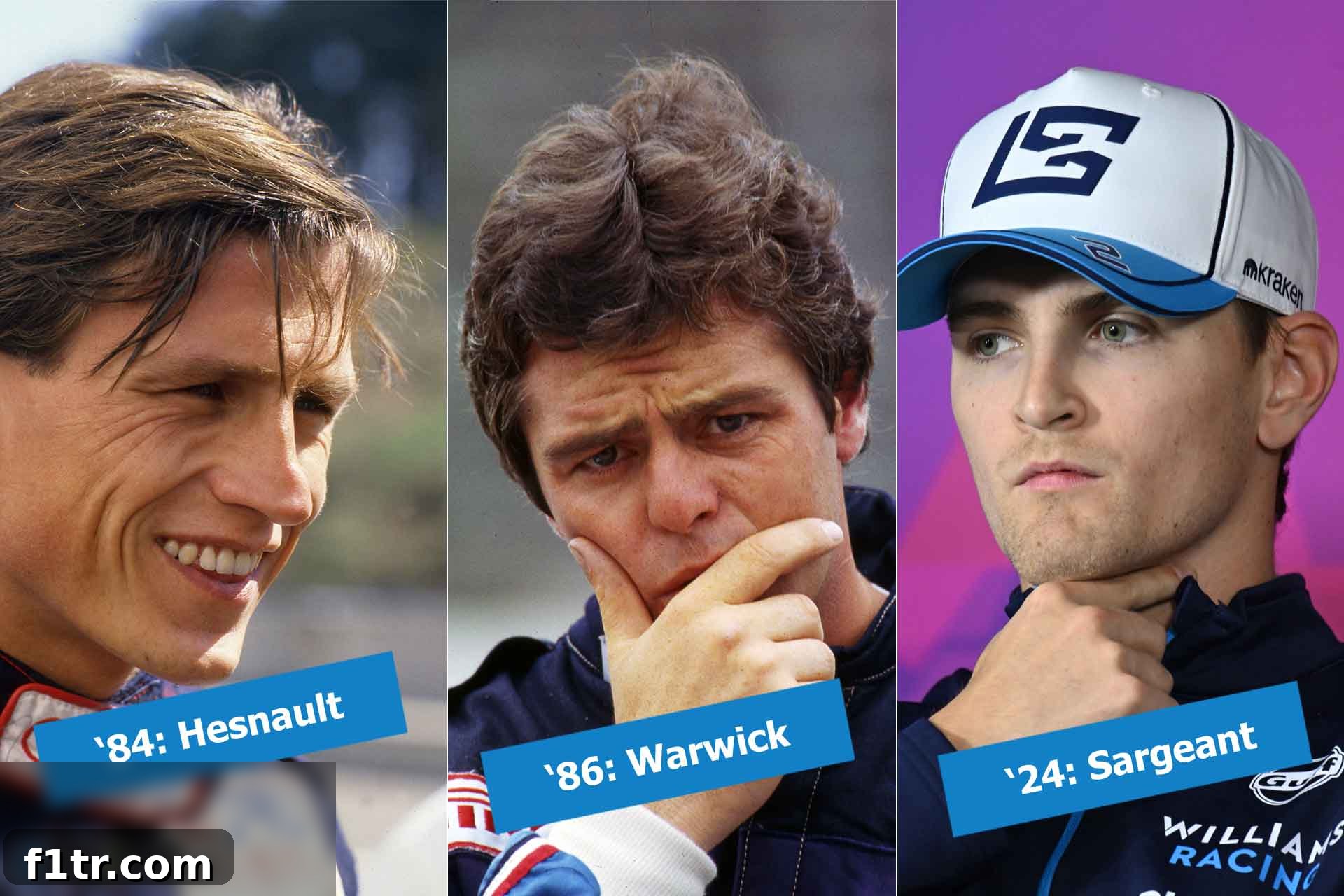
The Australian Grand Prix delivered a stark reminder of the often brutal realities of Formula 1, not just for the drivers on track but for those on the sidelines. Last weekend, Logan Sargeant found himself at the heart of an unprecedented team decision, forced to relinquish his Williams FW46 to his teammate, Alexander Albon. Albon had severely damaged his own chassis in a dramatic crash during Friday practice, leaving the team with only one fully operational car. Team principal James Vowles, citing Albon’s stronger track record and better chances of scoring crucial points, made the agonizing call. While a logical decision in the cutthroat world of F1, it was an incredibly tough pill to swallow for Sargeant, generating an outpouring of sympathy from fans and pundits alike.
Such an event is a stark anomaly in modern Formula 1. The notion of a driver being benched mid-weekend to accommodate a teammate due to a lack of spare parts is virtually unheard of in recent memory. Indeed, to find a similar instance, one must delve deep into the annals of F1 history, going back nearly four decades for the last comparable scenario. In the last 50 years, this agonizing sacrifice has occurred only five times, underscoring the extraordinary circumstances Williams faced.
A Look Back: Iconic Moments of Driver Sacrifice in Formula 1 History
Logan Sargeant’s predicament, though painful, is not entirely without precedent. Formula 1’s rich history is punctuated by moments of extreme team pressure and unconventional decisions, particularly in eras where resources were scarcer and regulations more flexible. Examining these past incidents reveals a fascinating evolution of the sport and the unwavering commitment required from its participants.
1986: Brabham’s Double Misfortune – Warwick Steps Aside for Patrese
The 1986 Formula 1 season was already fraught with tragedy and struggle for the Brabham team. It commenced under a dark cloud, and then took a heartbreaking turn when their popular driver, Elio de Angelis, tragically lost his life in a testing accident at Paul Ricard. Derek Warwick stepped into his vacant seat alongside the experienced Riccardo Patrese. Despite fielding the radical, low-line BT55 designed by the legendary Gordon Murray, powered by an explosively potent BMW turbo engine, the 1983 champions had only scraped together a mere two points by the 12th round of the season.
The Austrian Grand Prix at the high-speed Osterreichring (now the Red Bull Ring) offered a glimmer of hope. The circuit’s fast, flowing nature, devoid of many slow corners, was expected to play directly into the BT55’s aerodynamic strengths and the engine’s raw power. However, practice sessions proved brutally challenging. Patrese’s BMW engine proved too “explosive” in the literal sense, erupting in a massive fire that destroyed one chassis, significantly depleting Brabham’s already stretched resources.
Just when the team thought their luck couldn’t worsen, Warwick suffered a monumental crash. A new Pirelli tyre construction failed at his left-rear, sending him off the track with devastating force and further reducing the team’s stock of spare parts. Despite these setbacks, the team’s qualifying performance was remarkable: Patrese secured an impressive fourth on the grid, with Warwick not far behind in tenth – their best combined qualifying effort of the season. However, the pre-race drama was far from over. A critical gearbox fault was discovered on Patrese’s car just before the start. Faced with an impossible choice, team principal Bernie Ecclestone made the executive decision: Patrese, seen as the stronger contender for points, would take Warwick’s sole remaining running BT55.
Warwick, an ultimate team player, graciously accepted the sacrifice. Yet, the brutal hand of fate was not done with Brabham that weekend. Patrese’s inherited BT55, the last hope, lasted a mere two laps before its engine blew, forcing him into retirement. Warwick’s sacrifice, though commendable, proved ultimately in vain, leaving Brabham with zero points and a profound sense of misfortune.
1984: Ligier’s Desperate Bid – Hesnault Cedes to De Cesaris at Dijon
Francois Hesnault’s transition from Formula 3 to the pinnacle of motorsport with Ligier in 1984 was proving to be a baptism of fire. His inaugural season was marred by a series of misfortunes, including two technical failures and collisions with seasoned drivers like Martin Brundle and Jacques Laffite. The fifth round of the championship, his home race at Dijon, began in an equally unpromising fashion when he tangled with Patrese in practice, resulting in another damaging crash.
Despite the difficult start to the weekend, Hesnault showed flashes of potential, qualifying a respectable 15th on the grid. This was a significantly better performance than his more experienced teammate, Andrea de Cesaris, could manage. De Cesaris’s weekend was a comedy of errors; after Friday’s qualifying, his car’s fire extinguisher was found to be empty, leading to the deletion of all his times. Saturday brought torrential rain, making any improvement impossible, and his best effort was a dismal 11 seconds slower than the pace required. Consequently, De Cesaris, Ligier’s nominated number one driver, found himself in 27th place, outside the 26-car limit for the race start.
Faced with the embarrassing prospect of their star driver failing to qualify for his home race, team principal Guy Ligier devised a controversial solution. Hesnault’s car, which had legitimately qualified in 15th, was formally withdrawn from the event. De Cesaris was then entered in the final grid slot, effectively taking over Hesnault’s entry. It was a clear demonstration of team hierarchy and a desperate gamble to ensure their lead driver participated.
In modern F1, where points are awarded much further down the field, De Cesaris’s subsequent 10th-place finish might have been considered a partial success, potentially salvaging a point. However, in 1984, only the top six finishers scored, meaning Ligier’s gamble yielded no championship points. A candid Guy Ligier later admitted, “For a 10th place it would have been better to let Hesnault go out,” a revealing statement about the cost-benefit analysis of such a drastic measure.
1978: ATS and the Brazilian Gamble – Jarier Yields to Mass
The 1970s were a period of much greater fluidity in Formula 1, where car-swapping and impromptu driver changes were far more common than in later, more regulated eras. The 1978 season, in particular, saw several instances of teams improvising under pressure. Earlier that year, at the Brazilian Grand Prix, another driver experienced the bitter taste of giving up his car to a leading teammate, despite having out-qualified him – a scenario uncannily similar to Hesnault’s predicament.
Jean-Pierre Jarier, Hesnault’s compatriot, was racing for the ATS team. He had performed commendably, qualifying his ATS in 16th position. This was a full four places ahead of his teammate, Jochen Mass. However, Mass, a one-time Grand Prix winner who had joined ATS that season from McLaren, carried the crucial “number one” driver designation. On Sunday morning, a critical fuel tank leak was discovered in Mass’s car. With time against them and limited resources, the team made the swift decision: Mass would take over Jarier’s car for the race.
The team’s bold gamble nearly paid off handsomely. Mass, piloting Jarier’s car, drove a strong race, ultimately finishing in seventh place. This was agonizingly close to the points, which at the time were awarded only to the top six. Had he secured a point, it would have been a significant achievement for the struggling ATS team. The margin of what could have been was even narrower given the context of the race; Mario Andretti, who finished just three places ahead, was nursing a transmission problem and struggling home in fourth gear. Had Andretti’s issue worsened, ATS might have celebrated a points finish. As it stood, Jarier’s sacrifice went unrewarded in the points column, but it highlighted the stark hierarchy within teams and the pressures of resource scarcity.
1977: Lotus’s Fiery Start – Andretti Takes Over Nilsson’s Car
Fire extinguishers, surprisingly, have played a more prominent role in the history of F1 car swaps than one might expect. However, at the opening round of the 1977 season in Buenos Aires, Mario Andretti’s issue wasn’t an empty extinguisher but a terrifying explosion. As Andretti sped past the pits at full throttle, his car’s fire extinguisher unexpectedly detonated. The shocking incident ripped off the car’s nose cone and severely damaged part of its braking system. Miraculously, Andretti himself emerged unscathed from the high-speed drama.
Lotus, like many teams of the era, operated with limited spares. For the first race of the season, they had only two examples of their new, innovative Type 78 available. With Andretti’s chassis critically damaged, and no immediate replacement, the team made the unavoidable decision: Andretti would be given his teammate Gunnar Nilsson’s car for the race. Nilsson, a promising talent, had to step aside for the team’s lead driver and hopeful championship contender.
Starting from eighth on the grid in Nilsson’s car, Andretti swiftly demonstrated why he was the team’s chosen spearhead. He rapidly climbed to fourth place and then into the podium positions as the legendary Niki Lauda began to fall back. The race, however, was a chaotic affair. Andretti lost valuable time and sustained front wing damage in a tangle with the lapped Alex Ribeiro. Later, a wheel bearing problem emerged, ultimately forcing him to retire with just two laps remaining.
Despite the late retirement, the extremely high attrition rate of the 1977 Argentine Grand Prix meant that Andretti was still classified in fifth place, earning Lotus two valuable championship points. This was the same race where Jody Scheckter famously secured a debut victory for the Wolf team, highlighting the unpredictable nature of racing in that era and the relative success of Lotus’s quick thinking, despite the dramatic car swap.
1974: Frank Williams Racing’s Early Days – Robarts Gives Way to Belso
Our final example of a driver relinquishing their car for a teammate in the last five decades brings us back to the roots of the Williams name – specifically, Frank Williams Racing Cars in its formative years. This incident underscores the challenging beginnings of one of F1’s most enduring teams.
Frank Williams embarked on his second season as a constructor in 1974, with Arturo Merzario as his primary driver and a revolving cast of different drivers piloting the second car. For the Swedish Grand Prix, Merzario was absent due to injury, and Richard Robarts was drafted in to race alongside Tom Belso. The team fielded the ‘Iso Marlboro’ cars, a rebranding of their existing chassis, reflecting the dynamic and often financially precarious nature of independent teams at the time.
The morning warm-up on race day brought fresh trouble. Tom Belso suffered a sudden suspension failure that sent his car veering down an escape road. With the start of the race looming and no time to repair the damaged suspension on Belso’s car, a tough decision had to be made. Belso, considered by the team to be a more promising prospect for the weekend, was promptly given the team’s only other operational car – Robarts’s.
Making only his second start in a Grand Prix, Belso made the most of the opportunity, driving the ‘Iso Marlboro’ to an eighth-place finish. While two places outside the points-scoring positions of the time, it marked his only finish in Formula 1. For Richard Robarts, however, this unfortunate incident at the Swedish Grand Prix would mark his fourth and final appearance in a Grand Prix, an unceremonious end to his brief F1 career, a direct consequence of a team’s desperate tactical decision.
The Evolution of Car Swaps in Formula 1
A Bygone Era: When Flexibility Ruled the Pits
While the recent Logan Sargeant incident sent shockwaves through the F1 community, it’s crucial to understand that such flexibility in driver line-ups, or even mid-weekend car exchanges, was once far more common. In the less rigidly structured decades of Formula 1, particularly in the 1960s and 70s, teams often arrived at events with anything from one to five drivers. The absence of strict regulations regarding chassis allocation, coupled with fewer financial penalties for such maneuvers, meant that broken machinery frequently led to some drivers missing out, or cars being reassigned based on perceived performance or the primary driver’s needs.
Beyond the specific, high-profile cases detailed above, the 1970s saw at least five more instances of intra-team car swaps or mid-weekend changes. This number climbs to 13 in the 1960s, illustrating a pervasive culture of improvisation. Even further back, in the first decade of the World Championship, the situation was different again; teams were frequently permitted to swap drivers mid-race, a practice that eventually faded as the sport professionalized and safety regulations tightened. This historical context highlights how much F1 has evolved from a more amateur, flexible environment to the highly sophisticated, regulated, and resource-intensive sport we know today.
The Modern Predicament: Williams’s Unique Challenge
The Williams team’s predicament in Australia wasn’t just about a damaged car; it was a symptom of a deeper logistical and financial strain. They arrived in Melbourne without a spare chassis – a situation largely unheard of for a modern F1 team. While they had originally aimed to have a spare ready for the season opener in Bahrain, delays in manufacturing and the significant damage Albon inflicted on his chassis meant their resources were stretched to breaking point. This is why the team now faces the further challenge of arriving at the next race in Suzuka, Japan, once again without a spare.
While Williams isn’t the first team in recent memory to turn up to a race without a spare car (smaller teams have occasionally faced similar pressures), they are undeniably the first in a very long time to be forced to the extreme measure of benching one of their drivers due to such a logistical shortfall. This incident serves as a stark reminder of the immense pressures, both technical and financial, that even storied teams like Williams face in the relentless pursuit of competitiveness in contemporary Formula 1. It also underscores how much the sport has changed, transforming such improvised solutions from routine occurrences into shocking headlines.
Conclusion: The Enduring Spirit of Sacrifice in Formula 1
The saga of Logan Sargeant and the Williams team is a poignant chapter in the ever-evolving narrative of Formula 1. While heartbreaking for the individual driver, it echoes a rare but recurring theme throughout the sport’s history: the ultimate sacrifice of personal ambition for collective team gain. From Bernie Ecclestone’s cold calculation at Brabham to Guy Ligier’s pragmatic decision in Dijon, and the necessity-driven swaps at ATS, Lotus, and Frank Williams Racing, these moments highlight the extreme pressures and unforgiving nature of top-tier motorsport.
Today’s Formula 1 is a world away from the improvisational spirit of the 1970s. With bespoke chassis, rigid regulations, and astronomical costs, the idea of a simple car swap is almost unthinkable. Yet, the Williams incident reminds us that even with all the technological advancements and meticulous planning, unforeseen circumstances can still force teams into desperate, emotionally charged decisions. Logan Sargeant’s moment of sacrifice, therefore, isn’t just a modern anomaly; it’s a powerful link to a bygone era, reminding us that at its heart, Formula 1 remains a brutal yet captivating test of engineering, strategy, and the enduring spirit of its participants.