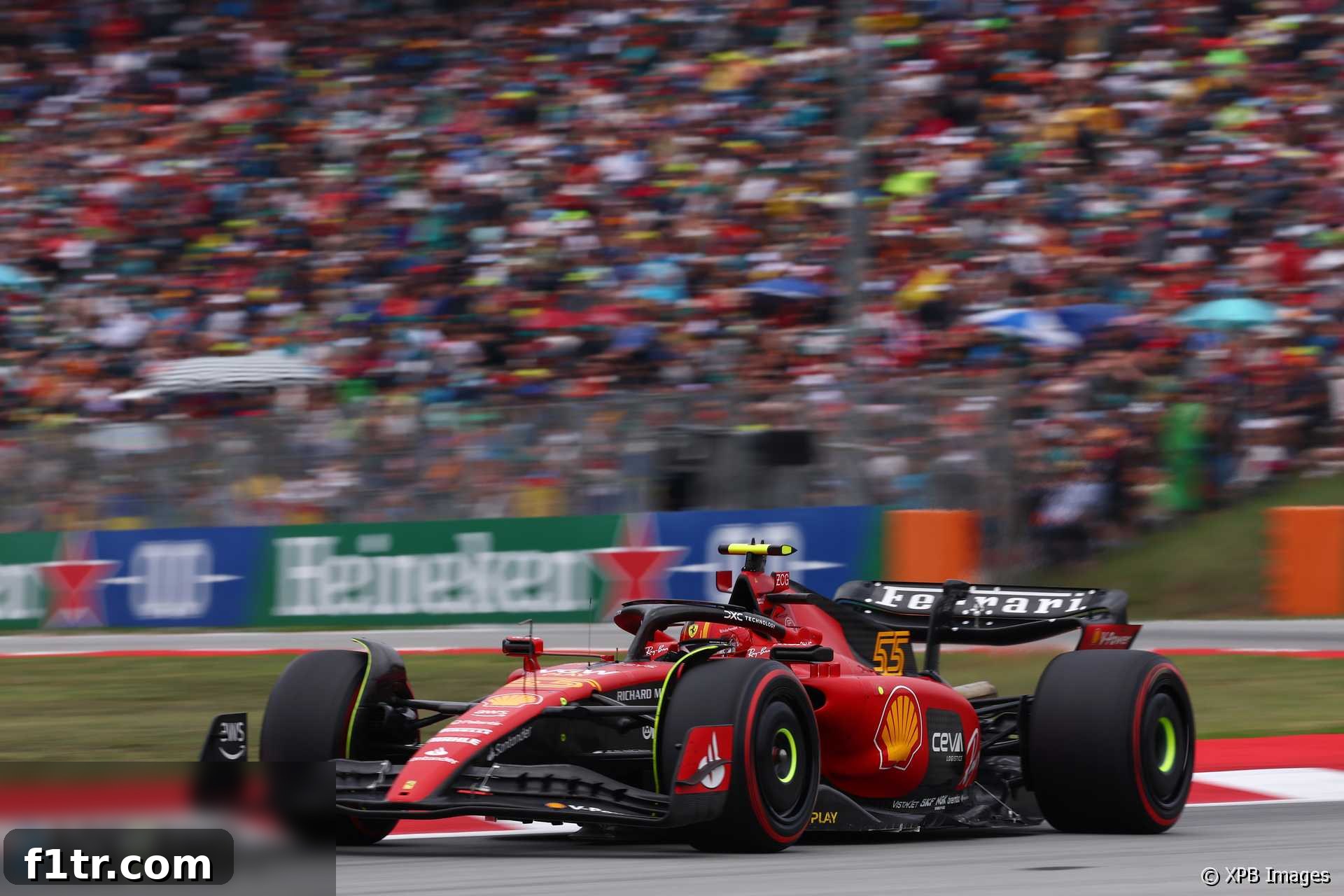
The highly anticipated upgrade package introduced by Ferrari at the Spanish Grand Prix appears to be delivering promising initial results, according to Carlos Sainz Jnr. His impressive qualifying performance, securing a front-row start, offered a significant morale boost for the Scuderia, which has faced a challenging start to the 2023 Formula 1 season. The team’s bold decision to implement a substantial change to its car’s sidepod design was aimed squarely at addressing the notorious ‘peaky’ behaviour of the SF-23, a characteristic both drivers have frequently cited as a major hurdle in consistently extracting the car’s full potential during race conditions.
Ferrari’s Spanish GP Upgrade: A Step Towards Predictability and Performance
Ferrari arrived at the Circuit de Catalunya with a clear objective: to make the SF-23 a more manageable and predictable machine. The significant aerodynamic revisions, particularly to the sidepod area, were not merely incremental tweaks but a strategic redirection in the car’s developmental path. This was confirmed by Carlos Sainz himself, who expressed satisfaction with the early returns from the new package following a strong qualifying session.
Initial Impressions: Medium to Low-Speed Gains
Sainz provided a distinctly positive assessment of the changes, particularly highlighting improvements in critical areas of the track. “The new package was meant to improve mainly the medium to low-speed [performance], and in that area, we have definitely felt a step in the right direction,” Sainz commented after securing second place on the grid for Sunday’s race. This feedback is crucial for Ferrari, as consistent performance across varying corner speeds has been a key weakness of the SF-23.
The Spaniard elaborated on the strategic intent behind the upgrade. It wasn’t about an immediate, dramatic leap in raw pace, but rather about fundamentally altering the car’s operational characteristics. “A step into a different direction is not so much a big upgrade or a big change in our performance but opening a bit of a different window of working range for the car. That was the main target of this upgrade, not to suddenly go half a second quicker,” he explained. This approach suggests a long-term vision, aiming to broaden the SF-23’s sweet spot, making it less temperamental and more adaptable to diverse circuit conditions. The ultimate goal, as Sainz articulated, is to achieve a car that is “more predictable, more drivable, easier to put together a lap.” Should this initial positive trend continue, it could mark a significant turning point in Ferrari’s quest for more consistent performance and greater competitiveness.
Navigating the Challenges of Circuit de Catalunya
Despite the encouraging progress with the new package, Sainz was quick to acknowledge that the unique characteristics of the Circuit de Catalunya may not fully flatter the updated Ferrari. The track, renowned for its demanding high-speed corners, became even quicker this year with the removal of the slow chicane at the end of the lap, a modification that has amplified the importance of high-speed aerodynamic efficiency and stability.
High-Speed Vulnerabilities and Track Layout
“Unfortunately, we’ve come to a track that doesn’t suit our package,” Sainz admitted, pointing to a persistent vulnerability of the SF-23. “Our high-speed performance really hasn’t been good since the beginning of the season. Since Australia, we’ve been struggling with the balance and with the bouncing and still many things that are happening to us in high speed.” This frank admission underscores a critical area where Ferrari still needs to make significant strides. While the low-speed performance shows improvement, the car’s inherent issues in fast corners, coupled with the demands of the revised Barcelona layout, present a formidable challenge. The focus will now shift to understanding and rectifying these high-speed deficiencies, as they remain a significant barrier to unlocking the car’s full potential across all types of circuits.
The Unpredictable SF-23: A Tale of Two Drivers
The contrasting fortunes of the Ferrari drivers during qualifying vividly illustrated the SF-23’s demanding and often capricious nature. While Sainz celebrated his first front-row start of the season, teammate Charles Leclerc endured a disastrous session, qualifying on the back row of the grid after battling a mysterious handling problem in Q1.
Sainz acknowledged the frustration and confusion surrounding Leclerc’s struggles, echoing sentiments that have become a recurring theme for the team throughout the year. “I don’t know exactly what happened to Charles but it’s been the same story of the whole year,” Sainz remarked, highlighting the car’s temperamental character. “It feels like it’s a very narrow window for us, very narrow window for the car, very tricky car to drive.” This “narrow window” signifies that the SF-23 requires very specific conditions and setup parameters to perform optimally, and even slight deviations can drastically impact its behaviour. The stark difference in performance between the two Ferrari cars in qualifying underscores the fine line between success and struggle with this particular machine. “As soon as the conditions get tricky, it can go one way or the other and you’re fighting very different balances. It’s a very fine line. For me today, it worked out okay,” Sainz concluded, a testament to his ability to navigate the car’s intricacies on this occasion, while Leclerc evidently could not.
Race Day Prospects: Battling the Best and the Rest
Looking ahead to the Grand Prix, Carlos Sainz maintained a realistic perspective regarding his chances against the dominant Red Bull Racing team, but expressed optimism for a competitive fight within the chasing pack.
Max Verstappen and Red Bull’s Unmatched Dominance
Sainz was under no illusion about the formidable challenge posed by Max Verstappen and Red Bull. Verstappen secured pole position by a substantial 0.462 seconds, an even more impressive feat considering he aborted his final flying lap. The Ferrari driver anticipates Red Bull’s superiority will be even more pronounced during the race, a pattern that has been consistently observed throughout the season. “I expect Red Bull to have more than half a second to a second of race pace advantage in that window, like they always have,” he predicted. Over 50-something laps at Barcelona, such a significant pace advantage translates into an insurmountable lead, effectively placing Red Bull in a league of their own. For Sainz, the primary battle will be for the coveted podium spots behind the runaway leaders.
The Intense Midfield Scramble
With Red Bull’s seemingly unassailable position at the front, Sainz’s focus shifts to the intense battle for the remaining podium places. He anticipates a fierce contest with rivals like Lando Norris, Lewis Hamilton, and other competitive midfield runners. “I wouldn’t have minded if Lewis or Lando would have out-qualified me, because here the clean side [of the grid] is probably a bit better for the start,” Sainz mused, acknowledging the strategic nuances of starting positions. The slipstream down to Turn 1 also plays a crucial role in Barcelona, adding an element of chance to the initial stages of the race. “But at the same time it’s all about also the tow and how lucky you get, if you can get a tow or not in the run down to turn one,” he added. Despite the Red Bull dominance, Sainz remains ambitious, declaring, “Obviously we’ll try to give it all into turn one and go and get that podium. And if Max does something strange, then get a win.” This reflects the opportunistic mindset required in Formula 1, where unexpected events can swiftly alter the race’s complexion.
Sainz believes the field behind Red Bull is exceptionally tight, setting the stage for a thrilling multi-team fight. “The rest of the field I think is tight and it’s going to be a good fight,” he affirmed. This season has seen an increasing compression of performance, especially among the teams vying for ‘best of the rest’ status. “Now it looks like the midfield is really starting to close-up with us,” he observed, pointing to the competitive resurgence of teams like Alpine, Haas, and McLaren. “You have the likes of the Alpines, even the Haas, Lando with the McLarens are appearing and just joining us in that fight for second or third best. Obviously Red Bull are in a league of their own but then everyone else, it looks like it’s really, really tight out there.”
The Evolving F1 Landscape and Ferrari’s Path Forward
The increasing competitiveness of the midfield is a significant theme of the current Formula 1 season. Sainz offered his insights into this phenomenon, suggesting that the timing of upgrade cycles might be playing a crucial role. “I think it is getting a bit tight especially since Monaco,” he explained. “I don’t know if people who started bringing upgrades maybe to Imola – Imola didn’t happen, but then to Monaco – I think maybe the field is compressing.” This convergence of performance suggests that teams are finding their stride with the current regulations, and strategic development is paying dividends.
Furthermore, the nature of recent circuits has contributed to the appearance of a tighter field. “Also the short lap, like in Monaco and here – one minute 12 seconds – also makes it look even tighter,” Sainz added. On shorter, less flowing tracks, the raw power and aerodynamic efficiency differences between cars can be somewhat masked, making lap times appear closer. However, for Ferrari, even with the new upgrades, the Circuit de Catalunya highlighted a persistent weakness. “And also for us, honestly, I don’t think it’s the best track for Ferrari: a lot of high speed corners and at the moment, those are where we are struggling the most, which is our main point of focus,” he concluded. This admission reinforces the understanding that while the Spanish GP upgrade is a positive step, it represents the beginning of a journey, not the end. Ferrari’s continuous development efforts must tackle the high-speed performance deficit to consistently challenge at the front on all circuits.
Support Independent F1 Journalism
Bringing the F1 news from the source
RaceFans strives to bring its readers news directly from the key players in Formula 1. We are able to do this thanks in part to the generous backing of our RaceFans Supporters.
By contributing £1 per month or £12 per year (or the equivalent in other currencies) you can help cover the costs involved in producing original journalism: Travelling, writing, creating, hosting, contacting and developing.
We have been proudly supported by our readers for over 10 years. If you enjoy our independent coverage, please consider becoming a RaceFans Supporter today. As a bonus, all our Supporters can also browse the site ad-free. Sign up or find out more via the links below:
- Become a RaceFans Supporter
- RaceFans Supporter FAQ
More from the 2023 Spanish Grand Prix
- Ben Sulayem raises safety concerns over “too many people on the grid” at races
- Why Ferrari say their change in design is the result of “discipline”, not “copying”
- Hamilton and Russell were seeking tow from Sainz when they collided – Mercedes
- Red Bull’s Spanish GP diffuser update was ‘inspired by rivals’ including Williams
- Why McLaren always doubted second-row start in Spain would lead to points finish
Browse all 2023 Spanish Grand Prix articles