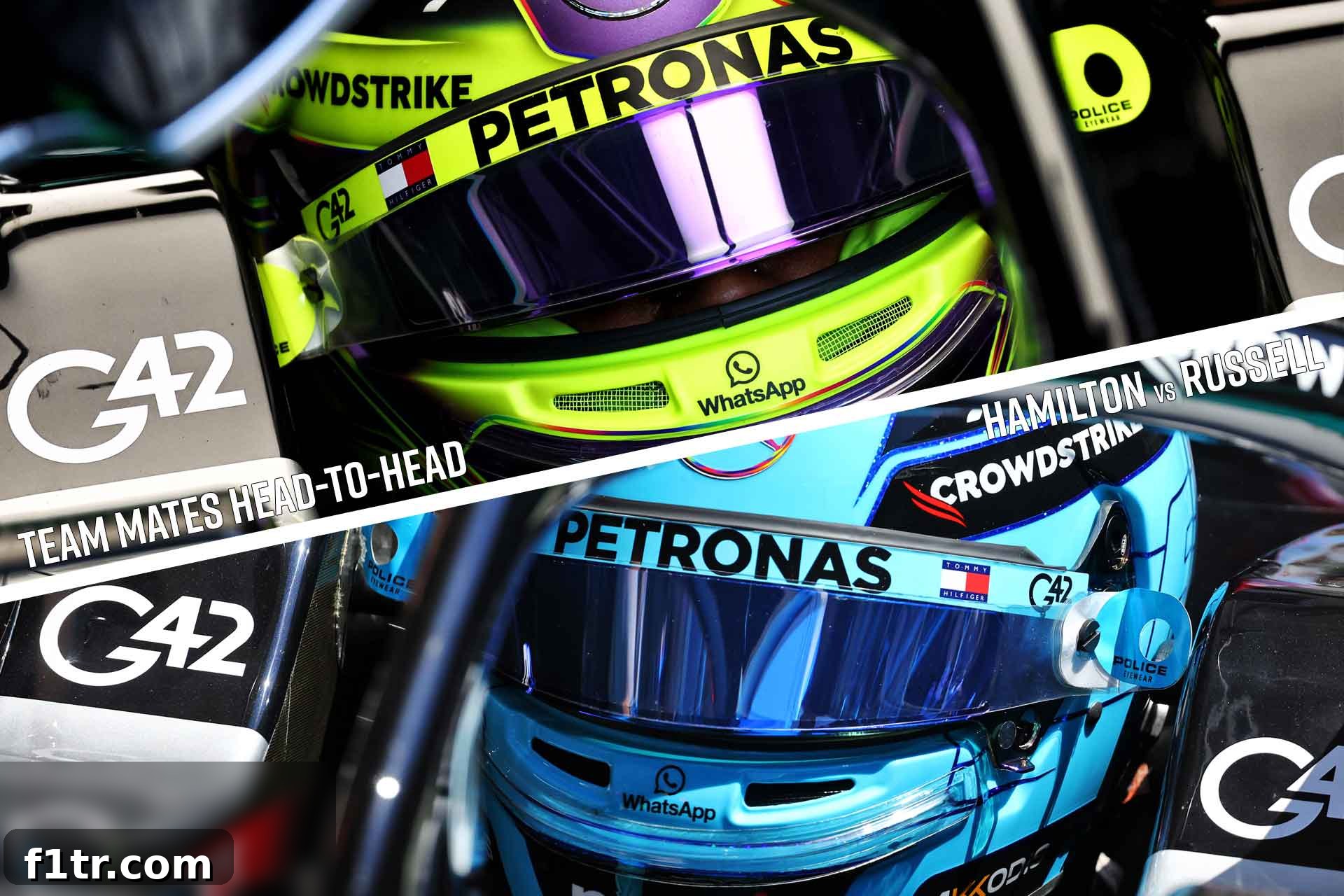
The Epic Intra-Team Battle: Lewis Hamilton vs. George Russell in Their Final Mercedes Season
The 2024 Formula 1 season marks a pivotal chapter for the Mercedes-AMG Petronas F1 Team, not just on the track but within its garage. As Lewis Hamilton and George Russell navigate their third and final season together as teammates, their battle for supremacy has evolved into one of the most intriguing and closely watched narratives in modern Formula 1. This highly anticipated season sees a seven-time World Champion striving to leave his long-time team on a high, while a rising star aims to cement his position as the future leader, creating a dynamic rife with both collaboration and intense competition, all set against the backdrop of Hamilton’s impending move to Ferrari.
Early in the season, the scales appeared to tip distinctly in favour of George Russell. By many metrics, Russell comfortably held the upper hand, particularly in the crucial qualifying sessions. He built a significant 10-4 lead in the qualifying battle against a driver renowned for his exceptional single-lap pace throughout his illustrious career. This striking disparity raised eyebrows across the paddock, prompting discussions about the W15 car’s characteristics and each driver’s adaptation to its nuances. Hamilton himself made what some interpreted as a candid, perhaps even pointed, remark when he found himself trailing 7-1 down after the Monaco Grand Prix, stating, “I don’t anticipate being ahead of George in qualifying.” This comment underscored a period of genuine struggle for the veteran champion to extract maximum performance from the car on Saturdays.
Sources within the Mercedes team offered insights into this early-season performance gap, observing that the W15 proved less intuitive for Hamilton compared to Russell. While Russell seemed to click more readily with the car’s initial setup and handling characteristics, Hamilton grappled with finding his rhythm and confidence, particularly with its rear-end stability. Furthermore, on certain occasions, Russell benefited from having the team’s latest front wing specification, an upgrade that undoubtedly offered a marginal but critical advantage in the finely balanced world of Formula 1 qualifying. These factors combined to create a scenario where Russell could consistently push the car closer to its limits during crucial single-lap runs, securing a strong qualifying record against his legendary teammate, setting a challenging tone for the initial phase of their final season together.
Mercedes W15’s Evolution and Hamilton’s Resurgence
The narrative of the Mercedes W15 car has been one of continuous, arduous development. Following two challenging seasons under the ground effect regulations, where Mercedes struggled to adapt, the team embarked on an aggressive update programme for 2024. Crucially, these updates have, for the most part, proven successful, slowly but surely transforming the car’s performance profile. Engineers at Brackley worked tirelessly to address the car’s inherent balance issues, particularly focusing on improving the correlation between simulator data and on-track performance, thereby broadening its optimal operating window. As these incremental upgrades were introduced, the W15 gradually transformed from a challenging, unpredictable machine into a more competitive package, capable of fighting at the sharp end of the grid.
This period of significant car improvement has directly coincided with a noticeable shift in Lewis Hamilton’s performance. As the W15 became more stable, predictable, and responsive to driver inputs, Hamilton’s confidence at the wheel soared, allowing him to drive with the characteristic precision, aggression, and racecraft that has defined his unparalleled career. This resurgence is not merely a matter of improved pace; it reflects a deeper connection between driver and machine, a crucial element for any championship contender. Hamilton’s ability to adapt and then master an evolving car is a testament to his enduring talent and relentless pursuit of perfection, proving that even after years at the pinnacle of motorsport, his competitive fire burns brighter than ever.
While Russell maintained an empirical lead heading into the mid-season summer break, largely due to his dominant qualifying performances and early-season points accumulation, Hamilton has emphatically turned the tide in recent races. Over the last five Grand Prix events, he has largely held the upper hand, demonstrating superior race pace, astute strategic awareness, and masterful tire management. This resurgence highlights not only Hamilton’s enduring talent and experience but also Mercedes’ dedication to providing both drivers with a car capable of fighting for victories. The dynamic has shifted from a younger driver capitalizing on a challenging car to the veteran champion harnessing an improving machine to reassert his dominance, setting the stage for a dramatic conclusion to their partnership.
Key Moments: Silverstone, Spa, and the Points Tally
The recent string of races has offered compelling evidence of Hamilton’s renewed vigour and the W15’s improved potential. At the British Grand Prix at Silverstone, a pivotal moment in the season, Hamilton delivered a masterclass performance in front of his ecstatic home crowd. He adeptly navigated the challenging conditions, which often included variable grip and strategic dilemmas, and executed a brilliant overtake on his teammate, George Russell. This move underscored Hamilton’s keen race craft and unwavering determination. Russell, unfortunately, later retired from the race due to a mechanical issue, an outcome beyond his control, but Hamilton’s strong finish secured valuable points for the team and provided a significant boost to his personal championship aspirations. The Silverstone result further solidified the perception that Hamilton was truly hitting his stride, perfectly timing his peak performance with the car’s increasing competitiveness.
The Belgian Grand Prix at Spa-Francorchamps presented another dramatic twist in the tale, further highlighting the strengths and challenges faced by both Mercedes drivers. Hamilton delivered a robust performance throughout the weekend, showcasing the W15’s capabilities in various conditions and demonstrating consistent front-running pace. While George Russell ultimately secured an astonishing, albeit controversial, victory, the circumstances surrounding his win were highly unusual, culminating in a post-race disqualification due to a technical infringement related to his car’s floor. Regardless of the final outcome for Russell, Hamilton’s strong showing throughout the weekend confirmed his competitive pace and ability to challenge for top honours against the likes of Red Bull and McLaren. It was a weekend that underscored the growing threat Mercedes posed to the front-runners and highlighted Hamilton’s consistent pace, even if his teammate’s disqualification meant the official points didn’t fully reflect the true story of Mercedes’ collective potential.
Thanks in part to Russell’s two unfortunate non-scores in the past three races – incidents over which he had little to no control, including the Spa disqualification and another technical retirement – Hamilton now holds a crucial points lead after 14 rounds. This shift in the championship standings has profoundly changed the dynamic of their intra-team rivalry. What began as a battle for respectable mid-points positions, emblematic of Mercedes’ struggles in recent seasons, has rapidly escalated into a direct fight for Grand Prix victories. This fierce competition, now at the very front of the grid, provides thrilling entertainment for fans and a testament to the hard work put in by the entire Mercedes team to bring their car back to winning ways, challenging for the top step of the podium rather than merely points.
The Psychological Edge and Historical Parallels
The psychological aspect of this intra-team rivalry cannot be overstated, especially given the extraordinary circumstances surrounding this season. With Lewis Hamilton’s confirmed move to Ferrari for the 2025 season, the stakes are incredibly high, imbuing every race with added significance. Hamilton is driven by an intense desire to leave Mercedes on the strongest possible note, potentially adding an eighth World Championship to his unparalleled legacy before embarking on a new chapter. For George Russell, this season represents a crucial opportunity to firmly establish himself as the undisputed leader of the team for years to come, demonstrating his ability to lead a top-tier F1 outfit. The pressure is immense on both sides, making every qualifying session, every overtake, and every strategic decision a magnified moment in their respective, divergent careers.
This evolving dynamic bears a striking resemblance to their first season together in 2022. In that year, Russell initially outscored Hamilton, adapting quicker to the challenging and often temperamental W13 car. However, as that season progressed and the car improved with various updates, Hamilton steadily closed the gap, demonstrating his formidable consistency, adaptability, and unwavering determination to fight back. The current season appears to be following a similar trajectory, with Hamilton now poised to even things up, or even surpass Russell, in the intra-team battle by season’s end, proving that his legendary status is well-earned and his competitive fire still burns as brightly as ever. These internal battles, while undeniably intense and sometimes fraught with tension, often push both drivers to extract even more performance, ultimately benefiting the team’s overall constructors’ championship ambitions.
Mercedes’ Championship Aspirations and Future Outlook
Beyond the individual rivalry, the exceptional performance of both Hamilton and Russell has a significant impact on Mercedes’ constructors’ championship aspirations. The team looks well set to continue closing the gap on their primary rivals, Red Bull and McLaren, over the remaining ten races of the season. The sustained improvement of the W15, coupled with the renewed confidence and consistent point-scoring ability of both drivers, positions Mercedes as a genuine threat for additional race wins and a strong finish in the Constructors’ standings. Every point gained by either Hamilton or Russell contributes significantly to this collective goal, highlighting the delicate yet crucial balance between individual ambition and the overarching success of the team, especially as they aim to reclaim their position at the very top of Formula 1.
Regardless of how the final races play out, George Russell has undoubtedly given an excellent account of himself against one of the greatest Formula 1 drivers of all time. His early season qualifying dominance, his composure under pressure, and his ability to convert opportunities into strong results (despite some recent misfortunes) have firmly reaffirmed his talent, potential, and suitability to lead a top team. For Hamilton, this season is a powerful reminder of his enduring class, his profound impact on the sport, and an opportunity to add a final glorious chapter to his illustrious Mercedes story before embarking on a new, highly anticipated adventure with Ferrari. The remaining races promise to be a captivating spectacle, as two exceptionally talented drivers push each other and their machine to the absolute limit in pursuit of victory, personal legacy, and team glory.
The stakes couldn’t be higher for both drivers and for the Mercedes team. With each Grand Prix, the battle between Lewis Hamilton and George Russell intensifies, offering Formula 1 fans a front-row seat to a masterclass in racing, strategy, and mental fortitude. This final shared season is not just about who finishes ahead in points or who secures more victories, but about the enduring legacy each driver will forge and the foundation they will lay for their respective future careers in the pinnacle of motorsport. It’s a compelling narrative of ambition, challenge, and the relentless pursuit of excellence that defines Formula 1.