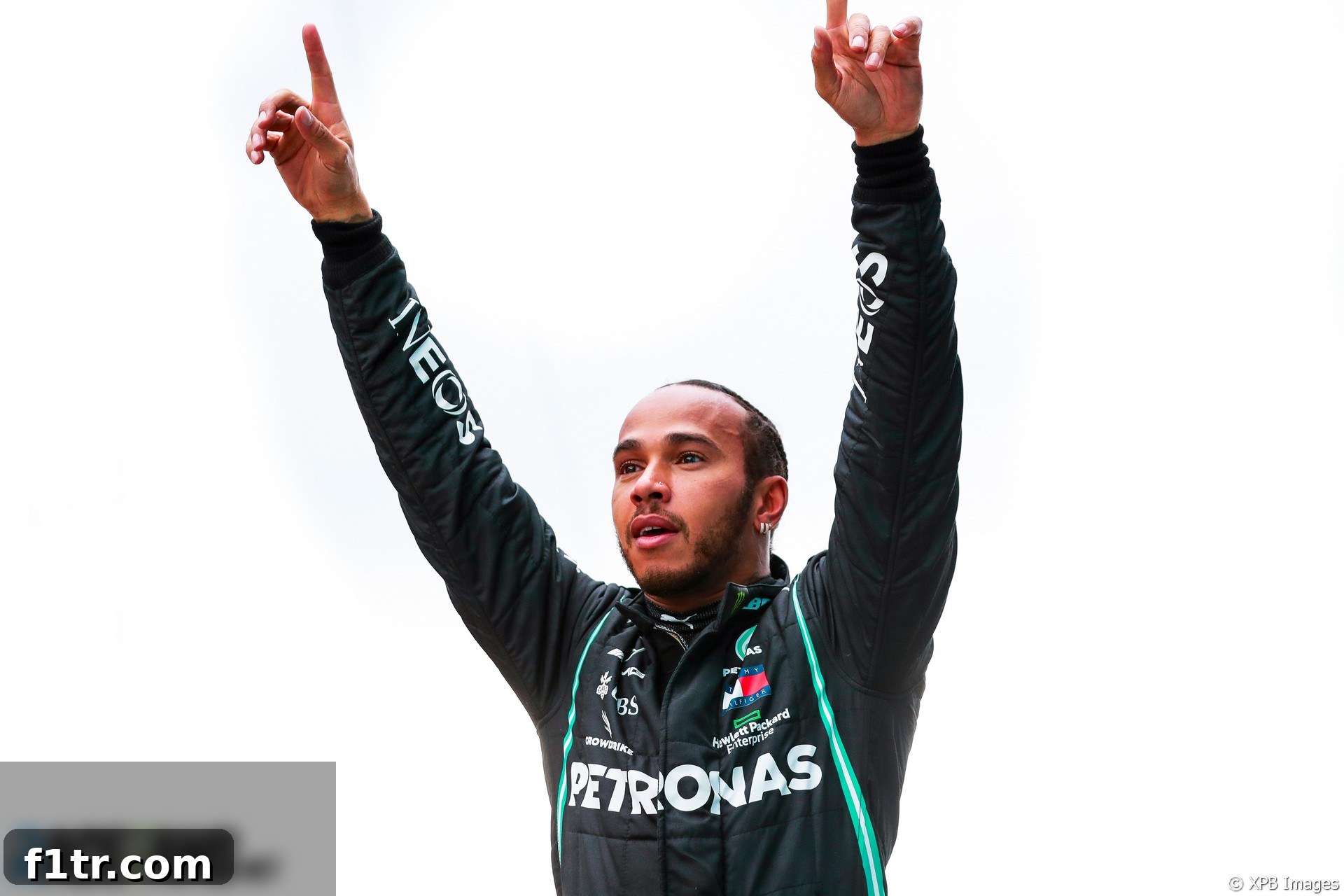
Lewis Hamilton’s Unstoppable 2020 F1 Championship Triumph: A Masterclass in Dominance
The 2020 Formula 1 season, an unprecedented year reshaped by global events, presented unique challenges and an altered calendar. Yet, amidst the uncertainty, one constant remained: the formidable dominance of Mercedes-AMG Petronas F1 Team, spearheaded by the unparalleled talent of Lewis Hamilton. With Red Bull Racing struggling to consistently match Mercedes’ pace and Scuderia Ferrari facing a year of significant underperformance, the championship narrative quickly distilled into a contest primarily between Hamilton and his teammate, Valtteri Bottas. While the eventual outcome seemed almost inevitable to many, the sheer clinical efficiency with which Hamilton secured his record-equaling seventh World Championship was nothing short of remarkable, with the title battle decisively concluded at the Istanbul Grand Prix, a full three races before the season’s close.
This swift resolution echoed previous championships where Hamilton had clinched the title with races to spare. However, what truly distinguished his 2020 achievement and elevated its impressiveness was the context of a significantly condensed calendar, featuring four fewer races than initially planned. Hamilton didn’t just win; he carved out an insurmountable lead over his competition with breathtaking speed, demonstrating an accelerated pace of championship conquest unseen in his prior title-winning campaigns. This wasn’t merely about having the best car; it was about maximizing every opportunity, extracting every ounce of performance, and demonstrating a level of consistency that left his rivals trailing far behind.
The Driving Masterclass: Unraveling Hamilton’s On-Track Brilliance
While a degree of fortune always plays a role in motorsport, Hamilton’s path to victory was overwhelmingly paved by his own relentless pursuit of excellence. Unlike his teammate Bottas, who suffered a race-ending technical failure in Germany, Hamilton largely avoided such mechanical woes throughout the season. His only absence from a race weekend – the Sakhir Grand Prix – was due to testing positive for Covid-19, an external factor that prevented him from repeating his 2019 feat of scoring points in every single race. Barring this unforeseen health event, his streak of consistency remained unbroken, a testament to both his driving and the reliability of his W11 challenger.
The bedrock of Hamilton’s success lay in his uncanny ability to consistently find his way to the front of the field. His qualifying performances were frequently dominant, securing pole position with mesmerizing regularity, and almost invariably converting these starting advantages into victorious race finishes. Yet, his brilliance extended far beyond simply starting first and staying there. His strategic acumen, profound understanding of tire management, and opportunistic racecraft were repeatedly on display, providing ample evidence of his unmatched skill.
Qualifying Prowess and Race Day Execution
Consider the Spanish Grand Prix, where a shrewd decision to opt for medium compound tires at a critical juncture allowed him to control the race with masterful precision. Or the Bahrain Grand Prix, where his intelligent tire management secured him pole position by a crucial margin, setting the stage for another triumph. At the Nürburgring, he demonstrated clinical opportunistic racing, seizing a decisive pass on Bottas to assert his authority. Perhaps most indicative of his sheer talent was his thumping margin of superiority in the wet qualifying session for the Styrian Grand Prix, where he left the entire field struggling in his wake, highlighting his exceptional command in challenging conditions.
His victories at Spa, Algarve, and especially Istanbul were not just wins but statements of intent. The Turkish Grand Prix, held on a treacherous, low-grip surface, offered an irrefutable demonstration of Hamilton’s superior driving. While many drivers struggled with the conditions, spinning off or battling for traction, Hamilton delivered a calculated, calm, and utterly dominant performance, meticulously managing his tires to surge from sixth on the grid to clinch victory and the championship. This was a drive where driver skill undeniably overshadowed any car advantage, silencing critics and cementing his legacy.
Resilience Amidst Setbacks: Navigating Penalties and Adversity
Even when faced with adversity, Hamilton’s resolve shone through. On a couple of occasions, he tripped over some of the more obscure areas of the sporting regulations, incidents that cost him likely wins. At Monza, he transgressed by entering a closed pit lane, a last-minute call involving a little-used rule, resulting in a stop-go penalty. Similarly, at Sochi, he was penalized for performing pre-race practice starts in an incorrect location. While the rules were clear, the application of penalties sometimes felt harsh, as demonstrated by Charles Leclerc’s experience at Spa, suggesting that a different mood among the stewards might have seen Hamilton escape sanction.
These incidents, though frustrating, served only as minor blips in an otherwise stellar season. Despite these setbacks, which momentarily denied him victories, Hamilton still triumphed in an astonishing 11 of the first 15 rounds before his COVID-19 diagnosis. This remarkable win rate underscored his unparalleled focus and ability to bounce back, making his 2020 campaign arguably his most crushing and complete performance to date.
Beyond the Machine: Debunking the “It’s Just the Car” Narrative
For those who dismiss Hamilton’s achievements as being solely attributable to the dominant Mercedes W11, it’s crucial to delve deeper into the intricate details that define such relentless success. It is inarguably true that Hamilton enjoyed a Mercedes package that was restored to almost 2014-2016 levels of dominance, offering a significant advantage over its competitors. However, this perspective overlooks the crucial comparison with his teammate, Valtteri Bottas.
Look closely at the data: Bottas was frequently able to run Hamilton incredibly close over a single qualifying lap. Yet, by the end of the season, the points gap between them was colossal. This disparity speaks volumes about the quality of the job Hamilton performed, not just on race day, but across every session, every decision, and every strategic call. Hamilton consistently found a way to extract that critical extra tenth, that additional lap of tire life, that perfect opportunistic moment which Bottas, despite being in the same machinery, often struggled to replicate. His relentless consistency, his ability to perform under pressure, and his masterful racecraft transformed a dominant car into an unstoppable force.
Appropriately enough, in a season where he scored his record-equaling seventh world championship, Hamilton’s performance was nothing short of Schumacheresque – a blend of raw speed, strategic intelligence, and an unyielding will to win that has few parallels in the history of Formula 1. He didn’t just drive the best car; he elevated it, demonstrating a symbiotic relationship between driver and machine that few others could achieve.
The Season in Numbers: Lewis Hamilton’s Unrivaled 2020 Performance
The statistics from the 2020 season vividly illustrate Lewis Hamilton’s unparalleled command. His ability to consistently outperform his teammate, not just in raw pace but also in race execution, was a hallmark of his championship campaign. The following table provides a snapshot of his performance against Valtteri Bottas, highlighting his extraordinary consistency and effectiveness throughout the year.
Lewis Hamilton |
|
|---|---|
| Beat team mate in qualifying | 11/16 |
| Beat team mate in race | 11/15 |
| Races finished | 16/16 |
| Laps spent ahead of team mate | 613/907 |
| Qualifying margin | -0.12s |
| Points | 347 |
These numbers paint a clear picture: Hamilton beat his teammate in qualifying in 11 out of 16 attempts, and in races, he outmaneuvered Bottas 11 times out of 15. The significant difference in laps spent ahead of his teammate (613 out of 907) and the substantial points gap of 347 demonstrates his superior race management and ability to capitalize on every opportunity. Even with a narrow qualifying margin, his Sunday performances consistently delivered maximum results, showcasing his profound understanding of race dynamics and strategic execution. His perfect record of finishing every race he started further underscores his reliability and precision.
Ultimately, the 2020 Formula 1 season was a historical chapter in the career of Lewis Hamilton. It was a year where he not only cemented his place as one of the greatest drivers of all time by equaling Michael Schumacher’s legendary tally of seven world championships but also demonstrated an unmatched ability to adapt, innovate, and dominate under extraordinary circumstances. His relentless pursuit of perfection, combined with moments of pure genius on track, solidified his legacy as a true icon of motorsport.
Further Reading: 2020 F1 Driver Rankings
- 2020 F1 driver rankings #1: Lewis Hamilton
- 2020 F1 driver rankings #2: Max Verstappen
- 2020 F1 driver rankings #3: Charles Leclerc
- 2020 F1 driver rankings #4: Carlos Sainz Jnr
- 2020 F1 driver rankings #5: Daniel Ricciardo
- 2020 F1 driver rankings #6: Pierre Gasly
- 2020 F1 driver rankings #7: Sergio Perez
- 2020 F1 driver rankings #8: Valtteri Bottas
- 2020 F1 driver rankings #9: George Russell
- 2020 F1 driver rankings #10: Lando Norris
- 2020 F1 driver rankings #11: Kevin Magnussen
- 2020 F1 driver rankings #12: Kimi Raikkonen
- 2020 F1 driver rankings #13: Daniil Kvyat
- 2020 F1 driver rankings #14: Esteban Ocon
- 2020 F1 driver rankings #15: Lance Stroll
- 2020 F1 driver rankings #16: Antonio Giovinazzi
- 2020 F1 driver rankings #17: Romain Grosjean
- 2020 F1 driver rankings #18: Alexander Albon
- 2020 F1 driver rankings #19: Sebastian Vettel
- 2020 F1 driver rankings #20: Nicholas Latifi