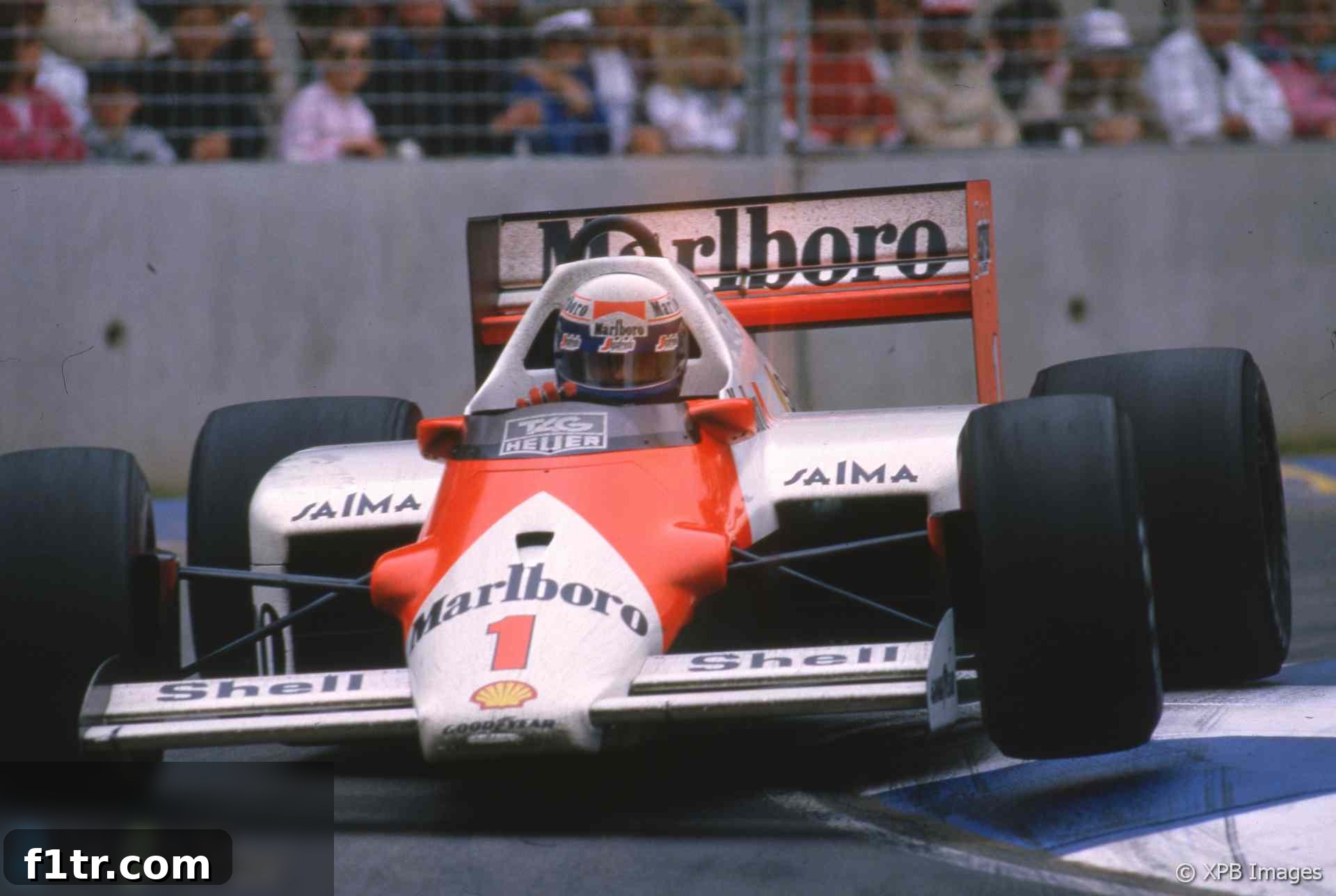
The annals of Formula 1 history are replete with iconic moments, but few stand out as vividly as the 1986 Australian Grand Prix. This race, the final round of the season, saw a nail-biting three-way battle for the Drivers’ Championship, a scenario so rare and exhilarating that it left an indelible mark on the sport. What unfolded in Adelaide was nothing short of extraordinary, a dramatic blend of raw speed, strategic genius, and heart-wrenching misfortune that culminated in one of the most astonishing races ever witnessed. The championship decider of 1986 produced a spectacle that racing fans still recount with awe, a testament to the unpredictable nature of top-tier motorsport.
Heading into that fateful day, Nigel Mansell, Alain Prost, and Nelson Piquet were all mathematically in contention for the coveted title. The tension was palpable, not just between the drivers from different teams, but critically, within the dominant Williams-Honda outfit itself. It was a race where destiny seemed to toy with the protagonists, as a series of improbable chance occurrences conspired to snatch victory from one and hand it to another. Ultimately, it was Alain Prost who emerged as the champion, a somewhat fortunate victor, perhaps, given the dramatic twists, yet undoubtedly a deserving one. His triumph was a masterclass in seizing opportunity amid chaos, proving his moniker ‘The Professor’ was truly earned.
This is the definitive account of how that sensational and unforgettable race unfolded, a narrative woven with speed, strategy, and sheer unpredictability.
A Championship on a Knife-Edge: The Three-Way Finale
The 1986 Formula 1 season had been a relentless grind, culminating in a championship situation that was as complex as it was thrilling. Unlike today’s straightforward points systems, the regulations of 1986 awarded points on a 9-6-4-3-2-1 basis for the top six finishers. Adding another layer of intricacy, drivers could only count their best 11 scores from the season’s 16 races. This particular rule meant that Nigel Mansell, leading the standings with 70 points, needed at least a third-place finish in Adelaide to guarantee his maiden championship over Prost, who sat on 64 points. The stakes couldn’t have been higher for the Briton, who was chasing his first-ever world title.
Further complicating matters, Nelson Piquet, Mansell’s teammate at Williams, was a formidable third with 63 points. The dynamic between the two Williams drivers was notoriously fractious, often described as bitterly competitive, akin to the intense rivalries seen between drivers like Lewis Hamilton and Fernando Alonso in contemporary F1. Both Piquet and Mansell were fiercely determined, sharing a potent car but little camaraderie. This internal rivalry added another layer of unpredictability, as neither seemed willing to yield to the other, even with the championship on the line. The stage was set for an explosive finale, not just against Prost, but between the two dominant Williams machines.
Qualifying and the Flying Start
The weekend began with Nigel Mansell demonstrating his blistering pace, scorching to pole position in his Williams-Honda FW11. He was closely followed by his teammate Piquet, highlighting the raw speed and formidable power of the Honda engine. The legendary Ayrton Senna secured third place on the grid for Lotus, with Alain Prost starting a crucial fourth for McLaren. Adding to the drama, Prost’s teammate, the outgoing Keke Rosberg, lined up in seventh for his final Grand Prix. Rosberg had already declared his intention to do everything within his power to aid Prost in his championship bid, a promise that would prove significant as the race unfolded.
As the lights went out, the start of the race was nothing short of frantic, a chaotic ballet of raw power and desperate ambition. Mansell initially held his lead into the first corner, but the field immediately closed in. Senna, known for his audacious starts, muscled his way past Mansell, snatching the lead. The charge didn’t stop there, as Piquet quickly followed suit, overtaking Mansell. Then, in a stunning display of aggression, Rosberg launched himself into the fray. The Finn was going “hell for leather,” as described by commentators, intent on making his final race a memorable one. He swiftly passed Senna for second place on lap two, reeling in Piquet with incredible pace, showcasing his typical ‘Flying Finn’ spirit.
On lap seven, Piquet, perhaps conserving his tyres or surprised by Rosberg’s relentless attack, surrendered the lead, allowing Rosberg to scamper off into what seemed like a commanding position. Senna, meanwhile, quickly began to fall back, his Lotus unable to maintain the pace of the frontrunners. The race at the front rapidly consolidated into an intense battle between the dominant McLaren and Williams machines. Rosberg led Piquet, while Prost skillfully maneuvered his way into third, passing Mansell on lap 11. The pressure continued to mount, and on lap 23, Piquet succumbed to it, spinning off briefly and allowing both Prost and Mansell to slip past him. Prost now found himself in a critical second position, with Mansell third, both within championship contention as the race wore on.
Advert | Become a RaceFans supporter andgo ad-free
The Unforeseen Turning Point: Prost’s Puncture
The first truly pivotal moment in this unfolding drama arrived on lap 32, a seemingly disastrous incident for Alain Prost that would, in retrospect, prove to be a profound blessing in disguise. The Frenchman, pushing hard, felt a sudden loss of pressure and limped his McLaren towards the pits, his right-front tyre punctured. It was an unscheduled stop, forcing him to take on new rubber and dropping him down to a disappointing fourth place, behind both Williams drivers. At this juncture, it appeared his championship aspirations had suffered a fatal blow, his race seemingly ruined by cruel luck, and the prospect of a third title fading fast.
However, what transpired next was the critical, unseen twist of fate that would echo through the remainder of the Grand Prix. Back in the pits, the Goodyear tyre technicians meticulously inspected Prost’s discarded tyre. To their surprise, the tyre, despite the puncture, appeared to be in remarkably good condition, showing no excessive wear or signs of delamination. Based on this observation, they confidently, and fatefully, informed the other teams that their tyres would indeed last the full race distance, negating the need for any further pit stops. This crucial piece of information, or rather, misinformation, would have profound consequences, shaping the remainder of the Grand Prix and the ultimate destiny of the Formula 1 championship.
In the laps that followed, the race continued to simmer with tension. Mansell, maintaining his third place, found himself momentarily held up by slower traffic. Seizing the opportunity, Piquet made an aggressive move to pass his teammate. Mansell, acutely aware of the championship implications and perhaps eager to avoid a direct confrontation with his teammate that could jeopardize his title hopes, steered well clear, allowing Piquet to take second place. For Mansell, Piquet taking second was no problem, as long as he maintained his third position, which was enough for the title. The race seemed to be settling into a rhythm, with Mansell carefully managing his pace and position, unaware of the lurking danger.
The Endgame: Rosberg’s Sudden Retirement
As the race entered its crucial latter stages, a fragile sense of calm seemed to descend upon the circuit. Rosberg was clear ahead in the lead, driving a magnificent final race, seemingly untouchable and determined to bow out with a victory. Alain Prost, despite his earlier setback, was holding a strong fourth position, unable to directly challenge the Williams pair ahead but still within striking distance should anything happen. Mansell, in third, appeared to be expertly cruising towards his maiden Formula 1 world championship, his title dreams seemingly within reach as he meticulously managed his pace and the gap to Prost.
Then, on lap 63, the race took another dramatic, unforeseen turn. Keke Rosberg, who had been driving flawlessly, suddenly heard a loud, ominous noise from the rear of his McLaren. Immediately assuming it was an engine failure, a common occurrence in the high-stress environment of Formula 1, he instinctively coasted his car to a halt at the side of the track, retiring from a commanding lead. His exit was a double-edged sword for Mansell: while it removed one car between him and the championship, promoting him to second, it also meant Prost, who had been close behind, now moved up to third, still very much in contention. The margin for error for Mansell had just narrowed significantly, increasing the pressure exponentially.
However, the true irony and tragedy of Rosberg’s retirement only became apparent moments later. As he emerged from his cockpit, he observed a distressing trail of rubber hanging from his right-rear tyre. It hadn’t been an engine failure at all; it was a catastrophic tyre de-lamination, a structural breakdown of the tyre compounds. This revelation sent shivers down the pit lane. The Goodyear technicians, who had earlier assured teams of tyre durability based on Prost’s seemingly benign puncture, were now completely blindsided. They had no idea that their tyres were, in fact, not lasting the full race distance under the extreme conditions of Adelaide. Even if they had, it was too late to react, for Nigel Mansell was already embarking on lap 64, hurtling down Dequetteville Terrace, completely unaware of the looming catastrophe that would shatter his championship aspirations.
Mansell’s Heartbreak: The Exploding Tyre
The image is forever seared into the collective memory of Formula 1 fans: Nigel Mansell’s crimson Williams-Honda, on lap 64, rocketing down the long, high-speed Dequetteville Terrace. As he passed Philippe Alliot’s Ligier, a sudden, violent explosion erupted from the left-rear of his car. A shower of brilliant sparks burst from the tyre, illuminating the dramatic failure as the tread violently separated from the carcass. The car instantly became a bucking bronco, pitching wildly as Mansell, with incredible instinct and courage, wrestled the uncontrollable machine under control. He somehow managed to prevent a devastating high-speed crash, bringing the crippled Williams to a halt without hitting anything, its nose eventually nudging the barrier at the end of the straight, a silent monument to his shattered dreams and a championship that had slipped through his grasp.
It is all too easy to view Mansell’s misfortune as the result of a single, isolated rogue tyre failure. However, the preceding events reveal a far more complex and cruel twist of fate. The calamity could have been avoided had it not been for that uncanny series of chance occurrences: Prost’s earlier puncture, the mistaken assessment by Goodyear technicians regarding tyre longevity, and Rosberg’s subsequent, identically-caused retirement just one lap prior. These were the kind of misfortunes that gnaw at a driver’s psyche, the ‘what-ifs’ that keep title rivals awake at night, and they had all converged upon Mansell in one agonizing moment, denying him what seemed like an almost certain championship.
Advert | Become a RaceFans supporter andgo ad-free
The Aftermath and Prost’s Fortuitous Triumph
Mansell’s sudden and spectacular retirement sent shockwaves through the Williams pit wall. With both Rosberg and Mansell now out due to tyre failures, a critical decision had to be made instantly regarding Nelson Piquet, who now led the race. Despite his commanding position, there was absolutely no hesitation from the Williams team. Fearing an identical and equally catastrophic tyre failure on Piquet’s car, they immediately called him into the pits for fresh tyres. This mandatory stop, while preventing a potential disaster and prioritizing driver safety, handed the lead, and with it, the 1986 Formula 1 World Championship, directly to Alain Prost, who now found himself in the lead with fresh rubber.
Prost, who had made his unscheduled pit stop for a puncture repair much earlier in the race – a stop that had initially seemed to ruin his chances – now found himself in an unassailable position. His early, forced stop had inadvertently put him on a different tyre strategy, ensuring his tyres were fresh for the crucial final laps. It was an astonishing reversal of fortune, a testament to how quickly the tide can turn in motorsport. The meticulous planning and raw pace of the Williams team had been undone by unforeseen circumstances and a critical error in tyre assessment, leaving Prost to capitalize with clinical precision and claim his second consecutive world title.
None of this, however, should diminish Alain Prost’s achievement or suggest that he was an unworthy champion in 1986. Far from it, ‘The Professor’ had demonstrated extraordinary consistency, tactical brilliance, and the mental fortitude to thrive under immense pressure throughout the season. He clinched a championship without the benefit of arguably the fastest car on the grid, navigating a season where his main rivals, Mansell and Piquet, often canceled each other out through their intense rivalry. He achieved this alongside a formidable teammate, Keke Rosberg, himself a former world champion, who, despite his efforts, failed to win a single race that year. Prost’s ability to maximize every opportunity and remain unflustered amidst the chaos was truly exemplary, showcasing a champion’s mindset.
But on that fateful day of reckoning in 1986, fortune undeniably smiled upon Alain Prost. The culmination of a season-long battle, decided by a series of events beyond any driver’s control, cemented the 1986 Australian Grand Prix as one of Formula 1’s most legendary and emotionally charged finales. It was a stark reminder that in motorsport, sometimes, the greatest skill lies not just in driving fast, but in being present, composed, and ready to embrace the unpredictable hand of fate. The image of Mansell’s exploding tyre remains an enduring symbol of championship heartbreak, and Prost’s unlikely victory, a masterpiece of strategic opportunism.
Advert | Become a RaceFans supporter andgo ad-free
Grand Prix flashback
- 40 years ago today: How a tyre war prompted Senna’s unfinished Monaco masterpiece
- Schumacher seals record-breaking 10th constructors championship for Ferrari
- Strategic superiority clinches Schumacher’s first Ferrari title
- Disaster for Hakkinen brings title within Schumacher’s grasp
- Schumacher turns the tide against McLaren on tragic day at Monza
- Hakkinen stuns Schumacher with three-wide pass for fourth win
- Hakkinen’s flying start fires him into championship lead
- Barrichello takes maiden win as Mercedes protester disrupts race
- Schumacher crashes, Hakkinen wins – but McLaren lose their points
- Bonus for Coulthard after passing Schumacher to win
Browse all Grand Prix flashbacks