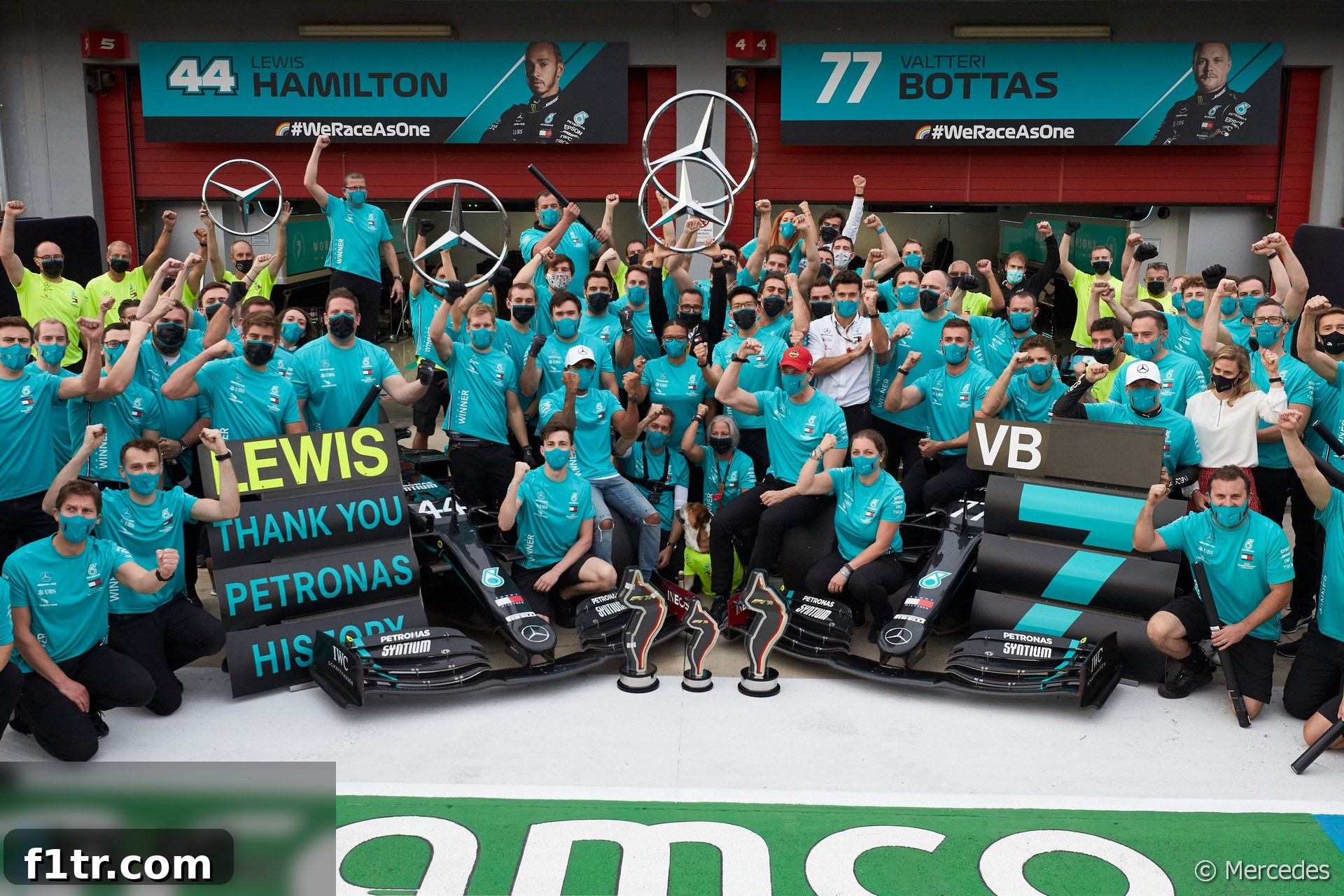
In a season unlike any other, the Mercedes-AMG Petronas Formula 1 Team etched its name deeper into motorsport history by securing an astonishing seventh consecutive Constructors’ Championship. This monumental achievement, a testament to unparalleled engineering, strategic brilliance, and relentless team spirit, was met with a bittersweet sentiment, as the global COVID-19 pandemic necessitated a subdued and distanced celebration. Andrew Shovlin, the team’s trackside engineering director, candidly described the planned festivities as “strange,” acknowledging the stark contrast to past jubilations due to significantly reduced staff numbers at their UK facilities.
Advert | Become a Supporter & go ad-free
While the travelling race crew experienced a moment of collective triumph following their decisive victory at Imola, the vast majority of the team’s workforce, based in England, found themselves under the constraints of a second national lockdown. This meant that the usual raucous factory celebrations, an integral part of Mercedes’ championship rituals, were simply not possible. The pandemic has reshaped not just the racing calendar, but the very fabric of how teams operate and, crucially, how they acknowledge their hard-won successes.
Mercedes’ Unprecedented Seventh Heaven: A Dynasty Forged in Adversity
The achievement of seven consecutive Constructors’ Championships stands as an unmatched feat in the annals of Formula 1, a sport renowned for its fierce competition and cyclical nature of dominance. Shovlin articulated the team’s initial disbelief, stating that such a prolonged period of success was “quite incredible” and “difficult to take in because we never set out to get to seven.” His reflection painted a picture of incremental ambition, a journey from securing a single championship to successively challenging and surpassing rivals.
“It was sort of one and then two,” Shovlin recounted, “And then ‘can we do three’? ‘Can we match Red Bull?’ ‘Can we beat Red Bull?’ ‘Can we beat Ferrari?’ And we just keep going and going.” This sentiment encapsulates the relentless pursuit of excellence that defines the Mercedes F1 team. It wasn’t about a pre-ordained destiny for seven titles, but a series of immediate, tangible goals, each conquered serving as a springboard for the next, progressively raising the bar for themselves and the entire sport. This continuous drive, coupled with meticulous planning and execution, transformed what might have been a fleeting moment of glory into an enduring dynasty.
The Philosophy of Relentless Improvement
At the core of Mercedes’ sustained success lies a deeply ingrained philosophy centered on adaptability and rigorous problem-solving. Shovlin highlighted the team’s exceptional ability to be “quite good at fixing problems” and to recover swiftly from any setbacks. In the high-stakes, fast-paced world of Formula 1, where marginal gains and quick reactions dictate fortunes, this capability is invaluable. A single race weekend can present myriad challenges, from unexpected mechanical failures to strategic missteps, and the capacity to diagnose, rectify, and learn from these issues is paramount.
“When we have a bad day we get on top of it and we come back stronger and that’s how we work, whether we win or lose,” Shovlin explained. This proactive approach, irrespective of immediate results, fosters a culture of continuous improvement that prevents complacency and drives innovation. It means every failure is seen not as a defeat, but as a crucial learning opportunity, a data point that informs future design, strategy, and execution. This resilient mindset is undoubtedly a significant factor in their ability to achieve such an extraordinary run of championships, enabling them to consistently outmaneuver and outperform their esteemed competitors over a prolonged period.
Navigating the New Normal: Celebrations Amidst a Pandemic
The global health crisis imposed unprecedented restrictions on all aspects of life, and Formula 1, with its international travel and large team operations, was profoundly affected. For Mercedes, the joy of clinching their seventh Constructors’ Championship was tempered by the necessity of adhering to stringent health and safety protocols. Unlike previous years, where factory-wide gatherings were the norm, the 2020 triumph called for a dramatically different approach to celebration. With measures in place to prevent the spread of the Covid-19 pandemic, only a bare minimum of essential personnel were permitted at the team’s chassis factory in Brackley and their high-performance engine facility in Brixworth. This meant traditional, communal festivities were simply out of the question, forcing the team to innovate in how they commemorated their success.
Factory Life in Lockdown: The Remote Operations Challenge
The operational landscape at Mercedes’ technical bases underwent significant transformation to comply with public health guidelines. “We’re at quite low capacity in the factory now because we’ve dropped it again,” Shovlin confirmed, illustrating the ongoing adjustments. This involved a widespread transition to remote working for all staff whose roles could accommodate it, drastically reducing the physical presence on site. The factories, usually bustling hubs of engineering brilliance and collaborative problem-solving, became quieter, more compartmentalized environments, focused solely on critical tasks that required hands-on presence.
“People who can work from home are working from home and there won’t be any gatherings,” he further elaborated. This shift presented unique challenges for a team that thrives on close-knit collaboration and direct communication. Adapting intricate engineering processes, design reviews, and manufacturing schedules to a predominantly remote model required immense organizational agility and the rapid deployment of digital solutions. Despite these hurdles, the team’s ability to maintain their competitive edge speaks volumes about their robust infrastructure and the dedication of their workforce, proving that even under extraordinary circumstances, excellence can be sustained.
The Emotional Toll of Distanced Triumphs
Beyond the logistical complexities, the enforced separation also carried an emotional weight. Formula 1 is inherently a team sport, with success being the culmination of countless individual contributions, from the designers and engineers to the mechanics and strategists. The shared experience of victory, the collective cheer, and the physical presence of hundreds of colleagues celebrating together, form an irreplaceable bond. “One of the nicest things about winning championships in Formula 1 is the fact that you do it as a team and it’s going to be strange not getting everyone together,” Shovlin reflected, capturing the poignant reality of their situation.
The team was forced to lean heavily on “technological solutions to try and have our celebrations and keep everyone together.” This meant virtual gatherings, online toasts, and digital acknowledgments becoming the new norm for expressing collective joy. While these platforms allowed for some form of connection, they inevitably lacked the spontaneity and camaraderie of physical celebrations. Nevertheless, Shovlin remained confident in the team’s spirit: “I’m sure that we’ll all find a way to celebrate it.” This resilience in the face of emotional challenges mirrors their on-track performance, demonstrating a deep-seated unity that transcends physical proximity.
The Gruelling Gauntlet of the Compressed Calendar
The 2020 Formula 1 season was not only shaped by the pandemic’s impact on team operations but also by an exceptionally condensed and intense racing calendar. Originally postponed and then dramatically reconfigured, the season packed a substantial number of races into a shortened timeframe, creating unprecedented logistical and human resource demands. Shovlin identified this as one of the most formidable challenges his team faced during their championship-winning year.
“It’s been incredibly intensive, the number of races,” he stated, explaining the relentless pace. Teams found themselves navigating “blocks of three and two” races, often with very little time off in between. This meant less recovery time for travelling personnel, less time for car development back at the factory between events, and increased pressure on every single department to maintain peak performance under highly strenuous conditions. The relentless travel, combined with strict isolation protocols, tested the physical and mental fortitude of everyone involved, from the drivers to the engineers and support staff.
This compressed schedule highlighted the immense dedication and sacrifice required. Each race became a marathon, and the cumulative fatigue could have easily led to errors. However, Mercedes demonstrated exceptional management of their resources and personnel, effectively rotating staff where possible and leveraging their deep bench of talent to sustain their competitive edge. Shovlin’s observation that this “has probably been the biggest difference” underscored how profoundly the calendar’s intensity impacted the entire season, making their triumph even more remarkable.
Beyond the Track: The Enduring Legacy of Adaptability
Mercedes’ unprecedented seventh Constructors’ Championship, achieved amidst the global upheaval of a pandemic and under the shadow of a uniquely challenging F1 calendar, will undoubtedly be remembered as one of the most significant feats in motorsport history. It’s a testament not only to raw speed and brilliant engineering but also to an extraordinary capacity for adaptability, resilience, and a profound understanding of team dynamics, even when those dynamics are tested by remote working and distanced celebrations.
The lessons learned during this period – from rapidly deploying remote work solutions to maintaining team morale across geographical distances – will likely influence how high-performance organizations operate long after the pandemic subsides. Mercedes has demonstrated that true dominance isn’t just about winning races; it’s about building a culture that can overcome any obstacle, adapt to any change, and continue to innovate and excel, regardless of the external environment. Their 2020 success story is a powerful narrative of human ingenuity and collective spirit prevailing against extraordinary odds.
Advert | Become a RaceFans supporter andgo ad-free
2020 F1 Season: Related Articles
- Reviewing the Season: How Mercedes Secured Their Historic Seventh Title
- Team Resilience: Adapting to the Challenges of a Pandemic-Hit Calendar
- The Unsung Heroes: Behind-the-Scenes Efforts at Brackley and Brixworth
- Driver Dynamics: Key Performances in Mercedes’ Championship Campaign
- Technological Edge: The Innovations That Powered Mercedes to Victory
Explore More from the 2020 F1 Season