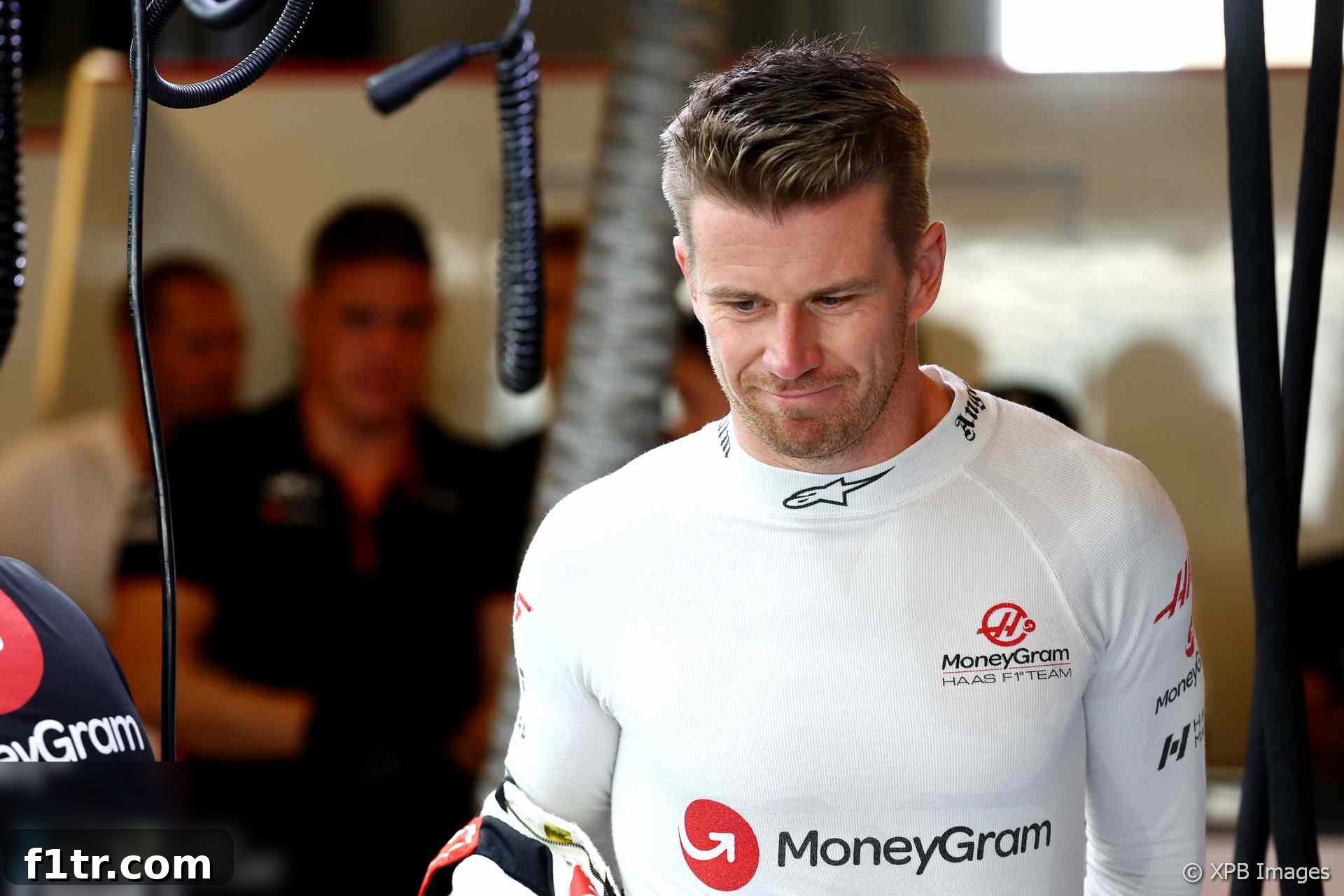
Nico Hulkenberg delivered a truly remarkable performance at the Abu Dhabi Grand Prix qualifying, orchestrating a masterclass that saw him pilot the older specification of the Haas chassis nine positions ahead of his teammate, Kevin Magnussen, who was driving the supposedly upgraded version. This stark contrast in performance led Hulkenberg to succinctly declare it “the story of our season,” encapsulating Haas’s ongoing struggles with development and consistency.
The Haas F1 Team had introduced a significant overhaul of its VF-23 chassis at the United States Grand Prix, four races prior to the season finale in Abu Dhabi. This extensive upgrade package was eagerly anticipated, designed to address some of the car’s inherent weaknesses, particularly its notorious tyre degradation issues and overall lack of pace compared to rivals. However, the new specification quickly proved to be a divisive topic within the team. Hulkenberg, known for his keen technical feedback and adaptability, never felt entirely comfortable with the revised car. His persistent unease and the team’s desire to conduct comparative analyses ultimately led to a strategic decision: for the final races, Hulkenberg reverted to the original, pre-upgrade chassis, while Magnussen continued with the new iteration.
The qualifying session in Abu Dhabi vividly highlighted the divergent paths the team had taken. During Q1, the initial phase of qualifying, Hulkenberg showcased exceptional pace, lapping three-tenths of a second quicker than Magnussen, despite driving the older machinery. This crucial advantage saw Magnussen eliminated in the first round, consigning him to a disappointing 17th place on the grid. Hulkenberg, conversely, demonstrated incredible rhythm and confidence, progressing through Q1, Q2, and ultimately reaching the top-ten shootout in Q3, securing a commendable eighth position. This disparity was not merely a matter of driver skill; it underscored a fundamental issue with the upgrade itself.
The older version of the VF-23, while proving quicker in a single-lap shootout, was historically known for being incredibly demanding on its tyres during race stints. This perennial challenge often saw Hulkenberg and Magnussen fall through the field during Grand Prix races, as their tyres quickly degraded compared to competitors. Addressing this, Hulkenberg acknowledged that the true test of his choice would come on Sunday. “We’ll see about that tomorrow night,” he stated when questioned about the old spec’s race pace. He elaborated on his initial impressions, affirming that his qualifying result merely reinforced his long-held belief: “I think it just confirms my impression that the updated car didn’t really give a significant step. They are probably very, very similar in terms of performance. Which in itself is not great because an update, you need it to work. So maybe it proved a point there. We’ll see tomorrow night.” This candid assessment laid bare the team’s predicament, suggesting that significant resources had been expended on an upgrade that yielded minimal, if any, discernible improvement.
Hulkenberg did not shy away from expressing the team’s collective disappointment regarding the upgrade’s failure. He admitted that such an extensive development had not delivered the anticipated leap in performance, a setback for a team striving to climb the Constructors’ Championship ladder. “Of course it’s very disappointing and upsetting for us,” he remarked. “We’re not happy about this, of course. That’s the story of our season. We didn’t develop anything and totally got overtaken and out-developed and hence we are last today. And that’s the root cause. So we need to really address that going into next year.” His words painted a stark picture of a team that had lost ground in the development race throughout the year, with the failed upgrade serving as a painful testament to their struggle. This lack of effective in-season development is a critical issue for any Formula 1 team, particularly for those in the lower midfield, as it often dictates their standing and competitive potential.
Adding another layer of intrigue to Hulkenberg’s outstanding qualifying effort was the fact that his weekend had been far from smooth sailing. His preparations were significantly disrupted, starting with the first practice session (FP1), which he sat out to allow test driver Oliver Bearman valuable track time in his car. While this is a common practice for teams throughout the season to evaluate young talent, it inevitably reduces a race driver’s precious track time. The challenges then compounded in the second practice session (FP2) when Hulkenberg made a mistake, resulting in a crash that severely limited his running. He managed only a single lap on the medium compound tyres, leaving him with minimal data and confidence heading into Saturday. Despite these considerable setbacks, Hulkenberg found his stride when it mattered most.
Reflecting on his unexpected success, Hulkenberg shared his surprise: “It’s not bad, and pretty unexpected, to be honest. Yesterday was obviously a really bad day with [first practice] – I sat out, that’s normal, that’s not the cause. Then obviously I did a mistake in [second practice] and only did one lap on the medium. So that was a bit worrying coming into today.” However, he quickly found his rhythm. “But [third practice] somehow I came off on the good foot with the car, had a good rhythm, had good confidence which allowed me to push and kept that feeling all the way through quali, which is very nice. I think our own predictions were that we probably were going to be out in Q1, so it was a nice little surprise there.” His ability to adapt and perform under pressure, despite limited track time and a recent incident, speaks volumes about his experience and raw talent, allowing him to extract maximum performance from a car that the team itself had low expectations for in qualifying.
The ramifications of this qualifying performance extend far beyond a single race result. For Haas, it represents a critical juncture. The failure of a major upgrade package raises serious questions about their aerodynamic philosophy, development processes, and the tools they employ to assess performance. As Hulkenberg rightly pointed out, this issue must be “addressed going into next year.” Haas needs a fundamental rethink of its approach to car development, especially given the intense competition in Formula 1 and the relatively tight budget cap. Understanding why the updated VF-23 failed to deliver and why the older specification proved superior in certain conditions will be crucial for the design and development of their 2024 challenger, the VF-24. The team’s inability to progress through the season with effective updates has left them at the tail end of the Constructors’ Championship, a position they are desperate to avoid in future seasons.
Nico Hulkenberg’s performance not only salvaged some pride for Haas in the final qualifying session of the year but also provided invaluable data and a clear, albeit unwelcome, message about the efficacy of their development path. His candid feedback and surprising turn of speed in the older-spec car underscored a deeper problem within the team’s engineering department. The challenge for Haas now is to translate these difficult lessons into actionable strategies for the future, ensuring that their next generation of cars can deliver consistent performance gains throughout the season. The Abu Dhabi Grand Prix served as a microcosm of their season, highlighting both the immense talent within their driver lineup and the significant hurdles they face in their quest for competitive relevance in Formula 1.
2023 Abu Dhabi Grand Prix – Related Articles
- Mercedes’ team photo shows we still have a long way to go on diversity – Hamilton
- Why luck was a factor in Perez’s penalty for “joke” comment
- Bottas and Zhou see encouraging signs from overhauled 2024 car
- Only Verstappen got the best from his car every weekend, rival team bosses admit
- How Sainz suffered the worst season finale for a driver since Schumacher in 1997
Browse all 2023 Abu Dhabi Grand Prix articles