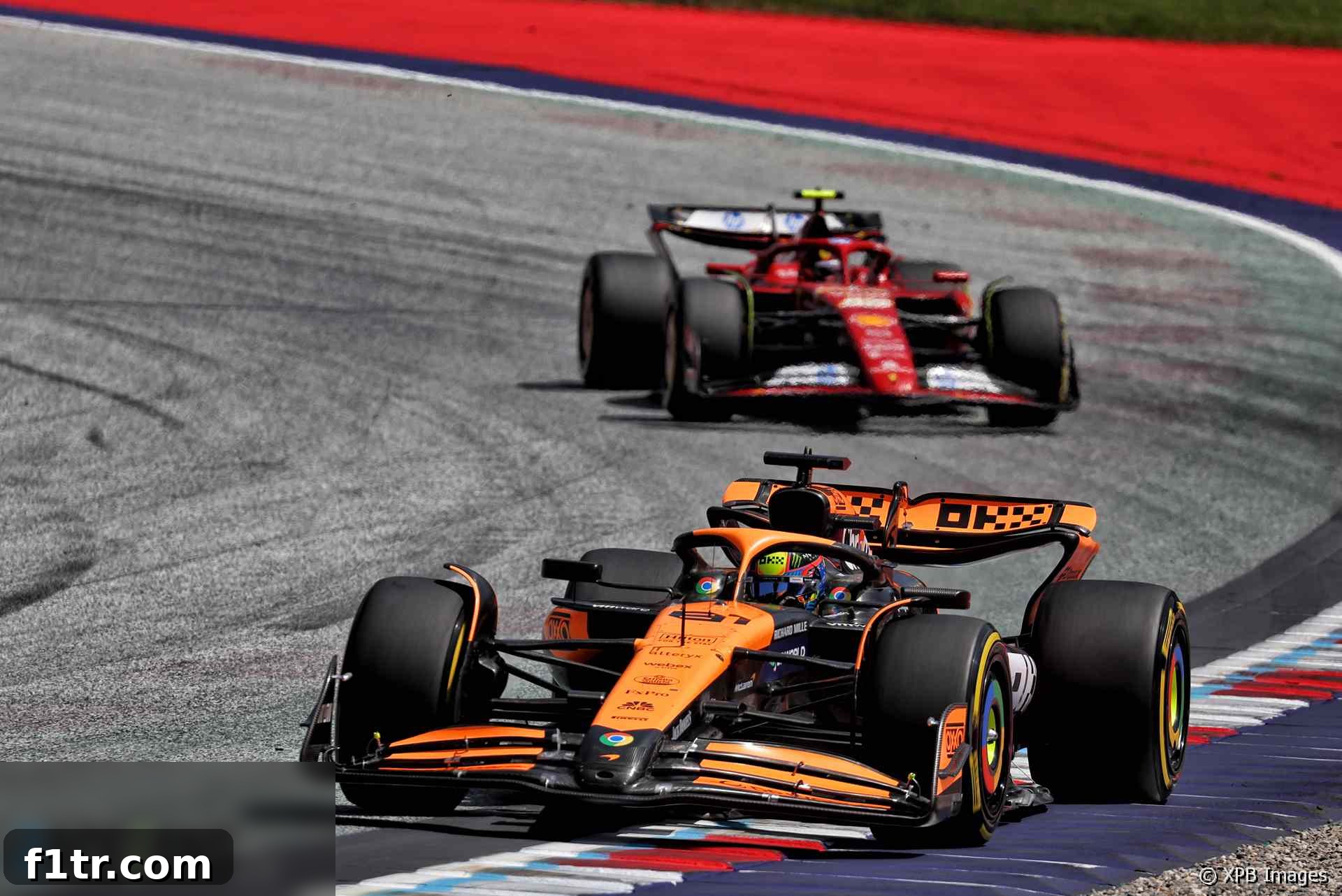
Two years ago, the Austrian Grand Prix Sunday unfolded with an air of near-certainty: Max Verstappen, having dominated the sprint race and secured pole position for the main event, seemed destined for victory. Yet, in a captivating twist of fate, Charles Leclerc and Ferrari orchestrated a masterclass in strategic execution, denying Verstappen and the legions of Dutch fans a home win. Leclerc, who appeared to lack the outright pace in the sprint, remarkably matched and even surpassed Verstappen’s speed over the full Grand Prix distance, demonstrating that clever tactics can triumph over raw speed. Fast forward to 2024, and McLaren finds itself in a strikingly similar position. After four consecutive races where they’ve finished second to Verstappen, the pressure is mounting for McLaren to emulate Ferrari’s 2022 triumph and break Red Bull’s dominance at their home circuit.
Despite a valiant effort in the sprint race, where Lando Norris went toe-to-toe with Verstappen only to emerge second best, his confidence, which has been soaring in recent rounds, has taken a slight hit. The sheer pace demonstrated by the Red Bull post-sprint has tempered expectations. “From the pace advantage Max had today, that’s probably going to carry into something tomorrow as well,” Norris candidly admitted after qualifying. “Then into quali today, it showed that they were just a pretty good step ahead of us. So we’ll see. It’s another day.” This sentiment underscores the formidable challenge facing McLaren and the rest of the grid: how to overcome a driver and a team operating at the peak of their powers, especially on a circuit that historically favors the Red Bull machinery.
The Evolving Challenge of the Weather at the Red Bull Ring
The forecast for Sunday’s Austrian Grand Prix hints at heavy rain, though thankfully, it’s expected to arrive well after the chequered flag has fallen. This offers a sigh of relief for teams and drivers hoping for a dry race. However, as Formula 1 consistently proves, rainfall isn’t the sole arbiter of challenging weather conditions. The scorching sun beating down on the circuit during Saturday’s sessions saw track temperatures soar into the mid-to-high 40s Celsius, creating an additional layer of complexity for tyre management. This intense heat had a noticeable impact during the sprint race, exacerbating overheating issues for drivers and making sustained performance incredibly difficult.
Sunday’s Grand Prix is scheduled to start two hours later than the sprint, which, counterintuitively, could intensify the tyre stress. With more time for the circuit tarmac to “bake” under the sun, track temperatures might even exceed Saturday’s readings, pushing the Pirelli tyres to their absolute limits. Drivers already grappled with tyre overheating in the shorter sprint, and warmer conditions for a full Grand Prix distance will inevitably restrict overtaking opportunities. When tyres are struggling with thermal degradation, pushing hard to pass a rival often results in a rapid loss of grip and pace, making such endeavors counterproductive. This scenario could force teams to adopt conservative strategies, similar to what McLaren and Lando Norris executed in Barcelona, where Norris shrewdly bided his time, conserving his tyres behind George Russell until he found clear air to unleash his car’s true potential.
Beyond tyre management, the relentless heat poses significant challenges for car cooling systems. Throughout the sprint race, Ferrari, in particular, was observed issuing constant instructions to Charles Leclerc and Carlos Sainz Jnr to cool down their cars’ brakes. While teams have a window to adjust car settings between qualifying and the race, a longer race distance in potentially hotter conditions will only magnify these cooling demands. Overheating brakes can lead to reduced braking performance, increased wear, and ultimately compromise driver confidence and safety. This makes effective thermal management a critical strategic element that could differentiate winners from those who merely survive the race.
Advert | Become a RaceFans supporter andgo ad-free
The Crucial Opening Laps: Start Dynamics and Early Aggression
The start of any Formula 1 race is a moment of immense tension and opportunity, and the Red Bull Ring, with its short run to Turn 1, often amplifies this drama. In the sprint race, McLaren had a numerical advantage with two cars directly behind Max Verstappen. Yet, they couldn’t capitalize on it during the opening lap. For the second time in as many weeks, Lando Norris’s launch off the line wasn’t as decisive as Verstappen’s, quickly shifting his focus from challenging the leader to defending from his own teammate in the early stages.
On Sunday, however, Norris faces a different challenge on the grid. With his teammate’s best Q3 time deleted, he won’t have a friendly McLaren alongside him. Instead, he will line up next to George Russell, the driver who sensationally outmaneuvered both Norris and Verstappen on the run to Turn 1 just last weekend in Spain. Russell’s ability to maximize grip and positioning in the initial moments of a race is formidable. However, Russell himself was cautious about replicating that stunning start at the Red Bull Ring. “I think it’s a bit more challenging here,” he commented. “I think [Verstappen and Norris] always get their elbows out. So maybe this time it’s sit back and watch it all take place.” This suggests a more circumspect approach from the Mercedes driver, potentially indicating that the unique characteristics of the Red Bull Ring start might not offer the same leverage for an aggressive launch.
While the initial getaway is critical, the window of opportunity extends beyond Turn 1, encompassing the entire opening sequence of laps. Both the Spanish Grand Prix and Saturday’s sprint race underscored a short but vital period where tyres offer maximum grip before thermal degradation sets in. During these precious few laps, drivers can truly push the limits, executing overtakes and establishing track position before they are forced into the more measured phase of tyre management. Once this initial burst of performance dissipates, the race transitions into a strategic game of conservation. Therefore, for Norris, Russell, or any other challenger hoping to depose Verstappen on Sunday, a strong start combined with aggressive, decisive driving in those crucial opening laps will be paramount to gaining and holding an early advantage.
Strategy: The Two-Stop Rule and Tactical Flexibility
Given the significant level of tyre degradation observed throughout the weekend and the expected higher track temperatures for Sunday’s Grand Prix, a one-stop strategy is widely considered unrealistic. The abrasive nature of the Red Bull Ring and the heat combine to make a single pit stop virtually impossible without severely compromising pace and risking excessive tyre wear or even catastrophic failure.
Last year’s race saw Max Verstappen dominate with what was technically a two-stop strategy, which he then extended into a luxurious three-stop solely to secure the fastest lap on the final tour, highlighting his overwhelming advantage. Starting on medium tyres, Verstappen opted for a robust hard compound middle stint, a contrasting approach to his four closest rivals, who all ran consecutive medium stints before switching to softs for their third and final phase. This strategic divergence demonstrated the flexibility available at the time and the unique challenges posed by the Spielberg circuit.
However, this year’s race is anticipated to be even warmer, placing greater demands on drivers to meticulously manage their tyres across each stint. Despite these increased thermal challenges, Pirelli’s motorsport director, Mario Isola, firmly predicts that a two-stop strategy remains the optimal path, likely employing a similar combination of medium and hard compounds. “A one-stop is not a realistic choice,” Isola explained. “Not because of tyre wear, but in terms of degradation and pace, although a three-stop could work if there is a Safety Car in the second part of the race, or if degradation is higher than expected. In this case, even the C5 [softs] could come into play – albeit not in a major way.” This assessment confirms that while a two-stop is the baseline, the unpredictable nature of Formula 1, especially with Safety Car interventions or unexpectedly high degradation, could open the door for more aggressive three-stop approaches, potentially bringing the softest C5 compound into play for short, high-performance bursts.
Advert | Become a RaceFans supporter andgo ad-free
The Art of Overtaking at the Red Bull Ring
The sprint race offered valuable insights into the overtaking dynamics at the Red Bull Ring. It clearly demonstrated that Max Verstappen, despite his dominant form, can be vulnerable if his rivals manage to stay within that critical one-second DRS window during the opening laps. The circuit’s layout, with its long straights leading into Turns 3 and 4, provides prime overtaking opportunities, particularly with the aid of DRS. However, Verstappen himself delivered a crucial lesson in opportunistic racing during the sprint. After Norris briefly snatched the lead at the preceding corner, Verstappen exploited the smallest opening left by the McLaren into Turn 4, immediately retaking the lead with decisive precision. This swift counter-attack highlighted not only Verstappen’s relentless aggression but also the fine margins involved in track position battles.
While Norris and Russell would undoubtedly relish the chance to take the lead from the Red Bull at the start or any point in the race, Russell indicated a shift in his mental approach following his experience in Spain. “I think last week I lost a lot of time battling with Lando and probably focused too much on the guys ahead of me,” Russell admitted, reflecting on the Spanish Grand Prix where he ultimately lost a position to Lewis Hamilton and nearly to Charles Leclerc. “Ultimately, that cost me the position to Lewis [Hamilton] and almost with Charles as well. So I think the race is behind us tomorrow.” This strategic introspection suggests a more patient, long-game mentality from Russell. Rather than engaging in immediate, wheel-to-wheel battles that might compromise tyre life or track position in the long run, the focus will be on executing a strong strategy and allowing the race to unfold, potentially capitalizing on others’ errors or the inevitable tyre degradation over the full distance. This approach could prove significantly more effective than attempting direct overtakes against a well-defended Red Bull on a circuit where raw pace alone may not be enough.
The Unpredictable Factor: Safety Cars and Race Incidents
Remarkably, the sprint race at the Red Bull Ring proceeded without a single incident requiring even a yellow flag across its 23 laps, with every driver successfully reaching the finish line. This anomaly begs the question: will the Grand Prix prove equally incident-free? History suggests otherwise. The Red Bull Ring has seen its share of drama, and a Grand Prix rarely runs entirely green for all 71 laps. In fact, if Sunday’s race were to run without a single Safety Car, it would be only the second such occurrence out of the last seven held at the circuit.
As is common in Formula 1, the opening laps inherently carry the highest probability of triggering a Safety Car incident due to the close proximity of cars and heightened aggression. However, a significant statistical trend at the Red Bull Ring reveals that five of the last eight Safety Car interventions were initiated by incidents occurring beyond the first lap of the race. This underscores the potential for mid-race disruptions that can dramatically reshape the strategic landscape. A Safety Car deployed within the crucial middle 60 laps of the race would almost certainly trigger a flurry of activity in the pit lane. Teams would seize the opportunity for a “cheap” pit stop, completing one of the multiple expected tyre changes under reduced time loss. Such an intervention, much like what was witnessed in Miami and Canada this season, could become a race-deciding factor, with the timing and positioning of cars relative to the Safety Car deployment dictating who gains a significant strategic advantage and who loses out.
Advert | Become a RaceFans supporter andgo ad-free
One to Watch: Oscar Piastri’s Redemption Opportunity
After a strong performance in the sprint race where he finished ahead of his teammate and, arguably, should have qualified third for the Grand Prix before a penalty, Oscar Piastri emerges as the clear “one to watch” on Sunday. The young Australian driver has shown flashes of brilliance throughout the season, and his raw pace often puts him in contention at the sharp end of the grid.
If the McLaren MCL38 is truly as competitive as its rivals suggest – positioning it as at least on par with, if not slightly superior to, the Red Bull in certain conditions – then Piastri has a golden opportunity to prove that potential. Starting further down the grid due to penalties means he will need to expertly navigate through a dense midfield pack, showcasing both his car’s inherent speed and his own racecraft. His struggle to make significant progress through the field in the previous weekend’s race in Spain adds an extra layer of intrigue. This Austrian Grand Prix will serve as a crucial test of both the McLaren’s long-run performance in challenging conditions and Piastri’s ability to execute a flawless comeback drive, pushing for a return to the podium.
Over to You: Austrian Grand Prix Predictions
With all factors considered – the relentless pace of Max Verstappen, McLaren’s determined challenge, the strategic nuances of tyre management in the heat, and the ever-present threat of Safety Cars – the 2024 Austrian Grand Prix promises to be a captivating spectacle. Will Max Verstappen complete his dominance of the weekend and extend his championship lead, or can Lando Norris, Oscar Piastri, or another rival rise to the occasion and deliver a performance akin to Leclerc’s memorable upset in 2022? The Red Bull Ring is renowned for its short, punchy laps and tight racing, making every strategic decision and every overtake critical. Who do you think will stand on the top step of the podium? Have your say in the comments below.
2024 Austrian Grand Prix
- Austrian GP clash will have taught Norris how to race Verstappen – Ricciardo
- Verstappen was “lucky” tyre damage didn’t force him to retire like Norris
- Pirelli introducing new C6 tyre to improve racing on street tracks next year
- Norris admits ‘overreacting’ but queries why Verstappen avoided track limits penalty
- Norris and Verstappen’s Austrian GP collision “blown out of proportion” – rivals
Browse all 2024 Austrian Grand Prix articles
Become a RaceFans Supporter
RaceFans is run thanks in part to the generous support of its readers. By contributing £1 per month or £12 per year (or the same in whichever currency you use) you can help cover the costs of creating, hosting and developing RaceFans today and in the future.
Become a RaceFans Supporter today and browse the site ad-free. Sign up or find out more via the links below:
- Become a RaceFans Supporter
- RaceFans Supporter FAQ
Miss nothing from RaceFans
Get a daily email with all our latest stories – and nothing else. No marketing, no ads. Sign up here: