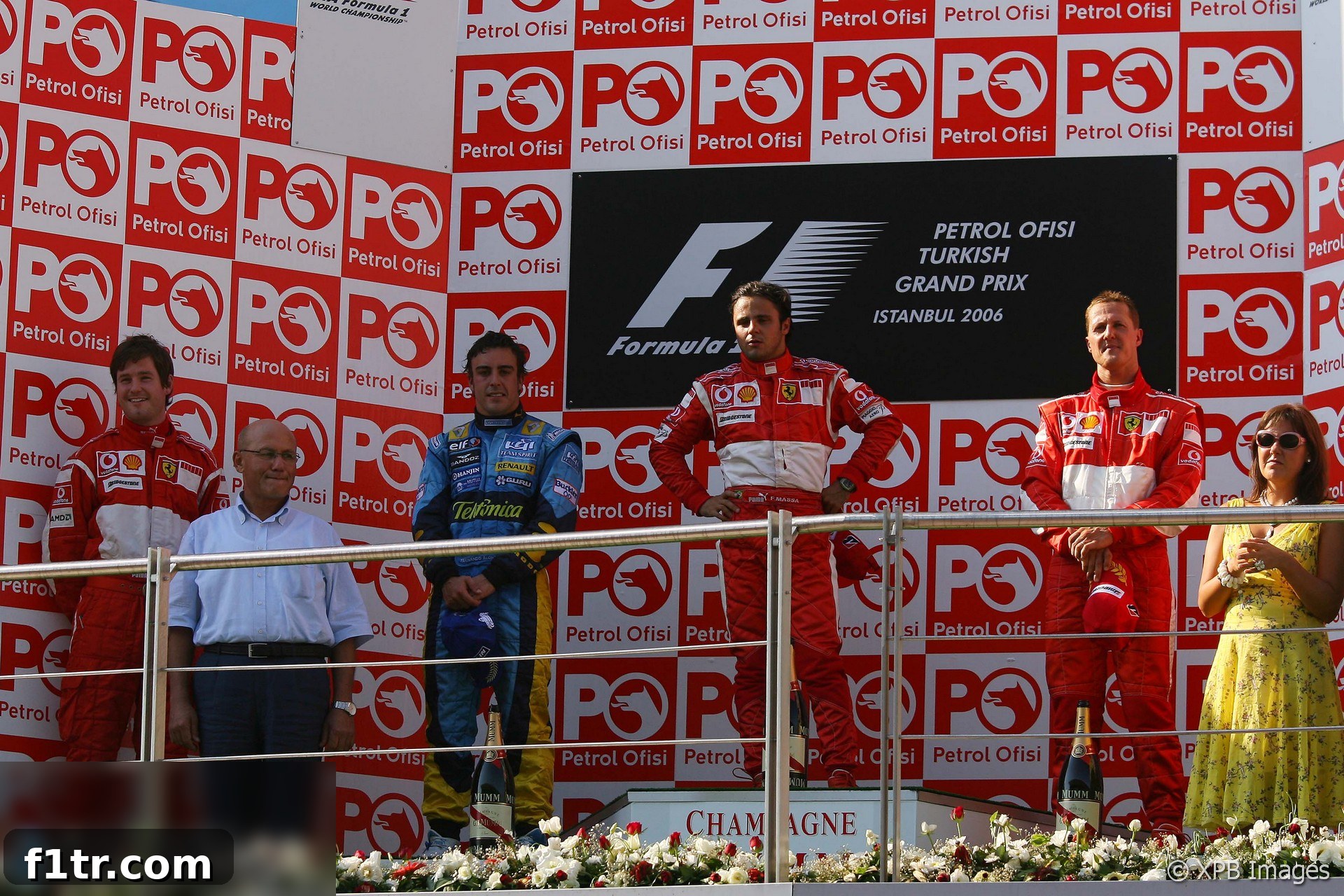
2006 Turkish Grand Prix: Schumacher’s Missed Opportunity, Massa’s Maiden Triumph, and Alonso’s Championship Boost
What promised to be a meticulously executed race for Michael Schumacher, designed to harvest maximum championship points, ultimately unraveled. Instead, the dramatic 2006 Turkish Grand Prix delivered a memorable maiden Grand Prix victory to his grateful Ferrari teammate, Felipe Massa. Meanwhile, Fernando Alonso secured a crucial second-place finish, extending his lead in the drivers’ championship for the first time since June, though the Renault driver knew his battle was far from over.
The stage was set for a Schumacher masterclass. The German ace had demonstrated blistering pace during the second part of qualifying, clocking an astonishing 1’25.850s – a full second faster than any other competitor. At that moment, the outcome of the Turkish Grand Prix at the spectacular Istanbul Park seemed all but a foregone conclusion. Few would have dared to bet against Schumacher not only securing pole position but then cruising to a dominant victory, potentially with Massa in a dutiful second place to inflict maximum damage on Alonso’s championship aspirations.
Qualifying Drama: Massa Capitalizes on Schumacher’s Errors
However, the narrative began to shift even before the race lights went out. Schumacher, usually unflappable under pressure, made a series of unforced errors during the crucial final part of qualifying. Twice, he ran wide at the notoriously challenging Turn 1, handing an unexpected opportunity to his teammate. Massa, seizing the moment, capitalized on Schumacher’s missteps to claim a sensational pole position – his very first in Formula 1. Behind the two Ferraris, Alonso and Giancarlo Fisichella positioned their Renaults, poised to unleash their renowned start-line speed, a potent weapon against the Italian giants.
A Chaotic Start and Early Race Maneuvers
As the lights extinguished, the opening seconds of the Turkish Grand Prix erupted into chaos. Ferrari had clearly orchestrated a strategy to contain Alonso, and initially, it worked to perfection. Schumacher deliberately swung right, effectively boxing the Spaniard behind Massa and preventing him from gaining any early advantage. This maneuver, while strategic, had immediate consequences further back. Fisichella, finding himself with nowhere to go, was forced to take evasive action and spun his Renault, instantly igniting a chain reaction of incidents.
The ensuing mayhem saw Christian Klien lock his brakes violently, spearing straight off the track. This forced Kimi Raikkonen to take evasive action, diving off the circuit only to be hit by Scott Speed, resulting in a punctured left-rear tyre for the McLaren driver. A fast-starting Nick Heidfeld arrived at the scene of the crash just in time to lose his front wing, as did the recovering Fisichella. Ralf Schumacher spun amidst the confusion, and Tiago Monteiro, left with absolutely no room to maneuver, crashed out of the race. Despite the dramatic scenes, none of these initial incidents were deemed severe enough by race control to warrant the immediate deployment of the safety car.
Surprisingly, the chaos at the front of the midfield allowed some drivers to make significant gains. The Williams duo of Mark Webber and Nico Rosberg found themselves in promising fourth and sixth positions, respectively, having started ninth and fourteenth. They sandwiched Jenson Button, who held a steady fifth. However, the biggest beneficiary of the opening lap pandemonium was Vitantonio Liuzzi, who climbed an incredible eleven places to seventh. Unfortunately for the Toro Rosso driver, he would slowly drop down the order, unable to defend his position effectively on a track where overtaking is not only possible but frequent.
The Pivotal Safety Car and Strategic Shifts
In the early laps, Massa managed to pull away from the chasing pack, his light fuel load allowing him to build a comfortable gap – a deliberate strategy to guarantee he out-qualified the Renaults. Schumacher, running on a heavier fuel load, also distanced himself from Alonso, patiently biding his time. His plan was clear: use his superior fuel strategy to leapfrog Massa during the pit stops, assuming team orders wouldn’t dictate the outcome sooner.
This meticulously crafted plan, however, was dramatically scuppered on lap 13. Vitantonio Liuzzi, fiercely defending his position from Jarno Trulli’s Toyota, spun at Turn 1 and, crucially, was unable to move his car from the kerbing on the outside of the corner. This incident finally triggered the safety car, instantly neutralizing the race and sending the leading cars scrambling for the pits. In the ensuing pit lane flurry, Schumacher suffered a critical delay behind Massa’s stop. This momentary hesitation proved immensely costly, as it dropped the German driver directly behind Fernando Alonso. Suddenly, Schumacher was on the back foot, needing to aggressively attack Alonso if he hoped to make any significant progress in the championship standings.
At the restart, a somewhat dawdling, lapped Nick Heidfeld briefly protected Massa from Alonso. However, the Spaniard swiftly dispatched the BMW, with Schumacher following closely behind. This restart marked the beginning of a relentless chase, setting the stage for one of the most intense battles of the season.
Mid-Race Battles: Istanbul Park Proves its Overtaking Credentials
Further back in the field, the inherent qualities of Istanbul Park as an outstanding overtaker’s circuit were on full display. The track’s flowing corners and long straights provided ample opportunities for daring moves and close-quarters racing.
Robert Kubica, driving for BMW Sauber, executed an exquisitely judged move on Mark Webber, demonstrating precision and bravery. A recovering Giancarlo Fisichella followed him through the final three corners on lap 18, showcasing his determination to make up for his early spin. On the very next lap, Fisichella managed to pick off Kubica, but the Pole put up a fierce fight for the position, highlighting the competitive spirit throughout the grid. Rubens Barrichello attempted a similar move on Jarno Trulli, but his Toyota rival smartly reversed the maneuver, holding his ground. Pedro de la Rosa then deftly nabbed Christian Klien on the outside of the same bend to secure sixth place. The challenging nature of Turn 8 and the surrounding sections continued to deliver action, as Kubica himself succumbed to Ralf Schumacher in a similar fashion on lap 23, further shuffling the midfield order.
Schumacher’s Costly Blunder at Turn 8
While the midfield provided enthralling overtaking action, the battle for the major points between the championship protagonists, though less swashbuckling, was undeniably more tense. On lap 28, the immense pressure and physical demands of the race seemed to take their toll on Michael Schumacher. At the notorious high-speed, high-G load Turn 8 – a corner demanding absolute precision and unwavering concentration – Schumacher slithered wide, struggling to rejoin the circuit cleanly. This uncharacteristic error had an immediate cost of four crucial seconds, allowing Alonso to consolidate his position. However, its true impact would prove to be far more costly than just time; it was a significant blow to his championship aspirations.
The reasons behind Schumacher’s mistake could have been manifold: the stamina-sapping forces exerted by the circuit, frustration boiling over from his early misfortunes in qualifying and the safety car period, the immense pressure of the championship hanging delicately in the balance, or simply a moment of ‘brain-fade’ under extreme duress. Regardless of the cause, it was a rare and impactful lapse from a driver known for his almost robotic consistency.
The race saw only a smattering of retirements, mostly confined to the usual suspects. Sakon Yamamoto spun out at Turn 1 on lap 24, an unfortunate end to a weekend that had started on a high note after he out-qualified Takuma Sato. Nico Rosberg’s Williams also gave up the ghost, marking their tenth mechanical failure in a race this season, highlighting the team’s ongoing reliability struggles.
The Grandstand Finish: Alonso Holds Off Schumacher
As the final pit stops approached, the leading trio picked up their pace in unison, pushing their cars to the limit. Massa and Alonso made their way into the pits together on lap 38. Schumacher, however, continued for another three laps, pushing hard and attacking the fastest lap time before finally diving into the pit lane. The Ferrari mechanics performed a lightning-fast stop, turning Schumacher around in next to no time. But even their efficiency couldn’t get him out before Alonso had shot past, retaining his second place.
Now, with just fifteen laps remaining, the championship leaders were set to go toe-to-toe in a thrilling sprint to the finish. The Ferrari 248 F1, with Schumacher at the helm, relentlessly hounded the Renault R26 in the slower, tighter corners of the circuit. However, the Renault consistently slipped slightly out of range in the quicker sections. Alonso’s most vulnerable point was at the very end of the lap, especially from the last corner leading onto the main straight, where rear tyre wear was becoming a critical factor.
The laps ticked by inexorably, each one a testament to Alonso’s defensive masterclass and Schumacher’s relentless pursuit. At one point, Schumacher made a daring dive at Alonso on the outside of Turn 7. But Alonso, with incredible poise and precision, tucked the seven-time champion up at the apex, slowed his momentum, and then scampered off again, denying Schumacher any real opportunity to pass. The tension was palpable, a genuine clash of titans.
Off in the distance, Felipe Massa was lapping serenely, maintaining a comfortable lead. Despite Schumacher and Alonso being locked in battle and therefore lapping comparatively slowly, Massa never truly capitalized by pushing hard to extend his lead dramatically. It became clear that he was waiting for the inevitable call from Jean Todt, the Ferrari team principal, to yield his position to Schumacher for championship purposes. But to the surprise of many, that call never came. Fernando Alonso never faltered, exhibiting incredible defensive driving, and Felipe Massa crossed the line to take his first-ever Grand Prix victory. Alonso and Schumacher finished a nail-biting 0.081 seconds apart, a testament to the intensity of their battle.
Massa’s Maiden Triumph and the Best of the Rest
Massa’s maiden win was a joyous occasion for the young Brazilian, a reward for his strong performance throughout the weekend. Behind the leading trio, Jenson Button delivered a solid performance, claiming the title of ‘best of the rest’ in fourth place. He finished ahead of Pedro de la Rosa and Giancarlo Fisichella, who both staged impressive comebacks from their early race troubles. Rubens Barrichello chased Ralf Schumacher across the finish line, securing the final two points positions. Jarno Trulli, who had run strongly earlier, was thoroughly undone by Ralf (who had started much further back) and languished in ninth, one place ahead of Mark Webber. The Australian had looked poised to break Williams’ long and painful string of races without scoring points, but it was not to be.
The remaining classified finishers included Christian Klien, Robert Kubica, Scott Speed, Nick Heidfeld, and David Coulthard. Takuma Sato was still running at the end of the race but unfortunately failed to complete enough of the race distance to be officially classified.
Championship Implications and Conclusion
The 2006 Turkish Grand Prix will forever be remembered as a race of significant missed opportunities for Michael Schumacher. While the safety car period undoubtedly played a role in reshuffling the strategic cards, Schumacher himself would likely acknowledge that it was his own unforced errors – both in qualifying and his critical moment at Turn 8 – that ultimately let Fernando Alonso off the hook and allowed him to consolidate his championship lead.
The outcome significantly altered the championship landscape. Instead of closing the gap, Schumacher saw Alonso extend his advantage, injecting fresh momentum into the Spaniard’s campaign. The question that loomed large after Istanbul was: would this result increase the pressure on the multiple champion, potentially provoking more errors in the critical final races, or would it simply strengthen his legendary resolve? The answer would begin to unfold at Monza in just three weeks’ time, promising another thrilling chapter in one of Formula 1’s most iconic championship battles.
For more exclusive content and an ad-free experience, consider becoming a RaceFans supporter.