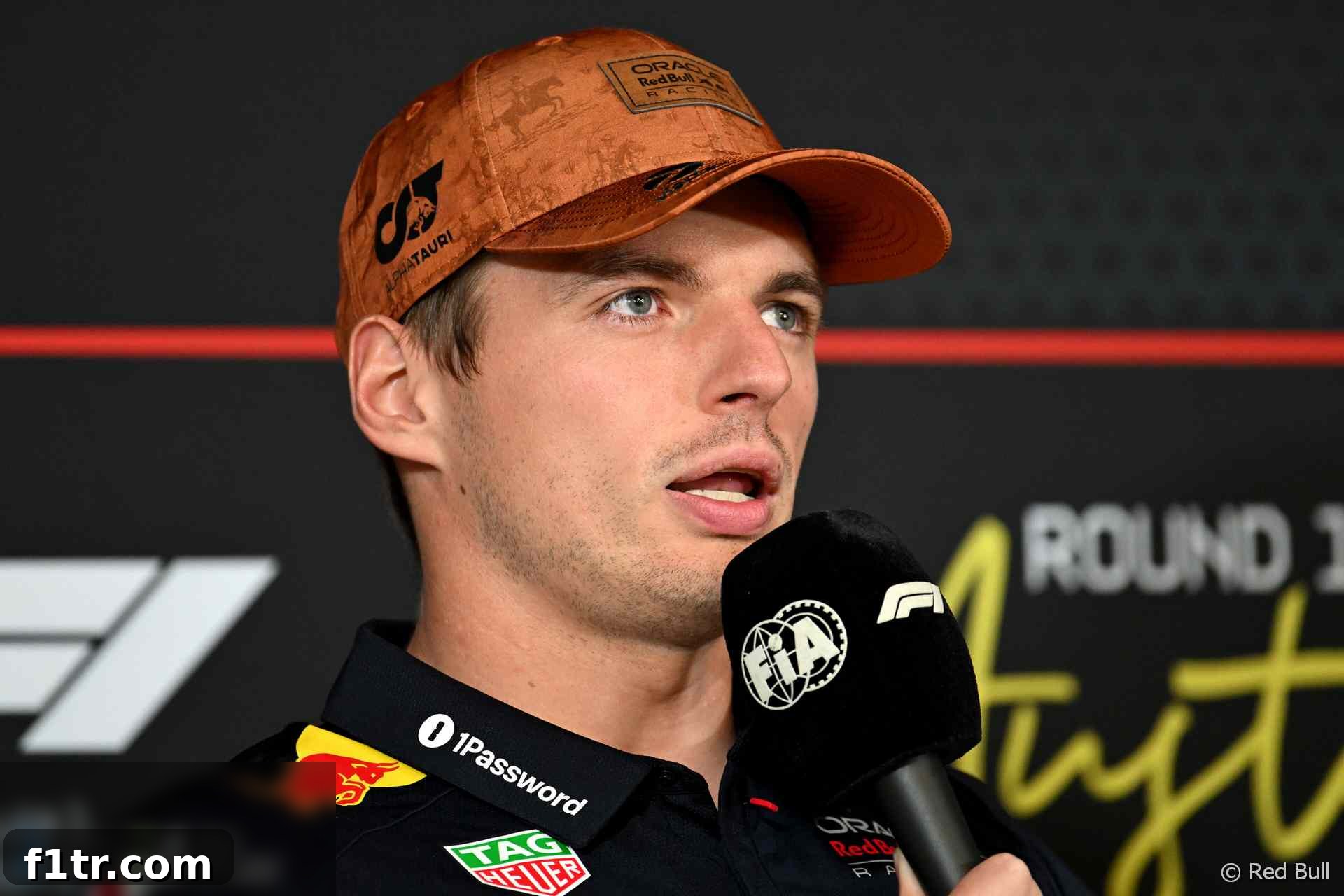
Max Verstappen, the reigning Formula 1 World Champion, has highlighted a critical area where his Red Bull Racing team needs to make significant strides to match the potent performance of their rivals, McLaren. According to Verstappen, the Woking-based outfit still holds a distinct advantage in medium-speed corners, a challenge Red Bull is actively working to overcome despite their recent resurgence in form.
Red Bull has demonstrably narrowed the performance gap to McLaren since the summer break, showcasing remarkable progress across various circuit configurations. Over the past four rounds of the championship, Verstappen has secured an impressive two victories and two second-place finishes, underscoring the improved competitiveness of the Red Bull car. This adaptability has been particularly evident on both low-downforce circuits like Monza and Baku, where top-end speed is paramount, and on high-downforce, technical tracks such as the Singapore street circuit, which demands maximum aerodynamic grip and chassis agility.
However, despite these notable advancements, Verstappen remains keenly aware that certain performance disparities persist. He emphasized the ongoing need for Red Bull to refine specific aspects of their car to ensure they can consistently challenge McLaren across all types of tracks on the Formula 1 calendar. This pursuit of holistic performance is crucial for maintaining their competitive edge and tackling future races.
“I think in general, they are still quite strong in the medium-speed corners,” Verstappen stated, pointing directly to McLaren’s prowess. “That’s definitely a strength of their car.” He further elaborated on the variable nature of F1 performance, noting, “The rest depends a bit on the track layout and conditions, it’s a bit difficult to say. But medium-speed corners is probably still where they’re very good.” This observation underscores the nuanced performance profiles of F1 cars, where specific corner types can reveal underlying strengths and weaknesses.
Medium-speed corners represent a unique challenge for Formula 1 engineers and drivers. Unlike slow-speed corners, which heavily rely on mechanical grip and traction out of the apex, or high-speed corners, where outright aerodynamic efficiency is king, medium-speed corners demand a delicate balance. They require precise aero stability, responsive chassis tuning, and the driver’s absolute confidence to carry significant speed through the apex while managing tire degradation. McLaren’s consistent strength in this domain suggests a well-optimized aerodynamic package and a balanced chassis that delivers consistent downforce and mechanical grip in these critical phases of a lap. Understanding and replicating this balance is a key focus for Red Bull’s technical team.
Red Bull’s journey of improvement has been particularly stark since the Hungarian Grand Prix, the final race before the summer break. At that event, Verstappen struggled significantly, qualifying in a disappointing eighth position and eventually finishing ninth. This performance served as a wake-up call, prompting an intense period of analysis and development. The transformation since then has been remarkable, reflecting the relentless pursuit of perfection inherent in Formula 1.
Verstappen shed light on the tangible improvements within the car’s dynamics. “The car is just a bit more balanced now,” he explained. “It doesn’t oversteer dramatically or understeer dramatically.” This shift from erratic handling to a more predictable and stable platform is pivotal. A car that exhibits dramatic oversteer (the rear losing grip) or understeer (the front losing grip) forces the driver to constantly compensate, leading to slower lap times, increased tire wear, and reduced confidence. The current, more cohesive balance allows Verstappen to push the car closer to its limits with greater consistency, extracting more performance over a race distance.
Achieving optimal car balance involves intricate adjustments to aerodynamics, suspension settings, and weight distribution. Engineers work tirelessly to fine-tune these parameters for each circuit, ensuring the car remains responsive and stable under varying loads and speeds. Verstappen’s comments suggest that Red Bull has made significant progress in finding this elusive equilibrium, enabling the car to transition smoothly through corners and deliver power efficiently. This continuous fine-tuning is an ongoing process in F1, as Verstappen himself noted: “But every weekend, you’re fine-tuning things because it’s never perfect. Luckily, lately, the car, it’s been a bit more together.” This philosophy of incremental gains forms the backbone of success in the highly competitive world of Formula 1.
Despite his recent strong results, particularly a second-place finish at the Singapore Grand Prix, Verstappen was candid about the car’s performance. During the demanding night race, he repeatedly voiced concerns about the car’s handling, specifically highlighting issues with its gearshifts. These technical glitches proved frustrating for the Dutch driver, who ultimately crossed the finish line five seconds behind race winner George Russell.
The Singapore Grand Prix is renowned for its tight, twisty layout and unforgiving walls, where precision and flawless execution are paramount. Any interruption to a driver’s rhythm, such as problematic gearshifts, can severely compromise performance. In a race decided by fine margins, even momentary hesitations during gear changes can accumulate to significant time losses over 60 laps. Verstappen firmly believes that, had these issues been absent, Red Bull could have extracted more potential from the car, potentially challenging for the top step of the podium.
“The last three weekends have been very nice, some better than others,” he reflected, acknowledging the team’s overall positive trajectory. “I still think in Singapore we didn’t maximise the potential of the car.” This sentiment reflects a champion’s mindset – always striving for perfection, even when securing a strong result. The unmaximized potential serves as a powerful motivator for the team to delve deeper into data analysis and development. “But again, you analyze everything and try to do better. That’s what we’ll try to do again here.” This commitment to relentless analysis and continuous improvement is a hallmark of Red Bull Racing’s success and a crucial factor in their ongoing pursuit of Formula 1 dominance. The intricate dance between driver feedback and engineering solutions defines the cutting edge of motorsports performance, ensuring that no stone is left unturned in the quest for ultimate speed and reliability on the track.
Miss nothing from RaceFans
Get a daily email with all our latest stories – and nothing else. No marketing, no ads. Sign up here:
2025 United States Grand Prix
- Tsunoda apologised to Racing Bulls for “very unnecessary” comments on Lawson
- Sainz brands Mexican GP grid penalty “completely disproportionate”
- No more ‘repercussions’ for Norris: McLaren change stance after Austin collision
- Bearman feared he’d triggered ban with Antonelli incident in sprint race
- Every team except Sauber to run rookie driver during first practice in Mexico
Browse all 2025 United States Grand Prix articles