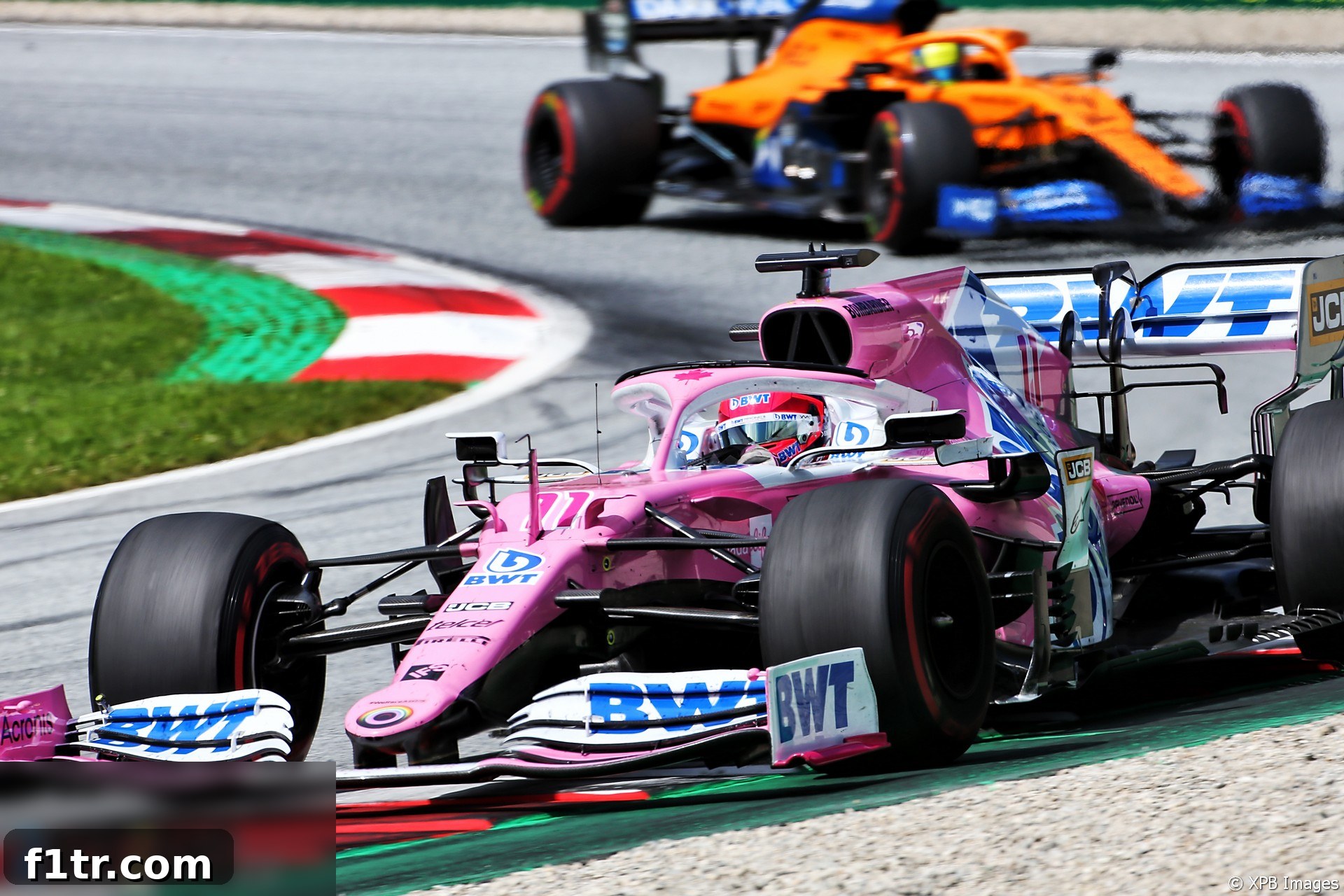
Red Bull Racing team principal Christian Horner issued a stark warning to the entire Formula 1 paddock following the Styrian Grand Prix, highlighting the formidable pace demonstrated by Racing Point. The performance of Sergio Perez, in particular, caught Horner’s attention, suggesting a new, potent contender had emerged on the grid.
Advert | Become a Supporter & go ad-free
During the closing stages of the race, Sergio Perez mounted an aggressive challenge on Alexander Albon for fourth place. Despite ultimately dropping back after sustaining front wing damage in a tussle with the Red Bull driver, Perez’s raw speed leading up to that point was undeniable. Horner, ever vigilant of competitive threats, had meticulously observed the rate at which Perez closed the gap, a performance that undoubtedly sent ripples of concern through the Red Bull garage and beyond.
“I think everybody would be worried by the Racing Point,” Horner stated, his words carrying the weight of experience in F1’s cutthroat environment. “I mean, he was quicker than a Mercedes, Perez, at that point in the race.” This specific observation underscores the profound impact of Racing Point’s pace. To be faster than a factory Mercedes, even for a segment of the race, is a testament to the significant strides the Silverstone-based team had made. The implications for the rest of the grid, especially those fighting for podiums and championship points, were immediately apparent.
Racing Point’s Unnerving Pace: A Threat to the Front-Runners
Horner elaborated on the details, providing a concrete comparison that amplified his concern. “Bearing in mind that Bottas was on tyres that were within one lap of age to the Racing Point, Perez was three or four tenths quicker. So it was very impressive pace that they showed.” This analytical breakdown reveals not just a momentary flash of speed, but a sustained, superior performance on similar tyre compounds. Such a consistent advantage over a car widely considered to be the second-fastest on the grid, if not outright equal at times, signifies a fundamental shift in the competitive landscape. Racing Point, often dubbed the ‘Pink Mercedes’ due to the striking similarities of their RP20 challenger to the championship-winning Mercedes W10 from the previous season, was proving its critics and admirers alike right about its potential.
The ‘Pink Mercedes’ narrative itself was a major talking point in the 2020 season. Racing Point openly admitted to designing their car based on photographic evidence and legitimate data acquisition from the 2019 Mercedes. This approach, while technically within the rules as interpreted by the FIA at the time, stirred significant controversy, particularly among rival teams who felt it circumvented the spirit of fair competition. Horner’s comments subtly underscored this contentious backdrop, as the car’s on-track performance validated the effectiveness of their design philosophy, presenting a formidable package that could legitimately challenge the sport’s established elite.
Despite the damage sustained in the closing laps, Alexander Albon’s defence against Perez was commendable. “I think Alex drove incredibly well to keep him behind,” Horner praised, acknowledging the challenging circumstances his driver faced. Albon’s ability to hold off a faster car, even for a limited period, offered a glimmer of positivity for Red Bull. “But also, if you look at Alex’s pace on that tyre versus Bottas, there was encouragement that we could take from that in a car that wasn’t carrying any damage.” This indicates Red Bull saw signs of their own potential, suggesting that without the unforeseen incidents and with optimal car performance, they too possessed the underlying speed to compete with the sport’s front-runners. It painted a picture of a team grappling with fine-tuning their package but recognizing the inherent capabilities within their machinery.
Red Bull’s Search for Speed: The Mercedes Challenge
Max Verstappen, Red Bull’s talismanic driver, had been more direct in his assessment, unequivocally stating that Red Bull was “too slow” to keep pace with Mercedes during the race. This blunt appraisal from Verstappen highlights the stark reality facing Red Bull: bridging the gap to Mercedes required more than incremental improvements. It necessitated a fundamental step forward in performance, especially in key areas where Mercedes maintained a commanding lead. Horner largely concurred with Verstappen’s observation, pinpointing the primary area of deficiency.
“Their straight-line speed is impressive,” Horner commented, referring to Mercedes. This observation is crucial. In modern Formula 1, straight-line speed is a complex interplay of engine power, aerodynamic efficiency, and ERS deployment strategies. Mercedes had historically maintained a significant advantage in this domain, often leveraging their formidable power unit to gain crucial tenths on the straights. This allowed them to pull away from rivals or make overtakes with relative ease, particularly on circuits with long straights like the Red Bull Ring where the Styrian Grand Prix was held.
Red Bull, renowned for its aerodynamic prowess, often builds cars that excel in cornering, generating significant downforce. Horner confirmed this strength, stating, “We’re pretty much there in cornering speeds. There’s some corners we’re better, some that we’re not quite as good.” This indicates that Red Bull’s RB16 chassis was fundamentally sound in its design, performing competitively through the bends. However, the gains made in the corners were seemingly being negated by the deficit on the straights. The challenge for Red Bull, therefore, lay in finding a balance: improving straight-line speed without compromising their cornering strengths, a notoriously difficult tightrope walk in F1 car design.
The Winter Development Battle and the 2020 Season Dynamics
Horner’s concluding remark on Mercedes’ straight-line speed underlined the scale of the challenge: “But certainly on this track their straight line speed has been very impressive. So they’ve made a good step over the winter.” This acknowledgement highlights the relentless development race in Formula 1. Even after years of dominance, Mercedes had evidently found further performance gains during the off-season, particularly in engine performance and aerodynamic efficiency, pushing the boundaries even further. This continuous evolution meant that rivals like Red Bull couldn’t afford to stand still; they needed to innovate and improve at an even faster rate to close the gap. The Styrian Grand Prix served as a clear indicator that the 2020 season would be a battle not just of drivers, but of engineering prowess and developmental cycles.
The emergence of Racing Point as a front-running contender added another layer of intrigue to the 2020 F1 season. Their ability to challenge the likes of Red Bull and even demonstrate superior pace to a Mercedes at certain points not only put pressure on the established top teams but also created a more unpredictable dynamic in the midfield battle. Teams like McLaren, Renault, and Ferrari (who were struggling in 2020) now had another formidable opponent to contend with, intensifying the fight for valuable championship points.
Advert | Become a RaceFans supporter andgo ad-free
Looking Ahead: Implications for Red Bull and the Championship Battle
For Red Bull, Horner’s warning about Racing Point wasn’t just about a single race performance; it was a broader signal about the competitive landscape of the 2020 season. It meant that even if they could somehow bridge the gap to Mercedes, they now had another incredibly quick car to contend with for podiums and race victories. This added pressure would force Red Bull to extract every ounce of performance from their package, scrutinizing every aspect of their car’s design, engine integration, and operational strategies. The pursuit of an F1 world championship is never a straightforward path, but the unexpected rise of Racing Point made the challenge even more multifaceted for Christian Horner and his team.
The battle for second place in the constructors’ championship, a goal Red Bull consistently aims for, also became more intense. With Racing Point now firmly in the mix, securing those crucial points would require even greater consistency and superior strategic execution. The technical directives surrounding the legality of the Racing Point car would continue to be debated, but on the track, their performance spoke for itself, demanding respect and adaptation from their rivals.
Ultimately, Christian Horner’s comments after the Styrian Grand Prix served as a wake-up call, not just for Red Bull but for the entire F1 community. Racing Point had arrived, and their performance was too significant to ignore. The 2020 Formula 1 season, already unique due to its revised calendar and protocols, had just become even more compelling, promising thrilling battles and strategic chess matches as teams vied for supremacy.
2020 F1 Season Insights and Further Reading
- Grosjean to make F1 test return tomorrow for first time since Bahrain horror crash
- Pictures: Wrecked chassis from Grosjean’s Bahrain fireball crash to go on display
- Bottas vs Rosberg: Hamilton’s Mercedes team mates compared after 78 races each
- F1 revenues fell by $877 million in Covid-struck 2020 season
- Hamilton and Mercedes finally announce new deal for 2021 season
Browse all 2020 F1 season articles