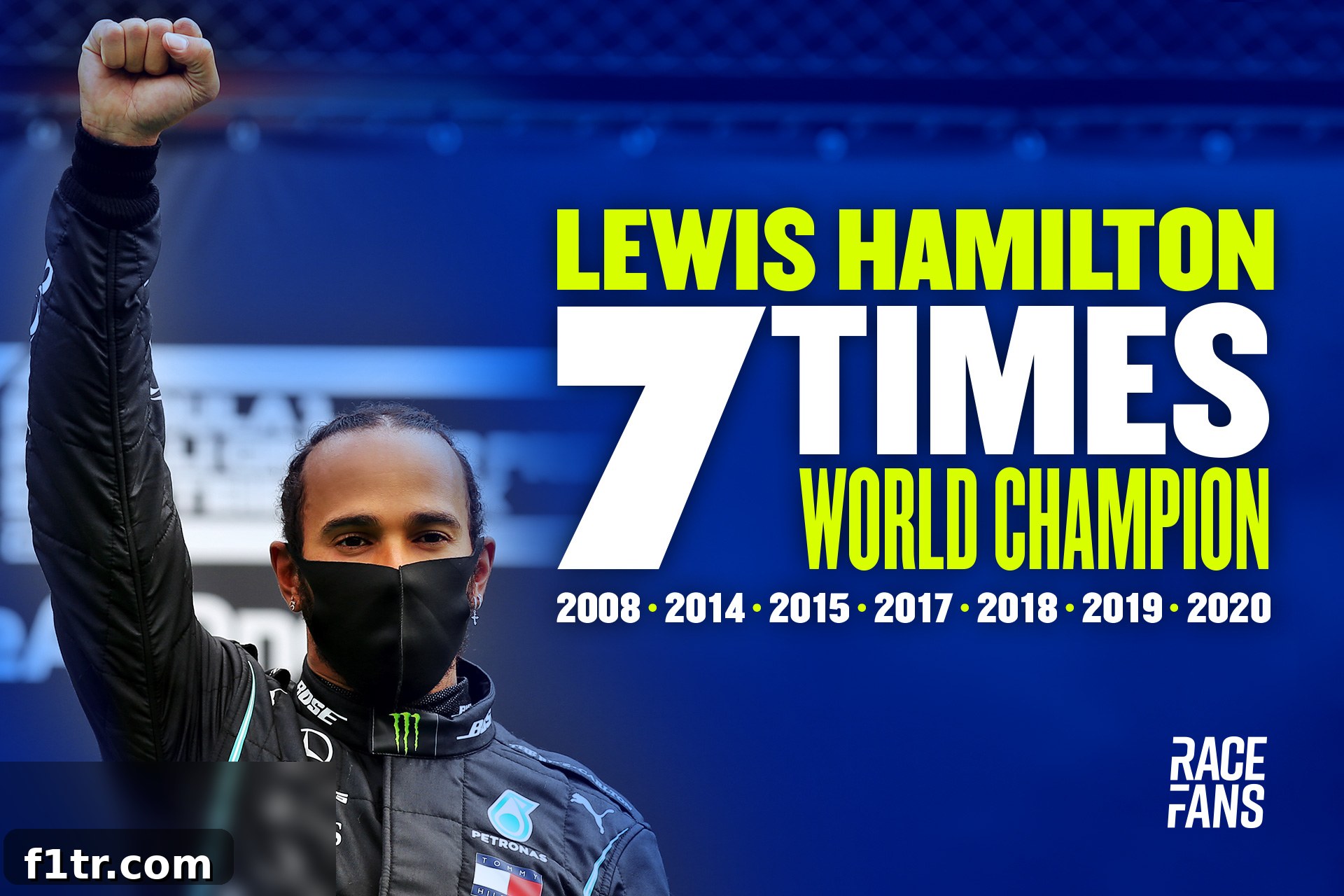
Lewis Hamilton Makes History: Equalling Michael Schumacher’s Legendary Seven F1 Titles
In a season that defied expectations and captivated audiences worldwide, Lewis Hamilton etched his name even deeper into the annals of Formula 1 history. With three races still remaining in the extraordinary 2020 season, the British sensation secured his seventh career World Drivers’ Championship, a monumental achievement that drew parallels to the sport’s most revered figure. This triumph didn’t just add another trophy to his cabinet; it officially elevated him to a status only one other driver had ever reached: a seven-time Formula 1 World Champion, standing shoulder-to-shoulder with the iconic Michael Schumacher.
Hamilton’s Ascent to Stardom: A Decade of Dominance
Lewis Hamilton’s journey to seven world titles is a narrative of unwavering determination, unparalleled talent, and strategic brilliance. His Formula 1 career began with McLaren in 2007, where he immediately showcased his prodigious talent, narrowly missing the championship in his rookie year. By his second season in 2008, he had already clinched his maiden world championship in a dramatic season finale at the Brazilian Grand Prix, becoming the youngest F1 world champion at the time. This early success hinted at the extraordinary career that would follow.
Following this initial triumph, a period of fierce competition and technical challenges meant Hamilton had to wait six years for his second title. This came in 2014, marking a pivotal moment in his career: his strategic move from McLaren to the then-developing Mercedes-AMG Petronas Formula One Team at the end of the 2012 season. Many questioned the decision at the time, as Mercedes had yet to prove itself as a front-running team. However, this decision proved to be a masterstroke, as it coincided with the dawn of Formula 1’s hybrid era, laying the foundation for an unprecedented period of dominance.
The synergy between Hamilton and Mercedes quickly yielded remarkable results. He secured back-to-back championships in 2014 and 2015, showcasing his exceptional driving prowess combined with Mercedes’ superior hybrid-era machinery. The 2016 season presented a formidable challenge from his determined teammate, Nico Rosberg. In a closely fought battle that went down to the wire, Hamilton narrowly lost the title by just five points. Rosberg’s subsequent retirement from the sport, however, opened the door for Hamilton to reassert his supremacy, and he has since gone on an unbroken streak, winning every championship from 2017 through 2020. This sustained period of success underscores his remarkable consistency, adaptability to evolving regulations, and relentless pursuit of perfection in the sport, solidifying his status as a modern-day legend.
Michael Schumacher: The Original Seven-Time Champion
Before Lewis Hamilton’s incredible achievement, the benchmark for Formula 1 greatness was singularly held by Michael Schumacher. The German legend, often referred to as ‘Schumi’, set the seemingly insurmountable record of seven world championships in 2004. His career was a testament to raw speed, meticulous preparation, and a fierce competitive spirit that not only propelled him to individual glory but also transformed Ferrari into a championship-winning juggernaut.
Schumacher’s championship journey began with Benetton, where he secured consecutive world titles in 1994 and 1995. These early successes established him as a generational talent, capable of extracting maximum performance from any car and dominating rivals. His audacious move to Ferrari in 1996, a team then struggling for top honours after decades of underperformance, was a defining moment. Over several years, through immense dedication and a strategic overhaul of the team with key figures like Ross Brawn and Jean Todt, Schumacher spearheaded one of the most dominant periods in F1 history. After several near-misses in the late 1990s, the turn of the millennium saw the start of an unparalleled era.
From 2000 to 2004, Michael Schumacher claimed five consecutive drivers’ championships, an unprecedented feat that solidified his status as an icon. During this era, he not only surpassed the five-title record held by the legendary Juan Manuel Fangio, a record that had stood unchallenged since the 1950s, but he also redefined what was possible in Formula 1. Schumacher’s blend of aggressive driving, strategic intelligence, and unwavering commitment to his team set a new standard for excellence, inspiring a generation of fans and future racing drivers.
A Shared Legacy: Comparing Two Titans
The comparison between Lewis Hamilton and Michael Schumacher is inevitable and fascinating, offering a glimpse into the diverse paths to greatness in Formula 1. Both drivers achieved their seven titles with two different teams, showcasing their adaptability and ability to build championship-winning environments. Schumacher’s initial two titles came with Benetton before his historic five with Ferrari. Hamilton’s first was with McLaren, followed by his incredible six with Mercedes.
While the eras they competed in were vastly different—Schumacher dominating the V10 era with tire wars and refuelling, Hamilton mastering the V6 turbo-hybrid era with complex aerodynamics and sophisticated power units—their impact on the sport and their respective teams is strikingly similar. Both pushed the boundaries of their machinery, their physical and mental capabilities, and their team’s performance. They both exemplified the relentless pursuit of excellence, combining raw driving talent with an astute understanding of strategy and team dynamics. Their records stand as a testament to not just individual brilliance but also the dedication of hundreds of engineers, mechanics, and strategists working in unison to achieve common goals.
The parity of their achievements at the summit of Formula 1 underscores a universal truth in elite motorsport: sustained success requires an extraordinary blend of inherent skill, relentless work ethic, and the rare ability to inspire and lead a team. As Hamilton now shares this elite numerical record with Schumacher, the debate about the “greatest of all time” only intensifies, but what is undeniable is that both have left an indelible mark on the sport, inspiring generations of fans and future drivers. Their legacies will continue to shape discussions about F1 greatness for decades to come, defining what it means to be a true champion.
The Elite Club: Formula 1’s Multi-Time Champions
While Hamilton and Schumacher stand at the absolute pinnacle with seven championships each, the history of Formula 1 is rich with drivers who have achieved multiple world titles, solidifying their legendary status. These individuals represent the very best of motorsport, their names synonymous with speed, skill, and an unyielding will to win. From the pioneering days of the sport to its modern era, securing even one world championship is a monumental task, let alone multiple. The table below highlights these extraordinary talents, showcasing the pantheon of drivers who have lifted the coveted F1 Drivers’ Championship trophy more than once as of the 2020 season. Each name represents a unique story of triumph, challenges, and dedication to the ultimate goal in motorsport.
List of Formula 1 Drivers’ Champions (as of 2020)
| Rank | Driver | Championships | Years |
|---|---|---|---|
| 1 | Michael Schumacher | 7 | 1994, 1995, 2000, 2001, 2002, 2003, 2004 |
| 1 | Lewis Hamilton | 7 | 2008, 2014, 2015, 2017, 2018, 2019, 2020 |
| 3 | Juan Manuel Fangio | 5 | 1951, 1954, 1955, 1956, 1957 |
| 4 | Alain Prost | 4 | 1985, 1986, 1989, 1993 |
| 4 | Sebastian Vettel | 4 | 2010, 2011, 2012, 2013 |
| 6 | Jack Brabham | 3 | 1959, 1960, 1966 |
| 6 | Jackie Stewart | 3 | 1969, 1971, 1973 |
| 6 | Niki Lauda | 3 | 1975, 1977, 1984 |
| 6 | Nelson Piquet | 3 | 1981, 1983, 1987 |
| 6 | Ayrton Senna | 3 | 1988, 1990, 1991 |
| 11 | Alberto Ascari | 2 | 1952, 1953 |
| 11 | Jim Clark | 2 | 1963, 1965 |
| 11 | Graham Hill | 2 | 1962, 1968 |
| 11 | Emerson Fittipaldi | 2 | 1972, 1974 |
| 11 | Mika Hakkinen | 2 | 1998, 1999 |
| 11 | Fernando Alonso | 2 | 2005, 2006 |
| 17 | Giuseppe Farina | 1 | 1950 |
| 17 | Mike Hawthorn | 1 | 1958 |
| 17 | Phil Hill | 1 | 1961 |
| 17 | John Surtees | 1 | 1964 |
| 17 | Denny Hulme | 1 | 1967 |
| 17 | Jochen Rindt | 1 | 1970 |
| 17 | James Hunt | 1 | 1976 |
| 17 | Mario Andretti | 1 | 1978 |
| 17 | Jody Scheckter | 1 | 1979 |
| 17 | Alan Jones | 1 | 1980 |
| 17 | Keke Rosberg | 1 | 1982 |
| 17 | Nigel Mansell | 1 | 1992 |
| 17 | Damon Hill | 1 | 1996 |
| 17 | Jacques Villeneuve | 1 | 1997 |
| 17 | Kimi Raikkonen | 1 | 2007 |
| 17 | Jenson Button | 1 | 2009 |
| 17 | Nico Rosberg | 1 | 2016 |
The Challenging Road to Seven: The 2020 Turkish Grand Prix
Lewis Hamilton’s seventh championship wasn’t merely a statistical milestone; it was a testament to his adaptability and supreme skill, particularly evident in the extraordinary conditions of the 2020 Turkish Grand Prix, where he clinched the title. The race at Istanbul Park presented an unprecedented challenge, with a newly resurfaced track offering incredibly low grip, compounded by persistent rain and cold temperatures throughout the weekend. These “perfect storm” conditions made for one of the most unpredictable and thrilling races of the season, demanding supreme car control, nuanced tire management, and strategic brilliance from every driver.
Against this backdrop of treacherous and ever-evolving conditions, Hamilton delivered a masterclass performance. Starting a modest sixth on the grid due to a difficult qualifying session, he expertly managed his intermediate tires, demonstrating exceptional foresight and feel for the slippery circuit. As rivals struggled with grip and made multiple pit stops, Hamilton strategically extended his tire life and carved his way through the field, eventually taking the lead and claiming a dominant victory. This win, his tenth of the 2020 season, perfectly encapsulated his championship-winning qualities: exceptional race craft, profound understanding of tire management, and the mental fortitude to perform under immense pressure.
The 2020 Turkish Grand Prix will forever be remembered as the race where Hamilton not only secured his record-equalling seventh title but did so in a manner that highlighted his extraordinary talent, overcoming the most challenging circumstances to deliver a performance befitting a champion of his calibre. It was a victory that silenced any doubters and solidified his reputation as one of the greatest wet-weather drivers of all time, further cementing his place in Formula 1 lore.
Conclusion: A New Chapter in F1 History
Lewis Hamilton’s achievement of equalling Michael Schumacher’s record of seven Formula 1 World Championships marks a truly significant moment in motorsport. It is a testament to an unparalleled career, driven by ambition, talent, and relentless dedication. This historic milestone not only celebrates Hamilton’s individual genius but also underscores the enduring legacy of Schumacher, whose records once seemed unassailable. As the sport continues to evolve, the legacies of these two titans will forever define the pinnacle of Formula 1 excellence, inspiring future generations of drivers and fans alike. Hamilton’s 2020 triumph not only solidified his place among the legends but also opened a new chapter, promising even more thrilling contests and potential record-breaking pursuits in the years to come.