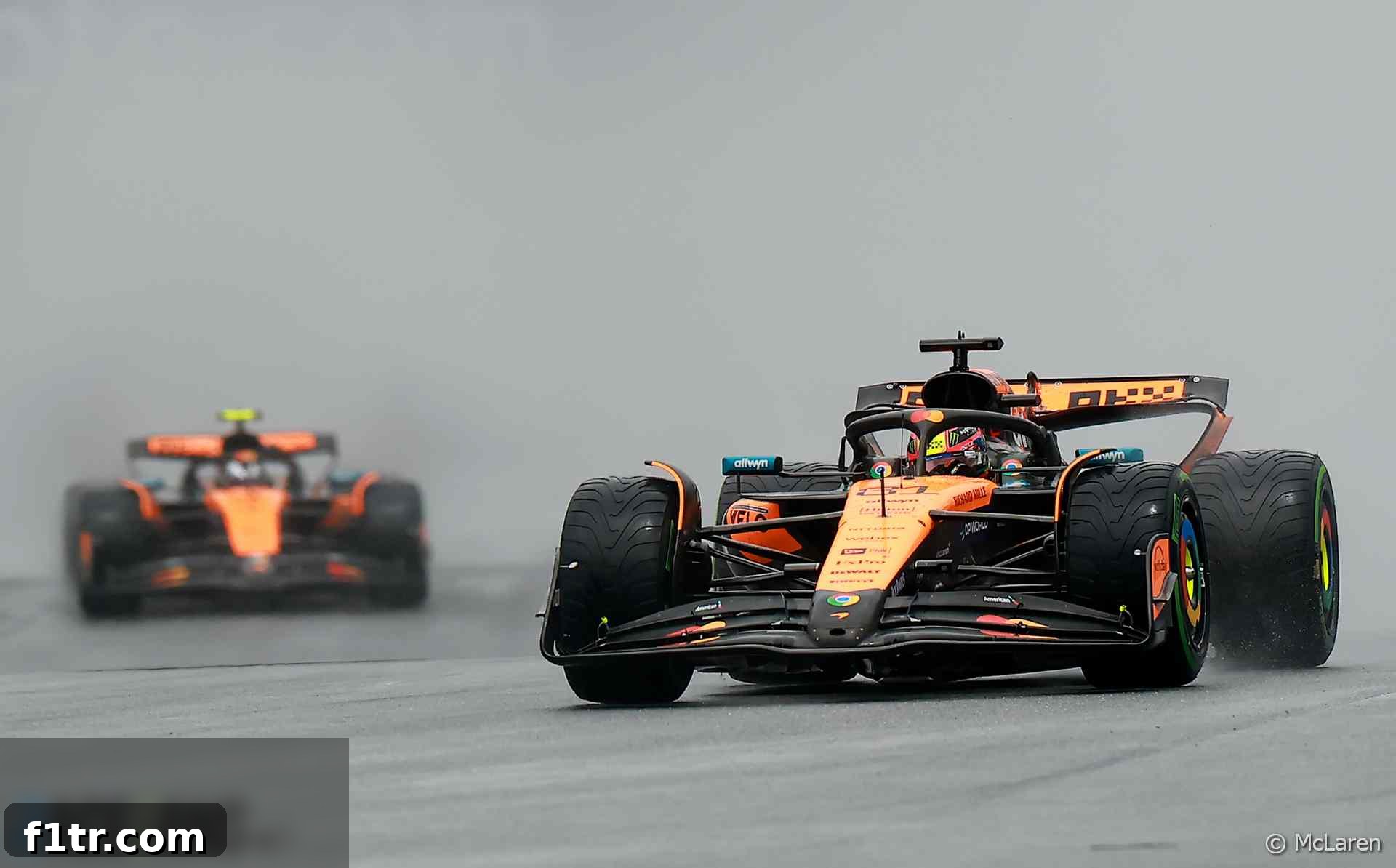
The 2025 Miami Grand Prix sprint race delivered an electrifying spectacle of high-octane drama, unexpected twists, and a memorable victory for Lando Norris. What began under the looming threat of rain quickly descended into a chaotic affair, culminating in a win that will be remembered for McLaren’s strategic prowess and a significant stroke of fortune. Max Verstappen, typically dominant, found himself on the wrong side of luck and penalties, ultimately failing to score points in a race that reshaped the early narratives of the Miami weekend.
From the moment drivers arrived at the track, the atmosphere was charged with anticipation and uncertainty. Rain began falling approximately three-quarters of an hour before the sprint race was scheduled to commence, instantly transforming the challenging Miami International Autodrome circuit into a treacherous arena. This immediate shift in conditions prompted a crucial pre-race announcement from Pirelli, Formula 1’s official tyre supplier. They increased the minimum starting pressures for front tyres by 1psi to 25.5psi, a minor but potentially impactful adjustment for grip and stability on the slick surfaces. Rear tyre pressures remained unchanged at 21.5psi.
The treacherous conditions claimed their first high-profile victim even before the race officially began. Charles Leclerc, a fan favorite and a key competitor for Ferrari, endured a disastrous reconnaissance lap. As drivers ventured out of the pits to assess the wet track and worsening rain, Leclerc lost control of his Ferrari. The incident resulted in significant damage to his car, and despite a valiant effort to drag the badly damaged vehicle back to the pits, the severity of the impact meant he would be unable to participate in the sprint race. This early setback for Ferrari cast a shadow over their weekend aspirations and highlighted the extreme challenges posed by the weather.
With Leclerc out, the starting procedure itself became an extended exercise in caution. Race control made the decision to initiate the formation lap behind the Safety Car, a move necessitated by the poor visibility reported by drivers. Piastri, running in second, grimly noted, “Visibility even in P2 is terrible,” underscoring the precarious conditions. An extra formation lap was added, further reducing the race distance by one lap and intensifying the sprint format. All drivers opted for intermediate tyres, a sensible choice given the wet track, though Carlos Sainz bravely – or perhaps optimistically – ventured out on full wets, hoping for a significant downpour that never quite materialized to his advantage.
As the grid finally formed after two cautious formation laps, race control confirmed a standing start, adding another layer of unpredictability to the already tense proceedings. When the lights went out, the sprint race truly came alive with immediate drama. Antonelli had a difficult start, going off track momentarily, which allowed Oscar Piastri to seize the lead, closely followed by Lando Norris and Max Verstappen. Further back, Liam Lawson demonstrated exceptional skill, making a great start to climb from an effective 13th position to ninth. However, his progress was hampered by a complaint about his visor, suggesting further difficulties in the challenging visibility.
The early laps were not without controversy. Race control swiftly noted Antonelli and Piastri for a potential incident at the start, indicating a review of their actions. Simultaneously, Verstappen was also flagged for potentially being out of position on the grid. While the stewards decided against investigating Antonelli and Piastri, the scrutiny on Verstappen lingered, setting a tone for a race where every move would be under intense observation.
The midfield battles were just as fierce. On lap five, Carlos Sainz and Esteban Ocon engaged in a thrilling wheel-to-wheel duel for 12th place, swapping positions twice at the end of the lap, showcasing the competitive spirit even outside the points-paying positions. This intense rivalry continued on lap eight, with the Williams driver (implied to be Albon, given Sainz’s later complaint about him) briefly getting ahead at turn 17, only to lose the place due to understeer. These close fights added another dimension to the chaotic sprint.
As the track slowly began to dry in certain areas, strategic decisions became paramount. On lap 11, Yuki Tsunoda was the first driver to commit to slicks, opting for a set of medium tyres. His decision immediately paid dividends; Tsunoda was reported to be over half a second faster than anyone else in the middle sector alone, demonstrating the potential for the slick tyres. This bold move prompted others to consider their own pit strategies, with Lewis Hamilton next to pit from sixth place on lap 14, followed by Russell and Alonso.
However, the pit lane itself became the scene of a dramatic incident that would significantly impact the race leader. Max Verstappen, coming in for his pit stop, was involved in a collision with Antonelli. Red Bull controversially released Verstappen directly into the side of the Mercedes, a clear unsafe release. This incident would later prove costly for the Dutchman. Meanwhile, Norris, showing great awareness and track management, decided to stay out for another lap while Piastri finally came in for his stop, setting up the critical sequence of events.
The race took its most significant turn on lap 14. Fernando Alonso, pushing hard, unfortunately crashed, bringing out the Safety Car. This incident proved to be a pivotal moment. While many drivers were grappling with their strategies and the changing track conditions, Lando Norris, who had managed his tyres and track position brilliantly, found himself in the lead under the Safety Car. The timing was absolutely perfect for the McLaren driver.
In the aftermath of Alonso’s crash and the Safety Car deployment, the stewards finally handed down their verdict on Verstappen’s pit lane incident. A 10-second time penalty was imposed for the unsafe release, effectively dropping him out of contention for points. This penalty, combined with the earlier incident where Hamilton had passed Verstappen’s damaged car (presumably from the pit lane collision or a subsequent issue), sealed a frustrating day for the reigning champion.
The Safety Car remained out for the final lap, ensuring a controlled finish and cementing Lando Norris’s victory. It was a “fortuitous win,” as described, where a combination of excellent driving, clever strategy, and a significant slice of luck with the Safety Car played perfectly into his hands. Norris’s triumph in Miami was a sensational result for McLaren, offering a strong boost to their season and a significant morale boost for the team. Conversely, for Max Verstappen, it was a rare and disappointing outing, failing to score points in a sprint race marked by uncharacteristic errors and penalties.
This session has finished. No further updates will be posted. For a more detailed account of the race, including Norris’s remarkable performance and Verstappen’s struggles, here’s our full report.
2025 Miami Grand Prix: Further Insights and Developments
The thrilling sprint race was just one chapter in what proved to be a captivating 2025 Miami Grand Prix weekend. The events of the sprint set the stage for further discussions and analyses that reverberated through the paddock and beyond.
- Nothing for Ferrari to learn from Miami team orders episode – Vasseur
- Hamilton proud of Ferrari as ‘we’re taking a beating from media and people’s comments’
- McLaren legality never in doubt says Piastri as FIA’s post-race check clears car
- Albon did not disobey team orders in Miami says Vowles after Sainz’s complaint
- McLaren score their most emphatic win since Hamilton’s 2008 Silverstone triumph
Browse all 2025 Miami Grand Prix articles