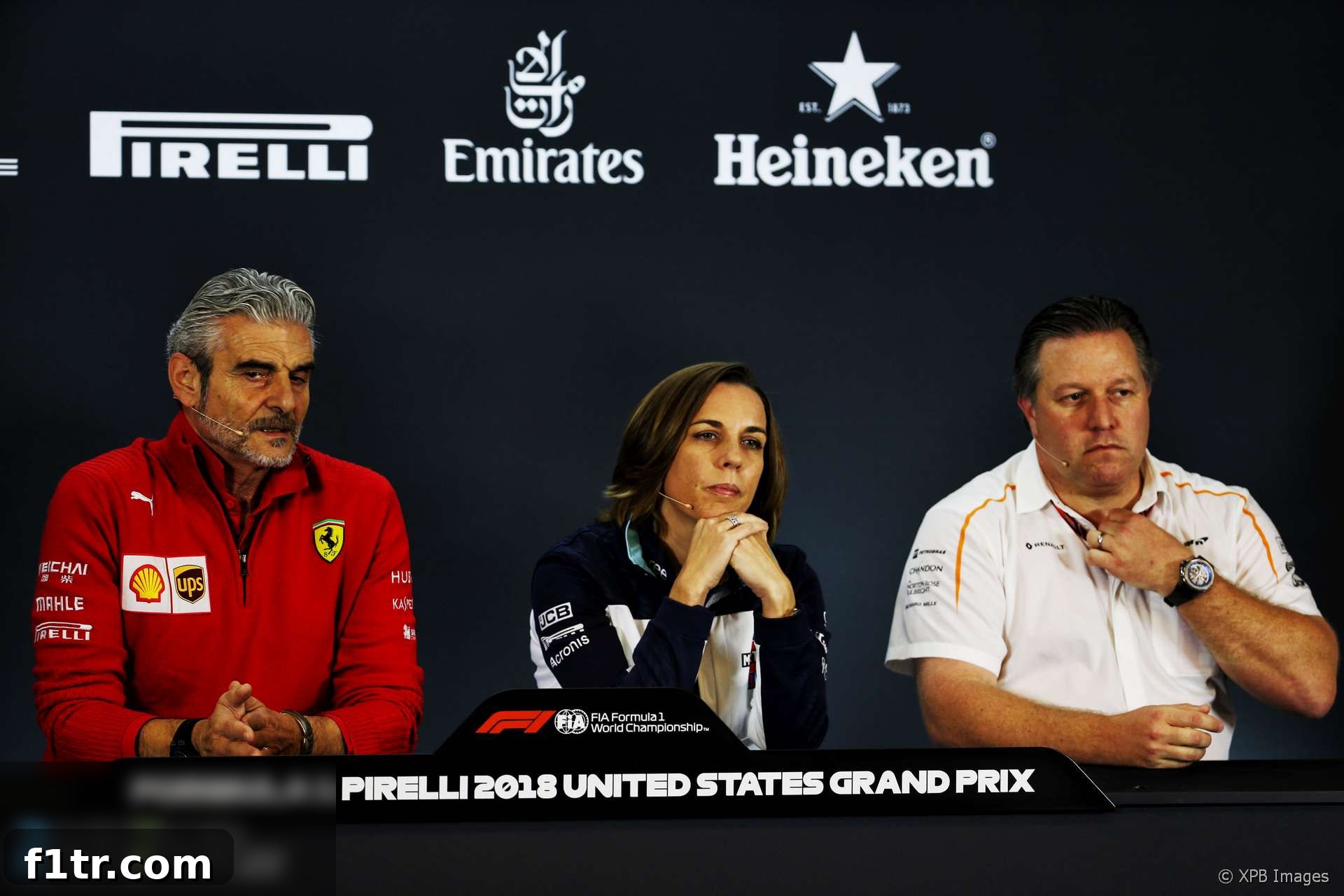
Formula 1 team principals have clarified that their recent series of private summit meetings are not indicative of a move to re-establish the Formula One Teams’ Association (FOTA), an influential body that previously united the sport’s constructors.
Advert | Become a Supporter & go ad-free
The ten competing teams have recently engaged in exclusive discussions, notably holding gatherings without representatives from either Formula One Management (FOM) or the Fédération Internationale de l’Automobile (FIA) during the Grand Prix weekends at Suzuka and Austin. A subsequent meeting was also scheduled to take place concurrently with the Mexican Grand Prix, signaling a growing trend of direct inter-team dialogue.
F1 Teams Deny FOTA Revival Amidst Crucial Private Meetings
Uniting Voices for the Future of Formula 1: Beyond FOTA’s Shadow
In a sport renowned for its intense competition, both on and off the track, the sight of rival Formula 1 teams gathering privately has historically raised eyebrows and fueled speculation. The latest series of such meetings, held away from the watchful eyes of the sport’s official governing and commercial bodies, has once again brought to the forefront discussions about team autonomy, governance, and the future direction of Formula 1 racing. However, key figures within the paddock are keen to dispel notions of a return to a specific organizational structure, emphasizing collaborative intent over confrontational unity.
McLaren CEO Zak Brown Addresses FOTA Speculation
When pressed on the matter by RaceFans, McLaren Group CEO Zak Brown firmly stated that he does not foresee a recreation of FOTA. The former union, which played a significant role in F1 politics and development from 2009 until its official disbandment in 2014, represented a collective voice for the teams. Its legacy, however, is complex, marked by periods of strong influence and eventual fragmentation.
“No, I don’t see the re-formation of FOTA,” Brown articulated, clarifying the underlying purpose of these recent gatherings. “The teams, as we all are, are working towards what the future needs to look like, and so the teams are just coming together on a more regular basis to talk about where we think the sport should go. It’s all very constructive, nothing sinister about it, and I think it’s a good thing that the teams talk more openly and share our views because ultimately we’re all trying to get the sport in a better place, and that’s the objective of the meetings.” Brown’s comments highlight a desire for proactive engagement in shaping Formula 1’s destiny, focusing on shared goals rather than forming an opposition bloc.
The FOTA Legacy: A Historical Context for Team Collaboration
To fully appreciate the significance of current team meetings and the specific denial of a FOTA reformation, it is crucial to understand the historical context of the Formula One Teams’ Association. FOTA emerged in 2008, primarily driven by Ferrari, McLaren, and Renault, as a response to concerns over cost controls, revenue distribution, and the direction of the sport under the previous leadership. Its objectives were ambitious: to present a united front for the teams in negotiations with the FIA and the commercial rights holder, to promote stability, and to work collaboratively on technical and sporting regulations.
During its active years, FOTA achieved notable successes, including influencing significant rule changes, contributing to the development of the Kinetic Energy Recovery System (KERS), and advocating for greater transparency. The association served as a powerful platform for teams to voice their collective concerns and negotiate more effectively. However, internal disagreements, particularly regarding resource distribution and the introduction of new technical regulations, eventually led to its decline. Teams began to withdraw, and by early 2014, FOTA was officially disbanded, leaving a void in organized team representation. The memory of FOTA’s challenges and its ultimate dissolution likely informs the current leaders’ cautious approach to forming similar associations, preferring a less formal, more flexible dialogue.
Mercedes’ Toto Wolff Reinforces Constructive Dialogue
Mercedes team principal Toto Wolff, whose team hospitality area generously hosted the initial two private meetings, echoed Brown’s sentiments regarding the absence of plans to resurrect FOTA. Wolff’s perspective offers further insight into the constructive spirit permeating these discussions, emphasizing transparency and open communication as core tenets.
“I think we will always be able to sit down and put things out in the open,” Wolff remarked, underscoring a commitment to direct and honest exchanges among competitors. He characterized the last team summit in Austin as “one of the rather positive meetings,” a descriptor that speaks volumes about the quality and effectiveness of the dialogue. “It was constructive. Things were openly discussed. Which generally is something that with Chase [Carey] running this paddock has become more open and transparent. The meeting this morning had a little bit of the same spirit.” This acknowledgement points to a broader shift in the F1 environment under Liberty Media’s stewardship, fostering a culture where teams feel more empowered to engage in direct, transparent discussions.
Wolff further elaborated on the crucial common ground that unites the diverse interests of the teams: “Obviously the objectives are very different between the teams but fundamentally what unites us is that we want the sport to be successful. One team or one group of teams running away with the championship, having a two-tier championship like we’re having now, we know that is not good. And that’s why the discussion was positive.” This statement cuts to the heart of the matter – the desire for a more competitive and sustainable Formula 1. The concept of a “two-tier championship,” where a few dominant teams consistently outperform the rest, poses a significant threat to the sport’s appeal and long-term viability, prompting a collective call for systemic change.
Beyond the Meetings: Shaping F1’s Future Regulations and Competitive Balance
If these meetings are not aimed at reforming FOTA, what exactly are the teams hoping to achieve? The consistent theme emerging from both Zak Brown and Toto Wolff is the collective ambition to move Formula 1 “in a better place.” This overarching goal encompasses a multitude of critical areas that will define the sport for years to come. Key among these are the upcoming regulations for engines, aerodynamics, and the implementation of a more equitable cost cap system. Teams are eager to influence these discussions to ensure a future where competitive balance is enhanced, financial sustainability is achieved across the grid, and the spectacle of racing remains paramount.
The dialogue extends to vital commercial aspects, including the redistribution of F1 revenue. Smaller, independent teams have long struggled with disproportionate financial burdens and a revenue model that heavily favors the established constructors. A more balanced revenue distribution would not only foster greater competitiveness but also secure the long-term presence of more teams, ensuring a robust and diverse grid. These private meetings serve as a crucial platform for teams to align their perspectives, understand each other’s priorities, and formulate a unified strategy to present to Liberty Media and the FIA, particularly as negotiations for future Concorde Agreements loom. The objective is not to dictate, but to collaborate and co-create a future Formula 1 that thrives on innovation, competition, and widespread appeal.
The proactive engagement signifies a maturing approach to team politics within Formula 1. Instead of reacting to proposals from above, teams are taking the initiative to collectively brainstorm solutions and advocate for changes that they believe are essential for the health of the sport. This collaborative spirit, while not manifesting in a formal association like FOTA, is arguably more potent in its ability to influence change through consensus and shared vision, rather than adversarial demands. The ultimate goal remains a stronger, more exciting, and more sustainable Formula 1 for fans and participants alike.
Advert | Become a RaceFans supporter andgo ad-free
Discover the significant lesson F1 must take from the collapse of CART in the latest instalment of Dieter Rencken’s RacingLines column later today on RaceFans.
2018 F1 Season Insights and Analysis
- F1 feared “death knell” for Drive to Survive after Ferrari and Mercedes snub
- McLaren staff told us we were “totally crazy” to take Honda engines in 2018 – Tost
- ‘It doesn’t matter if we start last’: How Red Bull’s junior team aided Honda’s leap forward
- Honda’s jet division helped F1 engineers solve power unit problem
- McLaren Racing losses rise after Honda split
Browse all 2018 F1 season articles