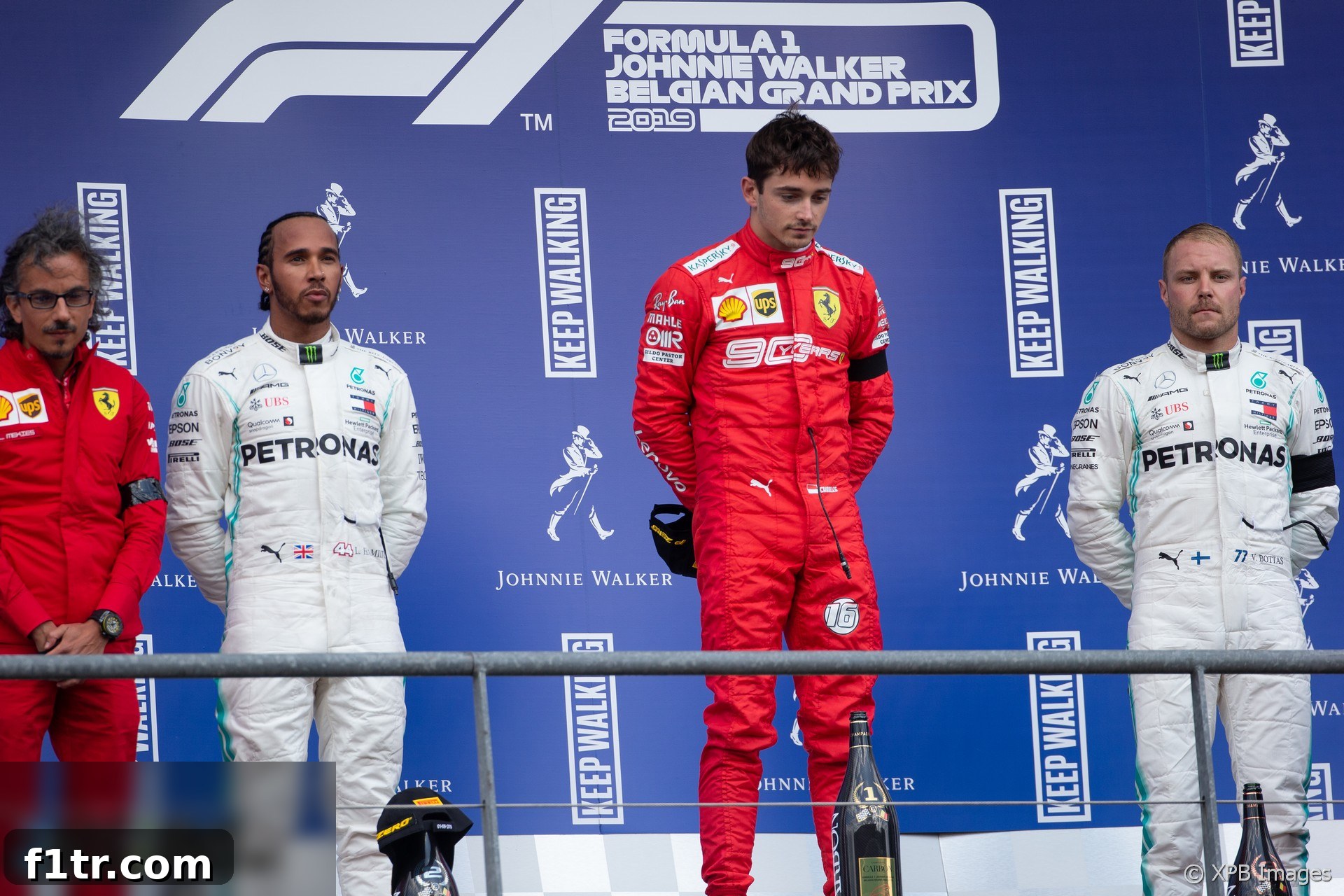
Charles Leclerc’s inaugural Formula 1 victory, achieved at the iconic Spa-Francorchamps circuit, stands as a testament to his undeniable talent and relentless ambition. Yet, this monumental career milestone was inextricably linked to a profound tragedy: the untimely death of his friend and fellow racer, Anthoine Hubert, just the day before. Leclerc himself admitted that it would take weeks, perhaps even longer, for him to truly savor and appreciate the significance of his first win, a victory that carried an almost unbearable weight of grief.
“It’s very difficult to enjoy this first win with the situation we’ve had yesterday,” Leclerc openly shared following the race. His words perfectly encapsulated the complex, conflicting emotions that enveloped not just him, but the entire motorsport community. The joy of achieving a lifelong dream was heavily clouded by the sorrow of losing a cherished friend and competitor.
A Dream Realized, A Joy Dimmed by Tragedy
For Leclerc, reaching Formula 1, let alone securing a victory, had been the apex of his aspirations since childhood. “Overall it means just a dream come true,” he explained, reflecting on his journey. “Since a child I’ve been looking up to Formula 1, dreaming to be first a Formula 1 driver, which happened last year, then driving for Ferrari this year, then the first win today.” This progression – from dreaming of F1, to becoming a driver, joining Ferrari, and finally winning – painted a picture of a meticulously crafted career ascending to its glorious peak. The win at Spa, a legendary circuit known for its unforgiving nature, made the achievement even more poignant.
However, this personal triumph was immediately juxtaposed with the stark reality of motorsport’s inherent dangers. The devastating crash involving Anthoine Hubert during the Formula 2 support race had sent shockwaves through the paddock, reminding everyone of the fragility of life at such high speeds. For Leclerc, this loss was not merely that of a fellow competitor, but a deeply personal one, impacting him on a fundamental level.
A Shared Childhood Dream, A Shattered Reality
Leclerc elaborated on the depth of his connection to Hubert, recalling their shared beginnings in motorsport. “So it’s a good day but on the other hand losing Anthoine yesterday brings me back to 2005, my first ever French championship, there was him, Esteban [Ocon], Pierre [Gasly], myself and we were four kids that were dreaming of Formula 1. We have grown up together in karting for many years and to lose him yesterday was a big shock for me but obviously for everyone in motorsport.”
This personal anecdote provided a heartbreaking insight into the camaraderie and shared journey that defines young racers. These four boys, bound by a common dream, navigated the cutthroat world of karting and junior formulas together, forging bonds that transcended mere competition. Hubert’s passing served as a brutal reminder of the risks they all knowingly embraced. The collective grief within the motorsport family was palpable, but for those like Leclerc who had shared formative years with Hubert, the shock and sorrow were particularly acute. The image of four hopeful children dreaming of Formula 1, now tragically reduced to three, cast a long shadow over what should have been an unadulterated celebration.
The emotional burden was immense. “So it was a very sad day and very difficult to enjoy it fully today hopefully in two or three weeks I will realise what happened,” Leclerc concluded, highlighting the emotional disconnect between his professional achievement and his personal grief. This period of reflection would be crucial for him to process the momentous events of that weekend, allowing the joy of victory to eventually surface from beneath the pall of sorrow.
The Unbearable Weight of the Helmet: Racing After Tragedy
Returning to the track less than 24 hours after a fatal incident presented an unprecedented psychological challenge for Leclerc and all the drivers. The very circuit where a life had been lost demanded absolute focus, courage, and a willingness to push the limits once again. “For me it was definitely the first situation like that on a track where you race the day after,” Leclerc stated, acknowledging the unique difficulty of the circumstances. “So it’s obviously quite challenging to close the visor and go through the same corner at the same speed you did before.”
This candid admission underscores the incredible mental fortitude required of Formula 1 drivers. To compartmentalize such immense grief and fear, to trust their machinery and their own abilities, and to attack corners like Raidillon – the very section where Hubert’s accident occurred – at speeds exceeding 300 km/h, speaks volumes about their psychological resilience. The act of “closing the visor” becomes a metaphor for shutting out external distractions and internal turmoil, entering a state of intense concentration where instinct and training take over. Yet, the human element can never be fully suppressed, making such a task unimaginably demanding.
Navigating the Fine Line: Speed vs. Safety
The tragedy at Spa inevitably reignited discussions about safety in motorsport. Leclerc, while acknowledging the inherent dangers, also praised the continuous efforts of the FIA (Fédération Internationale de l’Automobile) in improving safety standards across the sport. “I think everyone is working extremely hard to try to improve the security of the sport which I think should always be the priority,” he affirmed. This dedication to safety has been a cornerstone of Formula 1’s evolution, especially in recent decades.
From the introduction of the HANS device and the Halo cockpit protection system to advancements in circuit design, barrier technology, and medical response times, the FIA has consistently pushed for innovations that safeguard drivers. Significant investment in research and development has led to cars that are remarkably resilient in crashes, cockpits that offer enhanced protection, and track layouts designed to mitigate the most severe impacts. These measures have undoubtedly saved countless lives and reduced serious injuries, transforming a sport once notorious for its high fatality rate into one that, while still dangerous, is immeasurably safer than in its earlier eras.
The Enduring Danger: An Inherent Risk
Despite these monumental advancements, Leclerc maintained a pragmatic view: motor racing can never be made entirely risk-free. “But then it will always remain a dangerous sport. Obviously once you are going at this speed it is dangerous. And then here Eau Rouge is quite dangerous because the wall is quite close. So there will always be some corners that are challenging, that are more dangerous than others,” he explained. This sentiment resonates deeply within the motorsport community. The very essence of Formula 1 lies in pushing the boundaries of speed and engineering, requiring drivers to navigate complex, high-speed corners with pinpoint precision.
The iconic Eau Rouge-Raidillon complex at Spa, a rapid uphill left-right-left sequence, perfectly exemplifies these inherent challenges. Drivers experience extreme g-forces as they hurtle through the compression at the bottom before climbing a steep incline, often blind at the apex, with concrete walls in close proximity. While safety enhancements have been made to this section over the years, its fundamental nature as a high-risk, high-reward corner remains. Leclerc’s comments served as a stark reminder that even with the most sophisticated safety measures, the laws of physics and the sheer forces involved in high-speed racing mean that danger will always be an intrinsic part of the sport.
Leclerc’s Perspective and the Future of Safety
Leclerc reiterated his appreciation for the strides made by governing bodies. “But overall I think the FIA has done an incredible job in the last 20 years to improve safety in our cars.” His perspective is shared by many within F1, acknowledging the continuous, painstaking work behind the scenes to make the sport as safe as humanly possible, without compromising its thrilling essence. The balance between maintaining the spectacle of F1 and prioritizing driver safety is a constant, evolving challenge, met with unwavering commitment from the FIA, teams, and drivers alike.
The events of that Belgian Grand Prix weekend in 2019 will forever be etched in Formula 1 history. Charles Leclerc’s maiden victory, a triumphant moment for a young star and a proud day for Ferrari, will always be remembered through the lens of profound sorrow for Anthoine Hubert. It was a weekend that laid bare the raw emotions of the sport – the ecstasy of victory, the agony of loss, and the ever-present, complex relationship between speed, ambition, and danger. For Leclerc, his first F1 win was not just a career highlight; it was a deeply personal reflection on life, death, and the shared dreams of four young boys who aspired to conquer the world of Formula 1.
2019 F1 Season Insights
- Crying in the Melbourne car park at 2019 grand prix was my career low – Ocon
- McLaren Racing reports reduced £71 million loss in 2019
- Kvyat: Hockenheim podium last year was “my biggest achievement” so far
- How the FIA’s new encrypted fuel flow meter targets Ferrari’s suspected ‘aliasing’ trick
- “He smashed my office door”: 23 must-see moments from ‘Drive to Survive’ season two
Browse all 2019 F1 season articles