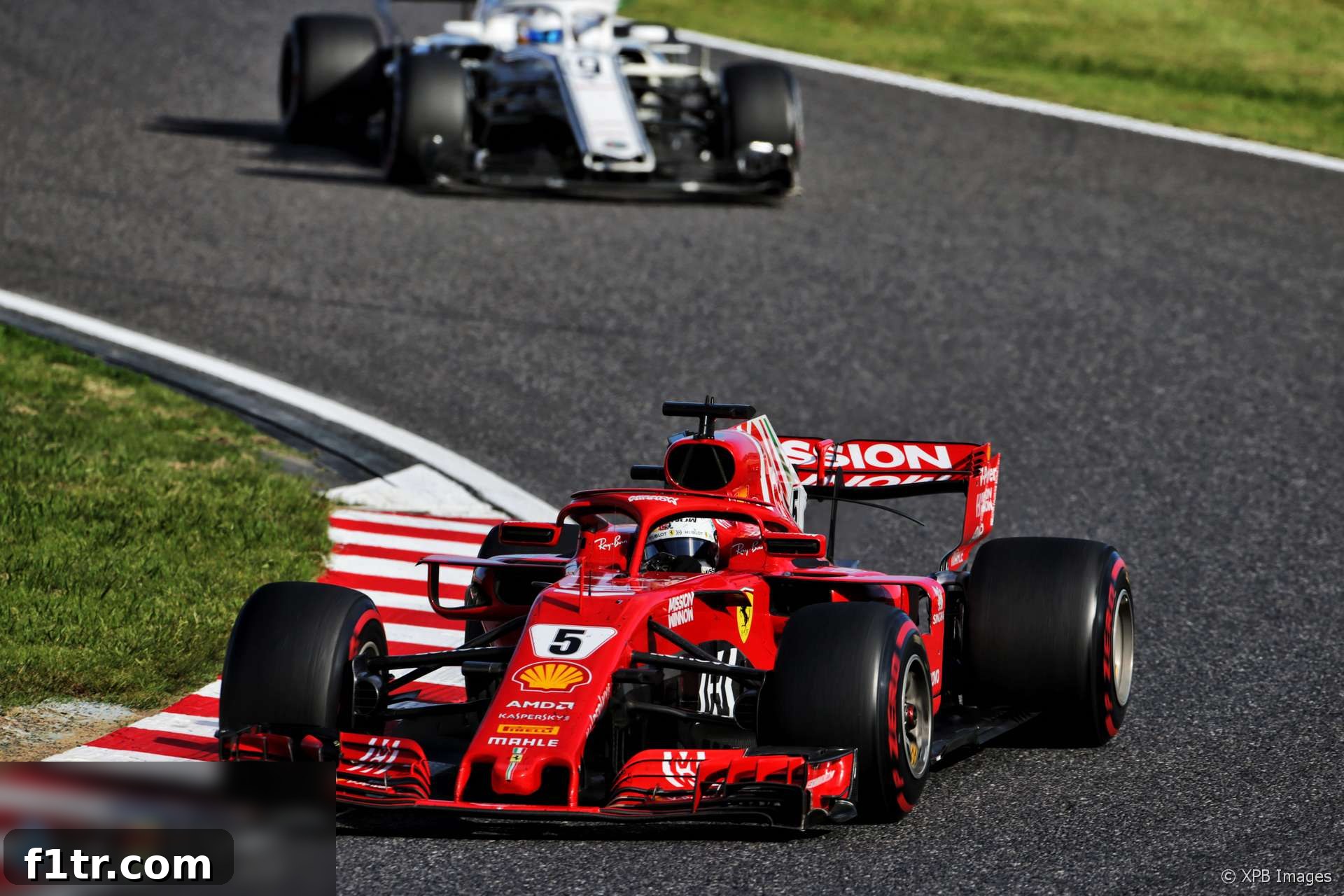
Sebastian Vettel found himself at the center of a heated debate following a dramatic collision with Max Verstappen during the 2018 Japanese Grand Prix. The incident, which occurred at the challenging Spoon Curve, saw the two formidable drivers come together while fiercely contesting third place. Despite the contact costing him track position and valuable time, Vettel remained resolute in his stance, asserting that he “wasn’t desperate to get past” Verstappen but was simply seizing a legitimate opportunity. This high-octane encounter became a significant talking point of a season already laden with tension and championship implications, highlighting the fine line between aggressive racing and avoidable contact in the pinnacle of motorsport.
The Suzuka Showdown: An Unforgettable Clash at Spoon Curve
The Suzuka Circuit, revered for its technical demands and high-speed sections, proved to be the backdrop for a pivotal moment in the 2018 Formula 1 season. With the championship battle reaching its crescendo, every point and every position was crucial. As the race unfolded, Sebastian Vettel, driving for Ferrari, found himself locked in a fierce battle with Red Bull’s Max Verstappen for the coveted third spot. The incident in question unfolded at Spoon Curve, a notoriously tricky double-apex left-hander that demands precision and commitment from drivers. Vettel, having closed in on Verstappen, saw an opening and launched an overtake attempt on the inside.
What ensued was a clash that would ignite discussions across the F1 paddock and among fans worldwide. Vettel’s Ferrari made contact with Verstappen’s Red Bull, sending both cars wide and disrupting their races. The collision was particularly contentious because Verstappen had already incurred a five-second time penalty earlier in the race for an incident involving Kimi Raikkonen. This prior penalty added another layer of complexity to Vettel’s decision-making, as he was aware that he didn’t necessarily need to pass Verstappen on track to gain a net advantage if the Dutchman’s penalty was factored in. However, the German driver’s instinct to race and secure position on merit ultimately prevailed, leading to the unfortunate contact.
Advert | Become a Supporter & go ad-free
Vettel’s Unwavering Stance: “I Don’t Regret the Move”
In the aftermath of the Japanese Grand Prix collision, Sebastian Vettel was unequivocal in his defense of the move. Addressing the media, the four-time world champion stated firmly, “I don’t regret the move.” This declaration underscored his belief that the overtake attempt was not only justifiable but also strategically sound in the heat of the moment. While acknowledging that hindsight often offers a different perspective, Vettel emphasized that from inside the cockpit, all the crucial elements aligned to make the move a viable one.
Vettel meticulously broke down his thought process, detailing the precise conditions that compelled him to go for the overtake. He explained, “But inside the car, the gap was there, his battery was clipping, I was boosting, I saved my battery, I had more speed, I would make the corner, I was side-by-side and he didn’t give enough room and we touched.” This detailed account painted a picture of a calculated maneuver rather than a desperate lunge. He highlighted his car’s superior pace at that specific moment, aided by energy management strategies that allowed him to deploy a boost while Verstappen’s battery was “clipping,” indicating a temporary power reduction. Vettel was confident in his ability to make the corner cleanly, having positioned his car alongside Verstappen, suggesting that the Red Bull driver’s failure to yield adequate space was the primary cause of the contact. This perspective firmly placed the onus on Verstappen for the collision, maintaining that a professional driver should always leave racing room for a competitor who is alongside.
A Pattern of Aggression? Vettel Cites Verstappen’s Raikkonen Incident
Sebastian Vettel further bolstered his argument by drawing a parallel to Max Verstappen’s earlier incident with Kimi Raikkonen during the very same race. Verstappen had received a five-second penalty for that prior contact, an outcome that, in Vettel’s view, illuminated a concerning pattern in the young Dutchman’s driving style. Vettel articulated his perception that Verstappen tends to be overly unwilling to concede space to his rivals, pushing the limits of fair racing rather than adhering to the established etiquette of leaving sufficient room when another car is alongside.
“I was obviously pushing to get past but I wasn’t desperate to get past,” Vettel reiterated, addressing concerns that his championship aspirations might have led to an impulsive decision. He acknowledged awareness of Verstappen’s penalty but emphasized his conviction that his Ferrari possessed superior pace, making the on-track pass a natural objective. “I knew he had a penalty but I also felt that we were faster. And then he was clipping on that straight with the battery and I was catching, I had a good exit. Obviously the Safety Car helped to be closer.” This sequence of events, from a good Safety Car restart to optimal energy deployment, created the perfect storm for Vettel to launch his attack.
Vettel continued to elaborate on Verstappen’s perceived defensive tactics: “The gap was there but as soon as he saw me obviously he defended. But I had the inside. As soon as he realised somebody is close or next to him he tries to, in my opinion, push when you shouldn’t push any more.” This pointed critique suggested that while defending is a legitimate part of racing, there comes a point where a driver must acknowledge the presence of a competitor and avoid an inevitable collision by ceding just enough space. The four-time champion referenced the Raikkonen incident directly: “I mean look at Kimi: he’s off the track and he comes back and if Kimi just drives on they collide. But it’s not always right that the other guy has to move. We’re all racing, the race is long, for me the gap was there otherwise I don’t do it. I think I got through the whole field without any trouble, sometimes closer, sometimes with more margin.” Vettel’s assessment highlighted the fundamental principle of racing: while competition is fierce, a degree of mutual respect and spatial awareness is paramount to avoid unnecessary incidents. He concluded, “It’s normal that sometimes it gets close but I think you need to always leave a space. In that case I couldn’t go anywhere and then we touched.”
The Stewards’ Verdict: A Balanced Assessment
Following a thorough review of the incident by the race stewards, a verdict was delivered that steered clear of assigning sole blame to either driver. The official ruling stated that “no driver was wholly or predominantly to blame for the incident.” This decision reflected the complex nature of the on-track battle and the difficulty in definitively apportioning fault in high-speed, side-by-side racing scenarios. While it might have left some fans and drivers wanting a clearer resolution, it underscored the nuanced interpretation often required in assessing racing incidents. The stewards acknowledged the aggressive racing from both sides, recognizing that both drivers contributed to the situation without one being overwhelmingly at fault, ultimately classifying it as a racing incident inherent to the competitive nature of Formula 1.
Advert | Become a RaceFans supporter andgo ad-free
Implications and the Broader Context of the 2018 Season
The collision between Sebastian Vettel and Max Verstappen at Suzuka was more than just an isolated incident; it was a microcosm of the intense pressures and rivalries that defined the 2018 Formula 1 season. For Vettel, who was engaged in a challenging championship fight against Lewis Hamilton, every setback felt magnified. While this particular incident didn’t directly cost him a win, it was another point of frustration in a season where momentum often seemed to slip away. His insistence on the legitimacy of his move, even in the face of contact, underscored his championship-winning mindset and his relentless pursuit of every possible position.
For Max Verstappen, the incident, coupled with his earlier penalty for contact with Kimi Raikkonen, reinforced a burgeoning reputation for aggressive, uncompromising racing. While thrilling for spectators, this style often led to controversies and penalties. The Suzuka double-whammy only added fuel to the debate surrounding his approach to wheel-to-wheel combat, particularly when battling seasoned veterans like Vettel and Raikkonen. The stewards’ verdict of a ‘racing incident’ for the Vettel clash, while not penalizing Verstappen further, did little to quell the discussion about driver etiquette and the responsibility to leave room.
Ultimately, the Japanese Grand Prix collision served as a potent reminder of the razor-thin margins and instantaneous decisions that define Formula 1 racing. It highlighted the eternal tension between outright aggression and strategic caution, between seizing an opportunity and knowing when to back out. Both drivers, known for their competitive spirit, found themselves embroiled in an incident that encapsulated the fierce nature of F1. While the immediate outcome saw neither driver fully blamed, the event certainly left an indelible mark on the narrative of the 2018 season and continued to shape the perceptions of two of the sport’s most captivating personalities.
2018 F1 season
- F1 feared “death knell” for Drive to Survive after Ferrari and Mercedes snub
- McLaren staff told us we were “totally crazy” to take Honda engines in 2018 – Tost
- ‘It doesn’t matter if we start last’: How Red Bull’s junior team aided Honda’s leap forward
- Honda’s jet division helped F1 engineers solve power unit problem
- McLaren Racing losses rise after Honda split
Browse all 2018 F1 season articles