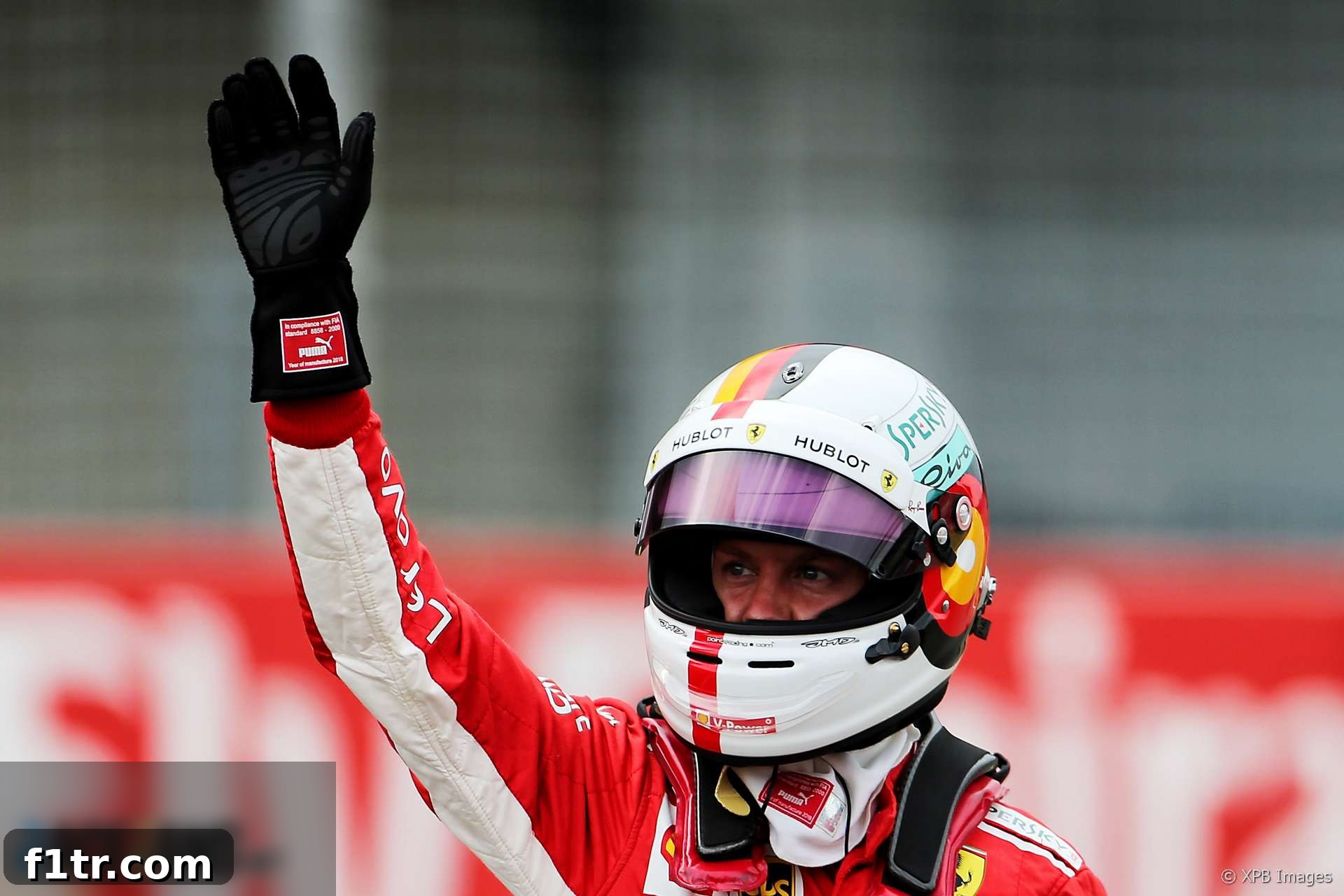
The 2018 German Grand Prix qualifying at the iconic Hockenheimring delivered an exhilarating and often shocking spectacle, culminating in a triumphant home pole position for Sebastian Vettel and Ferrari. While the German hero celebrated a dominant performance, the session was equally defined by the stunning and premature exit of championship leader Lewis Hamilton in Q1, his Mercedes hobbled by an unexpected hydraulic failure. This dramatic turn of events reshaped the grid and set a thrilling precedent for Sunday’s race, promising high stakes and intense competition from the very start.
Dominant Display: Vettel Secures Hockenheim Pole as Hamilton Stumbles in German Grand Prix Qualifying
In a qualifying session brimming with contrasts, Sebastian Vettel demonstrated Ferrari’s formidable pace on his home turf. The Scuderia-powered cars dictated much of the narrative, showcasing a distinct advantage throughout the different phases. However, the most talked-about moment was undeniably Lewis Hamilton’s unprecedented struggle and subsequent elimination during the very first phase. A damaged car, initially suspected to be kerb-related, quickly evolved into a critical hydraulic failure, sending shockwaves through the Formula 1 paddock and dramatically altering the championship landscape even before the race began.
Q1: Lewis Hamilton’s Shock Exit Rocks Hockenheim
Following a thoroughly wet Free Practice 3 session earlier in the day, the Hockenheimring had thankfully dried out considerably by the time Q1 commenced. This rapid transition from damp to dry conditions immediately saw lap times plummet back to the competitive levels witnessed during Friday’s Free Practice 2. While the earlier wet session had offered a glimmer of hope for teams like Sauber and Williams, allowing them to temporarily mask their pace deficit, the return to a dry track quickly exposed their underlying struggles. Both Lance Stroll and Sergey Sirotkin found themselves deep within the elimination zone from the outset, facing a daunting challenge to progress further.
The bottom half of the leaderboard proved to be a fiercely contested area, with several prominent drivers battling to escape the dreaded drop zone. Sergio Perez, both Toro Rosso drivers, and both McLarens were precariously positioned, each fighting for crucial tenths of a second. Fernando Alonso, a two-time world champion renowned for his qualifying prowess, found himself on the bubble for much of the session, highlighting the intense midfield competition. His teammate, Stoffel Vandoorne, regrettably struggled to find any significant pace, remaining at the tail end of the field throughout Q1.
However, the true seismic event of Q1 originated from an entirely unforeseen quarter: Lewis Hamilton. The championship leader endured two unusually untidy laps, visibly wrestling with his Mercedes W09. He was conspicuously off the pace of his teammate, Valtteri Bottas, and the leading Ferraris, sliding wide and making significant contact with the kerbs on at least two occasions. The initial cause of his struggles was subject to immediate speculation – whether an underlying car issue forced his errors or if the forceful contact with the kerbs subsequently damaged his car. After his second major excursion, a chilling radio message confirmed the dire situation: Hamilton reported he couldn’t change gear, seemingly stuck in fourth, a clear indication of a severe mechanical malfunction.
In a desperate bid, Hamilton attempted to nurse his stricken car back to the pit lane. Had he succeeded in returning to the garage, his previously set lap time might have been sufficient to see him through to Q2. However, moments later, cameras captured the poignant scene of Hamilton disembarking his car near Turn 10, a forlorn figure attempting to push the heavy Formula 1 machine for the remaining five turns back to safety. It was a powerful image that encapsulated the despair of a champion facing an insurmountable obstacle.
Mercedes swiftly confirmed via team radio that the issue was indeed hydraulic, a critical system failure impacting the gearbox. Furthermore, they relayed a stark warning of a significant risk of irreparable damage to the power unit if he continued to attempt to move the car, prompting Hamilton to ultimately stop the car on their direct command. While his earlier lap time technically placed him in a provisional Q2 slot, his inability to bring the car back or participate further sealed his elimination. The dramatic turn of events meant that Stoffel Vandoorne, Lance Stroll, and both Toro Rosso drivers – Pierre Gasly and Brendon Hartley – were officially eliminated in the first qualifying session. They were joined by Esteban Ocon, who was agonizingly bumped into the drop zone by a surprisingly quick, late lap from Sergey Sirotkin, underscoring the cut-throat nature of Formula 1 qualifying and the fine margins separating success from failure.
Drivers Eliminated in Q1 at Hockenheim
| 16 | Esteban Ocon | Force India-Mercedes | 1’13.720 |
| 17 | Pierre Gasly | Toro Rosso-Honda | 1’13.749 |
| 18 | Brendon Hartley | Toro Rosso-Honda | 1’14.045 |
| 19 | Lance Stroll | Williams-Mercedes | 1’14.206 |
| 20 | Stoffel Vandoorne | McLaren-Renault | 1’14.401 |
Q2: Red Flag Drama and Shifting Fortunes in German GP Qualifying
The second qualifying session, Q2, commenced with a notably altered competitive landscape, primarily due to strategic decisions and unfortunate mechanical failures. Daniel Ricciardo, facing significant grid place penalties for power unit component changes, made the pragmatic choice not to run in Q2. His maximum achievable starting position for Sunday’s race was already fixed at fifteenth, rendering any further qualifying efforts largely redundant. With Lewis Hamilton also unable to set a time due to his earlier hydraulic failure, the on-track competition for elimination was narrowed to just three drivers, fundamentally changing the strategic considerations for the midfield teams vying for a coveted spot in Q3.
Both Sauber cars had commendably progressed into Q2 once again, a testament to their improving performance throughout the season. However, Marcus Ericsson found himself struggling to match the impressive pace set by his teammate, Charles Leclerc. Ericsson’s session took a dramatic and costly turn when, halfway through, he spun into the gravel trap at Turn 13, scattering debris across the track. This incident promptly brought out the red flag, temporarily halting the session. The timing was particularly disruptive for several drivers who were in the middle of crucial hot laps, forcing them to abort and lose valuable track time and momentum. The subsequent clean-up operation led to a substantial, anxiety-inducing break in qualifying, adding an extra layer of tension as drivers waited for the green flag to resume their fight for Q3.
When the session finally resumed, the battle against the clock intensified significantly. The remaining drivers pushed their machines to the absolute limit in a frantic dash for a top-ten spot. As the chequered flag waved, it was Fernando Alonso and Sergey Sirotkin who ultimately joined Marcus Ericsson in the elimination zone. The two McLaren and Williams cars, both suffering from performance deficits, found themselves clustered in the lower half of the grid for Sunday’s race, a stark reminder of the ongoing challenges faced by these historic teams in the 2018 season. The absence of two championship front-runners, Hamilton and Ricciardo, meant that while the usual top-tier contenders were missing, the midfield battle was as fierce and unforgiving as ever, with every driver meticulously pushing to secure their place in the final, decisive qualifying segment.
Drivers Eliminated in Q2 at Hockenheim
| 11 | Fernando Alonso | McLaren-Renault | 1’13.657 |
| 12 | Sergey Sirotkin | Williams-Mercedes | 1’13.702 |
| 13 | Marcus Ericsson | Sauber-Ferrari | 1’13.736 |
| 14 | Lewis Hamilton | Mercedes | No time |
| 15 | Daniel Ricciardo | Red Bull-TAG Heuer | No time |
Q3: Vettel’s Masterclass Secures Home Pole Position
As the qualifying session progressed into its final and most thrilling phase, Q3, the Hockenheimring track conditions continued their dramatic improvement. Grip levels were significantly higher, with drivers finding as much as seven-tenths of a second in lap time gains from Q1 alone. Furthermore, track temperatures were steadily climbing, increasing by more than five degrees Celsius by the time the top ten contenders took to the circuit for their pole position battle. This track evolution, combined with the increasing ambient temperatures, played a crucial role in extracting maximum performance from the cars, especially benefiting those that thrived in warmer conditions and offered superior mechanical grip.
Throughout the preceding qualifying sessions, Ferrari-powered cars had consistently demonstrated their superior strength and adaptability to the Hockenheim layout. This was evident not only in Sebastian Vettel’s and Kimi Raikkonen’s impressive pace, which saw them top Q1 times, but also in the sheer number of Ferrari-engined vehicles making it into Q3 – with only Marcus Ericsson, from the Ferrari-powered Sauber contingent, missing out. Their consistent performance hinted at a strong setup and an inherent speed advantage for Ferrari and its customer teams at Hockenheim, setting the stage for a potential red wave on the front row.
With two of the sport’s heavyweights, Lewis Hamilton and Daniel Ricciardo, unexpectedly out of the top ten fight, the onus fell squarely upon Valtteri Bottas to salvage Mercedes’ fortunes and mount a challenge for pole. The Finn initially delivered a promising lap, clocking in at 1’11.416, a time that was over a tenth quicker than Kimi Raikkonen’s best effort at that point. For a brief, thrilling moment, it appeared that Bottas might just be able to challenge for pole and provide a much-needed morale boost for the Silver Arrows in front of their home crowd.
However, Sebastian Vettel, racing on home soil with the weight of expectation on his shoulders, had other plans. In a masterful display of precision, raw speed, and unwavering focus, he responded decisively to Bottas’s challenge. His scorching lap of 1’11.212 was an emphatic statement, comfortably securing pole position for his cherished home race by a significant margin. The thunderous roar from the German crowd was palpable, celebrating their national hero’s stellar achievement. Vettel’s pole was not merely a personal triumph but also a crucial psychological victory for Ferrari in their tightly contested championship campaign.
Behind the dominant Ferraris and the sole remaining Mercedes of Bottas, the battle for the “best of the rest” was fiercely contested and equally thrilling. Kevin Magnussen proved to be the standout performer in this category, expertly guiding his Ferrari-powered Haas to a superb fifth place on the grid with a time of 1’12.200, just over a second back from Vettel’s blistering pace. This was an excellent and validating result for the American team, underscoring their significant progress in the 2018 season. Moreover, Ferrari junior Charles Leclerc, driving for Sauber, continued to impress with his burgeoning talent. His emerging skill shone through as he managed to outperform one of the only two Mercedes-powered cars in the top ten, pushing Sergio Perez of Force India down to the tenth and final spot in Q3, further solidifying the young Monegasque’s reputation as a future star. The collective performance of Ferrari and its client teams painted a strong picture of their capabilities at Hockenheim.
The stage was thus set for what promised to be an enthralling German Grand Prix. With Sebastian Vettel on pole, Valtteri Bottas alongside him, and a mix of seasoned veterans and rising stars filling out the top ten, all drivers were eager to capitalize on Hamilton’s misfortune and Ferrari’s undeniable pace, promising a truly unforgettable race weekend.
Top Ten in Q3 – 2018 German Grand Prix Qualifying Results
| 1 | Sebastian Vettel | Ferrari | 1’11.212 |
| 2 | Valtteri Bottas | Mercedes | 1’11.416 |
| 3 | Kimi Raikkonen | Ferrari | 1’11.547 |
| 4 | Max Verstappen | Red Bull-TAG Heuer | 1’11.822 |
| 5 | Kevin Magnussen | Haas-Ferrari | 1’12.200 |
| 6 | Romain Grosjean | Haas-Ferrari | 1’12.544 |
| 7 | Nico Hulkenberg | Renault | 1’12.560 |
| 8 | Carlos Sainz | Renault | 1’12.692 |
| 9 | Charles Leclerc | Sauber-Ferrari | 1’12.717 |
| 10 | Sergio Perez | Force India-Mercedes | 1’12.774 |
2018 German Grand Prix Coverage
Explore more in-depth analysis and highlights from the dramatic 2018 German Grand Prix weekend:
- 2018 German Grand Prix Star Performers
- Vettel is first driver to crash out of the lead solo in 13 years
- Top ten pictures from the 2018 German Grand Prix
- Hamilton rains on Vettel’s parade
- Paddock Diary: German Grand Prix day four
Browse all 2018 German Grand Prix articles