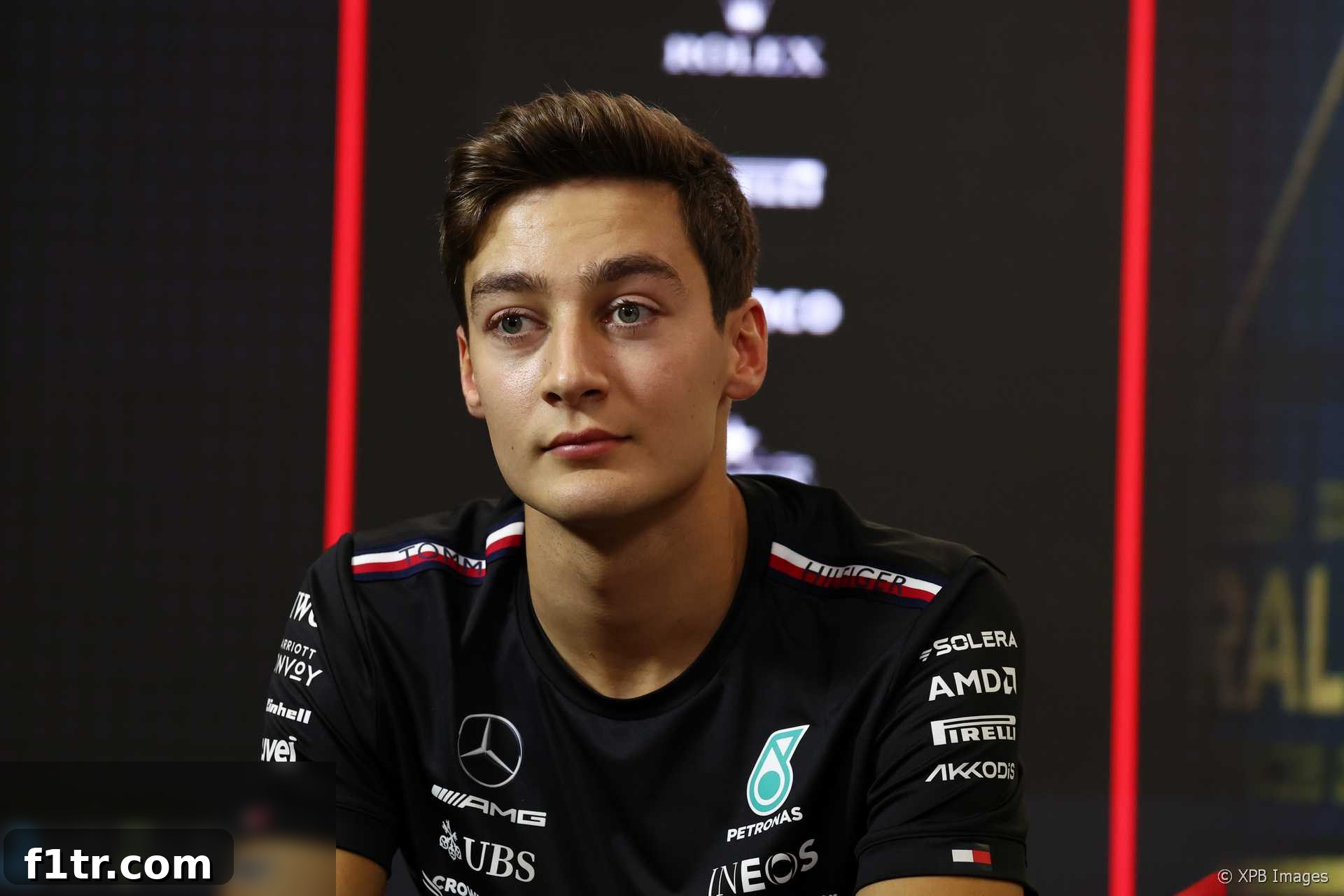
Mercedes F1’s Rapid Progress: George Russell Highlights More Gains in Weeks Than All Winter
Mercedes-AMG Petronas F1 Team driver George Russell has provided a compelling insight into the Silver Arrows’ ongoing development efforts, indicating a significant acceleration in their performance trajectory. According to Russell, the team has achieved more substantial performance improvements in the weeks leading up to the Australian Grand Prix than during the entire preceding winter development phase. This revealing statement underscores the intense period of re-evaluation and rapid adaptation within the Brackley-based squad, which has been working tirelessly to overcome a challenging start to the 2023 Formula 1 season.
Mercedes entered the 2023 campaign with high expectations, particularly after demonstrating a strong recovery towards the end of the previous season. However, the initial outings of their W14 challenger quickly revealed that the car was not performing at the desired level, necessitating a swift and decisive change in their technical philosophy. The team found itself battling not only the dominant Red Bull Racing but also being outperformed by its power unit customer, Aston Martin, leading to a period of introspective analysis and urgent remedial action.
A Disappointing Start and a Shift in Mercedes’ F1 Strategy for 2023
The 2023 F1 season presented an unexpected hurdle for Mercedes. After a turbulent 2022 campaign marked by persistent porpoising issues and a complex car concept, the team had anticipated a significant leap forward with the W14. However, both pre-season testing and the opening Grand Prix in Bahrain delivered a stark reality check. The new car displayed a notable lack of outright pace and inconsistent balance, positioning Mercedes firmly behind the formidable Red Bull RB19 and, notably, the highly impressive Aston Martin AMR23.
“I think it’s a case of managing expectations and just focusing on yourself and that development,” Russell openly admitted ahead of the Australian Grand Prix. His words reflect a pragmatic approach from a team that has had to recalibrate its immediate aspirations for the season. The initial development strategy over the winter had been a logical evolution of the successful path taken in the latter half of 2022, which culminated in a victory at the Brazilian Grand Prix. This approach, while grounded in past success, ultimately failed to translate into the competitive performance required on track.
Russell further elaborated on the team’s surprise at the W14’s initial performance: “We all believed over the winter what we were doing was correct because it was an evolution of what we did throughout last year. And we all saw the improvements we made as a team throughout last year to win a race at the end of the year and be fighting at the front. It caught us by surprise to see the lack of performance when we hit the track in Bahrain and that’s why we were quick to change our approach.” This candid assessment highlights the disconnect between the team’s simulations and the car’s real-world behavior, prompting an immediate pivot in their development direction.
The Immediate Response: Mercedes’ Rapid Strategic Pivot
The realization that their winter development path might have led them down a “wrong window” spurred an intense and immediate response from Mercedes’ engineering and design teams. Russell revealed the urgency of this adaptation, highlighting that significant changes began even during the very first race weekend of the season. “Already on the Saturday night of the Bahrain Grand Prix we were trying different things, going in a different direction with the development because we’d recognised we’d maybe gone too far,” he confirmed, showcasing the team’s capacity for rapid course correction.
This swift pivot underscores the high-stakes environment of Formula 1 development and Mercedes’ unwavering commitment to addressing performance deficits without delay. While specific technical details of these “different things” remain confidential, they undoubtedly involve fundamental re-evaluations of the car’s aerodynamic philosophy, suspension geometry, and potentially even aspects of its chassis design. The data and understanding gleaned from the initial races allowed Mercedes to pinpoint critical areas where their theoretical models diverged from the dynamic demands of an F1 car on track, necessitating a more radical shift than initially conceived.
Despite the intensified development efforts, Russell maintained a grounded and realistic perspective on the immediate outlook, openly acknowledging the formidable performance gap to their key rivals. “So I’m not going to sit here and say we’re incredibly optimistic. What I always say is we are making improvements and that should translate into lap time. But we recognise that Red Bull are over a second down the road at the moment,” he admitted. This honest assessment underscores the monumental challenge Mercedes faces in closing the gap to the dominant Red Bull RB19, which has set a blistering pace in the early rounds of the championship, establishing itself as the benchmark for 2023.
Unlocking the W14’s Potential: Significant Gains in a Short Period
Russell’s most compelling revelation pertains to the recent acceleration of Mercedes’ development curve. He expressed genuine confidence that the W14 has already begun to demonstrate improved speed and a better operating window compared to its initial frustrating outings in Bahrain. The critical period in question appears to be the two to three weeks preceding the Australian Grand Prix, during which the team’s focused efforts have yielded disproportionately greater performance gains than the entire preceding off-season development cycle.
“We’re working really hard at the moment with these changes, so I won’t give too much away,” Russell hinted, suggesting significant technical innovations. “We need to make sure that they work as expected. But we’re probably finding more gains in the past two or three weeks than we found over the whole winter by clearly developing in the wrong window. So it’s definitely heading in the right direction.”
This statement serves as a powerful testament to the team’s exceptional ability to learn, adapt, and innovate under pressure. It strongly suggests that Mercedes has not only accurately identified the core issues hindering the W14’s performance but has also successfully shifted into a more productive development direction. The “wrong window” likely refers to a conceptual design or aerodynamic path that, while potentially promising in controlled simulations, did not translate effectively to the complex and dynamic environment of a Formula 1 car on a race track. By moving away from this suboptimal path, the team has seemingly unlocked a more effective route to extracting performance, whether through enhanced aerodynamic efficiency, improved mechanical grip, or a more optimized operating range for the car’s intricate components.
Such rapid acceleration in development is a clear indicator of the profound engineering prowess, vast resources, and deep technical understanding available within the Mercedes-AMG F1 team. It speaks to a profound comprehension of complex aerodynamic flows, chassis dynamics, and tire interactions that, once the initial conceptual hurdle was overcome, allowed for a surge in performance discovery and a renewed sense of optimism within the team.
The Road Ahead: Patience, Persistent Development, and Championship Ambitions
Despite these encouraging signs of internal progress and accelerated development, Russell prudently cautioned that visible changes and dramatic performance leaps on track will not materialize instantly. Formula 1 car development is an inherently meticulous and time-consuming process, with major upgrades requiring extensive design, rigorous manufacturing, and comprehensive testing before they can be effectively deployed on a competitive racing car.
“Mercedes’ updates will take time to arrive,” Russell explained, managing expectations for immediate, dramatic transformations in the W14’s external appearance or instant lap time improvements. “Big changes are incremental. There’s nothing that you’ll see on the car this weekend because naturally you can’t get things brought that quickly to the car. But I think in due course we’ll see some big changes and hopefully the lap times represent that.”
This message of patience is vital for fans, media, and observers alike. While the internal rate of development might be exceptionally high, the physical manifestation of these gains in the form of newly designed components and substantial on-track performance improvements will necessitate several race weekends. The team is likely focusing on fundamental aerodynamic reworks, potentially including revised sidepod concepts, updated floor designs, and refined suspension geometry, all meticulously aimed at optimizing airflow, maximizing downforce generation, and improving the car’s balance across various speed ranges and track conditions.
Ultimately, Mercedes’ core ambition remains steadfast and undimmed. Despite the current challenges and the competitive deficit, the team’s long-term goal is unequivocally clear: “We’re here to fight for victories, for the championship, and clearly we’re not in a position to do that at the moment,” Russell firmly affirmed. This unwavering commitment to challenging for the highest honors in Formula 1 serves as a powerful and enduring motivator for every individual within the team, from the factory floor to the pit wall. The immediate and primary focus is on systematically closing the performance gap to both Red Bull and Aston Martin, consistently securing podium finishes, and, eventually, returning to the top step of the rostrum.
The journey back to championship contention will undoubtedly be arduous, demanding sustained effort, innovative engineering solutions, and flawless execution from every member of the team. However, George Russell’s latest insights offer a significant glimmer of hope and a clear indication that Mercedes is not merely reacting to its current predicament but is proactively, intelligently, and effectively tackling the challenges presented by the W14. The coming races will serve as a critical test of their rapid development capabilities and their strategic acumen as they strive to transform internal gains into tangible on-track performance, relentlessly pushing towards their ultimate goal of Formula 1 supremacy.