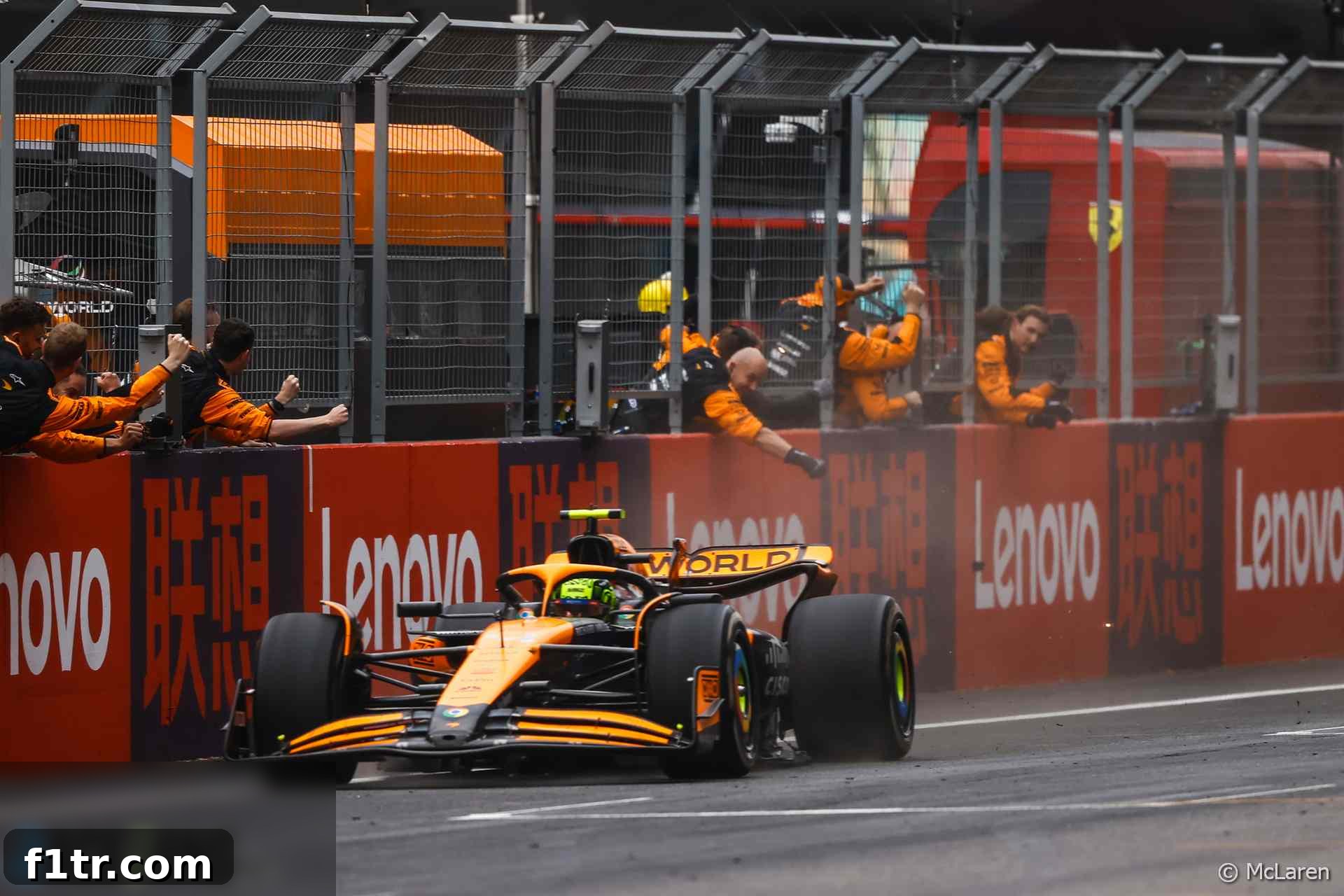
Lando Norris delivered an astonishing performance at the Chinese Grand Prix, securing McLaren’s best result of the 2024 season with a spectacular second-place finish. This achievement came despite the team’s genuine and vocal pre-race doubts regarding their competitiveness at the Shanghai International Circuit. The British driver’s podium placement, nestled between the dominant Red Bull machines, not only defied expectations but also provided a significant boost to McLaren’s championship aspirations.
The journey to this remarkable P2 finish was far from straightforward, especially considering the contrasting performance in the earlier Sprint Race. Norris had impressively qualified on pole position for the sprint but subsequently dropped to sixth place due to a compromised start. This initial setback further solidified the team’s apprehension about their prospects for the main event. However, the Grand Prix unfolded entirely differently, showcasing a stark and pleasant surprise for the Woking-based outfit.
Defying Pre-Race Skepticism: McLaren’s Unexpected Surge in Shanghai
Before the race weekend commenced, Lando Norris, known for his candid assessments, openly expressed his concerns that the Shanghai track’s unique characteristics would not favour the McLaren MCL38. Specifically, the circuit’s signature long, constant-radius corners – turns one, two, and thirteen – were identified as potential Achilles’ heels for the car. These types of corners had historically exposed weaknesses in the MCL38’s aerodynamic efficiency and tyre management capabilities. Norris’s predictions were not born of pessimism but rather a realistic evaluation based on previous performance data and simulated projections. Therefore, his eventual second-place finish was met with genuine surprise, a feeling he happily acknowledged as a “nice surprise.”
Reflecting on the Grand Prix, Norris described the team’s performance as a “big improvement” compared to the sprint race. While he acknowledged it “probably not” felt like the absolute best the car had been all season, he drew parallels with the Australian Grand Prix, where he also felt comfortable and confident with the car’s balance and handling. This sentiment underscores the unpredictable nature of Formula 1, where subtle changes in conditions or track characteristics can unlock unexpected performance. The shift in fortunes from Saturday to Sunday highlighted the delicate balance teams must strike and the continuous learning process involved in understanding modern F1 machinery.
Unraveling the Mystery: What Transformed McLaren’s Fortunes?
Several critical factors contributed to McLaren’s dramatic turnaround in the Grand Prix. Norris pointed to a confluence of environmental elements that seemingly played directly into their hands. “Things came alive, the conditions cooled down, the wind calmed down and both of these things, I think, played into our hands a little bit more,” he explained. Cooler ambient and track temperatures can significantly impact tyre behaviour, allowing tyres to stay within their optimal operating window for longer, thereby improving grip and reducing degradation. A calmer wind also provides a more stable aerodynamic platform, enhancing the car’s consistency through corners and reducing the chances of unexpected oversteer or understeer moments.
Beyond the weather, the Shanghai International Circuit itself presented a unique challenge and, ultimately, an unexpected advantage. The circuit had been treated with a sealant prior to the F1 weekend, and combined with wet conditions during Friday’s practice sessions, the racing surface evolved significantly over the three days. This meant grip levels varied considerably across different sections of the track. Norris noted that there were specific areas where the MCL38 performed better than anticipated. “The places we expected to struggle a lot more, we didn’t struggle as much in. These longer corners, like turn one, have always been a big weakness for us, and part of turn one was probably better than we were expecting. The second part was probably as we were expecting,” he elaborated. This suggests that the MCL38 found a sweet spot on the unusual tarmac, perhaps leveraging its inherent strengths in specific phases of cornering, or managing the unconventional grip more effectively than its rivals.
The continuous learning curve with the car was also a key theme. Norris reiterated, “we’re still learning about the car. It’s as simple as that.” The unique characteristics of the new tarmac surface in Shanghai might have offered a different grip profile compared to standard tracks, possibly aiding McLaren in ways they hadn’t foreseen. “This track is very different. The Tarmac is quite odd, maybe that played into our hands a bit more than we were thinking. Maybe with the old Tarmac we would have struggled a bit more. So it’s just little things,” he added. These ‘little things’ collectively culminated in a performance that far exceeded internal predictions.
Strategic Mastery and Unwavering Pace: Beyond the Safety Car
While the Safety Car intervention during the Grand Prix undoubtedly benefited Norris’s strategy, allowing for a timely and cost-effective pit stop, he was adamant that McLaren’s underlying pace was robust. The team’s strong performance against formidable competitors like the Ferraris and Sergio Perez in the other Red Bull was a testament to the MCL38’s unexpected capabilities on the day. This wasn’t merely a stroke of luck; it was a combination of a car that “came alive,” expert strategy, and Norris’s exceptional driving.
Norris firmly insisted that McLaren’s pre-race assessments are always genuine and transparent. “We’re not making it up. We’re giving our honest opinion on where we want to be. I think if we go into a weekend and we knew we’re going to be strong, we’ve said it,” he asserted. This commitment to honesty reflects a mature and realistic approach within the team. Throughout the 2024 season, McLaren has consistently positioned itself behind the dominant Red Bulls and often trailing Ferrari. There was, therefore, “no reason for us to suddenly think we should be ahead.” The sprint race results, which represented a “best kind of version of events of what can go down” in terms of immediate expectations, only reinforced this conservative outlook. The Grand Prix result was thus a pure, unadulterated surprise, highlighting the unpredictable and exhilarating nature of Formula 1.
The execution of the Grand Prix itself was a masterclass in controlled aggression. Unlike the sprint race where a poor start cost him dearly, Norris described a “good start” in the main race. He navigated turn one cleanly, avoiding any mistakes, and quickly gained positions, notably passing an Aston Martin. From that point onwards, he was able to “just control the race,” a stark contrast to the previous day’s challenges. This ability to manage the race from the front, maintain tyre life, and extract consistent performance from the car underscored both Norris’s growing maturity as a driver and the MCL38’s newfound adaptability on the Shanghai circuit.
Looking Ahead: What Does China Mean for McLaren’s Season?
The remarkable second-place finish in China serves as more than just a single strong result; it’s a powerful statement about McLaren’s potential and its ongoing development efforts. While the team acknowledges the unique circumstances that contributed to this performance – the circuit’s treated tarmac, the specific weather conditions, and the timely Safety Car – the underlying pace against top rivals cannot be ignored. It provides valuable data and reinforces confidence in their development trajectory.
For Lando Norris, this podium strengthens his reputation as one of F1’s most promising talents, capable of extracting maximum performance even when expectations are low. It also demonstrates McLaren’s capability to capitalize on opportunities, a crucial trait for any team aspiring to challenge for championship honours. The MCL38, a car that has shown flashes of brilliance but also moments of struggle, proved its versatility in Shanghai, particularly in managing unconventional track conditions and maintaining strong race pace. This result will undoubtedly fuel further analysis and development, as McLaren seeks to replicate such performances on a more consistent basis throughout the remainder of the 2024 Formula 1 season. The challenge now lies in understanding precisely which elements contributed most to this unexpected success and how to integrate those learnings into future car upgrades and race strategies, ensuring that the ‘nice surprises’ become more frequent occurrences for the team.
2024 Chinese Grand Prix Further Reading
- Alonso and Sainz incidents prompt changes to Formula 1’s rules
- Aston Martin fail in bid to have Alonso’s Shanghai penalty reviewed
- Mercedes cleared over Hamilton pit stop infraction as ‘nearly all teams in breach’
- Aston Martin petitions FIA to review Alonso’s penalty for Sainz collision
- “You need to be more on it”: 12 unheard radio exchanges from the Chinese GP
Browse all 2024 Chinese Grand Prix articles