Adrian Newey, Red Bull Racing’s revered Chief Technical Officer, has offered an illuminating glimpse into the genesis of the dominant design that has propelled his team to the forefront of Formula 1 since the significant overhaul of technical regulations. His insights reveal a master strategist’s confidence in his vision, even when faced with radically different interpretations by rival teams.
Newey specifically addressed why Red Bull steadfastly adhered to their unique aerodynamic philosophy, rather than succumbing to the temptation to investigate the bold, contrasting approach championed by Mercedes. This decision held firm despite Mercedes’ notable upturn in form throughout the latter half of the previous season, culminating in their impressive victory at the Brazilian Grand Prix.
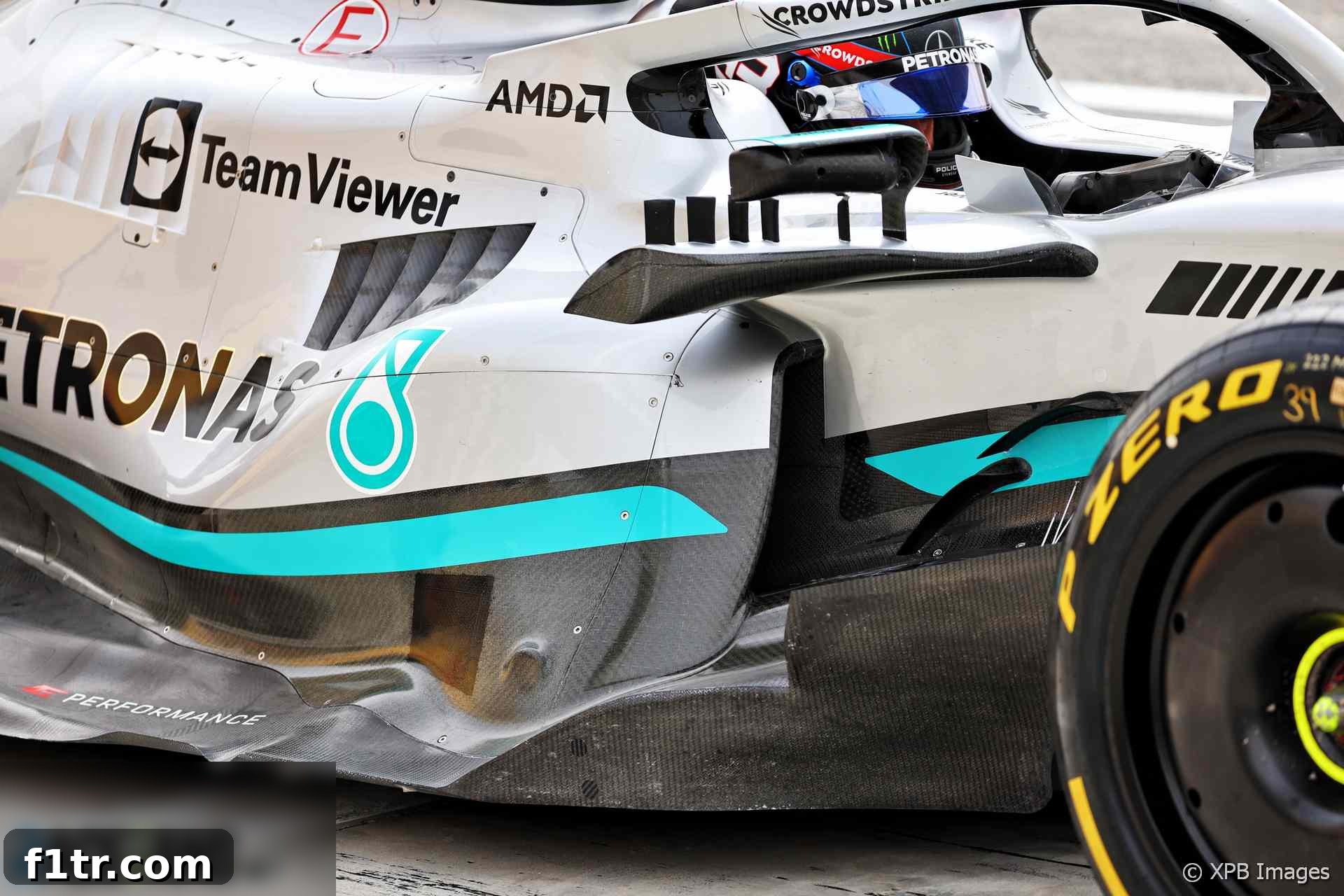
Mercedes, in their pursuit of aerodynamic efficiency under the stringent 2022 technical rules, unveiled the W13 with an exceptionally slender, almost ‘size-zero’ sidepod concept. This daring design choice initially presented the team with significant challenges, particularly severe bouncing (or porpoising) that hampered performance and driver comfort. However, through persistent development and understanding, Mercedes progressively unlocked more performance from their W13, allowing George Russell to secure their sole victory of the season in the penultimate round at Interlagos.
Despite Mercedes’ late-season resurgence, Newey maintained an unwavering conviction in Red Bull’s chosen path. He articulated that his “gut feeling” at the time suggested Red Bull’s underlying concept possessed far greater long-term development potential, not only for the impending 2023 season but for future iterations of the regulations.
“With last year’s car, we adopted an aerodynamic direction concerning the sidepod and overall car concept that was almost diametrically opposed to what Mercedes pursued,” Newey explained in an interview with the official F1 website. “Mercedes certainly demonstrated flashes of competitiveness last year, culminating in their win in Brazil.”
“This presented us with a critical decision: do we initiate research into Mercedes’ design, fearing we might have overlooked something crucial, or do we remain steadfast with our current methodology? My intuition strongly suggested we stick with our chosen direction.” This strategic confidence in their own philosophy ultimately proved instrumental in Red Bull’s overwhelming success.
Newey underscored the monumental nature of the 2022 technical regulations, which reintroduced and gave teams unprecedented freedom to harness the venturi effect for generating downforce through sophisticated car floors. He described it as “the single most significant rule change we’ve experienced since venturi cars were outlawed at the close of the 1982 season.” For Newey, the fundamental secret to maximizing a car’s performance under these new rules hinged on the successful, seamless integration of the three primary elements of the vehicle: aerodynamics, chassis, and suspension.
“It was a process of meticulously studying the rule book and then endeavoring to comprehend the optimal architecture,” Newey elaborated, referring to the placement of critical components. “This involved determining where to position the front wheels and rear wheels relative to the fixed elements of the chassis, engine, and gearbox. The foundational architecture is a decision that must be made early and correctly.”
“In my specific case,” he continued, “I prioritized the overall architecture, followed closely by the front and rear suspension systems. These are the crucial elements you absolutely must get right if at all possible. If you make an error with the bodywork, within reason, it can be rectified and changed during a season. However, if the underlying architecture is flawed, you are, at the very least, committed to that design for an entire season, severely limiting your development potential.” This emphasis on foundational correctness highlights Newey’s long-term strategic thinking.
The 2021 season presented a unique set of challenges for Red Bull. They faced the dual demand of designing their inaugural car for the radically new technical regulations slated for 2022, while simultaneously needing to continuously develop their existing 2021 challenger to remain fiercely competitive against Mercedes in a high-stakes battle for both the Drivers’ and Constructors’ World Championships. Newey candidly admitted that as a direct consequence of extending development on their 2021 car beyond initial plans, its successor, the formidable RB18, “was likely conceived in a significantly shorter timeframe than most, if not all, of our competitors.”
“In 2021, we were embroiled in an intense championship struggle with Mercedes,” Newey reflected. “Perhaps it was an incorrect decision in hindsight, but because for the first time in many years we genuinely had a shot at winning a championship, we made the strategic choice to invest a substantial amount of effort into developing that particular car throughout the year.”
While Max Verstappen heroically secured the Drivers’ Championship for Red Bull in 2021, Mercedes ultimately edged them out for the Constructors’ title. It was also later revealed that Red Bull had exceeded that year’s budget cap by £1.8 million, a breach that would later result in sanctions. This backdrop of intense competition and resource allocation played a crucial role in the RB18’s hurried genesis.
In contrast, 2022 saw Mercedes struggle immensely with their new car, leading to Ferrari emerging as Red Bull’s principal rivals at the front of the grid. Newey elaborated on the differing strategies employed by their competitors: “Ferrari adopted the polar opposite approach. They were not contending for the championship in 2021, so they ceased developing their 2021 car very early in the season and focused all their resources and attention entirely on the design of their 2022 car. Mercedes found themselves somewhere in between these two extremes.”
“We, however, continued our development efforts for much longer than either of those teams. Theoretically, this should have placed us at a disadvantage regarding the 2022 car’s initial development. But I firmly believe that what we managed to accomplish was getting the fundamental architecture absolutely correct.” This strategic decision, though risky, proved pivotal.
“Consequently, when the RB18 made its debut in Bahrain last year, Ferrari was undeniably as quick, if not occasionally quicker, during the early stages of the season. Nevertheless, we had successfully established the correct fundamentals, which provided us with an exceptionally robust and adaptable development platform upon which to build throughout the season, allowing us to rapidly pull ahead.”
Even Red Bull was not entirely immune to the challenges of bouncing and porpoising, issues that plagued many teams as they grappled with the new ground effect regulations. However, unlike most of their rivals, Red Bull demonstrated an uncanny ability to quickly understand and effectively master these phenomena.
“We certainly experienced a degree of bouncing,” Newey confirmed, “though it was not as severe as what other teams encountered. Yet, it was still an issue we needed to get on top of. Crucially, I believe we possessed a reasonably clear understanding of the necessary steps to mitigate it.”
“Therefore, by the time our first significant upgrade package arrived for the Bahrain Grand Prix, bouncing had become a far lesser concern for us compared to other teams. This meant that we were not forced to divert a substantial portion of our precious development energy into merely ‘fixing’ bouncing, a challenge that Ferrari and Mercedes, for instance, were heavily invested in. This efficiency allowed Red Bull to focus on performance gains rather than problem-solving.”
Newey’s extensive career in motorsport design, which began in the 1980s during the initial era of ground effect aerodynamics, proved to be an invaluable asset. His formative experiences, not only in Formula 1 but also in sports car and IndyCar racing, endowed him with a profound and advantageous understanding of the principles underlying the technical regulations reintroduced in 2022.
“I believe the key insight, particularly with these modern venturi cars that came into play at the beginning of last year – although it was equally true for the stepped-bottom cars that preceded them – is that it’s not solely about the aerodynamics,” Newey articulated. “It’s profoundly about how the aerodynamics intricately couples with the chassis and suspension system. And this interaction, this cross-coupling, is one of the major areas where I perhaps held a slight advantage.” He attributed this advantage to his early career experiences.
“I encountered this phenomenon firsthand when I was at Fittipaldi,” Newey recounted, referring to his time with the F1 team in the early 1980s. “By the time I returned to F1 in 1988, the cars had transitioned to flat-bottomed designs. However, my subsequent work in IndyCar was crucial. I spent three seasons designing for IndyCar, which also utilized venturi cars. Those experiences provided me with an exceptionally thorough understanding of this critical aero-suspension cross-coupling.”
Remarkably, Newey first encountered the confounding phenomenon of bouncing – which became the defining buzzword of the 2022 F1 season – four decades before its widespread re-emergence. This early exposure provided him with an unparalleled foundation of knowledge.
“I vividly recall an incident at Fittipaldi,” Newey shared. “Actually, the very first time I visited the circuit while working for Fittipaldi, Harvey Postlethwaite, who was the ambitious young technical director there, had a novel idea. Because the cars were running extremely stiffly, he thought he could save a bit of weight by discarding the front dampers and springs and replacing them entirely with bump rubbers. This was a concept he had experimented with during his earlier days at Hesketh.”
“I remember Keke Rosberg, our driver, coming past on the old pit straight at Silverstone, and the front wheels were literally airborne as the car sped by. It was bouncing so violently. I think that served as a very early, unforgettable lesson that grand prix car performance isn’t just about pure aerodynamics; it is fundamentally about the intricate and inseparable coupling of aerodynamics with the suspension system.” This foundational understanding, gleaned decades ago, proved indispensable in Red Bull’s rapid mastery of the 2022 ground effect challenges, solidifying their dominant position in Formula 1.
2023 F1 season
- FIA president cleared of alleged interference in two 2023 races
- First week viewing figures for new Drive to Survive season fall again
- Max who? Drive to Survive season six prefers its favourite faces
- RaceFans’ complete 2023 season review
- The F1 drivers who pulled off the 10 biggest charges through the field in 2023
Browse all 2023 F1 season articles