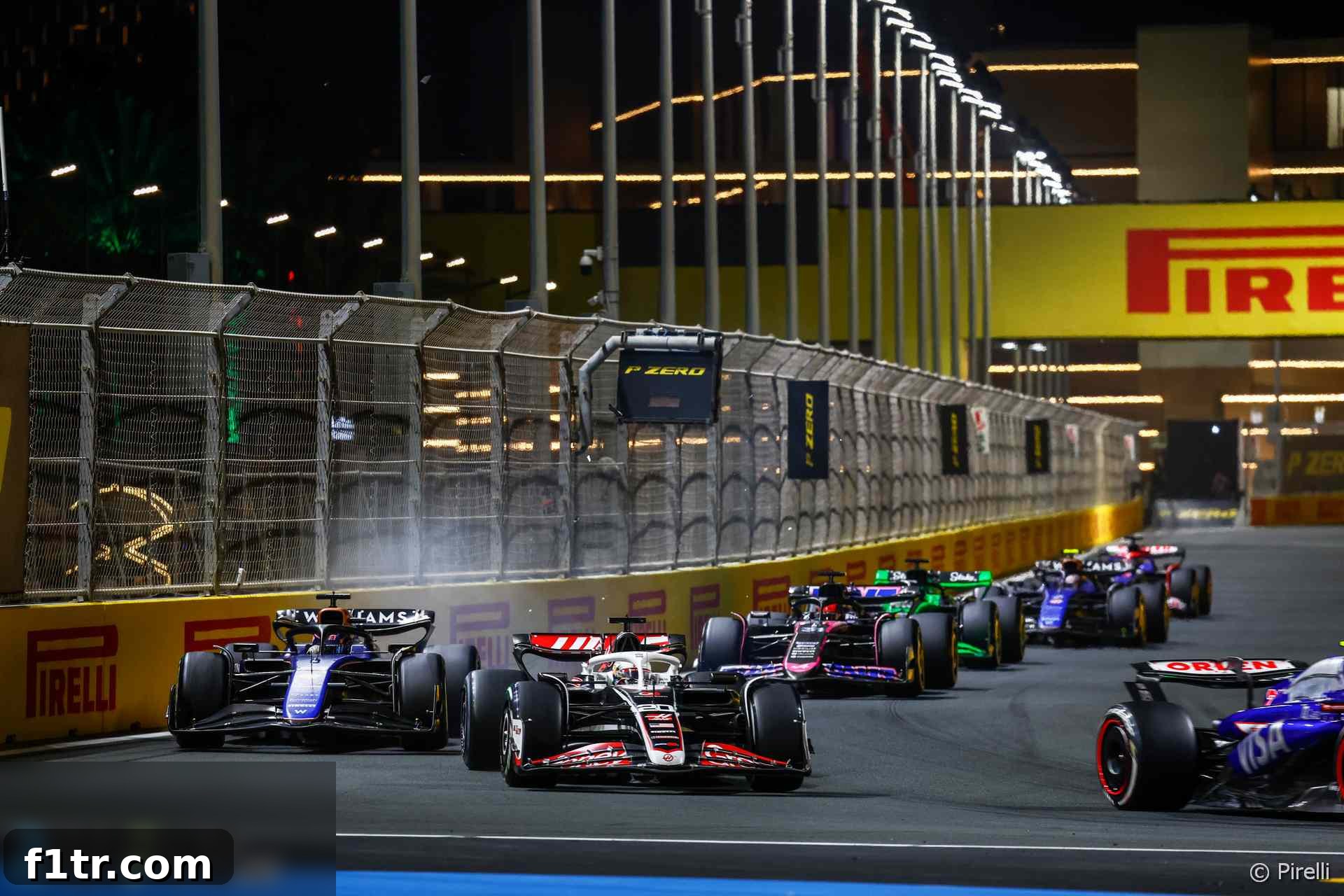
Kevin Magnussen on the Brink: F1 Race Ban Looms Amidst Penalty Point Controversy
Kevin Magnussen, the Danish driver for the Haas F1 Team, currently finds himself in a precarious position within the demanding world of Formula 1. Having accumulated a significant 10 penalty points on his Super Licence, Magnussen is now just two points shy of the critical 12-point threshold that triggers an automatic, mandatory one-race suspension. This looming threat has not only cast a considerable shadow over his current season but has also intensified ongoing debates within the sport regarding the fairness, consistency, and overall efficacy of F1’s penalty points system.
The situation became acutely clear following the Miami Grand Prix, where a series of infringements led to additional penalties that pushed Magnussen’s tally into double digits. With a substantial portion of the 2024 season still ahead, every maneuver on track will now be under extreme scrutiny, as even a minor misstep could result in him being sidelined for a Grand Prix – a consequence that no driver or team desires, particularly given the competitive nature of the Constructors’ Championship.
Understanding the Formula 1 Penalty Points System
The Formula 1 penalty points system, first introduced in 2014, was conceived with a clear objective: to enhance driver safety, encourage cleaner racing, and ensure a more consistent application of disciplinary rules across the grid. Under this system, drivers accrue points for a variety of infringements, ranging from dangerous driving and causing collisions to procedural errors during races or even exceeding track limits. The underlying principle is to deter repeat offenders by imposing a cumulative series of increasingly severe sanctions, ultimately culminating in a race ban for those who breach the 12-point limit.
Once a driver reaches 12 penalty points within any 12-month rolling period, they are automatically suspended from the next scheduled Grand Prix. It’s crucial to note that points remain active on a driver’s Super Licence for a full year from the date of their issuance. This means that Magnussen’s current 10 points will not expire simultaneously but will gradually drop off his record as the individual 12-month anniversaries of each infringement pass. While the system’s foundational intent is to uphold fairness and safety in one of the most high-stakes sports globally, its practical application has frequently been a source of contention. Critics often argue that the system can be disproportionate, penalizing relatively minor infractions with a severity that, when accumulated, can equal or even surpass the consequences for more egregious errors. Furthermore, the ever-expanding calendar of modern F1 seasons means drivers have more opportunities to collect points, leading some pundits and participants to suggest that the system, in its current form, may be outdated for the contemporary sporting landscape.
Magnussen’s Frustration: A Forced Evolution in Driving Style
Unsurprisingly, Kevin Magnussen has not held back in expressing his profound dissatisfaction with his current predicament. He has openly acknowledged that the threat of a race ban will compel him to fundamentally alter his characteristically aggressive and tenacious driving approach. “The next time is a race ban so I think I’ll have to,” he conceded, a statement that underscores the immense pressure under which he now operates. For a driver renowned for his uncompromising and assertive style, this enforced moderation could represent a significant psychological challenge and potentially impact his raw performance and race craft.
His frustration is particularly acute concerning the nature of some of the infringements that have contributed to his growing tally. While F1 stewards have generally become less inclined to issue penalty points for routine track limits violations in recent seasons, Magnussen received a notable three points for precisely this reason during the Miami sprint race. This decision, controversially, was justified by the stewards as occurring under “exceptional circumstances,” implying a unique context to his transgression. Magnussen strongly questioned the equity of this ruling, stating, “The fact that I’m at risk of a race ban for driving outside of some white lines on a piece of Tarmac, I don’t know if I feel that is right. It is the way the rules are so I accept that, but I feel there’s room for improvement there.”
This sentiment resonates deeply within a broader, ongoing debate across Formula 1. Is it truly justifiable for a driver to face a race ban – a punishment with severe sporting and financial ramifications – for infractions that many perceive as relatively minor or situational? Magnussen himself expanded on this point, suggesting that the expanded number of races in the modern F1 calendar exacerbates the issue significantly. “Not only in terms of the points, there are more races now than there was back when they were introduced and I feel you can end up getting a race ban effectively for a very minor thing. That’s what I feel.” He argues that the cumulative effect of seemingly minor penalties can lead to a disproportionately harsh outcome, potentially jeopardizing careers and eroding team morale.
The Controversial “Support Role” Tactic and Its Consequences
A substantial portion of Kevin Magnussen’s accrued penalty points stems from incidents where he explicitly admitted to consciously playing a “support role” for his Haas teammate, Nico Hulkenberg. This strategic, albeit controversial, tactic involves deliberately impeding or delaying rival drivers to enable Hulkenberg to gain track position or maintain an advantage, thereby maximizing the team’s chances of scoring crucial championship points. While team orders and strategic driving are well-established elements within Formula 1, actively causing collisions or intentionally leaving the track to block opponents crosses a clear line into infringements that warrant disciplinary action.
Magnussen candidly referred to his robust defensive maneuvers against Lewis Hamilton during the Miami sprint race as a prime example of this team-centric strategy yielding positive results for Haas. In that specific incident, Magnussen repeatedly ventured off-track to keep Hamilton behind him, a tactic that directly led to him receiving a three-point penalty for “leaving the track and gaining a lasting advantage.” He further confirmed employing similar, strategically aggressive tactics during the Saudi Arabian Grand Prix earlier in the season. From a team’s perspective, such selfless and tactical driving can be incredibly valuable, potentially securing vital points for the Constructors’ Championship, a particular imperative for smaller teams like Haas where every single point can significantly impact their standings and financial incentives. Magnussen openly acknowledged this challenging trade-off: “I think these situations where I’ve had to play the support role for my team mate, they have been paying off, so it’s been kind of valuable to us.”
However, the personal cost to Magnussen has become undeniably high. While his team may have reaped short-term benefits from his aggressive tactics, he now bears the heavy burden of being on the precipice of a race ban. This situation ignites a complex ethical debate: should drivers be penalized so severely for executing a team strategy, even if that strategy pushes or slightly exceeds the boundaries of fair play? It starkly highlights the inherent tension between individual driver responsibility, their personal safety, and the overarching objectives of their team within the hyper-competitive ecosystem of Formula 1.
Magnussen’s Accumulated Penalty Points: A Detailed Breakdown
The 10 penalty points currently active on Kevin Magnussen’s Super Licence have been accumulated through four distinct incidents since the commencement of the 2024 Formula 1 season. Each of these events, while seemingly isolated in nature, collectively paint a clear picture of a driver who consistently pushes the limits, sometimes beyond what the established regulations permit, particularly in aggressive wheel-to-wheel combat scenarios and calculated tactical blocking maneuvers.
| Event | Session | Infringement | Points |
|---|---|---|---|
| Saudi Arabian Grand Prix | Race | Collided with Alexander Albon | 3 |
| Chinese Grand Prix | Race | Collided with Yuki Tsunoda | 2 |
| Miami Grand Prix | Sprint race | Leaving the track and gaining a lasting advantage (against Lewis Hamilton) | 3 |
| Miami Grand Prix | Race | Collided with Logan Sargeant | 2 |
The three points incurred at the Saudi Arabian Grand Prix for his collision with Alexander Albon were a clear demonstration of driving deemed overly aggressive, compromising another competitor’s race. Similarly, the two points from the Chinese Grand Prix, where he made contact with Yuki Tsunoda, further underscore a pattern of close-quarters racing resulting in contact that was deemed avoidable by the stewards. The Miami Grand Prix proved particularly costly for Magnussen; not only did he receive three points for his controversial, tactical maneuvers against Lewis Hamilton in the sprint race, but an additional two points were added in the main race for a collision with local hero Logan Sargeant. This sequence of events has propelled Magnussen to the very precipice of a race ban, necessitating a fundamental re-evaluation of his on-track approach for the remainder of the season.
Broader Implications for Formula 1 Driver Conduct and Stewarding
Kevin Magnussen’s precarious situation extends far beyond merely an individual driver’s problem; it serves as a powerful magnifying glass on several critical aspects of modern Formula 1. For the Haas F1 Team, the potential loss of Magnussen for even a single race would represent a significant blow, particularly as they meticulously strive to consolidate and improve their position in the highly competitive Constructors’ Championship. Every point gained is of paramount importance for a team of Haas’s size and resources, and missing a driver – especially one as experienced and combative as Magnussen – could severely impact their strategic flexibility and overall scoring potential.
Furthermore, this scenario compels a thorough re-examination of driver conduct and accepted team strategy within the sport. While Magnussen’s “support role” may indeed have yielded tangible tactical advantages for his team, it undeniably raises pertinent questions about where the line is drawn between legitimate defensive driving and infringements that warrant penalties. Should a driver be expected to sacrifice their own points accumulation and career progression for the exclusive benefit of a teammate, particularly if doing so means risking a potentially career-altering race ban? This specific situation could inadvertently set a precedent or at least heavily influence how other teams and drivers approach similar tactical dilemmas in upcoming races.
Finally, the consistency and interpretation of stewarding decisions remain a perennial and often contentious topic of discussion within F1 circles. Magnussen’s specific criticism regarding the “exceptional circumstances” ruling for his track limits penalties, coupled with the overarching sentiment that relatively minor infractions can lead to major, disproportionate consequences, is by no means unique to him. Drivers, team principals, and fans alike frequently express a strong desire for greater clarity, transparency, and consistency from race stewards, especially when career-defining penalties are at stake. This incident adds yet another significant layer to that ongoing dialogue, urging the sport’s governing bodies to continually review, refine, and adapt its penalty systems to ensure they remain fit for purpose in an ever-evolving and increasingly demanding championship.
Looking Ahead: The Road for Kevin Magnussen
As the Formula 1 season progresses, all eyes will undoubtedly remain fixed on Kevin Magnussen. His challenge now is multifaceted: not only must he continue to perform at his absolute best, but he must also do so without accumulating any further penalty points. This necessitates a highly nuanced and disciplined approach, requiring him to maintain his inherent competitive edge while simultaneously exercising extreme caution and strategic restraint. The upcoming races will serve as a true test of his discipline, adaptability, and mental fortitude, as he endeavors to navigate the incredibly fine line between aggressive, championship-worthy racing and strictly adhering to the complex boundaries of the sport’s regulations. His current ordeal vividly underscores the immense pressure F1 drivers constantly face, not only from fierce competitors and the unwavering demands of their own teams but also from the intricate and often unforgiving web of rules and regulations designed to govern the pinnacle of motorsport.
Related Articles from the 2024 Emilia-Romagna Grand Prix
Stay informed with more insights and analyses from recent Formula 1 events and delve deeper into the race weekend activities:
- Ferrari expect qualifying gain after spotting rivals’ power strategy tactics
- How Alonso and Stroll copied Verstappen’s tactic plus more unheard Imola radio
- Verstappen beats Hamiltons winning rate with Emilia-Romagna GP victory
- How Russell resisted losing position to Hamilton “for no reason” with extra stop
- “Lando’s found some pace”: Unheard radio from Verstappen-Norris Imola duel
Browse all 2024 Emilia-Romagna Grand Prix articles