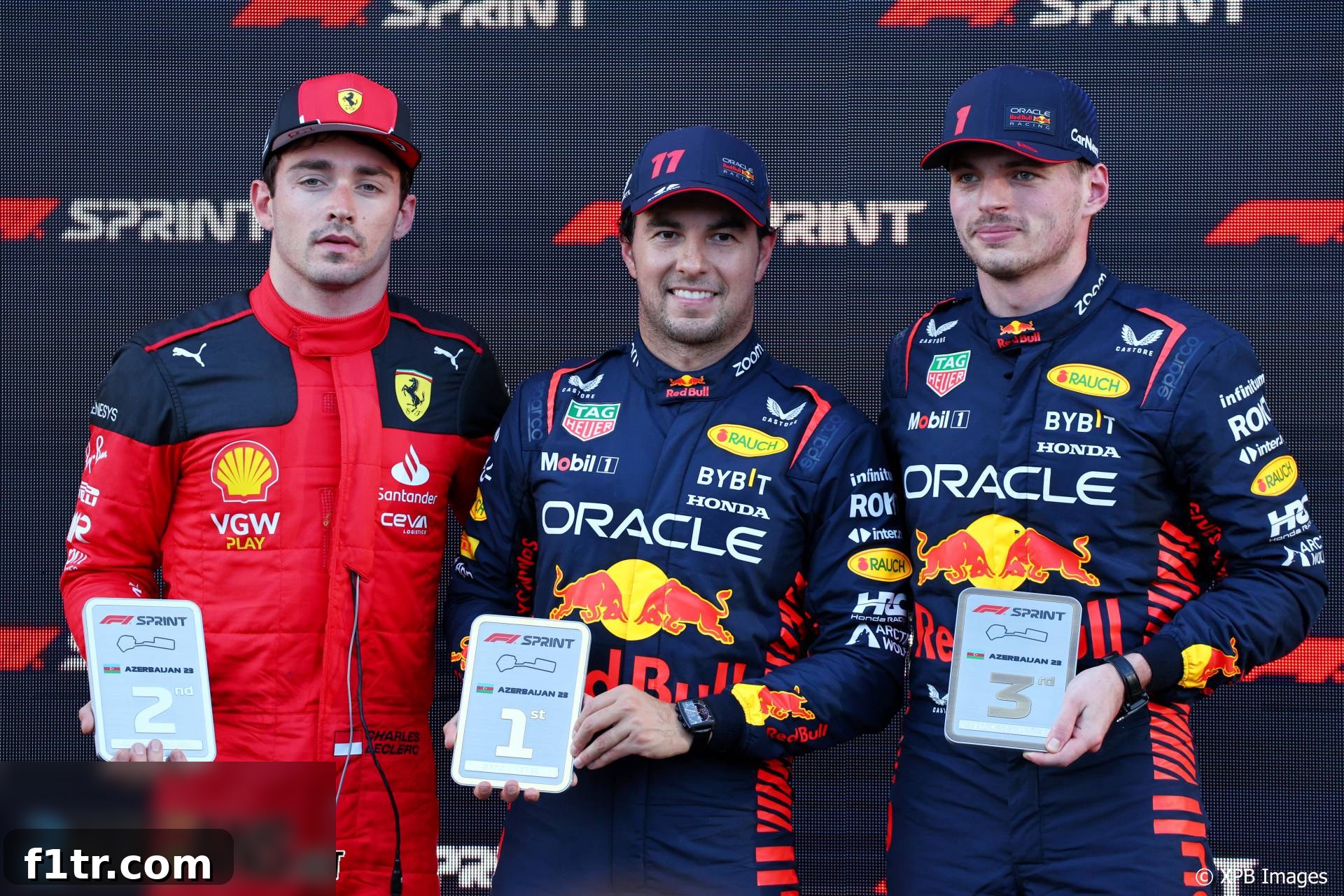
In the vibrant tapestry of Formula 1, some races stand out not just for their thrilling conclusions but also for their insightful previews. The 2023 Azerbaijan Grand Prix Sprint Race served precisely this purpose, offering a compelling prelude to Sunday’s main event on the challenging Baku Street Circuit. Much like the pay-per-view events of the 1990s, where a short preview show enticed viewers to invest in the main spectacle, this 17-lap dash provided teams, drivers, and fans alike with a clear, albeit perhaps sobering, understanding of what to expect from the longer Sunday grand prix.
The sprint race, while short, painted a vivid picture of the competitive landscape. With the same pole winner, Charles Leclerc, and the familiar Red Bull duo of Sergio Perez and Max Verstappen lining up closely behind him (albeit in a slightly altered order), the narrative felt less like a standalone contest and more like an extended first act. By its conclusion, the consensus was clear: few were anticipating a blockbuster grand prix based on the sprint’s relatively predictable outcome.
Red Bull’s Dominance: A Masterclass in Baku
While Charles Leclerc had once again demonstrated his exceptional qualifying prowess by securing pole position for both the Grand Prix and the Sprint Race, his Ferrari team knew the formidable challenge that lay ahead against the Red Bulls. Leclerc’s valiant effort was commendable, but Sergio Perez, a proven street circuit master, only had to bide his time. The moment DRS (Drag Reduction System) became active, Perez pounced, decisively claiming the lead and securing the maximum eight points on offer.
Reflecting on his victory, Perez stated, “I had to push quite hard initially to get past Charles, especially at the restart because on the first lap I could see he had good pace and very good mechanical grip. In the end, I think it was a really nicely executed race, and it’s been a great weekend from the whole team so far.” His words underscored Red Bull’s clinical execution and strategic advantage.
The sprint race highlighted a critical truth that persisted despite the four-week break between Australia and Azerbaijan: the core performance gap between Red Bull and Ferrari in race conditions remains significant. While Leclerc enjoyed a strong start, comfortably leading into the first corner—a particular area Red Bull has sometimes struggled with in early 2023, as evidenced by George Russell’s feisty challenge to Max Verstappen on the run to Turn 1—sustaining that lead was a Herculean task.
The Potent Power of Red Bull’s DRS
Both Verstappen, starting second on the grid for the Grand Prix, and Perez, third, possess the luxury of an exceptionally powerful DRS. The sprint race offered a vivid demonstration of this advantage. On lap seven, as DRS was activated, Perez exited Turn 16 onto Baku’s immensely long main straight six-tenths of a second behind Leclerc’s Ferrari. Combining Red Bull’s inherent straight-line speed with the slipstream effect, Perez gained over a tenth of a second, clocking 7kph faster than the Ferrari by the DRS activation point. Upon deploying DRS, Perez gained a staggering 20kph over Leclerc, surging past into the lead. On this circuit, against the might of the Red Bulls, Ferrari faces an almost insurmountable challenge to defend against such an overwhelming speed differential.
Ferrari’s Tyre Degradation Woes and Leclerc’s Strategic Sacrifice
Initially, there was a glimmer of hope for Ferrari. After losing the lead, Leclerc managed to remain within striking distance of Perez, even returning to DRS range shortly after falling out of it on lap nine. However, Ferrari’s long-standing tyre degradation issues soon resurfaced. While Perez maintained a consistent pace in the high 1’43s on tyres that were four laps older than Leclerc’s, the Ferrari driver began to visibly lose ground, inadvertently pulling Verstappen’s already damaged car further back with him.
Leclerc candidly admitted his strategic choice: he didn’t fight Perez too aggressively in a bid to preserve his tyres for as long as possible. “I knew this was our weak point,” he acknowledged. “I tried to stay within the DRS of Checo, so he could pull me along the straight, but that wasn’t enough. We were losing a little bit too much towards the end with the degradation, so let’s see what’s possible to improve tomorrow.” This insight underscored the delicate balance Ferrari must strike between outright pace and tyre longevity, a battle they often seem to lose.
Even Leclerc’s second-place finish ahead of Verstappen was less encouraging than it might have appeared on paper, largely due to the “shark bite-sized” hole torn from Verstappen’s sidepod during his collision with George Russell. This damage undoubtedly cost the championship leader a significant amount of speed and performance throughout the sprint race.
Verstappen described his car’s handling after the sprint as “a bit weird.” He added, “You expect a balance [change], but the way the car was jumping around a lot and sliding in some weird places, vibrations – it’s not great.” This suggested that without the damage, Verstappen would have likely posed an even greater threat to both Leclerc and Perez, further emphasizing Red Bull’s underlying pace advantage.
Carlos Sainz Jnr’s Struggle for Confidence
For the main Grand Prix, Ferrari has Carlos Sainz Jnr starting from the second row, directly behind the two Red Bulls. However, the evidence from Friday and Saturday’s sessions suggested that expecting him to be a significant factor in the race would be overly optimistic. Sainz himself openly admitted to his struggles, reflecting the challenges faced by Ferrari as a whole beyond Leclerc’s qualifying brilliance.
“It’s proving to be a very challenging weekend, and at this point, knowing what the pace is this weekend, it’s more a damage limitation weekend for me than anything else,” Sainz confessed after finishing fifth in the sprint race behind Russell. “I’m really struggling out there with confidence, always feeling really, really on the limit of the rear axle, and it’s not a nice feeling to have around Baku.” His comments underscored the difficulty Ferrari has in making the SF-23 consistently perform across varying conditions and for both drivers.
Baku’s Unique Demands and Tyre Strategy for the Grand Prix
Sunday’s Grand Prix is set to unfold under the intense afternoon sun, meaning track temperatures will be significantly higher than during the sprint race. This amplified heat will only exacerbate the issue of tyre degradation. As Valtteri Bottas noted, even after just 17 laps of the sprint, the soft tyres were “melting.” Consequently, Pirelli anticipates that teams will heavily rely on the hard compound tyres during the Grand Prix, likely starting on mediums before making a single stop for the more durable hard compound.
However, Baku is far from an ordinary circuit. Its inherent unpredictability, characterized by tight street sections and high-speed straights, means the risk of Safety Cars and even red flag stoppages is among the highest on the Formula 1 calendar. Fortunately for the vast majority of drivers, most have two unused sets of hard tyres available. This provides a crucial strategic fallback: if the race is suspended for any reason, even after a scheduled pit stop, drivers could potentially bolt on a fresh set of hard tyres without penalty, effectively gaining a ‘free’ stop and extending their tyre life.
Despite its reputation for drama, Baku has also delivered uneventful races in the past, including its inaugural event in 2016. Regardless of whether the Grand Prix unfolds calmly or descends into chaos, Sergio Perez remains supremely confident in his and his team’s abilities.
“I think I had more pace than what I’ve shown today,” he asserted, hinting at untapped potential. “I think tomorrow it’s again a new day and a new challenge.” His optimism, backed by Red Bull’s undeniable performance, sets a high bar for the Grand Prix, with many eyes on whether Ferrari can bridge the gap or if Red Bull will further solidify their early-season dominance.
Qualifying times in full
| Position | Number | Driver | Team | Q1 time | Q2 time (vs Q1) | Q3 time (vs Q2) |
|---|---|---|---|---|---|---|
| 1 | 16 | Charles Leclerc | Ferrari | 1’41.269 | 1’41.037 (-0.232s) | 1’40.203 (-0.834s) |
| 2 | 1 | Max Verstappen | Red Bull | 1’41.398 | 1’40.822 (-0.576s) | 1’40.391 (-0.431s) |
| 3 | 11 | Sergio Perez | Red Bull | 1’41.756 | 1’41.131 (-0.625s) | 1’40.495 (-0.636s) |
| 4 | 55 | Carlos Sainz Jnr | Ferrari | 1’42.197 | 1’41.369 (-0.828s) | 1’41.016 (-0.353s) |
| 5 | 44 | Lewis Hamilton | Mercedes | 1’42.113 | 1’41.650 (-0.463s) | 1’41.177 (-0.473s) |
| 6 | 14 | Fernando Alonso | Aston Martin-Mercedes | 1’41.720 | 1’41.370 (-0.350s) | 1’41.253 (-0.117s) |
| 7 | 4 | Lando Norris | McLaren-Mercedes | 1’42.154 | 1’41.485 (-0.669s) | 1’41.281 (-0.204s) |
| 8 | 22 | Yuki Tsunoda | AlphaTauri-Red Bull | 1’42.234 | 1’41.569 (-0.665s) | 1’41.581 (+0.012s) |
| 9 | 18 | Lance Stroll | Aston Martin-Mercedes | 1’42.524 | 1’41.576 (-0.948s) | 1’41.611 (+0.035s) |
| 10 | 81 | Oscar Piastri | McLaren-Mercedes | 1’42.455 | 1’41.636 (-0.819s) | 1’41.611 (-0.025s) |
| 11 | 63 | George Russell | Mercedes | 1’42.073 | 1’41.654 (-0.419s) | Missed by 0.004s |
| 12 | 31 | Esteban Ocon | Alpine-Renault | 1’42.622 | 1’41.798 (-0.824s) | Missed by 0.148s |
| 13 | 23 | Alexander Albon | Williams-Mercedes | 1’42.171 | 1’41.818 (-0.353s) | Missed by 0.168s |
| 14 | 77 | Valtteri Bottas | Alfa Romeo-Ferrari | 1’42.582 | 1’42.259 (-0.323s) | Missed by 0.609s |
| 15 | 2 | Logan Sargeant | Williams-Mercedes | 1’42.242 | 1’42.395 (+0.153s) | Missed by 0.745s |
| 16 | 24 | Zhou Guanyu | Alfa Romeo-Ferrari | 1’42.642 | Missed by 0.020s | |
| 17 | 27 | Nico Hulkenberg | Haas-Ferrari | 1’42.755 | Missed by 0.133s | |
| 18 | 20 | Kevin Magnussen | Haas-Ferrari | 1’43.417 | Missed by 0.795s | |
| 19 | 10 | Pierre Gasly | Alpine-Renault | 1’44.853 | Missed by 2.231s | |
| 20 | 21 | Nyck de Vries | AlphaTauri-Red Bull | 1’45.282 | Missed by 2.660s |
Sector times
| Position | Number | Driver | Sector one | Sector two | Sector three | Ultimate lap | Deficit to ultimate lap | |
|---|---|---|---|---|---|---|---|---|
| 1 | 16 | Charles Leclerc | 35.224 (2) | 40.191 (1) | 24.788 (6) | 1’40.203 | – | |
| 2 | 1 | Max Verstappen | 35.277 (3) | 40.335 (2) | 24.667 (1) | 1’40.279 | 0.112 | |
| 3 | 11 | Sergio Perez | 35.177 (1) | 40.365 (3) | 24.764 (2) | 1’40.306 | 0.189 | |
| 4 | 14 | Fernando Alonso | 35.526 (6) | 40.645 (4) | 24.769 (4) | 1’40.940 | 0.313 | |
| 5 | 55 | Carlos Sainz Jnr | 35.512 (5) | 40.689 (6) | 24.789 (7) | 1’40.990 | 0.026 | |
| 6 | 44 | Lewis Hamilton | 35.702 (9) | 40.678 (5) | 24.767 (3) | 1’41.147 | 0.030 | |
| 7 | 4 | Lando Norris | 35.461 (4) | 40.71 (7) | 25.006 (16) | 1’41.177 | 0.104 | |
| 8 | 18 | Lance Stroll | 35.813 (12) | 40.77 (8) | 24.778 (5) | 1’41.361 | 0.215 | |
| 9 | 22 | Yuki Tsunoda | 35.717 (10) | 40.835 (9) | 24.883 (9) | 1’41.435 | 0.134 | |
| 10 | 81 | Oscar Piastri | 35.636 (7) | 40.903 (10) | 24.925 (12) | 1’41.464 | 0.147 | |
| 11 | 63 | George Russell | 35.731 (11) | 40.933 (11) | 24.927 (13) | 1’41.591 | 0.063 | |
| 12 | 31 | Esteban Ocon | 35.7 (8) | 41.037 (13) | 24.893 (10) | 1’41.630 | 0.168 | |
| 13 | 23 | Alexander Albon | 35.84 (14) | 40.976 (12) | 24.988 (14) | 1’41.804 | 0.014 | |
| 14 | 2 | Logan Sargeant | 35.858 (15) | 41.47 (16) | 24.825 (8) | 1’42.153 | 0.089 | |
| 15 | 77 | Valtteri Bottas | 35.825 (13) | 41.257 (15) | 25.079 (17) | 1’42.161 | 0.098 | |
| 16 | 27 | Nico Hulkenberg | 36.249 (17) | 41.152 (14) | 24.908 (11) | 1’42.309 | 0.446 | |
| 17 | 24 | Zhou Guanyu | 36.052 (16) | 41.578 (18) | 25.002 (15) | 1’42.632 | 0.010 | |
| 18 | 20 | Kevin Magnussen | Haas | 36.39 (18) | 41.541 (17) | 25.178 (19) | 1’43.109 | 0.308 |
| 19 | 10 | Pierre Gasly | Alpine | 36.504 (19) | 42.427 (19) | 25.115 (18) | 1’44.046 | 0.807 |
| 20 | 21 | Nyck de Vries | AlphaTauri | 41.203 (20) | 47.497 (20) | 26.582 (20) | 1’55.282 | – |
Speed trap
| Position | Number | Driver | Car | Engine | Model | Max kph (mph) |
|---|---|---|---|---|---|---|
| 1 | 18 | Lance Stroll | Aston Martin | Mercedes | AMR23 | 324.4 (201.6) |
| 2 | 55 | Carlos Sainz Jnr | Ferrari | Ferrari | SF-23 | 321.7 (199.9) |
| 3 | 14 | Fernando Alonso | Aston Martin | Mercedes | AMR23 | 321.3 (199.6) |
| 4 | 16 | Charles Leclerc | Ferrari | Ferrari | SF-23 | 321 (199.5) |
| 5 | 2 | Logan Sargeant | Williams | Mercedes | FW45 | 320.9 (199.4) |
| 6 | 27 | Nico Hulkenberg | Haas | Ferrari | VF-23 | 319.6 (198.6) |
| 7 | 11 | Sergio Perez | Red Bull | Red Bull | RB19 | 319.5 (198.5) |
| 8 | 1 | Max Verstappen | Red Bull | Red Bull | RB19 | 319.2 (198.3) |
| 9 | 31 | Esteban Ocon | Alpine | Renault | A523 | 318.6 (198.0) |
| 10 | 22 | Yuki Tsunoda | AlphaTauri | Red Bull | AT04 | 318.4 (197.8) |
| 11 | 81 | Oscar Piastri | McLaren | Mercedes | MCL60 | 317.5 (197.3) |
| 12 | 24 | Zhou Guanyu | Alfa Romeo | Ferrari | C43 | 317.4 (197.2) |
| 13 | 23 | Alexander Albon | Williams | Mercedes | FW45 | 317.2 (197.1) |
| 14 | 44 | Lewis Hamilton | Mercedes | Mercedes | W14 | 317.2 (197.1) |
| 15 | 20 | Kevin Magnussen | Haas | Ferrari | VF-23 | 315.5 (196.0) |
| 16 | 4 | Lando Norris | McLaren | Mercedes | MCL60 | 315.4 (196.0) |
| 17 | 63 | George Russell | Mercedes | Mercedes | W14 | 315.3 (195.9) |
| 18 | 10 | Pierre Gasly | Alpine | Renault | A523 | 315.2 (195.9) |
| 19 | 77 | Valtteri Bottas | Alfa Romeo | Ferrari | C43 | 314.8 (195.6) |
| 20 | 21 | Nyck de Vries | AlphaTauri | Red Bull | AT04 | 301 (187.0) |
Over to you
Share your views on the Azerbaijan Grand Prix in the comments.
2023 Azerbaijan Grand Prix Related Articles
- Aston Martin radio messages reveal how “older brother” Alonso helps Stroll
- How slashing practice to a single hour in Baku tripped up F1 teams
- Bottas: “Rapid improvement needed” at Alfa Romeo
- Red Bull could become first team to score 1,000 points in a season
- Aston Martin hoping DRS fix works in Miami after Stroll manages fault in race
Browse all 2023 Azerbaijan Grand Prix articles