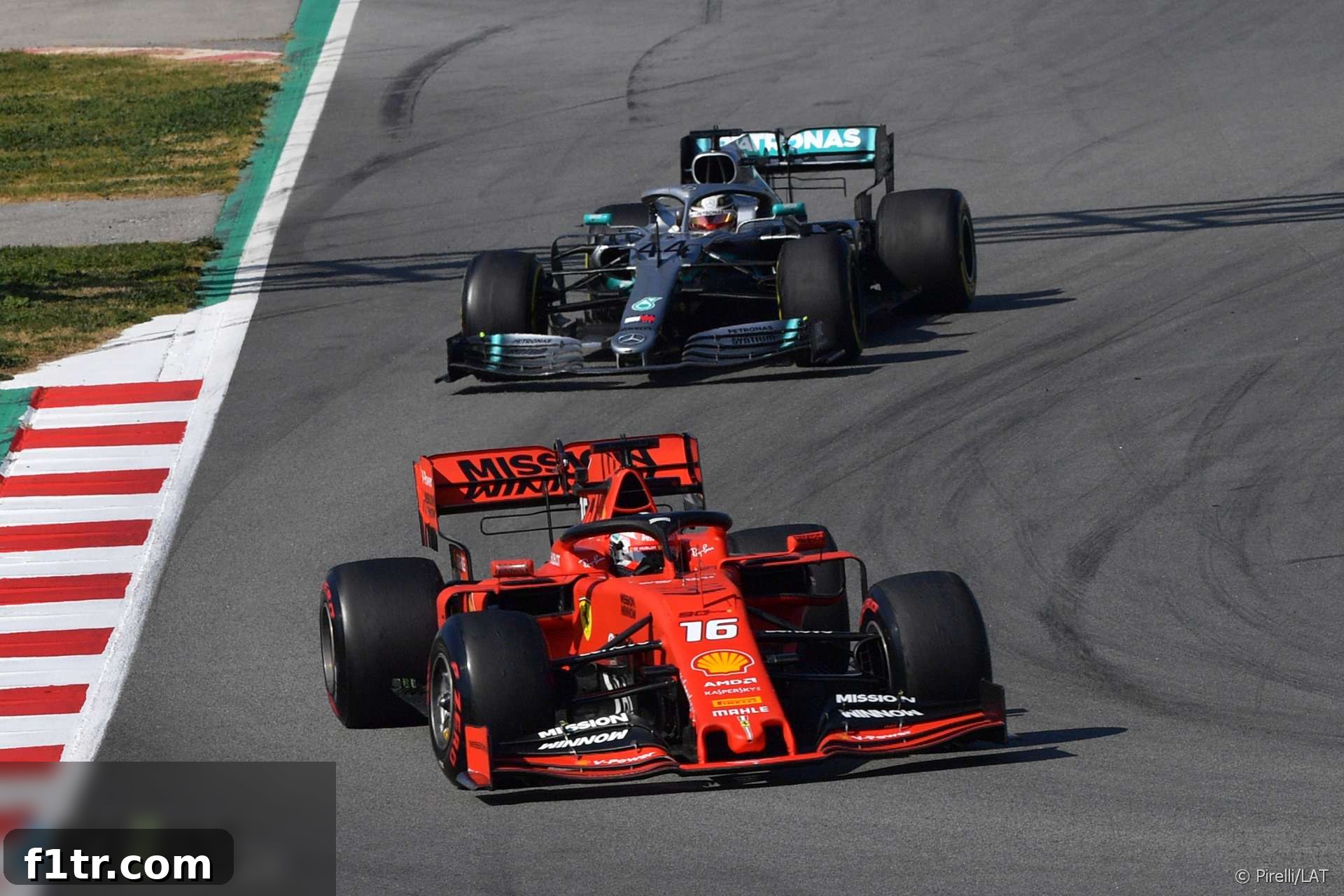
Lewis Hamilton Suspects Ferrari Gained Early Edge for 2019 F1 Season
Formula 1 superstar Lewis Hamilton has voiced his suspicions that fierce rivals Ferrari may have stolen a significant march on reigning champions Mercedes-AMG Petronas ahead of the crucial 2019 season. According to Hamilton, the Scuderia likely committed substantial resources to the development of their new car much earlier in the previous year, potentially giving them a critical advantage as teams geared up for a season marked by significant regulatory changes. This strategic foresight, Hamilton suggests, could be a key factor in Ferrari’s early pre-season testing performance.
Speaking to the media, including RaceFans, during pre-season testing, Hamilton elaborated on his belief that Ferrari strategically shifted their focus towards the 2019 F1 season once it became increasingly clear that Mercedes was poised to clinch the 2018 constructors’ and drivers’ championships. This strategic decision, if true, represents a calculated gamble, prioritizing future competitiveness over the fading prospects of the current season. Such a move is a testament to the high-stakes planning and intricate resource allocation that define top-tier Formula 1 teams.
The Strategic Rationale: Sacrificing Present for Future Gains
Hamilton explained the underlying logic behind such a strategic move, common in scenarios where a team sees its championship hopes for the current year diminishing. “Obviously during the year you have a huge group of people who are working towards winning world championships,” he stated. “If you’re not looking like you’re going to win the world championship out of worry you might pull some of the team off earlier.” This “pulling off earlier” refers to the highly impactful practice of reallocating engineering, design, and aerodynamic personnel from ongoing current-year car development to the next year’s project. Such a shift, especially in the intensely competitive and resource-intensive world of Formula 1, can translate into several critical months of additional development time for the new challenger.
“So most likely they started developing this car a month at least earlier than us, maybe,” Hamilton speculated. In Formula 1, where performance gains are meticulously measured in milliseconds and development cycles are relentless, even a month’s head start can translate into a substantial, race-winning performance advantage. This is particularly true when new technical regulations are introduced, offering a fresh slate for innovation. The 2018 season ultimately saw Mercedes prevail, but Ferrari had shown strong form in parts of the year, making their strategic pivot for 2019 a fascinating and potentially decisive factor.
Impact of Sweeping New Aerodynamic Regulations for 2019
The introduction of sweeping new aerodynamic rules for the 2019 season further amplified the potential benefit for any team that opted to focus on their next-generation car sooner. These regulations, primarily aimed at simplifying front wings, brake ducts, and bargeboards to reduce ‘dirty air’ and improve overtaking opportunities, presented a relatively blank canvas for designers. A team dedicating more time to understanding and exploiting these new rules early on could uncover innovative solutions and unlock performance gains that later-starting rivals might struggle to match. The complexity of modern F1 aerodynamics means that early, foundational work can yield compounding benefits throughout the development cycle.
Hamilton highlighted this intricate aspect of F1 team management, noting the perennial dilemma: “You only have a certain amount of resources you can use, you want to continue to make sure you solidify and win the current championship, or do you want to tail off to make sure that next year’s good? But you don’t know that next year’s going to be good because the rules change. So it’s trying to find a balance.” This perfectly encapsulates the strategic tightrope walk faced by top F1 teams: the constant tug-of-war between present glory and future potential, a balance made even more precarious by significant, unpredictable rule changes. Ferrari, having missed out on the 2018 titles despite a strong challenge, may have felt a greater imperative to make this forward-looking investment.
The Resource Allocation Dilemma: A High-Stakes Bet in Formula 1
Formula 1 teams operate under immense pressure, with finite resources—both human and financial—that must be meticulously allocated for maximum impact. The decision to prematurely halt or significantly scale back development on a championship-contending car to focus on the next season is a high-stakes gamble. For a team like Ferrari, facing the prospect of losing the 2018 title to Mercedes, this gamble might have seemed like a necessary evil to break Mercedes’ formidable stranglehold on the sport. It’s a calculated risk that, if successful, can fundamentally alter the competitive landscape for years to come.
The core of this strategic choice lies in the allocation of highly specialized personnel. Aerodynamicists, chassis designers, engine engineers, and simulation experts are all invaluable assets. Redirecting these individuals to a new project means accepting that the current car’s development will slow down, potentially conceding ground to rivals in the immediate term. However, if the new regulations are sufficiently disruptive, an early start allows for more iterative design, extensive simulation work, and comprehensive wind tunnel testing, ultimately leading to a more optimized and robust package from the outset of the new season. This early phase is crucial for establishing a strong performance baseline.
For Mercedes, the decision to push hard for the 2018 title meant maintaining full development effort on their W09 car until the championship was definitively secured. This dedication, while yielding another double title, inevitably meant a later start on their 2019 challenger, the W10. Hamilton’s comments suggest that this difference in development timelines could be playing a significant role in the perceived performance gap observed during early pre-season testing, setting up a fascinating dynamic for the start of the championship.
Ferrari’s Potential Staffing Advantage and Dynamic Approach
Beyond the strategic allocation of engineering resources, Hamilton also hinted at another potential factor contributing to Ferrari’s competitive edge: a possible staffing advantage. “I wouldn’t be surprised if Ferrari had more people,” he remarked. He further added, “In Italy it’s not easy to fire people, that’s what I heard.” While this observation might seem anecdotal, the sheer number of highly skilled engineers and technicians can be a decisive factor in Formula 1 development. A larger workforce, particularly one with stability and a deep pool of talent, allows for more concurrent projects, deeper analysis, and quicker problem-solving – all crucial elements in the relentless F1 development race.
The ability to maintain a large, stable team can provide an intangible but powerful benefit. It allows for continuity of knowledge, fosters deeper understanding of car philosophies, and enables quicker iteration cycles in design and development. This contrasts sharply with teams that might be forced to downsize or restructure more frequently due to financial pressures or performance shortfalls. Hamilton’s comment suggests an underlying perception of Ferrari’s organizational stability, which could indeed translate into a tangible development advantage, especially when navigating the complexities of new technical regulations.
Hamilton also drew a distinction between the mindsets of a team chasing a championship versus a team defending one. “It’s different when you’re chasing as opposed to defending. Last year they arrived here with a car that was working well but they’ve done even better this year,” he observed. A challenger team often feels a greater imperative to innovate aggressively and take calculated risks to close a gap, whereas a defending champion might adopt a more measured, evolutionary approach to safeguard their existing advantage. Ferrari’s apparent leap in performance from 2018 to 2019, according to Hamilton, indicates their success in this aggressive, forward-thinking pursuit, showcasing a team hungry for success.
Mercedes’ Challenge and Strategic Response to a Formidable Rival
Faced with Ferrari’s perceived advantage during pre-season testing, Mercedes now has critical decisions to make in the immediate future to close the gap. Hamilton acknowledged the magnitude of the task ahead but expressed unwavering confidence in his team’s ability to respond effectively. “I’m really, really proud of what my team has done to get us to where we are today. It’s not that I’m worried or anything or disappointed or anything, we’re just incredibly encouraged and infused with the fact that we’re working as hard as we are,” he affirmed. This statement highlights the resilient and determined spirit within the Mercedes camp.
Despite the initial performance deficit, there is no sense of panic, but rather a renewed determination to analyze, adapt, and overcome. Hamilton articulated the challenge clearly: “We’ve got a hill to climb but we know how to do it. It’s just about how we strategise how diligent we are in these next days to analyse what we do, no shortcuts and try to bring more performance.” The “hill to climb” metaphor perfectly captures the immense engineering and strategic effort required to overcome a rival’s early lead, emphasizing the meticulous process that lies ahead for the reigning champions.
Mercedes’ response will involve an intensive period of data analysis from testing, thoroughly understanding where the W10 is lacking compared to Ferrari’s SF90, and identifying precise areas for rapid improvement. This demanding process requires meticulous attention to detail, innovative design solutions, and efficient manufacturing to bring upgrades to the track as quickly as possible. The phrase “no shortcuts” is particularly significant, emphasizing the need for robust, well-engineered solutions rather than hasty fixes that might introduce instability or unforeseen issues, which could derail their championship hopes.
The Long-Term Implications of an Early Advantage in F1
Hamilton also issued a cautionary note regarding the long-term implications of Ferrari’s early advantage. “If you’re two or three steps ahead it’s easier to keep at least one of those feet ahead throughout the year. But time will tell,” he warned. This highlights a fundamental truth in Formula 1: initial performance disparities often set the tone for the entire season’s development race. A strong start provides momentum, data, and confidence that can be leveraged throughout the long and grueling season.
A team starting the season with a strong car can afford to develop it more incrementally, focusing on refinement and optimizing its existing strengths. This allows for a more controlled and less risky development path. Conversely, a team playing catch-up must take bigger, more aggressive development steps, which inherently carry more risk of introducing unforeseen problems or not achieving the desired performance gains. If Ferrari has indeed started “two or three steps ahead,” they can maintain a significant buffer, making it incredibly difficult for Mercedes to close the gap entirely, let alone overtake them in the championship standings.
The iterative nature of F1 development means that upgrades are built upon existing foundations. A superior base package allows for more effective subsequent upgrades, creating a compounding effect. Therefore, an early lead is not just about raw pace at the first race; it’s about the strategic advantage it confers in the continuous development battle throughout the 21-race calendar. The team that starts strong often has the momentum, the vast amounts of data, and the psychological confidence to continue improving at a rapid and consistent rate.
As the 2019 F1 season loomed, Hamilton’s astute observations painted a clear picture of the strategic battles taking place behind the scenes, even before the first race. While pre-season testing can often be misleading, the reigning champion’s insights provided a compelling narrative of Ferrari’s calculated risk and the monumental challenge facing Mercedes. The unfolding races of the season would ultimately reveal whether Ferrari’s early gamble truly paid off, or if Mercedes’ legendary resilience and development prowess would once again shine through to reclaim their dominance.
Related 2019 F1 Season Articles
- Crying in the Melbourne car park at 2019 grand prix was my career low – Ocon
- McLaren Racing reports reduced £71 million loss in 2019
- Kvyat: Hockenheim podium last year was “my biggest achievement” so far
- How the FIA’s new encrypted fuel flow meter targets Ferrari’s suspected ‘aliasing’ trick
- “He smashed my office door”: 23 must-see moments from ‘Drive to Survive’ season two
- RaceFans Top Ten Drivers of 2019: No. 5 – Charles Leclerc
- How Vettel’s crash at Monza opened door for Leclerc
- Verstappen: I can’t imagine how much time Hamilton spends on F1
- Brawn: Ferrari’s strategy in Mexico was “very perplexing”
- Perez was “very sad” after 2019 season “to finish where we did”
Browse all 2019 F1 season articles