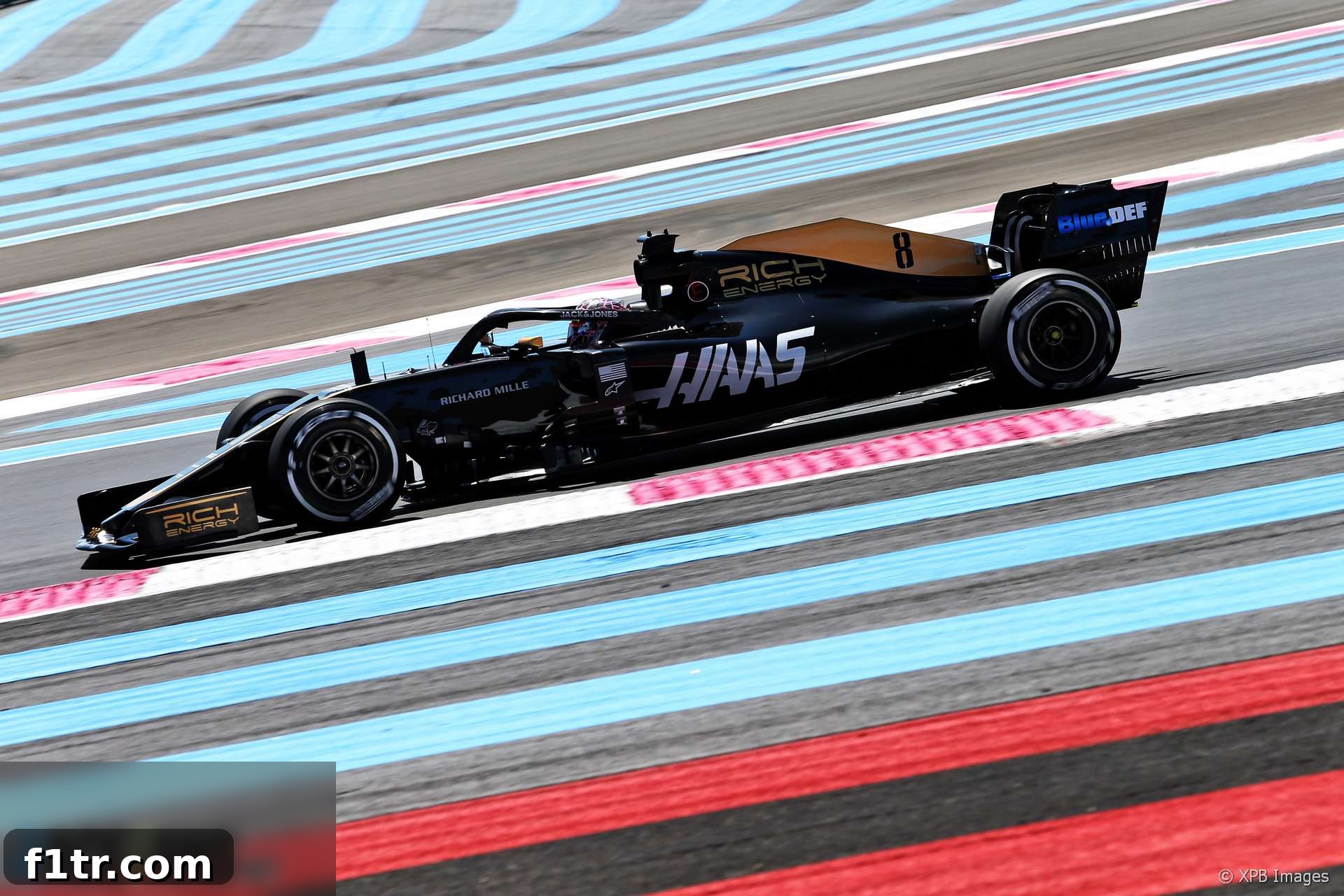
Romain Grosjean, a seasoned competitor in the fiercely contested world of Formula 1, has voiced a growing concern among drivers regarding the omnipresent issue of track limits. His recent remarks advocate for a fundamental redesign of modern circuit run-off areas, suggesting the reintroduction of natural barriers like grass verges to curb what he perceives as a pervasive exploitation of track boundaries by drivers. This contentious topic has once again ignited passionate debate across the motorsport community, highlighting the delicate balance between driver safety, sporting integrity, and the thrill of uncompromising racing.
The Haas driver’s comments arrived in the wake of the French Grand Prix, where Daniel Ricciardo received two separate penalties on the final lap. Ricciardo was sanctioned for exceeding track limits on two occasions at the Paul Ricard circuit, a venue notoriously bordered by extensive asphalt run-off areas. These vast stretches of tarmac, while designed with safety in mind, inadvertently offer little deterrent for drivers who push their cars beyond the white lines, seeking marginal gains in lap time.
The Track Limits Conundrum: A Driver’s Perspective
Grosjean unequivocally supported the stewards’ decision regarding Ricciardo’s penalties, asserting that “there are track limits” and they must be respected. However, his critique extends beyond individual infractions, targeting the very infrastructure of circuits that, in his view, encourage such transgressions. He argues that modern circuits, with their sprawling asphalt run-offs, create a “nightmare” scenario for race control and stewards, making consistent enforcement incredibly challenging.
“We’re putting ourselves in a position which has become a nightmare with those circuits with run-off everywhere,” Grosjean explained, articulating the frustrations felt by many within the paddock. He drew a sharp contrast between these contemporary designs and more traditional venues: “You don’t have a problem at Suzuka, you don’t have a problem in Monaco, you don’t have a problem in Canada.” These iconic tracks, with their unforgiving walls, gravel traps, and natural grass verges, impose an inherent penalty for exceeding limits, leaving no room for ambiguity or debate.
Grosjean’s solution for circuits like Paul Ricard, which he admits to loving as his home race, is strikingly simple yet profoundly impactful: “If you put two metres of grass on each side of the white line, the track limits, it can become the best track of the world.” He elaborates on the psychological shift this would induce in drivers: “Just because there’s so much run-off, who gives a damn about going straight? Put that and you don’t have any more problems, we don’t have any more of this discussion.” This physical deterrent, he believes, would have fundamentally altered Ricciardo’s approach in France, potentially preventing the controversial incidents and preserving Kimi Raikkonen’s position. The implication is clear: when the consequences of running wide are tangible, drivers will naturally exercise greater precision and respect for the track boundaries, leading to fairer and more exciting racing.
Support from the Grid: Bottas Echoes Concerns
Valtteri Bottas, a front-running driver for Mercedes, wholeheartedly supported Grosjean’s criticism of the pervasive use of asphalt run-offs. Bottas champions a return to more traditional circuit design elements that provide clear and immediate consequences for mistakes.
“I think the best thing outside the track is a wall, gravel or grass,” stated the Mercedes driver, outlining his preference for unambiguous boundaries. “That’s what I prefer. It’s very simple. There is a hard limit and no talks of track limits then.” Bottas’s perspective underscores a desire for clear-cut rules and consequences, removing the subjective element from stewarding decisions that often lead to inconsistency and frustration for both competitors and fans. When drivers face a clear physical penalty for exceeding limits, the debate over a millimetre or a fraction of a second beyond the white line becomes obsolete. This would streamline race control’s job and allow for greater focus on pure racing.
The Evolution of Circuit Design: Safety vs. Sport
The widespread adoption of asphalt run-off areas in modern motorsport circuits, particularly in Formula 1, is primarily a consequence of an unwavering commitment to driver and rider safety. Following several high-profile accidents in previous decades, the governing bodies, led by the FIA, initiated a push for safer track designs. Asphalt run-offs offer a controlled environment for vehicles that run wide, providing ample space for drivers to regain control or slow down without immediately encountering rigid barriers or abrasive gravel traps. This is particularly beneficial for motorcycle racing, where gravel can cause a rider to tumble, and for inexperienced drivers in lower formulae.
Furthermore, asphalt run-offs are easier and cheaper to maintain than gravel traps, which require regular sifting and redistribution after incidents. They also allow circuits to be multi-purpose, accommodating various forms of motorsport and even driver training days, without the constant need to clear gravel from the racing surface. However, this increased safety and operational efficiency have come at a cost to the sporting challenge, as Grosjean and Bottas eloquently argue.
The Red Bull Ring: A Model of Balance?
In contrast to the likes of Paul Ricard, the Red Bull Ring in Austria, a venue highly anticipated on the F1 calendar, stands out as one of the few modern circuits that still predominantly features extensive grass and gravel run-offs. While sections of asphalt have been introduced in specific areas, the track’s character is largely defined by its natural deterrents and strategically placed, aggressive kerbs that actively discourage drivers from running too far wide.
Bottas highlighted the effectiveness of such measures: “Some of those very aggressive kerbs, they definitely do the job because you can easily break the car so you really don’t want to go there.” These kerbs, often multi-stage or sharply angled, pose a genuine risk of damage to a car’s suspension or floor if driven over aggressively, thus forcing drivers to respect the track limits without the need for constant surveillance by stewards. This physical punishment for mistakes serves as a robust self-regulating mechanism for track integrity.
Despite acknowledging the trend towards tarmac, Bottas expressed a clear preference for the “old-school tracks” that have maintained their traditional layouts and characteristics. “But [having] Tarmac everywhere, I don’t like it, but it’s what it is. I’m sure many drivers feel the same but that’s the direction. I’m sure there’s reasons for it but I definitely preferred all the old-school tracks that are kept in similar way but at least the layout is still nice and similar. It has nice character, the track, and even if there’s a bit of Tarmac around I’m sure it’s still gonna be nice.” His sentiment resonates with a significant portion of the fanbase, who yearn for circuits that present a raw and uncompromising challenge, where driver skill is paramount and mistakes are costly.
Ahead of the recent Austrian Grand Prix, modifications were made to the Red Bull Ring, specifically extending the kerbs at turns three, four, seven, eight, and nine, and adding further run-off at turn four. Grosjean, however, downplayed the significance of these changes in addressing the core issue: “It hasn’t really changed, just some of the kerbs have been extended.” This implies that while minor tweaks can be made, a more fundamental approach is required to truly resolve the track limits debate and restore the integrity of racing boundaries across the sport.
The Impact on Racing and Fan Engagement
The absence of clear, physical track limits has far-reaching implications, extending beyond mere driver penalties. It fundamentally alters the dynamics of racing, potentially influencing overtaking manoeuvres, race strategies, and ultimately, the outcome of a Grand Prix. When drivers can consistently exploit run-off areas without immediate physical consequences, it can dilute the challenge of navigating a circuit with absolute precision. This can lead to a sense of unfairness, particularly when one driver gains an advantage by running wide, while another, adhering strictly to the white lines, loses out. For fans, the inconsistent application of rules and the seemingly arbitrary nature of penalties can be a source of immense frustration, detracting from the spectacle of Formula 1. The subjective nature of stewarding decisions, often based on video evidence and split-second judgments, becomes amplified when physical deterrents are absent, leading to ongoing controversies and a cloud of uncertainty over race results.
Towards a Solution: Balancing Safety and Sporting Challenge
The ongoing dialogue initiated by drivers like Romain Grosjean and Valtteri Bottas underscores a critical need for Formula 1 and the FIA to re-evaluate current circuit design philosophies. While driver safety must remain paramount, there is a strong argument that this can be achieved without entirely sacrificing the sporting challenge and the clarity of track limits. Solutions could include:
- Strategic Reintroduction of Grass/Gravel: Implementing Grosjean’s suggestion of narrow strips of grass or specific gravel traps at key corners where track limit abuses are most prevalent. This would provide an immediate, tangible penalty for exceeding boundaries without necessarily compromising major safety run-off zones.
- Aggressive Kerbing: Further standardising and implementing highly aggressive, car-damaging kerbs at critical points to deter drivers from running wide.
- Technological Monitoring: While not a physical deterrent, advanced electronic monitoring systems could provide instantaneous and objective data on track limit breaches, aiding stewards in consistent and timely decision-making. However, this still doesn’t address the core issue of a lack of physical penalty.
- Consistent Penalty Framework: Establishing a clearer and more consistently applied penalty framework for track limit infringements across all circuits, ensuring fairness and predictability for drivers and teams.
Ultimately, the goal is to strike a sustainable balance where circuits are safe enough to allow drivers to push the absolute limits of their machinery, yet unforgiving enough to penalise mistakes and clearly define the boundaries of the racing surface. This would not only enhance the sporting integrity of Formula 1 but also provide a more transparent and thrilling experience for fans worldwide, removing the lingering shadow of ‘track limits’ from the conversation and refocusing attention on the incredible skill and bravery of the drivers.
2019 F1 season
- Crying in the Melbourne car park at 2019 grand prix was my career low – Ocon
- McLaren Racing reports reduced £71 million loss in 2019
- Kvyat: Hockenheim podium last year was “my biggest achievement” so far
- How the FIA’s new encrypted fuel flow meter targets Ferrari’s suspected ‘aliasing’ trick
- “He smashed my office door”: 23 must-see moments from ‘Drive to Survive’ season two
Browse all 2019 F1 season articles