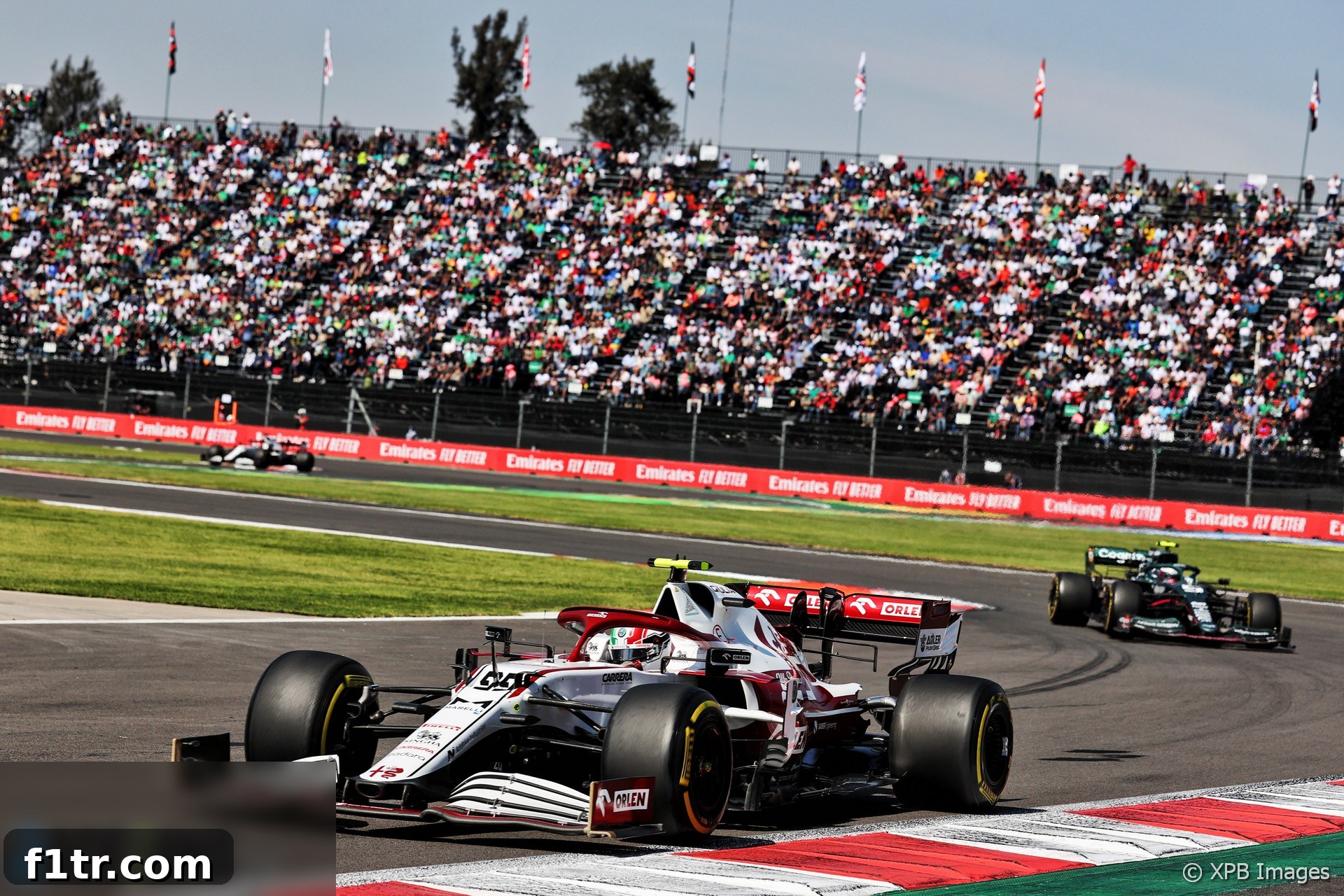
The air was thick with disappointment and a thinly veiled frustration for Antonio Giovinazzi at the conclusion of the Mexico City Grand Prix. His radio message to the Alfa Romeo pit wall – “thanks for the great strategy” – was laced with palpable sarcasm, a stark reflection of a promising race outcome that had tragically slipped through his fingers. Finishing 11th for the third consecutive race, just outside the coveted points-paying positions, Giovinazzi’s mood was understandably downcast. He had been running in a strong seventh place, positioning him for Alfa Romeo’s best result of the season, before a pivotal pit stop saw him drop precipitously through the field, even falling behind his own team mate, Kimi Raikkonen, who ultimately secured eighth place.
Speaking after the race, Giovinazzi did not mince words regarding his frustration. “I’m just really disappointed because today we had a chance to score points with two cars,” he stated emphatically. For a team like Alfa Romeo, struggling for every single point in the constructors’ championship, such an opportunity is invaluable. However, he quickly zeroed in on the core issue: “But on my side, the strategy was completely wrong.” He elaborated, dissecting the decision-making process from his perspective: “We pitted too early, but I don’t think [that] was the issue. The issue was that when I came out, I was in traffic. The strategy didn’t work.” His assessment painted a clear picture of a plan that, despite its intentions, had failed to account for the crucial dynamic of track position in the chaotic mid-pack.
The race had started with immense promise for the Alfa Romeo team. Giovinazzi, renowned for his aggressive starts, executed a phenomenal opening lap. He expertly navigated the traditional first-corner mayhem at the Autódromo Hermanos Rodríguez, capitalising on the chaos to leap an impressive six positions, settling into sixth place. Raikkonen, demonstrating his veteran skill, had to artfully dodge several cars that ran wide but managed to maintain a strong 10th position. This initial performance set the stage for what could have been a historic day for the team, offering the genuine prospect of a rare double-points finish – an outcome that would significantly boost their standings and morale.
As the race progressed, the pace of the faster cars began to tell. It was no surprise when Carlos Sainz Jnr, in the quicker Ferrari, effortlessly motored past Giovinazzi after the safety car restart. However, the team remained optimistic, setting their sights on holding onto seventh place. This position, if maintained, would still represent their best result of the season, a tangible reward for their efforts. Xevi Pujolar, Alfa Romeo’s head of track engineering, articulated the team’s initial positive outlook: “In turn one with all the incidents we lost a bit of position with Kimi, but we were very well positioned with Antonio. So there was still a good chance to score points.” The high altitude and specific track characteristics of Mexico often throw strategic curveballs, and Alfa Romeo seemed, at this early stage, to be mastering them.
The team’s strategic considerations for Giovinazzi were heavily influenced by the recovery drives of Daniel Ricciardo and Valtteri Bottas. Both drivers had been involved in a first-lap incident, forcing them into early pit stops and relegating them to the very back of the field. However, with their cars’ inherent pace, they were rapidly working their way back through the order, becoming a significant variable in the mid-field battle. Pujolar elaborated on the complex calculations at play: “Everything was going to plan. I think most people had planned with the medium and hard [tyres]. In terms of strategy, it’s how early will you go and how much will you extend the stint with a hard.” The decision was not merely about tyre life but about managing track position relative to key competitors.
Alfa Romeo found themselves in a classic strategic bind. Giovinazzi’s rear tyres began to struggle, and the team observed a growing train of cars behind him. The threat of an ‘undercut’ – where a rival pits early for fresh tyres and uses their superior pace to jump ahead – loomed large. Furthermore, the unknown factor of Ricciardo and Bottas, who had already pitted and were now managing their hard tyres, presented a unique challenge. Pujolar explained their concerns: “For us there was no incentive to go early, it was not needed, but at one point, Antonio started to struggle with the rear tyres. We were looking at the traffic behind, Kimi was still with good pace and we had that group with Ricciardo and Bottas that came in early and we knew that they were managing a bit the tyres.”
The team became particularly concerned that Sebastian Vettel and other drivers chasing Giovinazzi might pit early, aiming to leapfrog him. This defensive consideration ultimately drove their decision to bring Giovinazzi in sooner than initially planned. “The last thing we wanted was to have everyone compress behind Antonio. So we decided to box Antonio. And we knew that he will go out with them, with Bottas and Ricciardo.” The logic was sound: pit early, get onto fresh tyres, and re-emerge either ahead of or alongside Ricciardo and Bottas, banking on their superior machinery to quickly clear any traffic and allow Giovinazzi to maintain a clean air advantage. However, this is where the strategy unravelled.
Pujolar candidly admitted the critical misjudgment that sealed Giovinazzi’s fate: “What we misjudged here is the pace of these two guys.” The expectation was that Ricciardo and Bottas, despite their earlier incident, would quickly regain their race-winning pace and serve as effective trailblazers for Giovinazzi. “We thought that their pace will be faster or as fast as Kimi and all these [other] guys.” This crucial miscalculation proved disastrous. Instead of finding clean air or quick-moving traffic, Giovinazzi emerged from his pit stop directly behind the slower-than-expected Ricciardo and Bottas, who were either nursing their tyres aggressively or dealing with unforeseen damage that compromised their speed. His radio immediately crackled with frustration: “But now I’m in the traffic,” after being informed that his team mate and Vettel had stayed out and were lapping quicker.
The impact of this misjudgment was immediate and severe. “That was not ideal for Antonio and we didn’t expect that,” Pujolar conceded. Giovinazzi, now stuck in the dirty air and compromised pace of the recovering duo, lost vital track time and fell out of contention for points. “At that point we compromised that race because Ricciardo was – I don’t know if he had some problem, because even if you manage you don’t lose so much time. So I don’t know which kind of problems they had but we were losing track time with Antonio.” The unintended consequence was a cascade of lost positions and the erosion of his promising early race performance. By the time Ricciardo and Bottas eventually made their second stops, Vettel and Raikkonen, having extended their first stints, had already changed their tyres and rejoined the track ahead of Giovinazzi, permanently sealing his fate outside the points.
In stark contrast to Giovinazzi’s plight, Kimi Raikkonen’s race unfolded with a more fortunate strategic outcome. The veteran Finn stayed out longer, carefully managing his tyres and avoiding the traffic trap that ensnared his teammate. “With Kimi we were just managing the gap between Vettel and Alonso,” Pujolar explained. “There was no incentive to come in too early. So once we got the right window, we went with Kimi. For sure, we wanted to get close to Vettel and see if we could challenge him but it was not possible.” Raikkonen’s extended first stint allowed the track to clear and positioned him to pit into clean air, ultimately securing a valuable eighth place and contributing much-needed points to Alfa Romeo’s constructor tally.
For Antonio Giovinazzi, whose future in Formula 1 remains a subject of intense speculation and uncertainty, the Mexico City Grand Prix represented yet another potential points-scoring opportunity tragically lost. The weight of these missed chances, particularly in a season where points are so scarce for Alfa Romeo, is immense. “Kimi stayed P8 and I was P7 at that moment, so the disappointment is because the team didn’t score as much as possible,” he reflected, his voice heavy with the burden of what might have been. “This is really hard for myself as well.” In the cutthroat world of Formula 1, where a driver’s worth is often measured in championship points, a strategic misstep of this magnitude could have far-reaching implications, compounding the pressure on Giovinazzi as he fights to retain his seat in the sport’s premier category.
2021 Mexico City Grand Prix
- No one will win more F1 races than Verstappen this year
- Alfa Romeo’s misjudgement which prompted Giovinazzi’s sarcastic radio ‘thanks’
- “Nice catch”: How Verstappen’s canny bid to thwart Bottas almost succeeded
- 2021 Mexico City Grand Prix Star Performers
- Wolff “surprised” stewards did not investigate Ricciardo over Bottas collision
Browse all 2021 Mexico City Grand Prix articles