Advert | Become a Supporter & go ad-free
Hockenheimring Run-Off Debate: Drivers Decry ‘Unacceptable’ Surface Amidst Safety Concerns
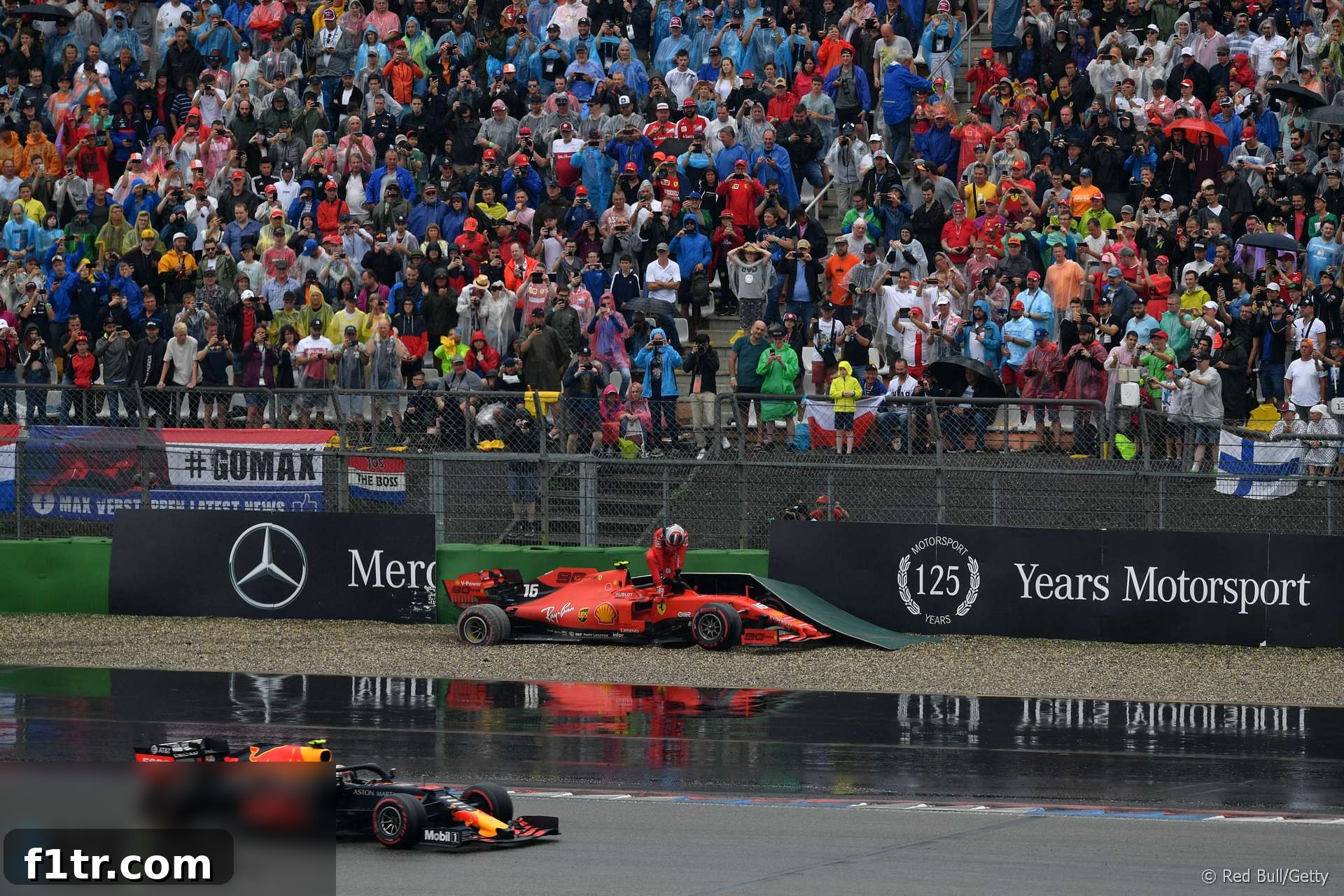
The 2019 German Grand Prix at the Hockenheimring proved to be a chaotic and unpredictable affair, marked by challenging wet conditions and numerous incidents. Among the most discussed topics post-race was the contentious run-off area at Turn 16, a section of the circuit that doubles as a drag strip. Following a significant crash by Charles Leclerc, and near-misses and spins from other prominent drivers, concerns were swiftly raised regarding the surface’s safety and suitability for Formula 1 racing. Drivers labeled the area “unacceptable” and “like ice,” sparking a debate with the sport’s governing body, the FIA, over track design and driver accountability.
The Treacherous Turn 16: A Costly Mistake for F1 Contenders
During the notoriously wet race, the Hockenheimring’s Turn 16 became a significant hazard, claiming several high-profile victims. Ferrari’s Charles Leclerc, who had been running strongly, was the first major casualty, spinning off and making heavy contact with the barrier. His immediate reaction was one of frustration and disbelief, describing the drag strip run-off as “very slippery” and vehemently deeming it “unacceptable.” This incident not only cost him valuable championship points but also highlighted a critical flaw in the circuit’s design, particularly under adverse weather conditions.
Adding weight to Leclerc’s criticism, Lewis Hamilton, the then-reigning world champion, also found himself struggling at the very same corner. In a rare and dramatic error, Hamilton spun and made contact with the barrier at Turn 16 on the same lap as Leclerc’s incident. His assessment mirrored Leclerc’s, describing the run-off surface as “like ice.” Hamilton further elaborated, lamenting the absence of traditional gravel traps: “Normally it would be gravel. If it’d been gravel I probably wouldn’t have gone as far and I would have been able to come back on. But pretty poor design, that aspect of the track, I would say.” His comments underscored a consensus among drivers regarding the distinct disadvantages of the drag strip surface in wet conditions compared to conventional safety measures.
Before these high-profile incidents, Carlos Sainz Jnr had also experienced a moment at Turn 16, narrowly avoiding contact with the wall. While he managed to keep his car intact, his experience further solidified the drivers’ view that the run-off was unusually perilous. Sainz candidly remarked, “I was probably one of the only ones not to put it in the wall after touching it. For us, it was a very costly mistake to put a tyre there.” The Spaniard’s comments resonated with the sentiment that the risk-reward ratio of running wide at that particular corner was heavily skewed against the drivers.
The shared frustration indicated that the matter would undoubtedly be raised with FIA Race Director Michael Masi. Sainz confirmed this, stating, “I guess it will be discussed in the drivers’ meeting. But at the same time, I think it made the race a bit more exciting. I paid my price for going there. Instead of that maybe you can put gravel and I would be very happy. But it’s a drag strip.” His mixed feelings encapsulated the paradox: while the challenging conditions contributed to an thrilling race for spectators, the inherent risks posed by the specific run-off area were a significant concern for competitors.
Advert | Become a RaceFans supporter andgo ad-free
The FIA’s Stance: Safety vs. Consequences
Despite the chorus of driver complaints, FIA Race Director Michael Masi offered a contrasting perspective on the Turn 16 run-off. When questioned by Racefans, Masi remained steadfast in his assessment of the drag strip’s safety. “The drag strip looks fine,” he asserted. He further explained that thorough inspections had been conducted both before and after the race, even with water present on the surface. “We inspected it the other day and had a look again post-race with the water on it. It’s fine,” Masi concluded.
Masi attributed the slippery conditions to the inherent properties of painted surfaces when wet, acknowledging, “Put water on painted run-off and as much as you can do anything to make sure that it’s anti-slip paint, it’s still more slippery than what unpainted Tarmac is.” While this explanation provides a technical rationale, it does not fully address the drivers’ core grievance regarding the comparative safety and punitive nature of the drag strip versus a traditional gravel trap, which is designed to slow cars more effectively and prevent barrier contact.
The FIA’s position is also framed within a broader philosophical debate about track design and driver accountability. Masi notably pointed out that F1 drivers have consistently advocated for run-off areas that offer “consequences” for exceeding track limits. “Credit where credit’s due, all 20 drivers have been very consistent in their views if they run off-track there should be consequences, so to speak,” he remarked. This argument suggests a delicate balance between providing ultimate safety and ensuring that mistakes come with a penalty, preventing drivers from exploiting expansive, forgiving run-off areas.
Masi conceded that drivers’ immediate reactions post-race might differ from their long-term, consistent feedback. “Maybe straight after a race they might have a different view the way that it’s affected them. But sitting down with them individually and as a group that’s been their consistent view and it hasn’t changed.” This highlights the ongoing tension in motorsport between the desire for thrilling, challenging racing and the paramount need for driver safety, a dynamic that constantly shapes circuit design and safety regulations.
The Broader Implications for Circuit Design and Safety in Formula 1
The Hockenheimring incident at Turn 16 served as a microcosm of a larger, ongoing debate within Formula 1 concerning track limits, run-off areas, and the philosophy behind circuit design. For years, the sport has grappled with finding the optimal balance between driver safety, which often necessitates vast tarmac run-offs, and the desire to punish mistakes, traditionally achieved with gravel traps or grass. Tarmac run-offs, while safer in terms of preventing significant damage or injury, can sometimes encourage drivers to push beyond the natural limits of the track without immediate consequence, leading to ‘track limits’ infringements rather than genuine off-track excursions.
The Hockenheimring’s drag strip run-off presented a unique challenge: a tarmac surface that, due to its specific properties and the wet conditions, became unusually treacherous. It offered a ‘consequence’ – albeit a highly unpredictable and potentially dangerous one – that drivers found unacceptable. This contrasts sharply with the intended consequences of gravel traps, which are designed to slow a car significantly, often beaching it, thereby ending its race without typically causing severe damage or high-speed impacts.
The drivers’ unified voice, led by figures like Leclerc and Hamilton, underscores the importance of their input in safety discussions. While the FIA has a responsibility to ensure overall safety, driver feedback, based on real-time experience at the absolute limit, is invaluable. This incident reaffirmed the need for continuous dialogue and evaluation of track surfaces, especially in areas that serve dual purposes or are prone to unusual conditions. The question isn’t just about whether a surface is technically “fine” but whether it’s optimally safe and fair for the specific demands of Formula 1 racing, particularly in challenging environments like a wet Grand Prix.
Hockenheimring’s Uncertain Future and the Lingering Debate
While the immediate controversy surrounding the Turn 16 run-off at Hockenheimring was intense, its long-term relevance to Formula 1 was somewhat curtailed by the circuit’s precarious position on the calendar. The problem was largely rendered moot as the Hockenheimring did not secure a place on the 2020 F1 calendar, and has struggled to maintain a consistent presence since. This meant that while the debate over the specific drag strip surface was critical at the time, the likelihood of future F1 cars encountering the same issue at this particular venue became slim.
However, the underlying questions raised by the Hockenheimring incident persist across the Formula 1 landscape. As the sport continues to visit a diverse array of circuits, some purpose-built for F1 and others adapted from existing facilities, the balance between safety innovation and maintaining the challenge for drivers remains a central theme. The incident at Turn 16 serves as a potent reminder that even seemingly minor elements of track design can have significant implications for race outcomes, driver safety, and the overall perception of the sport’s commitment to both thrilling competition and uncompromising safety standards. The dialogue between drivers and the FIA about consequences and appropriate run-off design continues to evolve, shaping the future of F1 circuits worldwide.
Advert | Become a RaceFans supporter andgo ad-free
More from the 2019 F1 Season
- Crying in the Melbourne car park at 2019 grand prix was my career low – Ocon
- McLaren Racing reports reduced £71 million loss in 2019
- Kvyat: Hockenheim podium last year was “my biggest achievement” so far
- How the FIA’s new encrypted fuel flow meter targets Ferrari’s suspected ‘aliasing’ trick
- “He smashed my office door”: 23 must-see moments from ‘Drive to Survive’ season two
Browse all 2019 F1 season articles