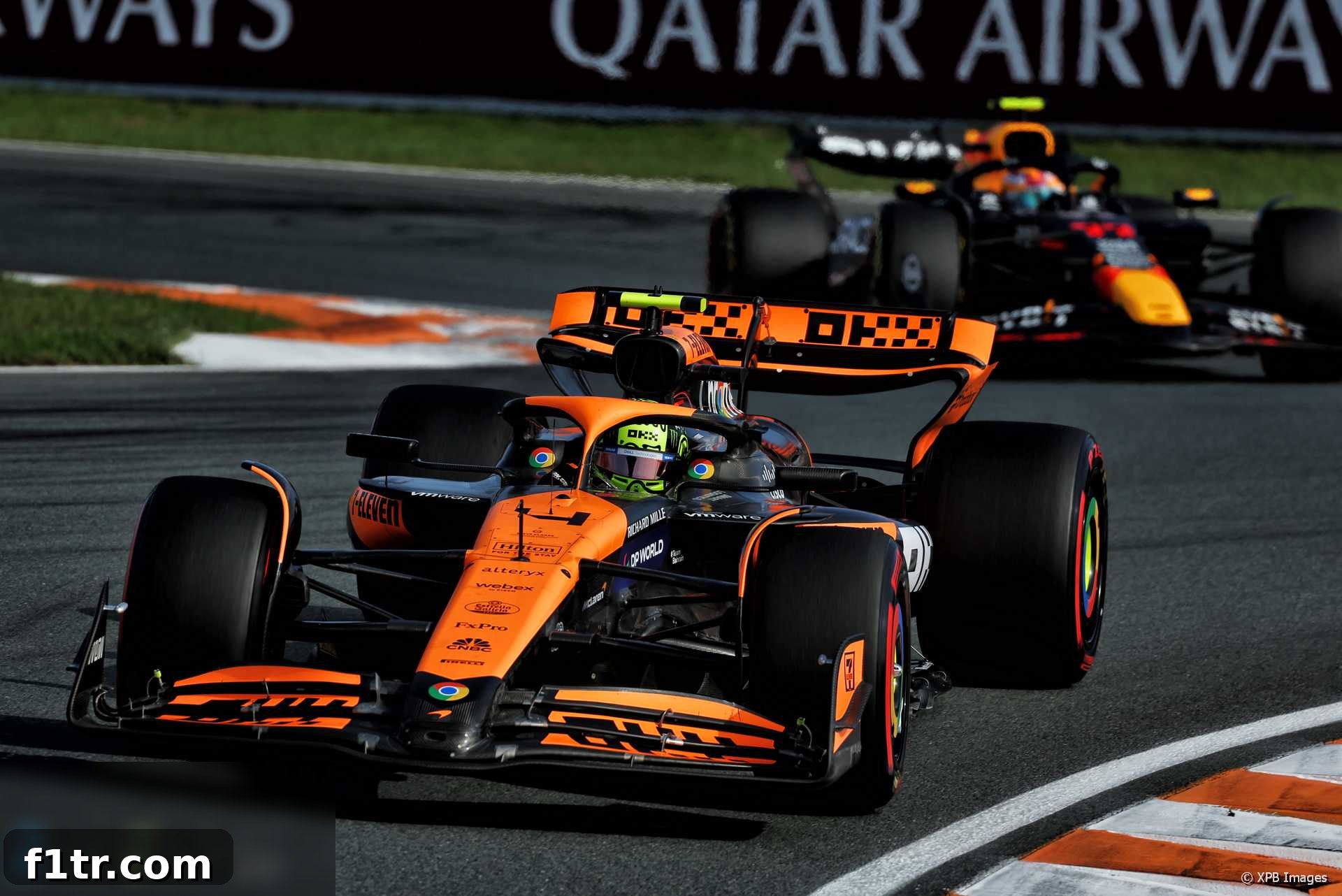
The Dutch Grand Prix qualifying session at Zandvoort proved to be an exceptionally demanding affair, primarily due to the relentless gusting winds. These challenging conditions transformed the circuit into a formidable test of precision and adaptability for every driver on the grid. Alexander Albon, a driver intimately familiar with the nuances of car handling, succinctly captured the severity of the situation, estimating that the difference between a clean lap in calm air and one battling the turbulent winds could be as substantial as half a second. This significant variance highlights just how precarious the balance was and the immense skill required to extract maximum performance.
Given the unpredictable nature of the wind, it was hardly surprising that only a select few drivers managed the near-impossible feat of perfectly linking their three fastest sector times into a single, cohesive qualifying lap. Such a performance demands absolute precision, unflappable confidence, and an almost intuitive understanding of the car’s limits under shifting aerodynamic loads. Among these elite few, Lando Norris emerged as the standout performer. He masterfully navigated the challenging Zandvoort circuit, stringing together optimal sector times that ultimately propelled his McLaren to a well-deserved pole position. His exceptional consistency and speed saw him claim the top spot by a remarkable margin of three-tenths of a second, an impressive feat given the tight competition and tricky conditions. (Detailed sector times are provided below for further analysis).
Long before the qualifying session even commenced, there was already considerable speculation and growing evidence suggesting that McLaren had, indeed, brought the fastest package to Zandvoort. The team’s strong performances in practice sessions had hinted at their formidable pace, and Norris’s pole position only served to solidify this belief. With the benefit of what was described as a ‘clean lap’ – a lap unmarred by errors or significant wind disturbances – Norris was able to unleash the full potential of his MCL38. His three-tenths advantage over his closest rival was not merely a testament to his individual brilliance but also a resounding statement about the inherent speed and balance of the McLaren challenger.
This qualifying advantage represented McLaren’s most significant performance gap over their nearest competitor in recent memory. In absolute terms, the margin stood at an impressive 0.356 seconds, while relatively, it accounted for a 0.51% difference in lap time. While the prevailing windy conditions undoubtedly played a role in exaggerating some of these differences, there is little doubt that McLaren’s latest package of aerodynamic upgrades also contributed substantially to this newfound dominance. The technical advancements brought to the car appear to have unlocked a higher level of performance, particularly in crucial areas like high-speed stability and cornering grip, which are vital at a demanding track like Zandvoort. This strong showing is not an isolated incident but rather reinforces a notable trend observed recently: McLaren’s exceptional strength on high-downforce circuits. Tracks like the iconic Hungaroring, which demand maximum aerodynamic grip, have also seen the Woking-based team excel. For their rivals, this consistent performance at specific circuit types presents a concerning pattern, though the silver lining might be that there are relatively few truly high-downforce focused tracks remaining on the calendar.
A deeper dive into the lap times recorded during the qualifying session revealed stark contrasts in performance across the grid. Notably, only Sauber managed to lap slower than their own pace from the previous year’s event at Zandvoort. More concerning still, the Swiss-based team found themselves further from the leading pace than any other team in the field. However, this observation must be approached with a degree of caution and nuance. Sauber’s qualifying performance cannot be considered entirely representative due to a significant technical infringement that led to the disqualification of their sole participating driver. This incident not only invalidated their recorded times but also underscored the challenges smaller teams face in consistently adhering to stringent technical regulations while pushing the boundaries of performance. It is worth noting that Sauber had also lagged behind Williams in the two preceding races, indicating a broader struggle with their car’s competitive edge. Conversely, the situation for Williams appeared far more optimistic. Should the Grove-based squad successfully resolve the compliance issues with their car’s floor without incurring a significant performance penalty, their pace demonstrated today strongly suggests they have indeed made a commendable step forward. This potential improvement offers a glimmer of hope for the team as they look to climb up the pecking order.
On the other side of the garage, the mood within the Ferrari camp was one of palpable dismay following their qualifying performance. Both drivers, Carlos Sainz Jnr and Charles Leclerc, openly expressed their disappointment with the pace of their SF-24 challenger. It’s important to acknowledge that Sainz had previously identified Zandvoort as a potentially weaker venue for the Scuderia, a prediction that unfortunately proved accurate. The Maranello team found themselves a significant 1.3% off the fastest lap time, a performance deficit worse than any they had experienced all season, with the sole exception of the Canadian Grand Prix in Montreal. This substantial gap to the frontrunners raised serious questions about the car’s fundamental characteristics and its suitability for the unique demands of the Dutch circuit. The challenges at Zandvoort, characterized by its flowing, high-speed corners and undulating profile, seemingly exposed specific weaknesses within the SF-24’s aerodynamic platform and chassis balance.
Despite the immediate disappointment, Ferrari’s lap times in Zandvoort were still substantially quicker than those they set in the previous year’s event. In 2023, the team had made a strategic decision to sacrifice performance at this particular race in a concerted effort to address and solve some of the persistent underlying problems they were encountering with their car at the time. This approach, which prioritized long-term development over immediate results, appeared to have yielded some fruit in terms of raw lap speed compared to the previous season. However, Charles Leclerc candidly revealed that the team had, in fact, adopted a very similar strategy earlier this year, making comparable sacrifices in four previous races. This admission indicates an ongoing struggle to consistently extract peak performance across all circuit types and suggests that Ferrari is still in a phase of significant car development and strategic trade-offs, aiming to broaden the operational window of their SF-24 and improve its adaptability to varying track characteristics.
The 2024 Dutch Grand Prix marked Formula 1’s fourth visit to the extensively remodelled Zandvoort circuit since its return to the calendar. With each passing year, the current generation of F1 cars continues to push the boundaries of speed, relentlessly closing the gap to the performance levels of their predecessors. This season, the fastest machines are now almost on par with, if not quicker than, the previous generation of cars that graced the circuit. Lando Norris’s pole position time, a blistering lap, was within a mere second of Max Verstappen’s record-setting pole position lap from the 2021 event. This incredible convergence of lap times underscores the relentless pace of development in Formula 1 and the incredible engineering feats achieved by the teams. Zandvoort, with its iconic banked corners and rapid changes in direction, remains a truly unique challenge, and the evolution of car design has allowed drivers to exploit its demanding layout with ever-increasing efficiency. The circuit’s character, combined with the continuous innovation in aerodynamics and power units, ensures that each visit delivers breathtaking speed and edge-of-the-seat racing.
Sector Times Breakdown: Norris’s Masterclass and Rival Performances
| P. | # | Driver | S1 | S2 | S3 | Ultimate lap (deficit) |
|---|---|---|---|---|---|---|
| 1 | 4 | Lando Norris | 23.824 (1) | 24.819 (2) | 21.03 (1) | 1’09.673 |
| 2 | 1 | Max Verstappen | 24.073 (6) | 24.731 (1) | 21.126 (2) | 1’09.930 (+0.099) |
| 3 | 81 | Oscar Piastri | 24.017 (3) | 24.882 (3) | 21.172 (5) | 1’10.071 (+0.101) |
| 4 | 63 | George Russell | 24.044 (4) | 24.984 (4) | 21.162 (4) | 1’10.190 (+0.054) |
| 5 | 11 | Sergio Perez | 24.065 (5) | 25.042 (5) | 21.309 (9) | 1’10.416 |
| 6 | 16 | Charles Leclerc | 24.16 (9) | 25.201 (10) | 21.16 (3) | 1’10.521 (+0.061) |
| 7 | 18 | Lance Stroll | 23.951 (2) | 25.128 (8) | 21.45 (14) | 1’10.529 (+0.132) |
| 8 | 14 | Fernando Alonso | 24.25 (12) | 25.123 (7) | 21.195 (6) | 1’10.568 (+0.065) |
| 9 | 10 | Pierre Gasly | 24.143 (7) | 25.054 (6) | 21.38 (11) | 1’10.577 (+0.238) |
| 10 | 23 | Alexander Albon | 24.158 (8) | 25.18 (9) | 21.285 (8) | 1’10.623 (+0.030) |
| 11 | 44 | Lewis Hamilton | 24.208 (10) | 25.23 (11) | 21.429 (13) | 1’10.867 (+0.081) |
| 12 | 55 | Carlos Sainz Jnr | 24.349 (14) | 25.341 (14) | 21.224 (7) | 1’10.914 |
| 13 | 22 | Yuki Tsunoda | 24.246 (11) | 25.241 (12) | 21.468 (15) | 1’10.955 |
| 14 | 27 | Nico Hulkenberg | 24.498 (15) | 25.263 (13) | 21.402 (12) | 1’11.163 (+0.052) |
| 15 | 20 | Kevin Magnussen | 24.318 (13) | 25.54 (16) | 21.374 (10) | 1’11.232 (+0.063) |
| 16 | 31 | Esteban Ocon | 24.526 (16) | 25.548 (17) | 21.642 (16) | 1’11.716 (+0.279) |
| 17 | 3 | Daniel Ricciardo | 24.704 (18) | 25.532 (15) | 21.707 (17) | 1’11.943 |
| 18 | 77 | Valtteri Bottas | 24.63 (17) | 25.672 (18) | 21.743 (18) | 1’12.045 (+0.123) |
| 19 | 24 | Zhou Guanyu | 25.036 (19) | 25.863 (19) | 21.921 (19) | 1’12.820 (+0.441) |
The sector times table from qualifying provides fascinating insights into where each driver gained or lost time around the Zandvoort circuit. Lando Norris’s pole position was a result of an incredibly well-balanced lap, securing the fastest time in Sector 1 and Sector 3, and the second-fastest in Sector 2. This near-perfect distribution of speed across all parts of the track underscores his ability to master the circuit’s varied demands, from the tight initial corners to the flowing, high-speed sections. Max Verstappen, despite missing pole, demonstrated his formidable prowess in Sector 2, claiming the fastest time there. This sector features several rapid changes of direction and demands exceptional stability and traction, areas where the Red Bull often excels. However, his slightly lower rankings in Sector 1 (6th) and Sector 3 (2nd) meant he couldn’t quite match Norris’s overall consistency.
Oscar Piastri, in the second McLaren, further highlighted the car’s strength, consistently placing in the top three for the first two sectors. His slight drop to 5th in Sector 3 indicates a minor area for improvement but still solidifies McLaren’s impressive pace. George Russell’s performance for Mercedes was respectable, securing 4th fastest in both Sector 1 and Sector 3, and maintaining a strong pace in Sector 2. Charles Leclerc’s 3rd fastest time in Sector 3, despite his overall qualifying position, is noteworthy. It suggests that the Ferrari has inherent speed in the faster, more flowing parts of the track, even if the car struggles with the more technical or slower sections that characterize Sector 1 and Sector 2 for him. This data clearly illustrates the intricate dance of car setup, driver skill, and track characteristics that ultimately determines qualifying success in Formula 1.
2024 Dutch Grand Prix Related Articles
The 2024 Dutch Grand Prix provided a wealth of talking points and analysis. For those seeking further insights into the race weekend’s developments and the broader implications for the Formula 1 season, we recommend exploring the following articles:
- Previous technical hires no obstacle to Newey joining Aston Martin – Krack
- Mercedes still unsure whether Spa floor upgrade is working
- McLaren’s Dutch GP upgrade “nowhere near” as significant as Miami package
- “Very hard to pinpoint” why car has become harder to drive – Verstappen
- Only one F1 driver is making worse starts than Norris in 2024
Browse all 2024 Dutch Grand Prix articles