Charles Leclerc’s Brazilian Grand Prix Nightmare: Ferrari Explains Formation Lap Failure
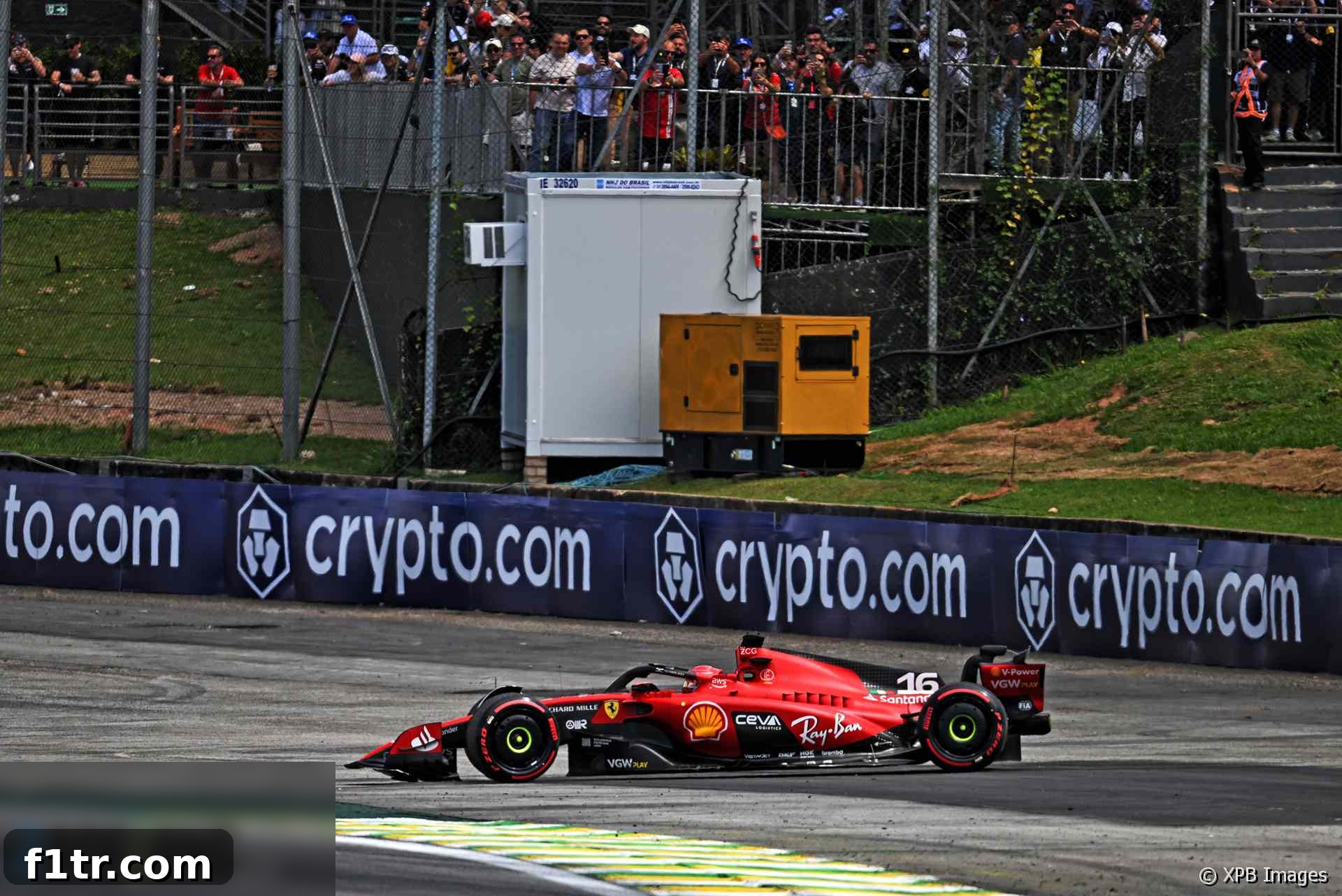
The São Paulo Grand Prix weekend took a dramatic and heartbreaking turn for Ferrari and Charles Leclerc even before the lights went out. In a cruel twist of fate, the Monegasque driver, poised for a strong performance starting from the front row, was forced to retire during the formation lap, his car spinning into a barrier as critical systems failed. This unexpected exit marked a devastating blow for Ferrari’s strategic aspirations and their ongoing battle in the Constructors’ Championship.
As Leclerc navigated his Ferrari SF-23 towards the starting grid ahead of Sunday’s main event, his car suddenly suffered a complete shutdown of its control systems and engine. The sudden loss of power and steering sent him veering off track and into a barrier, a shocking sight for fans and a gut-wrenching moment for the team. While he was briefly able to restart his power unit, an indication of some life returning to the machine, the respite was short-lived. The car subsequently stopped again, leaving Leclerc stranded and his race hopes extinguished.
Initial reports from Leclerc himself hinted at a hydraulic problem. However, Ferrari team principal Frederic Vasseur later clarified that this was merely a symptom of a deeper, more pervasive issue within the car’s complex electronic architecture. The actual root cause, as Vasseur indicated, pointed towards an electronic malfunction rather than a primary hydraulic failure.
Ferrari Investigates Electronic Glitch Behind Leclerc’s Early Exit
Speaking after the race, a visibly disappointed Frederic Vasseur shed more light on the incident. “The system switched off the hydraulics and engine,” Vasseur confirmed. “The reason for the command from the system we don’t know yet because the car is not back. But it was more an electronic problem.” This diagnostic challenge underscores the intricate nature of modern Formula 1 machinery, where a single electronic command can trigger a cascade of system failures, leading to immediate and unavoidable retirement.
Despite Leclerc’s valiant attempt to get the car moving again, making a mere “30 metres” after the initial shutdown, Vasseur stated that “it was in the same situation that it was better to stop. No way to recover.” This illustrates the severity of the electronic issue, which rendered the car completely unraceable, despite the driver’s desperate efforts to coax it back to life. The incident highlights the fine line between pushing the limits of technology and the catastrophic consequences when those limits are breached, even before the race officially begins.
A Crushing Strategic Blow for Ferrari in Brazil
Leclerc’s premature exit was not just a personal disappointment; it represented a massive strategic setback for the Scuderia. Having qualified brilliantly on the front row of the grid alongside championship leader Max Verstappen, Ferrari had carefully orchestrated their weekend around maximizing their performance in the Grand Prix. This included a calculated sacrifice in the preceding sprint race, where they opted against using new tyres, preserving them for Sunday’s main event.
“It’s very frustrating for Charles and for the team,” Vasseur expressed, his words laden with the weight of the missed opportunity. “But the issue is that also strategically all the weekend we put all the effort on the long one [race], to save new tyres we didn’t put new tyres for the race of the short one, we put everything on the long one, and we didn’t take the start.” This strategic gamble, designed to give Leclerc a distinct advantage with fresh rubber and prime track position, was entirely nullified by the technical failure, leaving Ferrari with nothing to show for their meticulous planning.
The emotional toll on Leclerc was evident. “For sure it’s frustrating. He was more than disappointed,” Vasseur noted, acknowledging the raw emotion of the moment. However, the team principal also emphasized the need for resilience and a forward-looking mindset. “But I am sure that tonight he will be back and he will be focused on Vegas.” This quick pivot to the upcoming Las Vegas Grand Prix reflects the relentless nature of Formula 1, where teams and drivers must quickly process setbacks and channel their energy into the next challenge.
Missed Opportunity to Challenge Mercedes and Secure a Podium
Despite the bitter disappointment, Vasseur found some encouragement in the underlying pace and potential that Ferrari had shown throughout the Brazilian Grand Prix weekend. “Now we have to stay calm to understand what’s happened to avoid any issue in the future,” he stressed, prioritizing a thorough investigation to prevent a recurrence of such a critical failure. The focus remains on understanding the electronic glitch and implementing robust solutions to safeguard future performances.
“I think the pace over the weekend was not that bad, we were in a good position today,” Vasseur continued. This sentiment underscores the inherent competitiveness of the SF-23 at Interlagos, suggesting that without the technical fault, Ferrari could have genuinely challenged at the front. The incident was, without a doubt, a “missed opportunity because we are catching up Mercedes a little bit over the weekend but with Charles on the first row, with three sets of new tyres it could have been much better.” This highlights the importance of every point in the Constructors’ Championship battle, where Ferrari is locked in a tight fight with Mercedes for second place.
Vasseur firmly believed that a podium finish “would have been possible” had Leclerc been able to take the start. He elaborated on the favorable conditions: “If you consider that we were also [racing] with three set of new [tyres], starting in clean air but the two Astons didn’t have a great start.” The advantage of new tyres, combined with a clear run into Turn 1 from the front row and potential struggles from competitors, painted a compelling picture of what could have been. Yet, Vasseur, ever the pragmatist, was quick to dismiss such hypothetical scenarios.
“But you know this kind of position is just bullshit. Racing is racing, you don’t have to race with ‘if, if, if.’ It is like it is,” Vasseur concluded, perfectly encapsulating the brutal reality of Formula 1. While analysis and understanding are crucial, dwelling on what might have been serves no purpose in a sport that demands unwavering focus on the present and the future. The incident, though painful, provides critical data for Ferrari to improve and ensure such a failure does not derail their ambitions again.
Looking Ahead: Ferrari’s Resolve for Las Vegas
The Brazilian Grand Prix presented a stark reminder of the unpredictable nature of Formula 1. Charles Leclerc’s formation lap retirement due to an unexpected electronic failure was a devastating blow for Ferrari, nullifying their strategic efforts and denying them a clear opportunity for a strong result, potentially even a podium. However, under Frederic Vasseur’s leadership, the team is committed to a thorough investigation to understand the root cause and implement preventative measures. With the Las Vegas Grand Prix rapidly approaching, Ferrari’s focus will now shift to a new circuit and a fresh chance for redemption, determined to put this Brazilian nightmare behind them and convert their inherent pace into tangible results.
2023 Brazilian Grand Prix News & Analysis
- Perez’s missed “open goal” in Miami was turning point in title fight – Horner
- F1 drivers insist new rules to prevent impeding in qualifying don’t work
- McLaren surprised by margin over rivals at track Norris thought would be “tough”
- “Follow Fernando’s line” – How Red Bull tried everything to get Perez past Alonso
- Mercedes’ Brazilian GP set-up was “conservative” after US GP disqualification
Browse all 2023 Brazilian Grand Prix articles