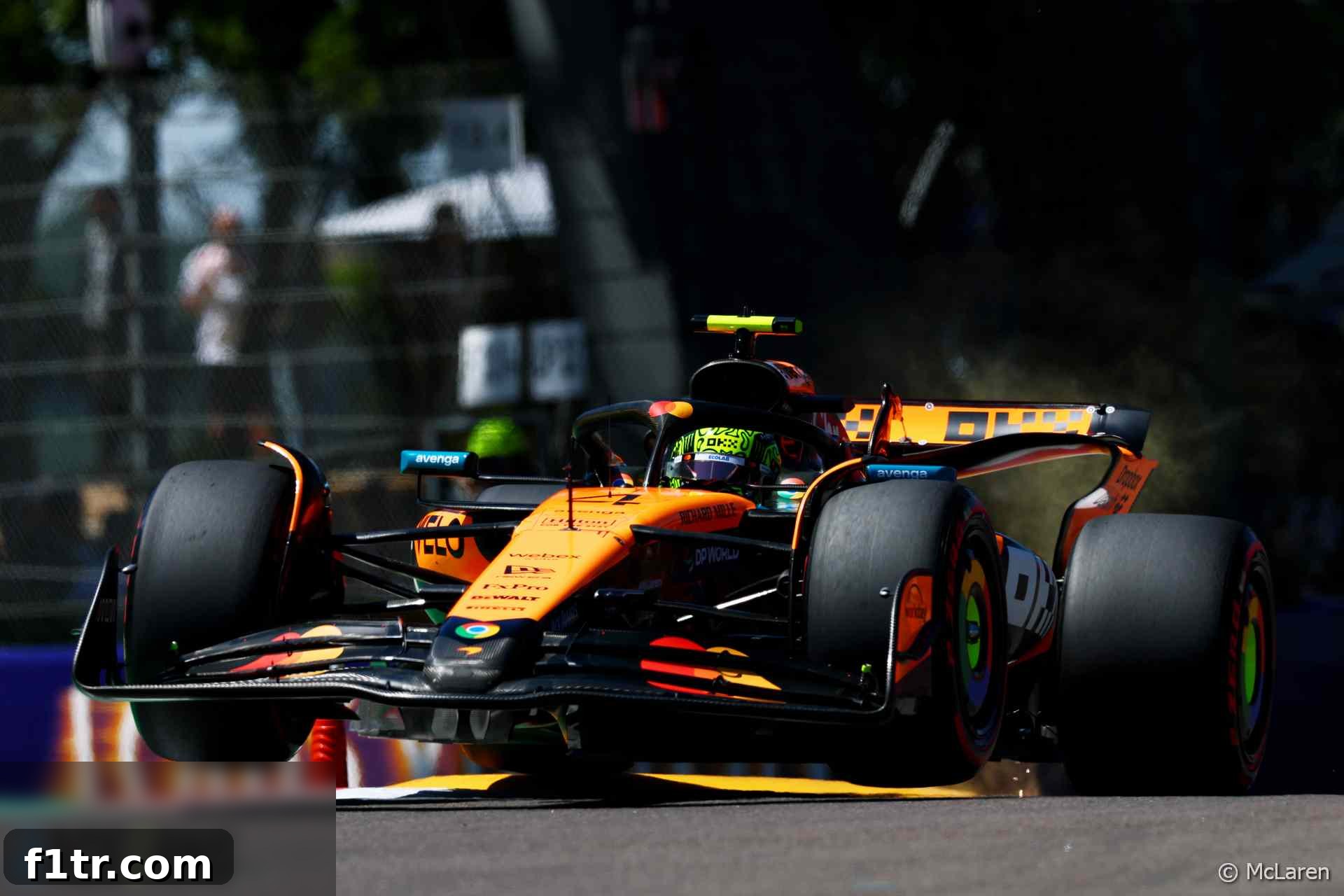
In the high-stakes world of Formula 1, where every tenth of a second can dictate success or failure, Lando Norris, one of the sport’s brightest talents, finds himself grappling with an unfamiliar challenge. The McLaren driver has openly admitted his confusion regarding a significant drop in his qualifying performance this season, a facet of his driving that has historically been his formidable strength. This unexpected dip has sparked considerable discussion and scrutiny among fans and pundits alike, as Norris navigates a period of self-reflection and intense analysis to understand the root cause of his recent struggles on Saturdays.
For years, Norris has been renowned for his exceptional single-lap pace, consistently outperforming his teammates in the crucial qualifying sessions. Last season, for instance, his qualifying record was nothing short of dominant, as he out-qualified his then-teammate in an impressive 20 out of 24 rounds. This established a reputation for reliability and raw speed that few could match. However, the current Formula 1 season tells a different story. Following the initial seven rounds, Norris finds himself trailing his new McLaren stablemate, Oscar Piastri, with a 4-3 record in their internal qualifying battle. This reversal of fortune is a stark contrast to his past achievements and presents a unique psychological and technical puzzle for the young Briton.
Despite these qualifying setbacks, Norris’s race craft and underlying speed remain undeniable. A prime example was the recent Emilia Romagna Grand Prix at Imola, where he secured a P4 grid slot. Remarkably, he then went on to finish ahead of Piastri in the race, despite his teammate starting from pole position. This illustrates a recurring theme: while his Saturdays have become more challenging, his Sundays often see him showcasing formidable pace and strategic prowess to recover positions. Yet, for Norris, the focus remains firmly on qualifying. He emphasizes the critical need to identify precisely where he is falling short during the crucial single-lap runs, recognizing that a stronger starting position inherently simplifies his race strategy and significantly improves his chances of securing podium finishes or even victories.
Speaking to Channel 4, Norris articulated his internal drive and frustration: “I just know that I can do more. Until I’m delivering my potential every weekend then I’m not going to be over the moon.” This statement underscores his high personal standards and unwavering commitment to extracting every ounce of performance from himself and his machinery. He further clarified, “I’m confident, I know what I can achieve, I know that I’ve got the speed, I’m not worried about any of that. I’m just worried about delivering it when it needs to be delivered. And that’s on Saturdays at the minute.” This candid admission reveals a nuanced understanding of his predicament; it’s not a question of capability, but rather of consistent execution under pressure, specifically in the unique environment of qualifying.
Historically, Norris has maintained an impeccable record, never losing a qualifying battle to a teammate over a full F1 season. This extraordinary streak highlights just how ingrained qualifying excellence has been in his racing identity. He openly acknowledged this legacy, stating, “Over the past few years, Saturdays have been mine. They’ve been my strength for many, many years.” This historical context makes his current struggles all the more perplexing, not just to observers, but primarily to Norris himself, who has always relied on this particular skill set to gain an edge over his rivals and peers.
Delving deeper into potential causes, Norris offered some insights into the shifts he’s perceived within the sport. He noted, “This year, with the car changing a little bit, with the tyres changing, for some reason it’s drifted away from me. I’ve got to work it out – and it’s taken time and it’ll take more time – why it’s a little bit more tricky for me to get the lap time out of it and why it’s just not clicking and why I’m just not seeing green [sectors] as often.” This suggests that subtle alterations in the car’s aerodynamic characteristics, coupled with the evolving behavior of the Pirelli tyres, might be impacting his ability to extract the absolute maximum performance during the knife-edge qualifying sessions. The phrase “not seeing green [sectors]” is particularly telling, referring to the real-time telemetry display where drivers aim to improve on their previous best sector times, striving for those crucial green indications that signify an optimal lap.
The intricate relationship between a driver and their car, especially under qualifying conditions, is often a delicate balance. Even minor adjustments to the car’s setup or the characteristics of the tyres can significantly alter a driver’s feel and confidence, impacting their ability to push to the absolute limit. Norris’s comments hint at a struggle to find that perfect harmony, that “click” where car and driver become one, allowing for those sensational, boundary-pushing laps that have become his hallmark. This ongoing quest for understanding and adaptation is a testament to the continuous evolution of Formula 1, where standing still, even for a moment, means falling behind.
While qualifying has presented its share of difficulties, Norris finds considerable reassurance in his strong race performances. His impressive recoveries to second place in the last two rounds, notably at Imola and Miami, serve as potent reminders of his underlying talent and speed. He reflected on these successes, stating, “Some difficulties, some things are not easy at the minute. But when you have a Sunday like [Imola], when you have Sundays like Miami and things where you can come back through and you show that you’ve got good pace, they’re always reassuring.” These race-day heroics confirm that the raw pace is still very much present, suggesting the issue is more specific to the unique demands of qualifying rather than a fundamental loss of speed or skill.
The distinction between qualifying and race pace is crucial here. While qualifying demands maximum attack for one or two flawless laps, racing involves managing tyres, fuel, strategy, and battling other drivers over a prolonged period. Norris’s ability to excel in the latter, even after a subpar qualifying, points to his excellent race craft and strategic awareness. This dichotomy provides a crucial psychological boost, allowing him to maintain confidence in his overall capabilities despite the Saturday puzzles. “So I’m not worried about my speed. I’m just taking a bit of time to understand why my Saturdays are not coming through,” he concluded, underscoring his methodical approach to problem-solving and his unwavering belief in his ultimate ability to conquer this current hurdle.
For McLaren, Norris’s ability to unlock his full qualifying potential is vital for their ambitions in the Constructors’ Championship. A consistent front-row presence from both drivers would significantly bolster their points tally and solidify their position among the top teams. The internal battle with Oscar Piastri, while challenging for Norris, also pushes both drivers to elevate their game, fostering healthy competition that ultimately benefits the team. As the season progresses, all eyes will be on Norris as he continues his determined effort to unravel the mystery of his qualifying performance, aiming to rediscover the consistent “green sectors” and once again establish his Saturdays as a dominant force in Formula 1.
2025 Emilia Romagna Grand Prix
- Antonelli was tiring from home race at Imola attention by Friday – Wolff
- Ferrari struggling to recreate set-up which “worked well” in Shanghai – Hamilton
- Verstappen told Red Bull to use Tsunoda before “hold him up” call
- ‘Saturdays have been mine for years but for some reason it’s drifted away’ – Norris
- “Plan C?”: Why McLaren only got their strategy right for one driver at Imola
Browse all 2025 Emilia Romagna Grand Prix articles