The exhilarating world of Formula 1 often delivers moments of intense wheel-to-wheel combat, and sometimes, those battles spill over into controversy. One such instance occurred during the 2018 Canadian Grand Prix, where Sergio Perez found himself questioning the stewards’ judgment after a significant on-track entanglement with Carlos Sainz Jnr. The incident, which saw Perez spin and lose crucial track positions, became a focal point of discussion regarding racing etiquette and the consistency of F1 officiating.
Perez Left Perplexed by Unpunished Sainz Contact in Canada
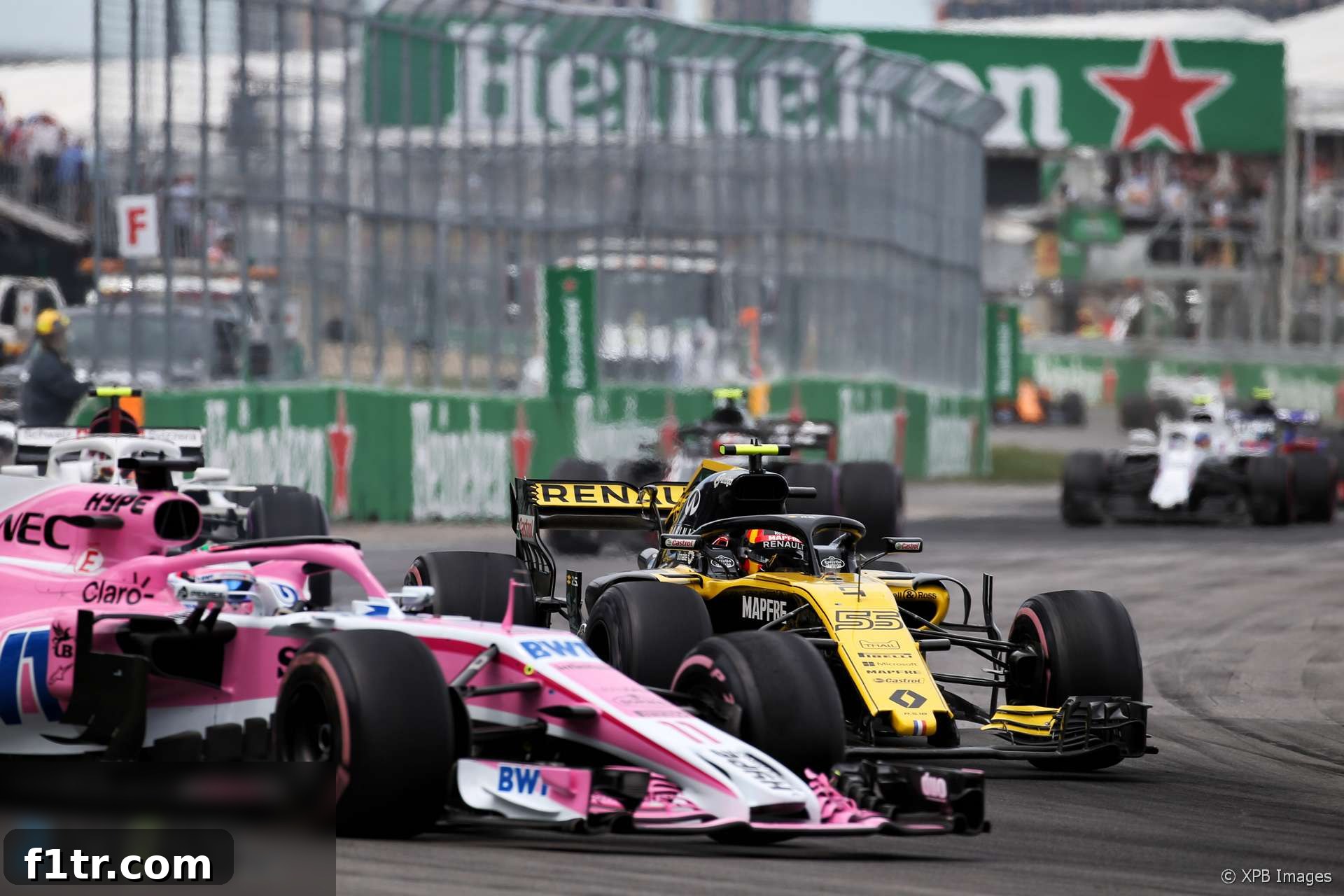
Following a Safety Car restart at the challenging Circuit Gilles Villeneuve, the tension was palpable as drivers jostled for position. Sergio Perez, then driving for Force India, launched an aggressive move on Carlos Sainz Jnr, who was at the time competing for Renault, vying for ninth place. The two cars made contact during the overtaking attempt, an incident that dramatically altered the trajectory of Perez’s race and left him seeking answers from the race control.
The Incident: A Turn One Tangle
The pivotal moment unfolded at Turn One, a critical corner notorious for its tight entry and demanding exit, especially after a Safety Car period when tires are cooler and drivers are eager to regain momentum. Perez, demonstrating his renowned race craft, made a move down the outside of Sainz. His aim was clear: to advance his position and secure valuable points for his team. However, what should have been a clean overtake turned into a frustrating collision.
“I think I had a pretty good restart behind Carlos,” Perez recounted, still clearly puzzled by the outcome of the maneuver. “I overtook him into Turn One, gave enough room, but I do not know what was the reason that I got hit.” The Mexican driver’s immediate reaction was one of survival, as his car veered precariously close to the wall. “I managed to save the car because it was going to go straight into the wall. Luckily I managed to save it and we kept on,” he added, highlighting the quick reflexes that prevented a potential race-ending crash.
Despite his efforts to recover, the contact forced Perez into a spin, costing him a staggering seven places on track. This sudden loss of position severely hampered his chances of a strong finish in a race where overtaking proved to be exceptionally difficult.
Sergio Perez’s Frustration: A Plea for Consistency
Perez’s bewilderment wasn’t just about the lost positions; it was fundamentally rooted in his belief that he had adhered to the unwritten rules of fair racing and deserved to be protected by the official regulations. He felt that he had done everything right, committing to the overtake, establishing position, and providing ample space for his competitor, only to be met with contact that he perceived as Sainz’s fault.
“I’m surprised that we didn’t see any penalty because I was ahead and I tried to give as much room as possible to make sure both cars go into the corner but it didn’t happen,” Perez articulated, his disappointment evident. He emphasized the severe implications of the stewards’ non-decision on his entire Grand Prix performance. “Afterwards, given how difficult it was to overtake today, our race was over.” For a driver fighting in the midfield, every single position is fiercely contested, and an incident like this, especially early in the race, can effectively ruin any strategic plans or hopes of scoring points. His race was indeed compromised, ultimately leading to a 14th place finish, while Sainz managed to cross the line in 8th, untouched by the stewards.
Stewards’ Ruling: A “Racing Incident” Verdict
In contrast to Perez’s strong conviction, the FIA race stewards delivered a verdict that often sparks debate among fans and drivers alike: a “racing incident.” Their official ruling stated that “no driver was predominantly to blame for the incident” and that “there was enough room for both cars to avoid the collision.” This decision implies a shared responsibility, suggesting that while contact occurred, neither driver’s actions were egregious enough to warrant a penalty.
FIA Race Director Charlie Whiting, a highly respected figure in Formula 1 at the time, publicly backed the stewards’ decision, further solidifying the official stance. “For me, it was just a very small touch,” Whiting commented, downplaying the severity of the contact. He continued, explaining his perspective: “Checo [Perez] was coming down the outside, he just turned in, and they just touched. For me, you couldn’t blame one driver completely for that.”
Whiting’s remarks highlight the subjective nature of stewarding and the fine line between an aggressive but fair overtake and a punishable offense. Stewards often analyze numerous factors, including camera angles, telemetry data, and the specific regulations governing racing conduct, before making a final judgment. The concept of “predominantly to blame” is central to these decisions, implying that unless one driver’s actions clearly and overwhelmingly caused the incident, it might be classified as an unavoidable consequence of hard racing.
The Nuances of F1 Stewarding and Overtaking
The 2018 Canadian Grand Prix incident between Perez and Sainz serves as a quintessential example of the complexities inherent in Formula 1 stewarding. The sport prides itself on promoting thrilling, wheel-to-wheel racing, but this must be balanced with ensuring driver safety and fair competition. Overtaking rules, while seemingly straightforward, are often open to interpretation in the heat of the moment.
When a driver attempts an overtake, especially on the outside into a corner like Turn One at Montreal, they are expected to have a significant portion of their car alongside the competitor to be considered “alongside.” The driver being overtaken is then expected to provide sufficient space. Perez clearly believed he had met these criteria, establishing his position and leaving space. Sainz, on the other hand, would have been defending his line, and the stewards’ decision suggests he was not deemed to have deliberately or negligently closed the door on Perez without justification.
The “small touch” aspect, as highlighted by Charlie Whiting, is also critical. In an era of extremely high downforce cars and finely tuned aerodynamics, even minor contact can have disproportionate consequences, particularly for the car on the outside or the one experiencing a momentary loss of grip. Perez’s car spinning out dramatically from what was described as a “small touch” underscores this sensitivity.
Impact on the 2018 Canadian Grand Prix and Beyond
For Sergio Perez, the stewards’ decision effectively sealed his fate for the 2018 Canadian Grand Prix. After the costly spin, recovering from 16th position to score points in a race where track position was paramount became an insurmountable challenge. Despite his valiant efforts to climb back through the field, he ultimately finished outside the points, a disappointing outcome for a driver who felt he was unjustly penalized by the lack of a penalty for his competitor.
Carlos Sainz, conversely, benefited directly from the stewards’ non-intervention, continuing his race without interruption or time penalty. His eighth-place finish contributed valuable points to Renault’s constructor’s championship campaign, illustrating how such decisions can significantly swing fortunes for teams and drivers.
The incident resonated with many within the F1 paddock, reigniting debates about the consistency of stewarding decisions across different races and varying circumstances. Drivers frequently call for greater clarity and consistency in how racing incidents are judged, arguing that it helps them understand the boundaries of aggressive racing. Perez’s frustration was not isolated; it reflected a common sentiment among competitors who dedicate their careers to finding the edge while adhering to the rules.
Conclusion: A Perennial F1 Dilemma
The collision between Sergio Perez and Carlos Sainz Jnr at the 2018 Canadian Grand Prix remains a vivid example of Formula 1’s enduring dilemmas: the tension between allowing robust, exciting racing and upholding fair play through consistent officiating. While Perez felt unequivocally wronged, the stewards and race director stood by their assessment that it was an unavoidable racing incident with no single driver predominantly at fault.
This episode serves as a powerful reminder that in the high-stakes world of Formula 1, every millisecond and every millimeter counts, and the interpretation of these moments can have profound impacts on a driver’s race, their team’s championship aspirations, and the broader narrative of the sport. It underscores the perpetual challenge faced by stewards to make split-second decisions that are both fair and consistent, satisfying the demands of competitors, teams, and fans alike.
2018 F1 Season Insights
- F1 feared “death knell” for Drive to Survive after Ferrari and Mercedes snub
- McLaren staff told us we were “totally crazy” to take Honda engines in 2018 – Tost
- ‘It doesn’t matter if we start last’: How Red Bull’s junior team aided Honda’s leap forward
- Honda’s jet division helped F1 engineers solve power unit problem
- McLaren Racing losses rise after Honda split
Browse all 2018 F1 season articles