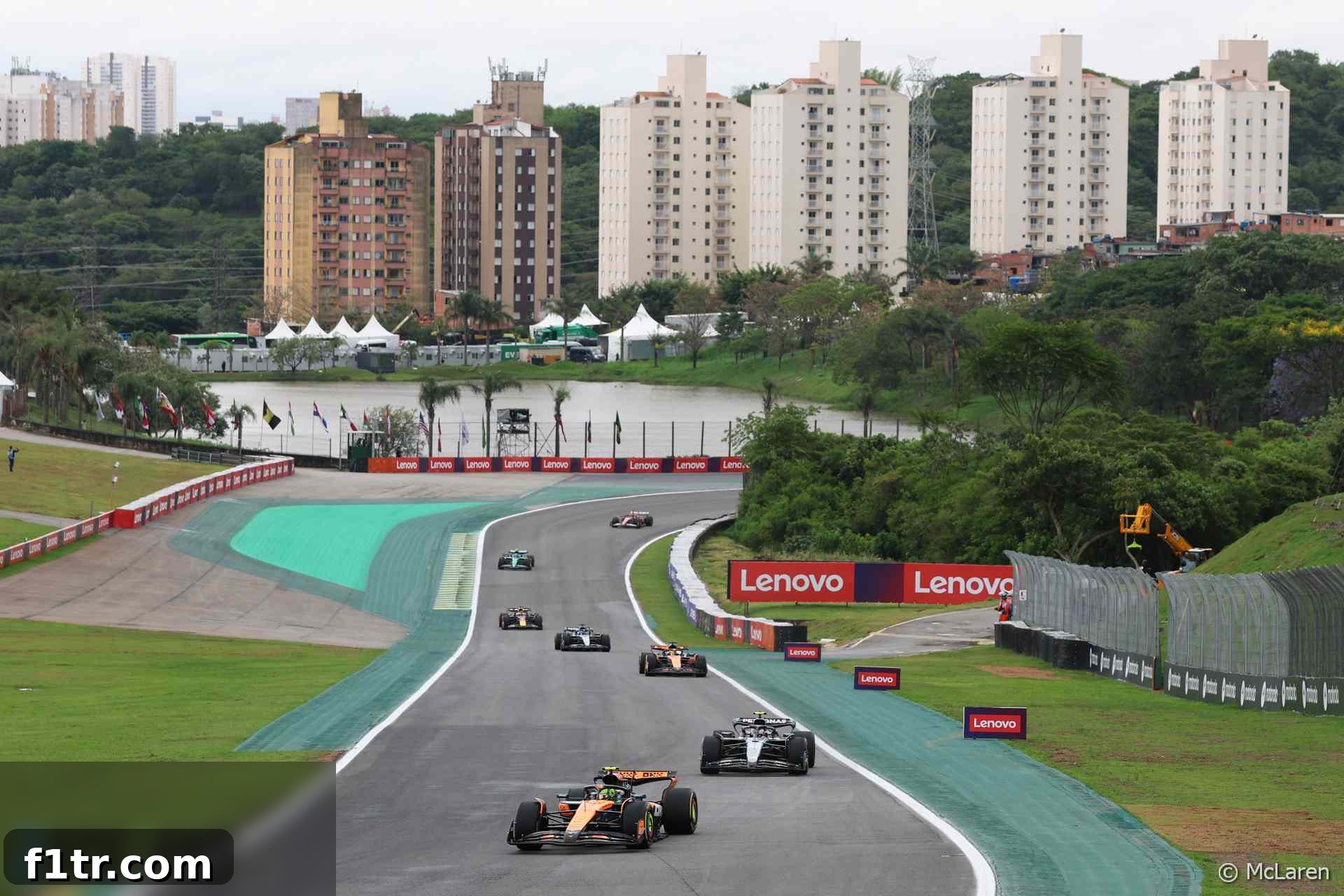
Lando Norris stands at a pivotal moment in his Formula 1 career, poised to extend his championship lead following a masterful pole position performance at the Brazilian Grand Prix. The high-stakes race at Interlagos offers a unique blend of challenges, from unpredictable weather to strategic complexities, all against the backdrop of a thrilling title fight.
While Norris secured a commanding victory in the preceding sprint race, his triumph was not without its moments of pressure, particularly from the resurgent Mercedes drivers. This intense battle hints at the potential for a captivating main event. Will Norris maintain his flawless form from the front, or will the competitive landscape of Interlagos throw unexpected challenges his way? We delve into what promises to be a gripping 21st grand prix of the season.
Weather Dynamics: A Cooler Interlagos Challenge
The weather conditions at the Autódromo José Carlos Pace often play a starring role, and this weekend is no exception. While the heavy rain that swept through São Paulo on Friday night and into Saturday ultimately had less impact on the sprint race than initially feared, it did contribute to tricky track conditions at the start. For Sunday’s main event, meteorologists indicate a lingering, albeit slight, chance of further rainfall, keeping teams and drivers on their toes.
More significantly, cooler temperatures are forecast to dominate the race day proceedings. Air temperatures at Interlagos are expected to hover just above 20°C, accompanied by substantial cloud cover. This combination translates directly to lower track temperatures, a crucial factor that can dramatically alter tire behavior and car performance. Teams like Mercedes, historically known for their ability to manage tires effectively in cooler conditions, may find this environment particularly advantageous, potentially closing the performance gap to their rivals. Conversely, teams that thrive in hotter conditions might struggle to generate optimal tire temperature, leading to reduced grip and increased degradation. This nuanced weather outlook adds another layer of intrigue to an already complex strategic puzzle.
The Critical Opening Lap: Interlagos’ Infamous Turn 1
Just as in Austin, the front row for the Brazilian Grand Prix mirrors that of the sprint race, with Lando Norris starting from pole position, flanked by the promising Andrea Kimi Antonelli. Norris demonstrated impressive composure in the sprint race, successfully defending his lead from the outset. However, the ghost of previous Interlagos starts looms large.
Only twelve months prior, Norris, despite starting strongly, succumbed to pressure at the very first corner, losing his lead to another Mercedes driver, George Russell, who had started alongside him. The run down to Turn 1 at Interlagos is notoriously challenging. The downhill sweep of the main straight leads into a tight, left-hand corner, often referred to as the Senna ‘S’. This sequence offers prime slipstreaming opportunities, making the opening metres of the race a high-risk, high-reward scenario. Drivers must balance aggressive positioning with careful defensive driving, all while managing cold tires and fuel loads. The short distance from pole position to the first braking zone (a critical metric, often meticulously analyzed by teams like Mercedes) ensures that the reaction time off the line and early cornering prowess will be absolutely paramount. Antonelli, starting P2, will be eager to capitalize on any hesitation from Norris, while the Mercedes drivers further down the grid will be watching for opportunities to make early gains. The first lap could very well dictate the rhythm and outcome of the entire grand prix.
Distance from pole position to first braking zone. Source: Mercedes
Strategic Imperatives: Navigating Tyre Choices and Pit Stops
Race strategy at Interlagos is almost always a tightrope walk, and the 2025 Brazilian Grand Prix is expected to be no different. Pirelli has supplied a harder compound range this year compared to the previous season, and coupled with the anticipated cooler track temperatures, drivers are strongly tipped to favor the soft and medium tire compounds for the bulk of the race distance. The hard tire, while durable, will likely struggle to generate sufficient heat and grip, making it a less attractive option for performance-driven stints.
A typical pit stop at Interlagos costs approximately 22 seconds, a significant time loss that heavily influences strategic decisions. On paper, a two-stop strategy might appear viable, offering greater flexibility and fresh rubber. However, recent races have underscored a crucial dynamic: the remarkably close lap times between competing cars and the inherent difficulty this poses for effective overtaking. In such a scenario, track position often trumps ultimate pace. Sacrificing track position for an extra pit stop becomes a highly risky gamble, pushing most teams and drivers towards a single pit stop. This one-stop approach typically involves a longer first stint on medium tires, followed by a switch to softs for the final push, or vice-versa depending on degradation rates and safety car timings.
Looking back, last year’s Brazilian Grand Prix began in wet conditions, prompting all drivers to start on intermediate tires. This highlights the unpredictable nature of Interlagos and the importance of adapting quickly. For today’s dry race, the available tire sets reveal interesting strategic nuances for each driver. For instance, some drivers, like Max Verstappen, possess multiple new soft tire sets, potentially enabling an aggressive strategy in the latter stages, or offering flexibility should an early safety car present a “free” pit stop opportunity. Others, with a larger allocation of used medium tires, might opt for a more conservative, single-stop approach, prioritizing consistent pace and track position. The intricate dance between tire management, pit lane delta, and the ever-present threat of safety cars will define the strategic battleground.
| Tyres available for the race | Hard | Medium | Soft | |||
|---|---|---|---|---|---|---|
| Driver | New | Used | New | Used | New | Used |
| Lando Norris | 1 | 0 | 1 | 2 | 0 | 3 |
| Andrea Kimi Antonelli | 1 | 0 | 1 | 1 | 0 | 4 |
| Charles Leclerc | 1 | 0 | 1 | 1 | 0 | 4 |
| Oscar Piastri | 1 | 0 | 1 | 1 | 0 | 4 |
| Isack Hadjar | 1 | 0 | 1 | 2 | 0 | 3 |
| George Russell | 1 | 0 | 0 | 2 | 0 | 4 |
| Liam Lawson | 1 | 0 | 2 | 1 | 0 | 3 |
| Oliver Bearman | 1 | 0 | 1 | 2 | 0 | 3 |
| Pierre Gasly | 1 | 0 | 1 | 1 | 0 | 4 |
| Nico Hulkenberg | 1 | 0 | 1 | 1 | 0 | 4 |
| Fernando Alonso | 1 | 0 | 1 | 2 | 1 | 2 |
| Alexander Albon | 1 | 0 | 1 | 1 | 0 | 4 |
| Lewis Hamilton | 1 | 0 | 2 | 0 | 2 | 2 |
| Lance Stroll | 1 | 0 | 0 | 3 | 1 | 2 |
| Carlos Sainz Jnr | 1 | 0 | 2 | 0 | 1 | 3 |
| Max Verstappen | 1 | 0 | 2 | 1 | 3 | 0 |
| Esteban Ocon | 1 | 0 | 2 | 0 | 3 | 1 |
| Franco Colapinto | 1 | 0 | 2 | 0 | 3 | 1 |
| Yuki Tsunoda | 1 | 0 | 3 | 0 | 3 | 0 |
| Gabriel Bortoleto | 1 | 0 | 1 | 1 | 4 | 0 |
Overtaking Opportunities and Penalty Watch
Interlagos, with its distinctive layout and undulating terrain, offers a handful of prime overtaking zones, largely facilitated by the Drag Reduction System (DRS). The DRS zones remain unchanged from last year, strategically placed to maximize racing action. Drivers can activate DRS on the long main straight that runs past the pits, a key area for slipstreaming and late-braking moves into the Senna ‘S’. A second DRS zone is located on the back straight, connecting the exit of the Senna ‘S’ (Turn 3) to the Descida do Lago (Turn 4). These two powerful zones are crucial for drivers trying to make progress through the field, especially given the difficulties of following closely through the twistier sections of the circuit.
However, the challenging nature of the Interlagos circuit can also lead to incidents. This weekend has already seen two drivers adding to their penalty points tallies: Oliver Bearman and Liam Lawson each received one penalty point for their first-lap clashes during the sprint race. Accumulating penalty points can have serious consequences, potentially leading to race bans if a driver reaches 12 points within a 12-month period. Such incidents underscore the fine line between aggressive racing and avoidable contact at this high-intensity venue. Drivers will need to be acutely aware of their conduct, particularly in the opening laps where congestion and cold tires increase the risk of collisions.
- Formula 1 drivers’ current penalty points
Speed Trap Insights: Ferrari’s Strategic Adjustment
The speed trap data from qualifying often provides a clear indication of a car’s straight-line efficiency and aerodynamic setup. Following the sprint race, Ferrari expressed concerns regarding their straight-line speed, a critical factor for both defending and attacking on Interlagos’ long straights. In response, the Scuderia made a strategic decision to switch to a lower downforce setup for the grand prix. This adjustment aims to boost their top-end speed, potentially making them more competitive against rivals in the DRS zones, albeit at the potential cost of some grip in the corners. This trade-off is a classic dilemma in Formula 1 setup choices, and its effectiveness will be closely scrutinized during the race.
Analyzing the speed trap results below, we can see the hierarchy of top speeds achieved during qualifying. McLaren, powered by Mercedes engines, appear to be exceptionally strong in this regard, with Lando Norris and Oscar Piastri topping the charts. Red Bull and Mercedes also feature prominently. Ferrari’s low-downforce adjustment will be geared towards matching or exceeding these figures, hoping to unlock vital performance that could be decisive in the race’s closing stages or in defending against overtakes. The battle for straight-line speed will undoubtedly be a key factor in how the race unfolds, particularly given the circuit’s reliance on DRS for making passes.
| P. | # | Driver | Car | Engine | Model | Max kph (mph) |
|---|---|---|---|---|---|---|
| 1 | 4 | Lando Norris | McLaren | Mercedes | MCL39 | 338.8 (210.5) |
| 2 | 81 | Oscar Piastri | McLaren | Mercedes | MCL39 | 338.6 (210.4) |
| 3 | 43 | Franco Colapinto | Alpine | Renault | A525 | 338.5 (210.3) |
| 4 | 22 | Yuki Tsunoda | Red Bull | Honda RBPT | RB21 | 338.5 (210.3) |
| 5 | 44 | Lewis Hamilton | Ferrari | Ferrari | SF-25 | 338.4 (210.3) |
| 6 | 1 | Max Verstappen | Red Bull | Honda RBPT | RB21 | 338.0 (210.0) |
| 7 | 23 | Alexander Albon | Williams | Mercedes | FW47 | 337.9 (210.0) |
| 8 | 6 | Isack Hadjar | Racing Bulls | Honda RBPT | 02 | 336.7 (209.2) |
| 9 | 16 | Charles Leclerc | Ferrari | Ferrari | SF-25 | 336.7 (209.2) |
| 10 | 63 | George Russell | Mercedes | Mercedes | W16 | 336.7 (209.2) |
| 11 | 10 | Pierre Gasly | Alpine | Renault | A525 | 336.6 (209.2) |
| 12 | 27 | Nico Hulkenberg | Sauber | Ferrari | C45 | 336.4 (209.0) |
| 13 | 12 | Andrea Kimi Antonelli | Mercedes | Mercedes | W16 | 336.1 (208.8) |
| 14 | 14 | Fernando Alonso | Aston Martin | Mercedes | AMR25 | 335.6 (208.5) |
| 15 | 30 | Liam Lawson | Racing Bulls | Honda RBPT | 02 | 335.5 (208.5) |
| 16 | 18 | Lance Stroll | Aston Martin | Mercedes | AMR25 | 335.1 (208.2) |
| 17 | 87 | Oliver Bearman | Haas | Ferrari | VF-25 | 334.0 (207.5) |
| 18 | 55 | Carlos Sainz Jnr | Williams | Mercedes | FW47 | 333.6 (207.3) |
| 19 | 31 | Esteban Ocon | Haas | Ferrari | VF-25 | 330.8 (205.5) |
Safety Car and Red Flag History: The Interlagos Wildcard
The Brazilian Grand Prix at Interlagos has a well-earned reputation for unpredictability, often punctuated by dramatic safety car periods and even red flags. The last two editions of the race vividly illustrate this tendency, with the red flag having flown in both. These neutralizations frequently reshuffle the pack and can be utterly decisive for the race outcome.
Last year, the race was halted due to intensifying rain, a decision that proved pivotal. Drivers who had not had the opportunity to pit during an earlier Virtual Safety Car period, notably Max Verstappen and the two Alpine drivers, were granted a “free” tire change under the red flag. This strategic gift allowed them to maintain their track positions with fresh intermediate tires, ultimately propelling them to fill the podium places. The Safety Car was also deployed again in the second half of that race, further emphasizing the chaotic potential of Interlagos. The year before, the 2023 race, run in dry conditions, was red-flagged almost immediately after the start due to a major crash involving Alexander Albon and Kevin Magnussen. Once the race resumed, it thankfully remained green until the end, but the early interruption significantly altered race dynamics.
Even the dry 2022 race saw multiple interruptions. Another collision at the start led to a lengthy neutralization, though this time only a Safety Car was required. Later in that same race, Lando Norris’s retirement was initially covered by a Virtual Safety Car (VSC), which was then upgraded to a full Safety Car. Understanding the distinctions is vital: a VSC mandates drivers to reduce speed to a delta time, maintaining relative gaps, while a full Safety Car bunches the field, often allowing for “free” pit stops for those strategically positioned. Given this history, teams will have contingency plans ready for every possible safety car scenario, knowing that track position, tire strategy, and quick decision-making under caution can be the difference between victory and defeat at Interlagos.
The Starting Grid and Championship Stakes
The grid for this year’s Brazilian Grand Prix is set, though Formula 1’s dynamic nature means any last-minute changes due to penalties or technical issues will be updated accordingly. As it stands, Lando Norris occupies the coveted pole position, an ideal starting point to maximize his championship aspirations.
- 2025 Brazilian Grand Prix grid
Norris significantly bolstered his championship lead by securing victory in the sprint race, pushing his advantage to nine crucial points. The implications for the championship are immense. If the drivers were to finish the Brazilian Grand Prix in the exact order they start, Norris would leave Interlagos a comfortable 22 points ahead of Oscar Piastri and a substantial 64 points clear of Max Verstappen, with a total of 83 points still available in the remaining races. This hypothetical scenario underscores the monumental opportunity Norris has to solidify his position at the top. However, Interlagos is renowned for its capacity to spring surprises, and with every point critical, Norris will be acutely aware of the need for a clean, strong performance. His rivals, meanwhile, will be pushing to minimize his gains and keep their own championship hopes alive.
- Formula 1 drivers’ championship points calculator
Your Take: The Race for Glory at Interlagos
As the Brazilian Grand Prix approaches, the excitement is palpable. Will Lando Norris seize this golden opportunity to complete a perfect weekend, converting his pole position into a dominant race victory and extending his championship lead even further? How significant a threat will the Mercedes drivers, who showed strong pace and tactical prowess in the sprint, prove to be? And what can we expect from Max Verstappen, who faces the daunting task of salvaging crucial points from the tail end of the field after a challenging qualifying session?
The unique challenges of Interlagos – its demanding layout, variable weather, and history of unpredictable safety car periods – promise a race filled with drama and strategic brilliance. Share your predictions and insights on the Brazilian Grand Prix in the comments below. We want to hear your thoughts on who will emerge victorious and how the championship battle will shift after this pivotal race!