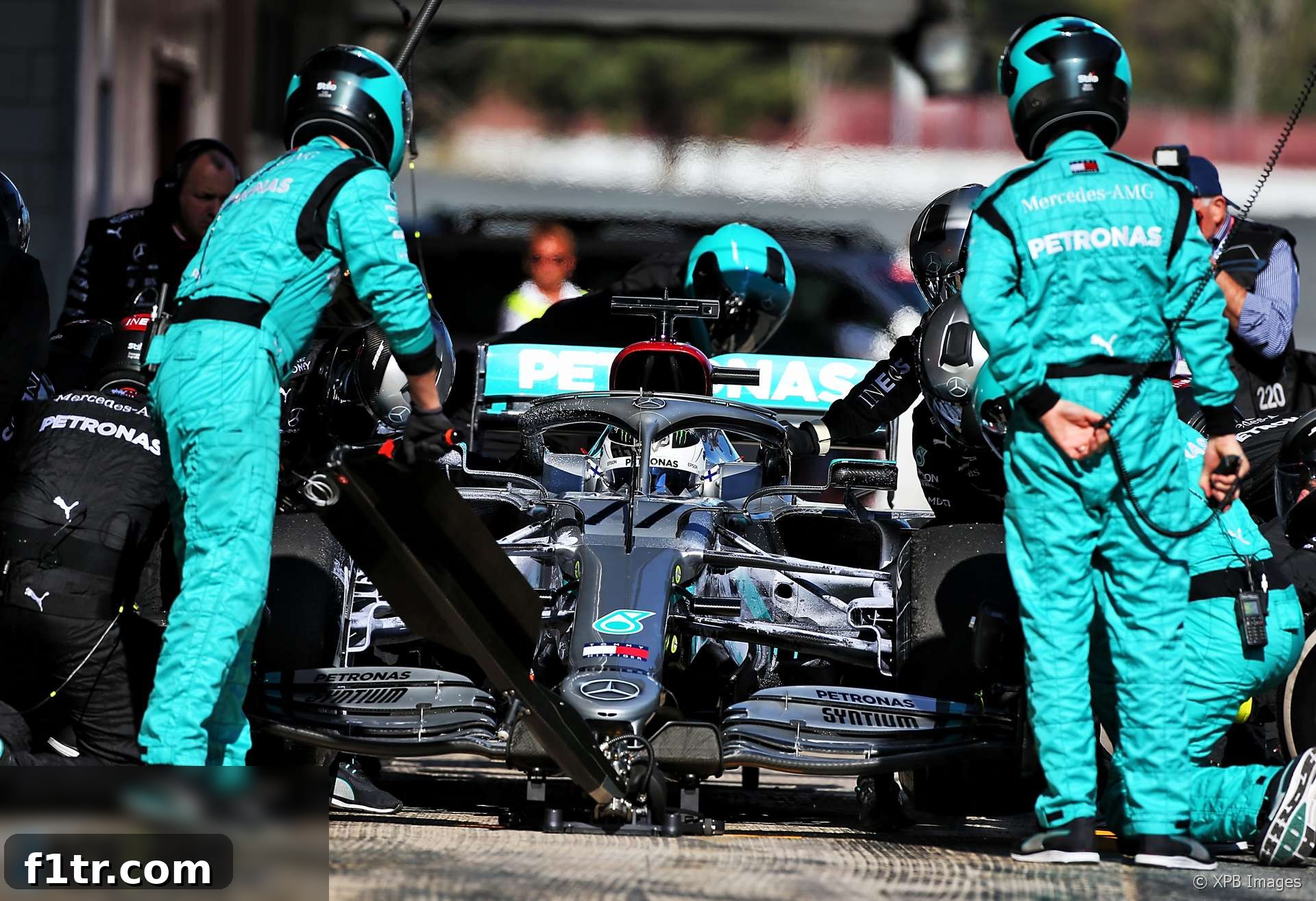
The exhilarating world of Formula 1 consistently pushes the boundaries of engineering and innovation, and few recent developments have captured the imagination quite like Mercedes-AMG Petronas F1 Team’s Dual Axis Steering (DAS) system. Unveiled during pre-season testing, this ingenious mechanism on the W11 chassis sparked immediate discussions, dissecting its potential impact and legality. At the heart of the initial insights into DAS was none other than Valtteri Bottas, the Mercedes driver who, fresh from topping the timing sheets in the very tests where DAS made its debut, offered a tantalizing glimpse into its capabilities and the team’s relentless pursuit of performance.
Unveiling the Dual Axis Steering (DAS) System
The Dual Axis Steering system, or DAS, represented a significant leap in Formula 1 innovation. First publicly observed during the 2020 pre-season testing in Barcelona, the system allowed Mercedes drivers to adjust the toe angle of the front wheels by pulling or pushing the steering wheel. This seemingly subtle modification had profound implications for how the W11 interacts with its tyres and the track. While seemingly straightforward in principle, the engineering behind DAS was incredibly complex, a testament to the ingenuity of Mercedes’ technical team. This was not a quick fix or a last-minute addition; as Bottas himself hinted, it was the culmination of extensive research and development.
How DAS Works and Its Technical Nuances
At its core, DAS allows the drivers to dynamically change the toe angle of the front wheels. When the steering wheel is pulled towards the driver, the front wheels adopt a different toe angle – typically a toe-out configuration. Pushing the steering wheel back to its original position would revert the wheels to their standard toe-in setting. The primary objective of such a system is believed to be tyre management. In a sport where tyre performance and degradation are often the deciding factors in a race, any advantage in this area is invaluable. By adjusting the toe angle, drivers could potentially influence the contact patch of the tyres, thereby controlling their temperature. For instance, on long straights, a driver could activate DAS to run a slight toe-out, warming up the outer edges of the tyres. This could be crucial for maintaining optimal tyre temperature, especially after slow corners or during safety car periods, ensuring the tyres are in their ideal working window when approaching the next braking zone or high-speed corner.
The benefits extend beyond just temperature. Managing the toe angle could also reduce drag on straights, offering a marginal aerodynamic gain, and potentially improving tyre wear over a race distance. The ability to fine-tune tyre behaviour on the fly provides drivers with an unprecedented level of control, allowing them to adapt to changing track conditions, tyre wear patterns, and strategic requirements throughout a grand prix. This kind of dynamic adjustability is a game-changer, demonstrating Mercedes’ commitment to extracting every ounce of performance within the strict confines of F1 regulations.
Valtteri Bottas’s Insights: A Driver’s Perspective
Valtteri Bottas, having been one of the first to extensively test the DAS system, offered an invaluable driver’s perspective. His initial comments, while guarded, conveyed a clear sense of optimism and admiration for the team’s engineering prowess. When asked about the system, Bottas expressed his pride in being part of a team that develops such groundbreaking innovations. “Obviously it’s very nice to be on the team running that kind of system,” he stated, highlighting the exceptional minds within the Mercedes camp. He acknowledged the immense effort involved in bringing such a complex system from concept to reality, emphasizing that it’s “not an easy thing to start making and designing and then actually to make it work as it is now.” This underlines the significant investment in time, resources, and intellectual capital that went into the development of DAS.
Bottas’s assessment of DAS’s potential was particularly telling. He confidently suggested that the system would indeed provide a “performance advantage in certain circumstances.” This statement implies a nuanced application of DAS, where its benefits would be maximized under specific conditions, such as particular track layouts, ambient temperatures, or tyre compounds. The driver’s skill in knowing precisely when and how to deploy DAS would become another critical element in their race craft, adding another layer of complexity and strategy to their driving.
Despite the initial positive feedback, Bottas also acknowledged that the team was “still learning about the system and the potential.” This is a crucial point, as any new technology, no matter how revolutionary, requires extensive analysis, refinement, and driver adaptation to unlock its full capabilities. The true test of DAS would come later in the season, across a variety of conditions and circuits. “We’ll be shown later on in the year in different conditions, different tracks, how it can help us, if it can,” Bottas noted, reflecting the ongoing process of optimization and understanding its comprehensive impact. He concluded by describing it as “quite impressive,” affirming its functional effectiveness, “but it works all fine.” This simple yet powerful statement reassured observers that despite its complexity, the system was reliable and integrated seamlessly into the W11’s operation.
The Strategic Edge and Competitive Landscape
The introduction of DAS immediately sent ripples through the Formula 1 paddock, forcing rival teams to confront a new dimension of technical challenge. The implications of DAS were not lost on Mercedes’ competitors, with several teams, including Ferrari, openly admitting they were “weighing up whether to develop a similar system of their own.” This reaction underscores the perceived performance advantage that DAS offered. In the relentless pursuit of marginal gains that defines F1, no team can afford to ignore a potentially significant competitive edge. However, developing a similar system would be no trivial task. It would require substantial engineering resources, financial investment, and precious development time, especially for teams already grappling with their own car designs and regulatory changes.
Bottas’s revelation that Mercedes had been working on DAS since “early last year,” with him being aware of it for “nearly one year ago,” highlighted the foresight and long-term planning that characterized Mercedes’ approach. This wasn’t an overnight project but a testament to sustained innovation. This long development cycle provided Mercedes with a considerable head start, placing immense pressure on rivals to catch up. The regulatory landscape of F1 also plays a critical role here. While DAS was deemed legal for the 2020 season, the FIA subsequently clarified that such systems would be banned from 2021 onwards. This presented a unique window of opportunity for Mercedes to exploit DAS for a single season, maximizing its benefits before it became obsolete under new regulations.
The strategic value of DAS lay not just in its direct performance benefits but also in its psychological impact. It served as a powerful declaration of Mercedes’ engineering dominance and their unwavering commitment to innovation. It forced rivals to divert attention and resources, potentially compromising their own development timelines, simply to understand and potentially replicate a system that would only be legal for one season. This kind of competitive maneuvering is a hallmark of Formula 1, where the battle off-track can be as intense and impactful as the one on it.
DAS as a Symbol of F1 Innovation
The Dual Axis Steering system stands as a potent symbol of the ceaseless innovation that drives Formula 1. It exemplifies how teams continuously scrutinize every aspect of a race car, seeking even the smallest advantage within the complex framework of technical regulations. DAS reminded the world that F1 is not just about raw power or aerodynamic sleekness; it’s also about ingenious mechanical solutions that enhance driver control and optimize tyre performance, often in ways that are imperceptible to the casual observer but critical to championship success.
The legacy of DAS, despite its short lifespan in F1, is multifaceted. It cemented Mercedes’ reputation as an engineering powerhouse, capable of delivering breakthrough technologies. It sparked debates about the spirit versus the letter of the law in F1 regulations, and it certainly contributed to the narrative of Mercedes’ unparalleled success during that era. More broadly, it highlighted the dynamic nature of F1, where innovation is both a competitive weapon and a constant source of fascination for fans and engineers alike. While the system itself may no longer be on the grid, its story remains a compelling chapter in the ongoing saga of Formula 1’s quest for ultimate speed and efficiency.
Valtteri Bottas’s early, enthusiastic remarks about DAS were indeed an accurate harbinger of its significance. The system was a daring and successful venture into uncharted engineering territory, showcasing Mercedes’ technical brilliance and their unyielding drive to dominate the pinnacle of motorsport. It served as a powerful reminder that in Formula 1, the pursuit of perfection is an endless journey, continually redefined by moments of extraordinary innovation like the Dual Axis Steering system.