[raceweekendpromotion]
Lewis Hamilton Disqualified from Sao Paulo GP Qualifying Over DRS Infringement
Advert | Become a Supporter & go ad-free
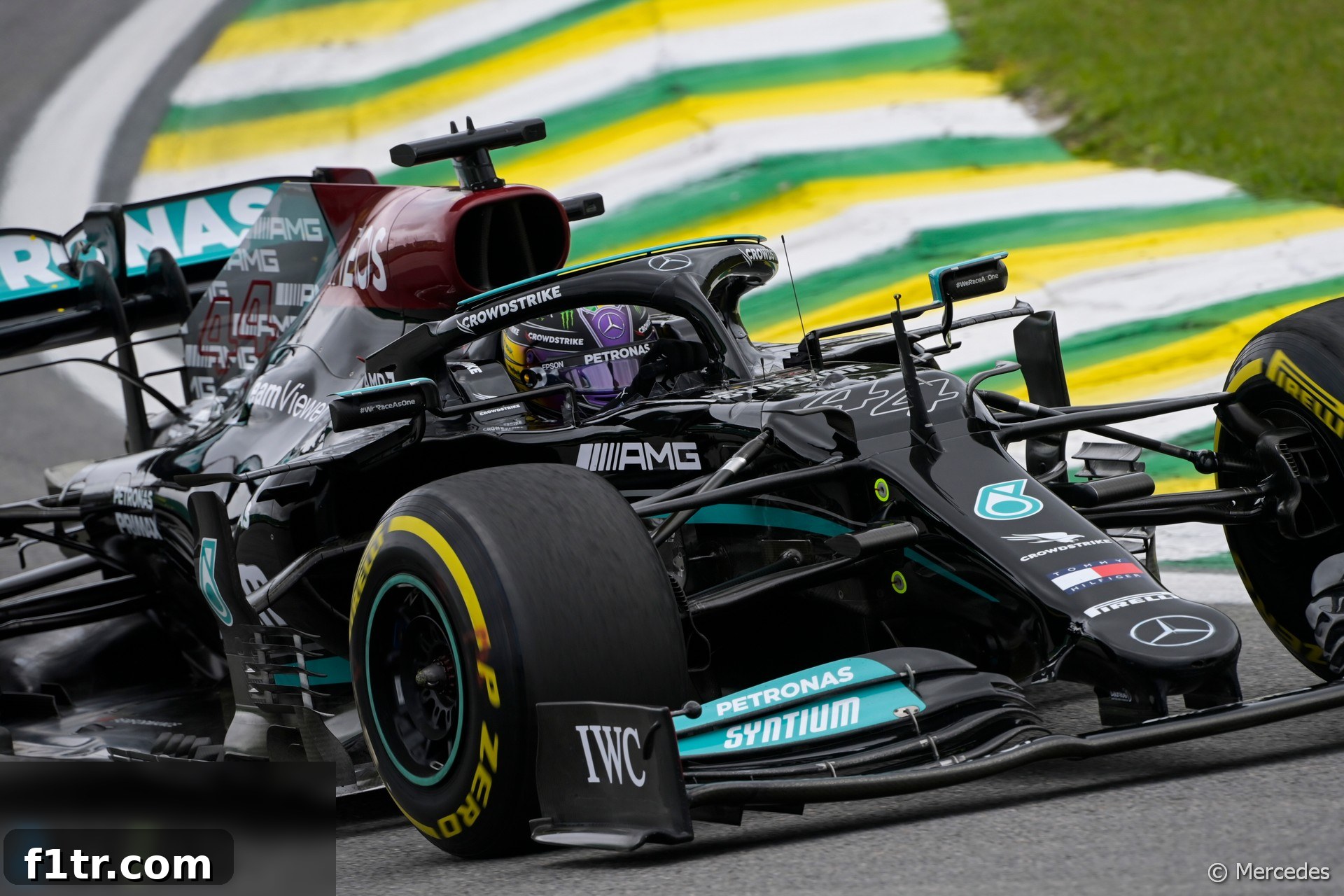
The 2021 Formula 1 season, a titanic battle between seven-time world champion Lewis Hamilton and his fierce rival Max Verstappen, witnessed another dramatic turn at the Sao Paulo Grand Prix. Hamilton was controversially excluded from the results of Friday’s qualifying session at Interlagos following a critical technical infringement discovered on his Mercedes W12 car. This significant and unexpected decision means the reigning world champion will face a daunting challenge, starting the crucial sprint qualifying race from the very back of the grid.
The implications of this penalty extend far beyond the sprint event. For Sunday’s main Grand Prix, Hamilton is already slated to incur a further five-place grid penalty. This additional sanction is a consequence of exceeding his maximum allocation of power unit elements earlier in the season, a strategic decision that Mercedes had hoped would provide a performance boost. This cumulative set of penalties places immense pressure on the British driver as he desperately seeks to close the 19-point gap to championship leader Max Verstappen in what has been an exceptionally tight title fight.
Understanding the Technical Breach: The Drag Reduction System (DRS) Controversy
The root cause of Hamilton’s disqualification lies in a violation of Formula 1’s highly stringent technical regulations concerning the Drag Reduction System (DRS). FIA technical delegate Jo Bauer identified that the DRS on Hamilton’s rear wing was able to open wider than the maximum permissible gap of 85 millimetres. This seemingly minor measurement discrepancy, uncovered during routine post-qualifying scrutineering, triggered a thorough investigation and ultimately led to a severe penalty for a component that is absolutely fundamental to modern F1 car performance and overtaking dynamics.
The DRS is an active aerodynamic device designed to facilitate overtaking by temporarily reducing aerodynamic drag on the rear wing, thereby allowing for higher straight-line speeds on designated sections of the track. Its operation is meticulously controlled to ensure fair competition and prevent any unintended or unregulated performance advantages. The regulations specify precise dimensions for the gap between the upper and lower elements of the rear wing, both when the DRS is deactivated (closed) and when it is activated (open). It was specifically during the ‘DRS activated’ state that Hamilton’s Mercedes W12 failed the conformity test, indicating a potential for excessive drag reduction.
Mercedes had demonstrated formidable pace throughout Friday’s qualifying session at Interlagos, with Hamilton delivering a sensational performance. He comfortably led all three stages of qualifying, setting blisteringly fast laps that saw him outpace his championship rival, Max Verstappen, by more than four tenths of a second. This commanding display had initially secured him pole position for Saturday’s sprint race, a triumph that was tragically overturned by the subsequent technical scrutiny.
With Hamilton’s disqualification, Max Verstappen automatically inherits pole position for the sprint qualifying race. This provides a significant and unexpected boost to his championship campaign, granting him a prime starting spot to earn valuable points and potentially extend his lead. Valtteri Bottas, Hamilton’s Mercedes teammate, who originally qualified third and whose car was found to be in full compliance with all regulations, will now join Verstappen on the front row of the grid. This dramatic reshuffling not only intensifies the sprint race itself, where drivers will fight for crucial grid positions for Sunday but also for championship points awarded to the top three finishers.
The Stewards’ Verdict: A Comprehensive and Unyielding Analysis
Mercedes’ swift confirmation that they would not appeal Hamilton’s disqualification underscored the robustness and clarity of the stewards’ findings. The official verdict from the stewards provided an exceptionally detailed breakdown of the technical breach and the extensive investigative process that meticulously led to their final decision. This document highlighted the rigorous nature of Formula 1’s technical checks and the FIA’s unwavering commitment to upholding the absolute integrity and fairness of the sport.
The technical delegate reported that car 44 failed the test designed to check the requirements of the last paragraph of Art. 3.6.3 of the 2021 FIA Formula 1 Technical Regulations. The check is described in Technical Directive 011-19.
In lay terms, there is a gap between the upper and lower parts of the rear wing. When the DRS is not activated this gap must be between 10mm and 15mm. The car passed this part of the test.
When DRS is activated, which raises the upper element of the wing to a flatter position, the gap must be between 10mm and 85mm. The maximum gap is measured, in accordance with TD/011-19, by pushing an 85mm gauge against the gap with a maximum load of 10N (ten newtons). If the gauge goes through then the car has failed the test. In this case, the gauge would not pass through at the inner section of the wing, but did at the outer section of the wing. This test was repeated four times with two different gauges, once being done in the presence of the stewards and representatives of the competitor.
The stewards held a hearing on Friday following qualifying with Ron Meadows, the competitor representative, and Simon Cole, the chief engineer [for] trackside and from the FIA Jo Bauer, technical delegate and Nicholas Tombazis, single seater technical director. The stewards then adjourned the hearing to gather more evidence and at 10:30am on Saturday morning held a further hearing that also included John Owen, chief designer for the competitor, who testified by video conference, but did not include [Jo] Bauer.
The competitor asserted that the design is intended to meet the regulations. It was clear to the stewards that the additional deflection was due to additional play either in the DRS actuator or the pivots at the end, or some combination or other fault with the mechanism, or incorrect assembly of the parts. The stewards heard, from both the team and the FIA that the same design has been tested many times during the season and uniformly passed. Further, the FIA has examined the design of the area of the car in question and are satisfied that the design meets the intent of the regulation. There is therefore no question in the minds of the stewards that the test failure indicates any intent to exceed the maximum dimension either by action or design.
The competitor also noted, that Art 3.6.3 of the regulation states a maximum dimension, which is possible to measure without applying a force or load. It is not until a force is applied, that the gauge is able to go through. There was no disagreement that the test itself was undertaken as described in TD/011-19. The gauges were measured and the stewards were satisfied that they were the correct dimension. The competitor therefore argues that their car complied with the regulation in the static position and thus meets the regulation.
The FIA argues that while not regulatory, the TD, like many others, describes the procedure for the test so that competitors may design cars to meet the regulations. Further, the TD states that the test is designed “to make sure that the rear wing element does not deflect to a larger opening than the permitted value…”. The stewards take the position that while a TD is not in itself a regulation, TDs are accepted as the method upon which the teams may rely and in this case, the test that was carried out was in conformity with the TD and its legitimate aims.
The competitor alleged that the fact that the car passed the test in the centre section of the wing is both a mitigating factor and shows that there was no intent to breach the regulation. While the stewards accept that the latter point may be true, the stewards believe that which sections failed is not relevant to the fact that the wing did fail the test.
The competitor noted that this is not a systemic breach, and is indeed unique. It was, rather, something gone wrong. The competitor further noted that they would have liked to have had the opportunity to inspect the parts with a view to having some explanation for the stewards as to how the problem arose. However, the stewards fundamentally accept the competitor’s explanation that the cause of the failed test was something “gone wrong” rather than a deliberate action. The stewards therefore
chose to keep the assembly under seal and preserve the evidence of the failure, rather than altering the parts in an inspection which would have involved some handling of the parts and thus some alteration of the evidence.The final point of the competitor regarding the assembly itself is that it is regular practice for the FIA Technical Department to allow teams to fix minor problems that they find with their cars, even during the parc ferme conditions of qualifying. Had the competitor recognised this problem during qualifying they surely would have sought, and the FIA Technical Department confirmed, they would have received permission to fix the parts or tighten bolts if needed.
The stewards were sympathetic to this argument and analysed whether they felt this was a mitigating circumstance. It is often a mitigating circumstance to make allowances for crash damage. However, the stewards could not extend this argument to cover parts that were found out of conformity in post session checks with no obvious reason in evidence other than considering normal running at this event. In the end, the regulations are clear and at the moment of the conformity check, the car did
not comply.At the end of the first hearing on Friday, amateur video emerged of driver Max Verstappen touching car 44 in parc ferme. The stewards took the time to gather all the available video footage of this incident and finally reviewed in car footage from car 14, car 77, car 33 and car 44 as well as CCTV footage from the FIA’s pit lane cameras, in addition to the amateur footage. The stewards held a separate hearing in
relation to this incident and incorporate the text of that decision herein.However, in summary the competitor of car 44 also agreed that it was unlikely that Verstappen’s actions caused the fault, however they felt that it was an open question. The stewards, however, were fully satisfied, having extensively reviewed the totality of the evidence regarding that incident, that it has no bearing on this case.
Finally, therefore, the stewards decide that car 44 failed the test indicated in TD/011-19 and is therefore in breach of Art 3.6.3 of the FIA Formula 1 Technical Regulations. The stewards agree with the competitor that this is something gone wrong, rather than an intentional act or design but did not find there to be mitigating circumstances.
Further, Art 1.3.3 of the International Sporting Code states that “it shall be no defence to claim that no performance advantage was obtained”. Therefore, the stewards order the usual penalty for technical non-compliance of disqualification from the qualifying session.
The stewards’ meticulous investigation revealed that the issue was not a systemic design flaw or a deliberate attempt to gain an unfair advantage. Instead, it was attributed to an “additional play” within the DRS mechanism, likely a fault in the actuator, pivots, or an assembly error. Crucially, Mercedes confirmed that the same design had passed all previous scrutineering tests throughout the season, and the FIA agreed that the fundamental design concept adhered to the regulations’ intent. However, despite accepting the unintentional nature of the fault, the stewards remained firm on the non-compliance.
Mercedes presented several arguments, including that the regulation specified a static dimension which the car complied with, and that the failure only occurred under the force applied during the TD/011-19 test. The FIA countered by emphasizing that Technical Directives, while not regulations themselves, define accepted test procedures that teams must design to. The stewards sided with the FIA, asserting that TDs are the recognized standard for technical compliance.
Another point of contention was the widely circulated amateur video footage showing Max Verstappen touching Hamilton’s car in parc fermé. The stewards conducted a separate, thorough investigation into this incident, reviewing extensive video evidence including onboard footage and FIA pit lane CCTV. Despite Mercedes acknowledging it was unlikely Verstappen’s actions caused the fault, they raised it as an “open question.” The stewards, however, concluded definitively that this incident had no bearing on the technical infringement.
Ultimately, the stewards found no mitigating circumstances. They highlighted Article 1.3.3 of the International Sporting Code, which explicitly states that “it shall be no defence to claim that no performance advantage was obtained.” This underscores the FIA’s zero-tolerance policy for technical non-compliance, irrespective of intent or perceived benefit. Consequently, the standard penalty for such a breach – disqualification from the qualifying session – was imposed.
The Road Ahead: Hamilton’s Monumental Challenge at Interlagos
The disqualification and the additional five-place grid penalty for Sunday’s main race set the stage for one of Lewis Hamilton’s most formidable challenges of the 2021 season. Starting the sprint race from the very back of the grid, Hamilton will need to demonstrate his unparalleled skill, strategic acumen, and the raw speed of his Mercedes to carve through the field and climb as many positions as possible. Every single position gained in the sprint race translates directly into a better starting spot for Sunday’s main Grand Prix, where he will face a further deficit due to his power unit penalty.
Interlagos, renowned for its undulating layout, tight corners, and passionate Brazilian fan base, often delivers unpredictable and thrilling races. Hamilton possesses a strong track record at this iconic circuit, and his legendary ability to recover from challenging grid positions has been a defining characteristic of his illustrious career. However, the fierce competitiveness of the 2021 F1 grid and the density of the midfield mean that making up positions will be far from straightforward. This weekend has now transformed into a monumental test of Hamilton’s resilience, his mental fortitude, and Mercedes’ overall strategic brilliance in a championship fight that is hurtling towards an exhilarating conclusion.
For Max Verstappen, Hamilton’s significant setback presents an unexpected and crucial advantage. Inheriting pole position for the sprint race, he has a clear and immediate opportunity to extend his championship lead, thereby applying even greater pressure on his rival. The dynamic of the championship battle has shifted dramatically in Verstappen’s favour, injecting yet another layer of intrigue and suspense into an already captivating season.
This incident serves as a powerful and stark reminder of the rigorous technical environment that defines Formula 1. Every single component on an F1 car is subjected to meticulous scrutiny, and even unintentional deviations from the highly detailed regulations carry severe and immediate consequences. The FIA’s firm and uncompromising stance on compliance underscores that technical adherence is paramount, regardless of perceived performance advantage or the absence of malicious intent, ultimately ensuring a truly level playing field for all competitors involved in the pinnacle of motorsport.
This article will be updated as more developments unfold throughout the Sao Paulo Grand Prix weekend.
Advert | Become a RaceFans supporter andgo ad-free
2021 Sao Paulo Grand Prix Related Articles
- Red Bull and Mercedes summoned to FIA hearing on review of Sao Paulo incident
- McLaren must “get back to scoring the results that are on the table” – Seidl
- Hamilton makes his second-biggest climb to victory from 10th on the grid
- F1 releases missing video footage from Verstappen’s car of Hamilton incident
- How Alonso and Ocon “pushed team tactics to the ultimate limit” to delay Gasly
Browse all 2021 Sao Paulo Grand Prix articles