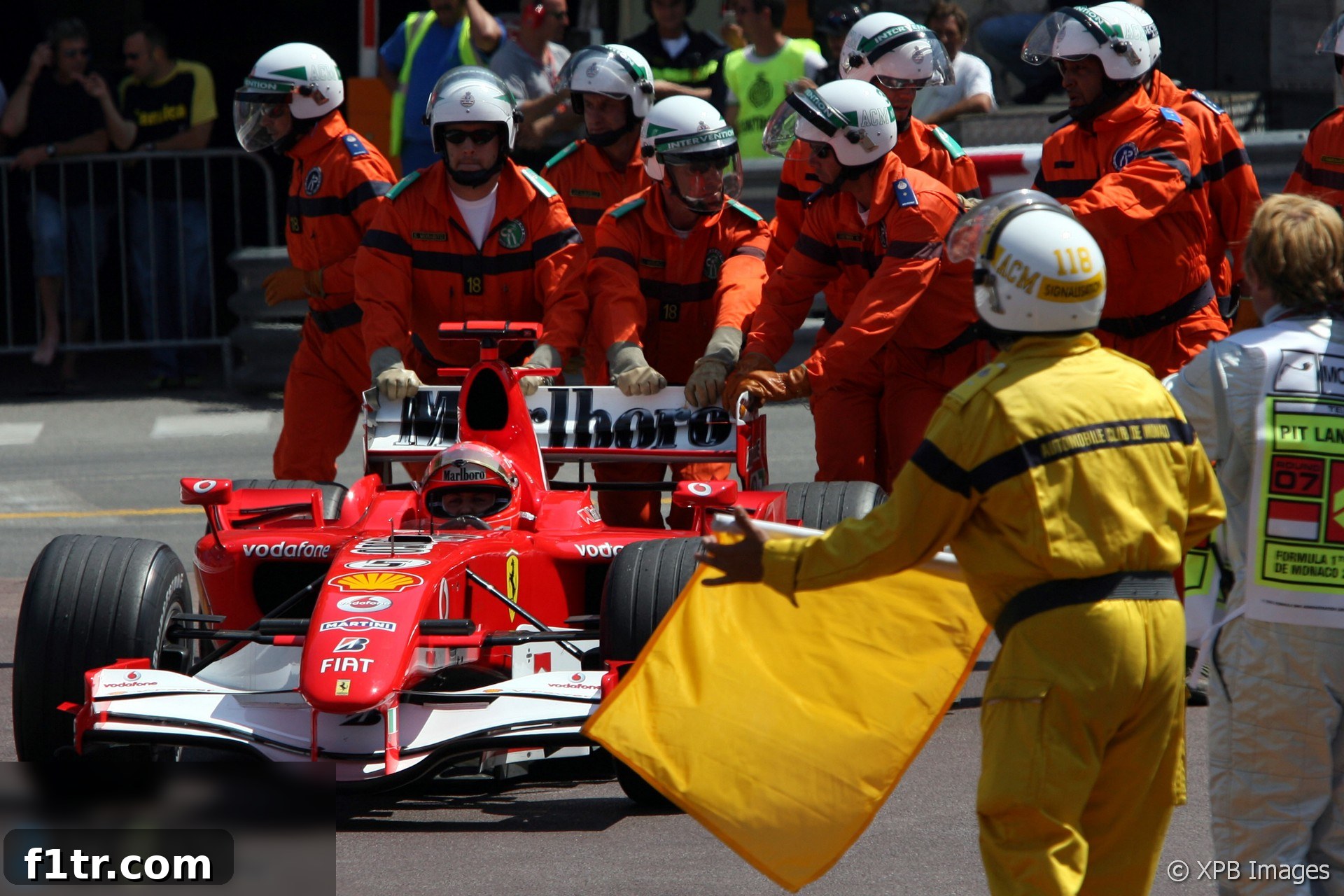
Michael Schumacher’s Rascassegate: Unraveling the Monaco 2006 Controversy
The 2006 Monaco Grand Prix remains etched in Formula 1 history for one of its most scandalous and debated moments: Michael Schumacher’s “Rascassegate.” This infamous incident, which saw the seven-time world champion deliberately stop his Ferrari on track during qualifying, was a moment that shocked the motorsport world and sparked intense debate about sportsmanship and the limits of strategic advantage. According to his then-teammate, Felipe Massa, the contentious decision was initially prompted by a suggestion from Ferrari’s highly respected technical director, Ross Brawn.
Monaco, with its tight, unforgiving streets, places an unparalleled premium on qualifying performance. Pole position is often considered half the race win, given the extreme difficulty of overtaking. In the high-stakes qualifying session for the 2006 Monaco Grand Prix, Michael Schumacher, a master of strategy and speed, found himself at the center of a controversy that would define his season and challenge perceptions of his illustrious career.
The Setup: A Crucial Qualifying Session in Monte Carlo
The 2006 Formula 1 season was a thrilling battle between two titans: Michael Schumacher, in his penultimate year before his initial retirement, and the young, ascendant Fernando Alonso. Heading into Monaco, the championship was fiercely contested, making every point, every grid position, absolutely vital. Schumacher, driving for Ferrari, was still very much a contender, demonstrating flashes of his legendary speed, even against a new generation of talent.
Monaco’s qualifying format, like all other races, involved three knock-out sessions (Q1, Q2, Q3). The final session, Q3, determined the top ten grid positions and was where the fastest drivers pushed their cars to the absolute limit. At the time of the incident, Schumacher was leading Q3, having already set a blistering lap time. As the session neared its conclusion, rivals were on their final flying laps, aiming to depose him from provisional pole.
The Incident: A Ferrari Stopped at Rascasse
It was in the dying moments of Q3 that the sporting world witnessed the inexplicable. As Michael Schumacher navigated his Ferrari F248 through the iconic Rascasse corner – a notoriously slow, tight right-hander leading onto the start-finish straight – his car suddenly slowed dramatically and came to a halt. While his car remained upright, its position effectively blocked the track and necessitated the waving of yellow flags. These yellow flags immediately forced any following drivers, including Schumacher’s main championship rival Fernando Alonso, to abandon their fast laps. This act effectively cemented Schumacher’s provisional pole position, as no one could improve their times under yellow flag conditions.
The immediate reaction was one of bewilderment, quickly followed by suspicion. Schumacher claimed a simple error, a momentary loss of control. However, the nature of the corner, the precision of his stop, and the strategic implications were too obvious to ignore. The stewards, the sport’s judicial body, quickly launched an investigation into what appeared to be a highly deliberate and calculated maneuver designed to gain an unfair advantage.
Felipe Massa’s Startling Revelation: A “Joke” Gone Wrong
Years after the incident, the true origins of the “Rascassegate” strategy came to light through the candid recollections of Schumacher’s teammate at Ferrari, Felipe Massa. Speaking in Sky’s Formula 1 documentary ‘The Race to Perfection,’ Massa divulged details of a pivotal conversation within the Ferrari team prior to the qualifying session. Massa recounted a team meeting where qualifying strategies were being discussed, particularly concerning the optimal use of tyre sets.
“We had a meeting with the team, we were talking about the qualifying,” Massa explained. He continued, describing Schumacher’s input: “And Michael said something: ‘Yeah but I mean if we are quicker straight away and then we go in for the second set…’.” It was then that Ross Brawn, a man celebrated for his strategic genius and calm demeanor, interjected with a seemingly innocuous remark. According to Massa, Brawn suggested, “Maybe we can create a yellow flag.” Massa clarified his own immediate reaction to this comment, stating, “And I said: ‘For fun. Not seriously, for fun.’”
The revelation that Brawn, even in jest, had floated such an idea added another layer of complexity to an already intricate controversy. Massa’s testimony strongly implies that what began as a hypothetical, perhaps even playful, suggestion in a strategic discussion, was tragically adopted as a serious tactic by Schumacher. “It happens exactly that [way],” Massa recounted with a sense of disbelief. “So Michael used that funny thing for him to do.” This deeply personal account from a teammate paints a picture of a suggestion that, despite being uttered light-heartedly, found fertile ground in Schumacher’s relentless competitive drive.
Schumacher’s Initial Denial and Eventual Confession
In the immediate aftermath of the incident, Michael Schumacher vehemently denied any wrongdoing, insisting that his stop at Rascasse was a genuine driving error. This denial, however, did little to quell the suspicions of fans, media, and fellow drivers. Massa, recalling the period, admitted his profound disbelief at Schumacher’s public stance. “I remember [after] that meeting I said ‘I can’t believe he did it’,” Massa shared. “He did it. And then the only thing is he was not able to say that he did it.”
The truth, however, proved elusive for a full year. It wasn’t until a year later that Schumacher finally admitted the deliberate nature of his actions to his trusted teammate. “It took one year for him to tell me that he did it on purpose,” Massa revealed. “One year. I said ‘how can you do that?’ It shows that everybody makes mistake in life and this was, definitely.” This delay in admission highlights the immense pressure and perhaps internal conflict Schumacher faced, a testament to the weight of his reputation and the gravity of the incident. It also speaks to the complexity of human nature, where even the greatest champions can succumb to moments of flawed judgment.
Ross Brawn’s Candid Reflection: An “Aberration”
Ross Brawn, a figure synonymous with Schumacher’s unprecedented success at Ferrari and later at Mercedes, also reflected on “Rascassegate” in the same documentary. Now serving as Formula 1’s managing director for motorsport, Brawn offered a nuanced perspective on his former driver’s actions. He described Schumacher’s behavior as an “aberration,” something outside the norm of his usually meticulous and fair approach to racing.
“Michael had occasional aberrations, things that you could never give a logical explanation for,” Brawn stated. He attributed these rare lapses to Schumacher’s “incredible competitiveness that drove him. And sometimes it would short-circuit.” This explanation suggests that in the heat of battle, Schumacher’s intense desire to win could, on rare occasions, override his otherwise sound judgment and adherence to sporting principles. Brawn further emphasized the regrettable nature of the incident, pointing out that it was strategically unnecessary.
“Monaco pole, it’s normally a given you want it,” Brawn conceded, acknowledging the immense value of starting from the front in Monte Carlo. “But on that occasion with the strategies that we had and the tyres we had and the car we had, there was actually no need for it.” He described the maneuver as “just a stupid move. And one of those little glitches, short circuits that Michael had two or three times in his career.” Brawn’s assessment, coming from a man who knew Schumacher intimately as a strategist and friend, provides a crucial insight into the psychological pressures and competitive instincts that sometimes pushed even the most disciplined athletes to the brink.
The Stewards’ Verdict and Immediate Fallout
The FIA race stewards, after a thorough investigation that included reviewing telemetry data and witness statements, concluded that Michael Schumacher had indeed deliberately stopped his car. Their ruling was unequivocal: Schumacher was disqualified from the qualifying session for the Monaco Grand Prix. This meant he would have to start the race from the very back of the grid, a devastating blow for any driver, but especially so at a circuit where track position is paramount.
The penalty sent shockwaves through the paddock. It reaffirmed the FIA’s commitment to upholding fair play and preventing drivers from manipulating sessions. For Schumacher, it was a rare public rebuke and a significant setback in his championship campaign. Fernando Alonso, who was thwarted from improving his lap, ultimately inherited pole position and went on to win the race, extending his lead in the championship. The incident undeniably had a tangible impact on the 2006 title fight, highlighting the severe consequences of such controversial actions.
The Enduring Legacy of Rascassegate
“Rascassegate” remains one of the most talked-about incidents in Formula 1 history, a stark reminder that even the greatest sporting heroes are not immune to controversy. It stands alongside other infamous moments in Schumacher’s career, such as the 1994 Adelaide collision with Damon Hill and the 1997 Jerez incident with Jacques Villeneuve, as examples of his fierce, sometimes ruthless, competitive streak. While these moments are often debated, they collectively form part of the complex tapestry of his legendary career.
The incident sparked a wider conversation within Formula 1 about sporting ethics, the fine line between strategic brilliance and unsportsmanlike conduct, and the responsibility of drivers and teams to maintain the integrity of the sport. For many fans, it tarnished a small part of Schumacher’s otherwise glittering legacy, while for others, it merely underscored the intensity of his will to win, even if it meant pushing the boundaries to their absolute limit.
Ultimately, “Rascassegate” serves as a compelling case study in motorsport history, revealing the intricate dynamics within a top-tier racing team, the immense pressure on its drivers, and the enduring debate surrounding controversial moments that define legends. It highlights the human element in a sport often dominated by technology, reminding us that behind the wheel are individuals driven by an unparalleled desire for victory, sometimes leading to decisions that leave an indelible mark on their careers and the sport itself.
Further Reading on F1 History
- When did F1 last have a mid-season break longer than five weeks? 1990
- Did Norris actually win Formula 1’s closest championship fight of all time?
- Hamilton is Ferrari’s first new driver in 44 years to complete season without a podium
- Ferrari are on course to lose an F1 record they’ve held since 2004
- Red Bull in 2010 or Ferrari in 1979? Past title fights illustrate McLaren’s current dilemma
Browse all history articles