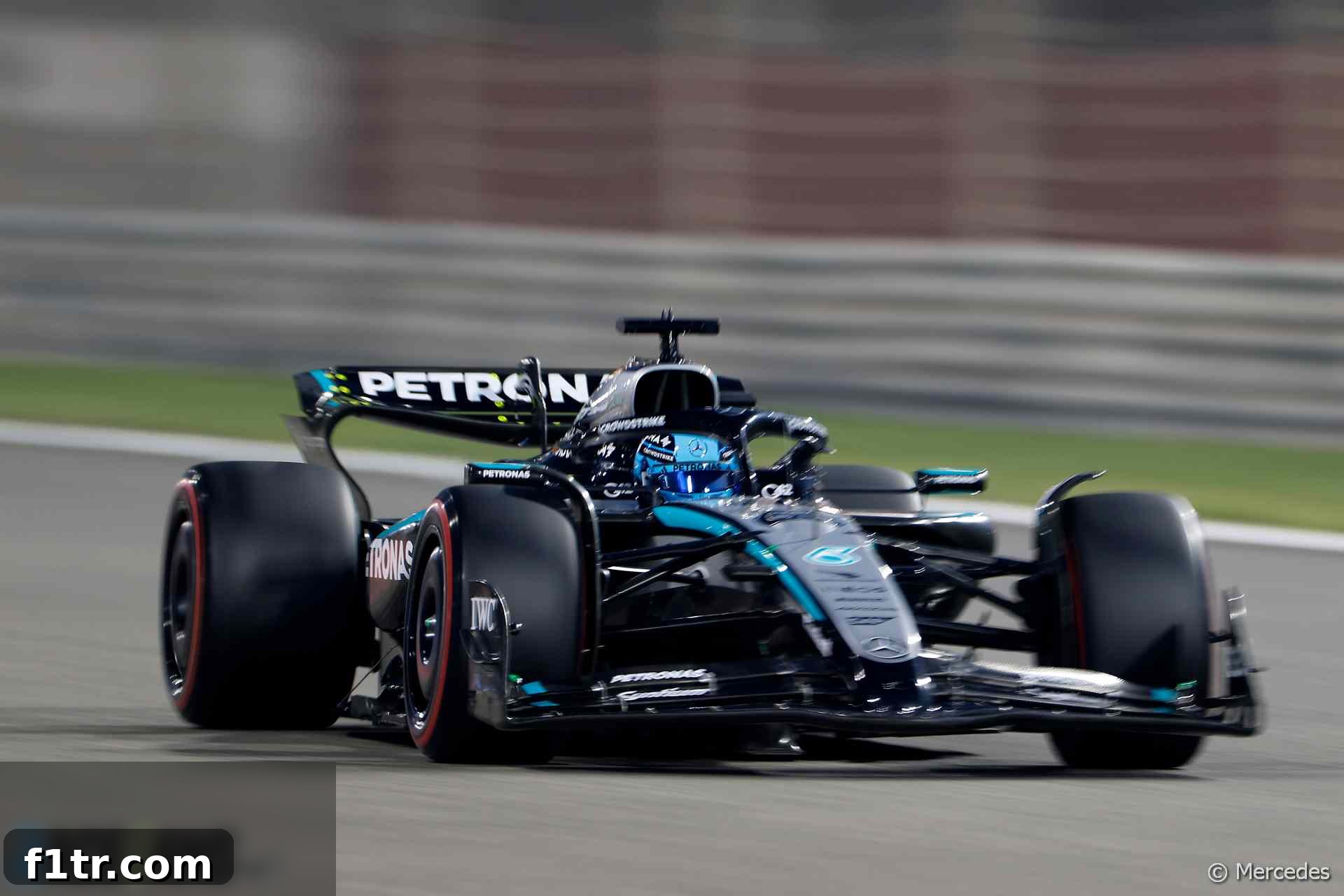
George Russell secured his impressive second-place finish at the Bahrain Grand Prix, a result that stood firm despite official confirmation that he inadvertently activated his Drag Reduction System (DRS) outside the permitted zones. In a highly unusual move that sparked considerable discussion, the race stewards opted against imposing any form of penalty, even after acknowledging that a technical infringement had indeed occurred.
Advert | Become a Supporter & go ad-free
George Russell Keeps Bahrain P2 After Unprecedented DRS No-Penalty Ruling
Understanding the Drag Reduction System (DRS) in Formula 1
The Drag Reduction System, or DRS, is a crucial aerodynamic aid in modern Formula 1 designed to promote overtaking. When activated, a flap on the rear wing opens, significantly reducing aerodynamic drag and allowing the car to achieve higher top speeds on designated straight sections of the track. Its use is strictly regulated to specific “DRS zones” during a race, typically requiring a driver to be within one second of the car ahead at a predetermined detection point. This system is usually automated, relying on a complex network of timing loops and telemetry to ensure fair and safe operation, preventing drivers from gaining an unfair advantage outside the intended parameters. The strict rules surrounding DRS activation are fundamental to maintaining competitive balance and ensuring sporting integrity, making any breach a serious matter.
The Technical Glitch: Manual DRS Activation and Timing System Failure
The stewards’ investigation into George Russell’s incident revealed a critical technical malfunction that necessitated a departure from standard operating procedures. A fault in the circuit’s timing system, supplied by an external party, disrupted the automated DRS activation mechanism on Russell’s car. This system is vital for accurately tracking a car’s position relative to competitors, which in turn dictates whether DRS activation is permissible. Without this precise positional data, the car’s onboard systems could not automatically determine if Russell was within the one-second window required to deploy DRS legally. Consequently, the FIA authorized Russell to operate his DRS manually, a rare directive issued under Article 22.1 h) of the sporting regulations, allowing for manual intervention in the event of system failures. This decision highlighted the reliance of modern F1 on sophisticated electronic infrastructure and the swift judgment required when these systems falter.
Advert | Become a RaceFans supporter andgo ad-free
Russell’s Simultaneous Challenges and Accidental Activation
Compounding the complexity of the situation, George Russell was simultaneously grappling with multiple critical issues aboard his Mercedes W16. Reports indicated he was experiencing significant brake-by-wire problems, alongside other electronic glitches, which undeniably added to the immense pressure and cognitive load on the driver. In the midst of these escalating technical difficulties, Russell was advised by his team to use an auxiliary button located in the cockpit. This multi-functional button serves as a backup radio switch, crucial for communication with the pit wall, but also doubles as a manual DRS activation button in scenarios like the one he was facing. It was during a critical moment on the straight between turns 10 and 11, while attempting to communicate with his team using this auxiliary control, that Russell inadvertently activated his DRS. This illustrates the razor-thin margins and high-stress environment in which Formula 1 drivers operate, where a single button can serve multiple, distinct functions, and a momentary lapse in concentration under duress can lead to unintended consequences.
Stewards’ Meticulous Examination: Telemetry Confirms No Sporting Advantage
Following the incident, the race stewards undertook a thorough and meticulous review of all available data, leaning heavily on advanced telemetry systems to reconstruct the precise sequence of events. Their investigation focused intensely on whether Russell had gained any measurable sporting advantage from the erroneous DRS activation. Telemetry data confirmed that the DRS flap was deployed for a mere 37 meters on a straight that spanned approximately 700 meters. Crucially, while this brief deployment did yield an infinitesimal gain of 0.02 seconds, the subsequent data showed Russell immediately reacted to the accidental activation. He consciously gave up a significant 0.28 seconds at the very next corner, effectively overcompensating for the momentary advantage. This instant and voluntary correction, clearly evidenced by the telemetry, was a pivotal factor in the stewards’ decision-making process. Their finding underscored the principle that while a technical breach had occurred, the absence of any lasting sporting benefit meant the spirit of fair competition was preserved.
An Unprecedented Decision: No Penalty Despite Technical Breach
The stewards’ final ruling, while technically acknowledging a breach of regulations, was exceptionally uncommon in Formula 1. Typically, even minor infringements, such as a driver exceeding track limits or a team making a procedural error, result in some form of sanction, whether it be a reprimand, a time penalty, or a small fine. However, in George Russell’s case, the stewards decided to issue no penalty of any kind. Their rationale was firmly rooted in the comprehensive telemetry analysis that proved Russell gained no enduring sporting advantage and, in fact, actively mitigated any potential gain. This decision highlights a nuanced approach to rule enforcement, where the specific context, the driver’s intent, and the measurable impact are all weighed heavily alongside the letter of the law. It suggests a willingness to exercise discretion when circumstances are truly exceptional and when the core principle of fair play remains uncompromised, setting a notable precedent for future incidents involving complex technical failures and driver actions under duress.
Implications and Future Considerations for F1 Regulations
This unique ruling regarding George Russell’s DRS activation at the Bahrain Grand Prix opens a fascinating discussion on the evolving landscape of Formula 1 regulations and their enforcement. While the stewards’ decision was clearly justified by the specific circumstances – a timing system failure, Russell’s multi-faceted car issues, his accidental activation, and the immediate, compensatory action – it underscores the increasing complexity of balancing rigid rulebooks with the realities of high-stakes, technologically advanced motorsport. The incident serves as a stark reminder of how interconnected and fragile the intricate electronic systems in modern F1 cars can be, and how quickly a routine operation can be complicated by unforeseen failures. It also prompts reflection on driver workload and the design of cockpit controls, particularly when multiple critical functions are assigned to single buttons. Moving forward, this precedent might encourage greater flexibility in assessing minor technical infringements where no genuine sporting advantage is gained, potentially shifting the focus more towards the spirit of the rules rather than strictly adhering to every letter. This nuanced approach could lead to further discussions within the FIA about the role of external system reliability and the measures taken to support drivers when core functionalities fail, ultimately aiming to ensure fairness without unduly penalizing unavoidable technical mishaps.
Advert | Become a RaceFans supporter andgo ad-free
2025 Bahrain Grand Prix Insights
- Hamilton making “drastic shift” in driving style to master Ferrari’s car
- Leclerc revealed Ferrari strategy details to Gasly before Bahrain Grand Prix
- Lawson made “very significant step forward” in Bahrain – Mekies
- Russell’s transponder was ‘frazzled and charred’ after Bahrain Grand Prix DRS drama
- “Don’t give me too much now”: Hamilton’s search for speed at Ferrari continues
Browse all 2025 Bahrain Grand Prix articles