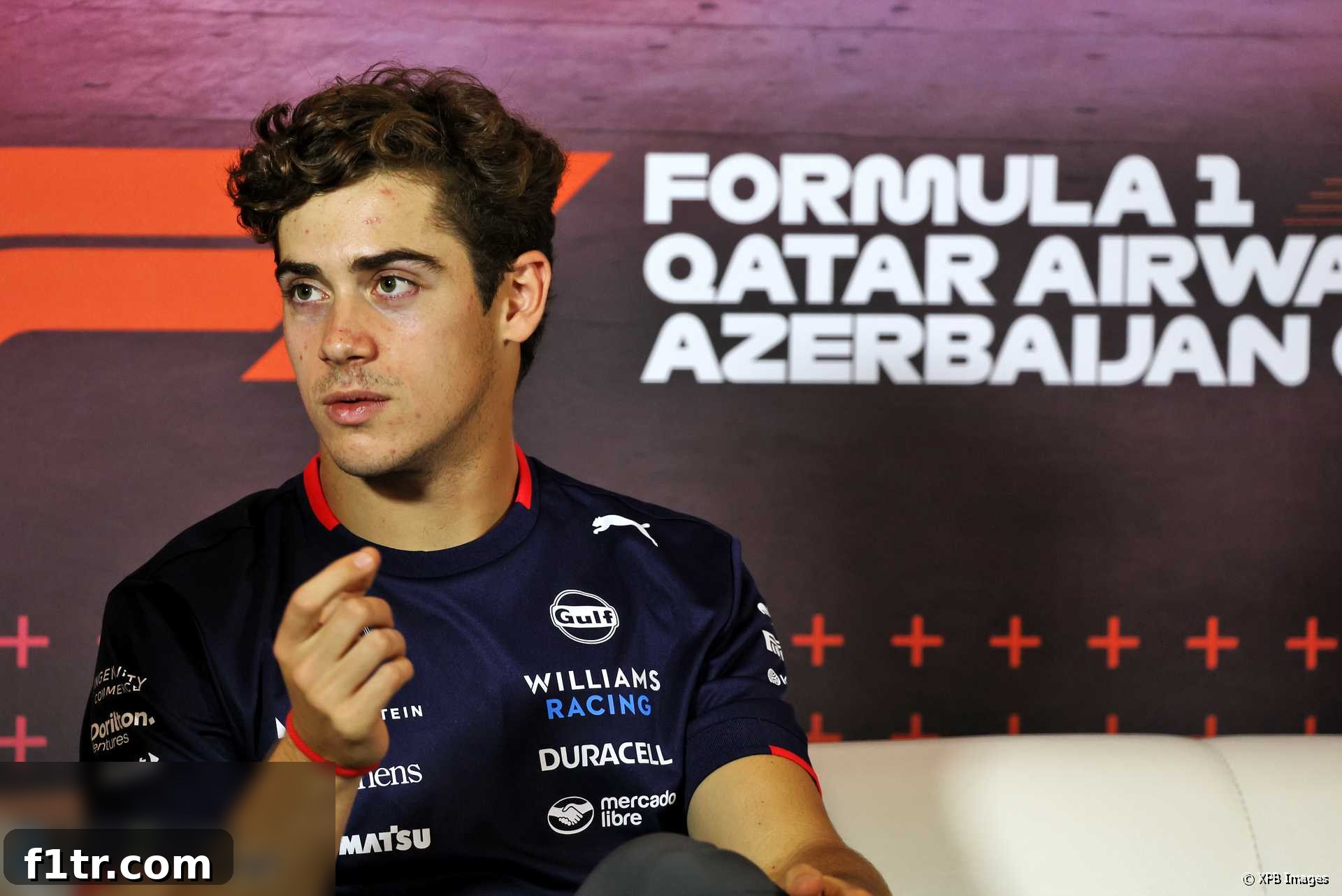
Franco Colapinto Confirms Williams Fixed F1 Seat Issues After Painful Monza Debut
Formula 1 newcomer Franco Colapinto has confirmed that Williams Racing has successfully resolved the critical seat discomfort he experienced during his highly anticipated debut at the Italian Grand Prix two weeks ago. The Argentine driver’s first taste of top-tier motorsport was notably marred by significant physical pain, making his otherwise impressive performance under such circumstances even more remarkable.
The Unexpected Agony: A Rookie’s First F1 Challenge
Colapinto, who was thrust into Logan Sargeant’s seat just three days before the Monza weekend, revealed the extent of his suffering post-race. He described the experience as having “never had so much pain in a race car before.” This candid revelation immediately cast a spotlight on one of the often-overlooked yet fundamental aspects of driver comfort and performance in Formula 1: the meticulously crafted, bespoke carbon fiber seat.
The transition from Formula 2 to Formula 1 is immense, not just in terms of raw car performance but also in the subtle yet crucial intricacies of equipment. “I never drove in a carbon seat before,” Colapinto explained, highlighting the stark difference between the junior categories and the pinnacle of motorsport. F1 seats are not merely chairs; they are rigorously sculpted to the driver’s exact physique, designed to absorb immense G-forces and vibrations while providing unwavering support. However, even with advanced body scans and precise manufacturing, the perfect fit isn’t always achieved instantly, especially under such a rapid and high-pressure onboarding process.
The Technical Nuance of an F1 Seat: More Than Just a Mold
An F1 car’s seat is far more than a simple cushion; it is a vital component of the driver-car interface. Constructed from incredibly rigid carbon fiber, it acts as an extension of the chassis, transmitting critical feedback from the car directly to the driver. This inherent stiffness, which Colapinto likened to “a wall,” is crucial for both structural integrity during high-speed impacts and for providing the direct, uninhibited feel required for precise car control. Yet, if not perfectly molded and integrated, it can create painful pressure points that become excruciating over the course of a Grand Prix distance, potentially compromising concentration, physical endurance, and ultimately, lap time. Colapinto’s experience vividly underscores the profound challenge of integrating a new driver into such a high-performance, precision-engineered machine with minimal preparation time.
Williams’ Swift Action: Prioritizing Driver Comfort and Performance
Recognizing the critical impact of driver comfort on performance, the Williams team wasted no time in addressing Colapinto’s concerns. The Argentine driver expressed immense relief, stating, “We did a really good job with the team now and it’s fully fixed, luckily. I think it’s going to be much better.” This rapid and effective resolution showcases the unwavering dedication of Formula 1 teams to their drivers’ well-being and their relentless, methodical pursuit of optimal performance. In a sport where every fraction of a second counts, a comfortable and supportive seat can make a significant difference.
A perfectly fitted seat is paramount for an F1 driver, serving multiple critical functions beyond mere comfort. It not only ensures that the driver can sustain the extreme physical loads of a race without distraction but also allows for precise and consistent control inputs, especially during the extreme braking, high-speed cornering, and rapid acceleration maneuvers that define Formula 1. Any distraction, such as persistent pain from an ill-fitting seat, can significantly hinder a driver’s ability to extract maximum performance from the car. The swift and successful fix for Colapinto’s seat is a clear testament to the detailed engineering, immediate responsiveness, and driver-centric approach required at the pinnacle of motorsport.
Physical Readiness Meets On-Track Demands
Despite the unforeseen seat issues, Colapinto remained confident in his extensive physical preparation for the gruelling demands of a Formula 1 Grand Prix. Having competed in Formula 2 earlier this year, his body was already finely honed for high-level motorsport, though F1 presents an entirely different magnitude of physical challenge and endurance requirements.
“In terms of how I train physically and how I was at for that race, I’m really happy,” he affirmed, indicating his satisfaction with his physical condition. The neck, in particular, is consistently cited by F1 drivers as the most challenged body part due to the immense G-forces sustained through high-speed corners and heavy braking zones. Colapinto’s strong neck response during his debut was a clear indicator of his diligent training and physical conditioning program. “The neck, that is sometimes the toughest part of F1, it reacted very well. So it means that we did a very good job on the training side. And the seat looks perfect now, so that’s very good news,” he added, reinforcing his readiness and optimism for future challenges now that the primary physical impediment has been removed.
A Remarkable Debut: Learning Under Pressure at Monza
Despite the physical discomfort and minimal preparation time, Colapinto’s performance at Monza garnered significant praise, particularly from Williams team principal James Vowles. Finishing within a mere 14 seconds of seasoned teammate Alexander Albon was a remarkable achievement. For a driver unexpectedly called up to Formula 1 with barely any prior mileage in the car, this was an exceptional feat and a clear demonstration of his inherent talent and rapid adaptability.
Navigating the Unknown: The Steep F1 Learning Curve
The Argentine rookie candidly admitted that the race itself was an enormous learning experience. “We were going into the race with a lot of question marks. I hadn’t done more than eight laps in a row in a Formula 1 car before that and then suddenly they put me into 53,” he recounted. This statement vividly illustrates the sheer leap from short practice runs and simulator sessions to a full Grand Prix distance, which demands meticulous management of tires, fuel, energy recovery systems, and intricate race strategy, all while battling rivals at speeds exceeding 300 km/h.
Monza, often dubbed the “Temple of Speed,” is notoriously challenging, demanding absolute precision and unwavering confidence in its high-speed braking zones and chicanes. For a debutant, navigating these technical complexities while simultaneously learning the car’s nuanced characteristics and coping with persistent physical pain is a monumental task. Colapinto’s approach was pragmatic and intelligent: “It was very tough and there were many circumstances that I was not sure what I had to do. I was learning during the race and we went step by step. I think that was the most important part, to be building on during the race weekend.” This methodical mindset allowed him to absorb information, adapt his driving, and improve progressively throughout his inaugural Grand Prix weekend, a trait highly valued and essential for success in Formula 1.
Bouncing Back from a Qualifying Setback
The Monza weekend wasn’t entirely without its challenges for the young driver. Colapinto openly acknowledged making a mistake in qualifying, which ultimately saw him eliminated in Q1, placing him nine positions behind Alexander Albon on the grid. Qualifying in Formula 1 is an incredibly high-pressure environment, where fractions of a second and a single error can make a monumental difference to a driver’s starting position and overall race prospects.
“I did a little mistake and I missed the chance to go into Q2, but it was still a very special weekend,” he reflected, showing a balanced perspective. What truly stood out, however, was his remarkable resilience and ability to perform under pressure. “The race was, as I said before, a lot of question marks and we did the job. I just bounced back very strong after a tough quali and I showed with the team, that gave me the trust to put me there and they are doing a lot of effort these last few races, that I could do the job.” This ability to rebound effectively from a setback and deliver an admirable performance in the race is a hallmark of a strong racing driver and undoubtedly reinforced Williams’ decision to grant him this crucial opportunity.
The Promise of a Brighter Future with Williams and Beyond
Franco Colapinto’s Formula 1 debut at Monza was a microcosm of a racing driver’s journey: immense talent meeting unexpected hurdles, followed by swift adaptation, resilience, and impressive performance. The successful rectification of his seat issues removes a significant physical barrier, allowing him to now focus entirely on extracting the maximum from the Williams FW46 and future Formula 1 machinery without distraction.
With the physical discomfort firmly behind him and invaluable race experience now under his belt, Colapinto is undoubtedly poised for stronger showings should further opportunities arise. His initial outing, characterized by pain, rapid learning, and profound resilience, has undeniably made a lasting impression on Williams Racing and the wider F1 paddock. It’s a compelling narrative of a young driver demonstrating his capability to not only thrive under immense pressure but also to rapidly adapt to the most demanding and competitive motorsport series in the world.
This formative experience will serve as a crucial building block for Colapinto’s burgeoning Formula 1 career. The trust placed in him by the Williams team, coupled with his demonstrable ability to deliver despite adversity, bodes exceptionally well for his future prospects in the sport. Fans and pundits alike will be watching closely to see how this promising talent continues to develop, now with full comfort and confidence in his machine, as he strives to establish himself in the world of Formula 1.