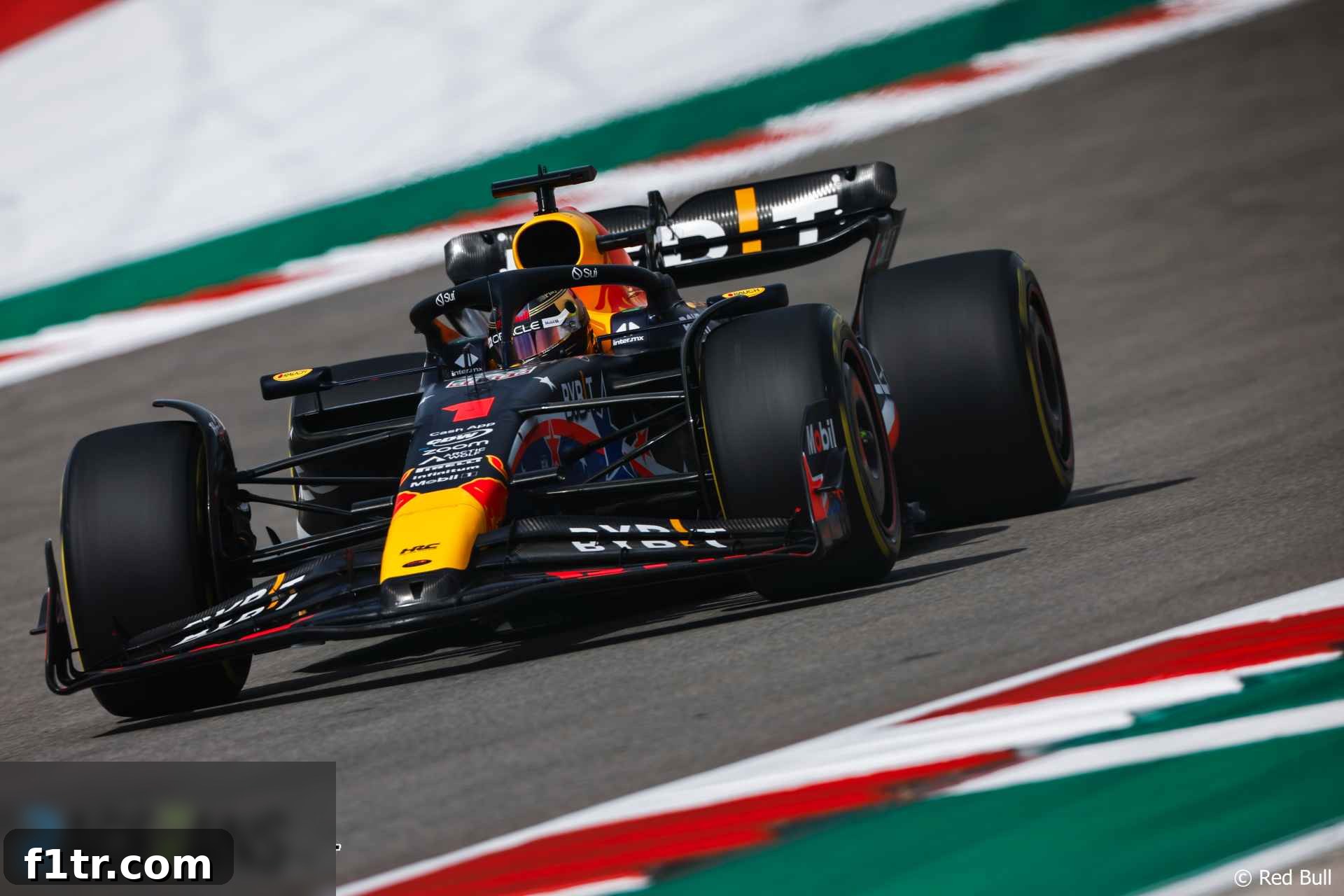
Max Verstappen Masters COTA Sprint Race with Flawless Pole-to-Flag Victory
The electrifying atmosphere at the Circuit of the Americas (COTA) provided a fitting backdrop for an exhilarating sprint race at the United States Grand Prix. From the moment the starting lights extinguished, Max Verstappen, the reigning world champion, delivered a commanding performance that underscored his formidable skill and his Red Bull car’s exceptional pace. Starting from a well-deserved pole position, the Dutch ace showcased absolute control, leading every single one of the nineteen laps. His unerring drive saw him cross the finish line a significant nine seconds ahead of Mercedes’ Lewis Hamilton, with Ferrari’s Charles Leclerc securing the final spot on the podium. This dominant display not only earned Verstappen valuable championship points but also laid down a formidable marker for the competition ahead of Sunday’s main event.
Pre-Race Preparations and High-Stakes Tyre Strategies
The unique sprint format of a Formula 1 weekend invariably introduces an additional layer of tactical complexity, particularly concerning car setup and tyre choices for a shorter, more intense race. With only 19 laps to contend with, tyre degradation becomes an even more critical factor than in a full Grand Prix, often influencing teams towards more conservative decisions to ensure consistent performance. As the cars lined up on the grid, the vast majority of the field opted for the robust medium compound Pirelli tyres. This choice aimed to strike a balance between sufficient grip and longevity, providing drivers with the confidence to push without the worry of excessive wear over the sprint distance. However, one prominent exception immediately caught the eye: Ferrari’s Carlos Sainz Jnr. Positioned sixth on the grid, Sainz made a bold strategic gamble, choosing to start on the softer compound tyres. While the softs promised superior initial grip and explosive pace off the line, they were notoriously susceptible to higher degradation, especially on the demanding, high-energy corners of COTA. This high-risk, high-reward decision by Sainz injected an exciting and unpredictable element into the midfield battles, hinting at a potential shift in fortunes as the race unfolded.
The Thrilling Start: Verstappen’s Defence and Hamilton’s Opportunism
As the five red lights extinguished, signalling the start of the sprint race, the roar of engines filled the Texas air as the field surged towards the iconic uphill run to Turn 1. From pole position, Max Verstappen executed a textbook start, but he was immediately met with a fierce challenge from second-placed Charles Leclerc. The Ferrari driver, hungry for an early lead, bravely darted to the outside, attempting to outmanoeuvre Verstappen into the notoriously tricky first corner. However, Verstappen was equally resolute, demonstrating exceptional race craft by masterfully defending his inside line with absolute precision, effectively boxing Leclerc out and forcing him to compromise his entry. This intense, wheel-to-wheel battle for the lead created a crucial window of opportunity for Lewis Hamilton. The seven-time world champion, renowned for his strategic intelligence and opportunistic driving, shrewdly capitalised on Leclerc’s momentarily compromised trajectory at the exit of Turn 1, sweeping past the Ferrari to snatch a crucial second place. This decisive move saw Hamilton slot directly behind Verstappen, setting up what many anticipated would be a thrilling direct confrontation at the front of the pack. Meanwhile, Carlos Sainz Jnr, benefiting from the superior initial grip of his soft tyres, made an impressive start, gaining two positions to settle into fourth place, ahead of the McLaren duo of Lando Norris and Oscar Piastri.
Early Laps Unfold: Dominance and Defensive Driving
With the initial chaos of Turn 1 navigated, the leading cars quickly settled into their rhythm, each driver pushing to establish their pace. Verstappen, now with Hamilton in his mirrors and Leclerc close behind, immediately began to demonstrate his raw speed. The Drag Reduction System (DRS) was activated at the start of the second lap, theoretically offering a chance for Hamilton to launch an attack. However, Verstappen’s blistering pace allowed him to pull out a lead of over a second from Hamilton by the end of Lap 2, effectively nullifying the DRS advantage for the pursuing Mercedes. Interestingly, despite building a gap, Verstappen communicated via team radio about the balance of his Red Bull, indicating he wasn’t entirely comfortable with the car’s handling. This brief moment of uncertainty allowed Hamilton to pull back within the one-second DRS window, hinting at a potential comeback. Yet, the reigning champion quickly recalibrated, finding his stride and steadily extending his lead. By the end of Lap 8, his advantage had stretched to a comfortable two-and-a-half seconds over Hamilton, while Leclerc fell further back, almost four seconds adrift in third. Verstappen’s masterful ability to manage his tyres and maintain a consistently quick pace was, once again, the defining feature of the race.
Further down the field, a significant incident unfolded involving Mercedes’ George Russell. Engaged in a tight battle for seventh position, Russell executed an overtake on Oscar Piastri at Turn 15. However, the manoeuvre was immediately flagged by race control as Russell was deemed to have exceeded track limits, thereby gaining an unfair advantage. Rather than immediately ceding the position back to Piastri – a common practice that can often prevent further penalties – Russell opted to maintain his position ahead of the McLaren. This decision proved to be costly. Stewards promptly investigated the incident and swiftly handed Russell a five-second time penalty for “leaving the track and gaining an advantage,” a standard punishment for such infringements. This penalty would significantly impact his final classification, irrespective of where he crossed the finish line.
Mid-Race Dynamics: Tyre Degradation and Tenacious Defence
As the sprint race progressed into its crucial middle phase, the divergent tyre strategies adopted by various teams began to demonstrably play out. Carlos Sainz Jnr’s ambitious decision to start on the soft compound tyres, which had allowed him to make strong gains in the opening laps, now started to reveal its inherent downside. The softer compound, while providing initial aggression, was visibly degrading, causing his lap times to drop. This reduction in pace allowed George Russell, on his more durable medium tyres, to rapidly close the gap, placing intense pressure on the Ferrari driver. Despite Russell being glued to Sainz’s gearbox and seemingly possessing healthier tyres, making a definitive overtake proved exceptionally challenging on the COTA circuit. Sainz, showcasing his renowned defensive prowess, held his ground brilliantly, masterfully managing his struggling soft tyres to keep the Mercedes behind him. This prolonged, intense battle highlighted the strategic trade-offs inherent in the sprint format, emphasizing both the importance of astute tyre management and tenacious defensive driving.
Meanwhile, at the pinnacle of the race, Max Verstappen continued his relentless, unchallenged charge. The gap he had established over Lewis Hamilton steadily grew, unequivocally signalling that Verstappen had settled into an optimal rhythm and was expertly managing his Red Bull. The car appeared perfectly balanced and responsive, allowing him to extract maximum performance lap after lap with effortless consistency. Hamilton, despite his best efforts to push the Mercedes, simply couldn’t match the raw speed and sustained performance of the Red Bull on this particular Saturday. Charles Leclerc, consolidating his third position, also found himself unable to challenge the blistering pace of the front two, creating a clear and unchallenged hierarchy at the sharp end of the field as the race approached its climax.
The Final Laps: Verstappen’s Unassailable Dominance
With the sprint race winding down into its final few laps, the outcome at the front was all but sealed. Max Verstappen, having built a significant and unassailable lead, could afford to manage his pace, conserving his tyres and cruising towards the chequered flag. He comfortably checked off the remaining laps, demonstrating absolute control and the maturity of a seasoned champion. As he crossed the line at the end of the 19th lap, he clinched a thoroughly deserved victory, securing all eight points available for the sprint race winner. It was a dominant display from start to finish, leaving no doubt about his supreme form and the competitive edge of his Red Bull package.
Lewis Hamilton brought his Mercedes home in a strong second place, finishing nine seconds adrift of the victorious Red Bull. While unable to mount a challenge for the win, his performance was a solid testament to Mercedes’ improved pace and offered a positive, encouraging outlook for the upcoming main Grand Prix on Sunday. Charles Leclerc completed the top three, finishing a further 8.5 seconds behind Hamilton, rounding off a valuable points haul for Scuderia Ferrari and cementing his podium position.
Final Standings and Points Distribution After Penalties
The application of George Russell’s five-second time penalty had a tangible impact on the final classifications of the midfield. McLaren’s Lando Norris drove a commendable and consistent race to secure fourth position, representing a strong result for the Woking-based squad. Red Bull’s second driver, Sergio Perez, finished in fifth, adding important constructor points to his team’s tally. Carlos Sainz Jnr, despite battling severe tyre degradation on his softs, displayed brilliant defensive driving to hold off Russell and cross the line in sixth place on the road. However, once Russell’s aforementioned time penalty was officially applied, the Mercedes driver dropped from seventh to eighth in the official standings. This reshuffle promoted Alpine’s Pierre Gasly into a well-earned seventh position, securing crucial points for his team. Williams’ Alexander Albon just narrowly missed out on points, finishing ninth, while Oscar Piastri, after his earlier battle with Russell and facing late-race tyre struggles, faded to tenth at the chequered flag, unable to salvage any championship points from the sprint.
The sprint race, with its condensed format, intense battles, and strategic nuances, once again proved to be an exciting and action-packed precursor to the main event. Max Verstappen’s flawless, dominant performance further solidified his status as the driver to beat, underlining his current unparalleled form. However, the determined efforts of Lewis Hamilton and Charles Leclerc, coupled with the strategic gambles and fiercely contested midfield skirmishes, promise an even more thrilling and unpredictable main Grand Prix on Sunday. All eyes now turn to the extended race, where tyre strategy, crucial pit stops, and sustained pressure over a longer distance will undoubtedly determine who stands on the top step of the podium at the 2023 United States Grand Prix.
2023 United States Grand Prix – Related Articles
- US GP was Mercedes’ best race of 2023 despite disqualification – Wolff
- Singapore and Austin retirements cost me top 10 championship place – Ocon
- United States Grand Prix result unchanged as FIA rejects Haas’ call for review
- Sargeant admits he’s ‘struggled to use all the downforce at times’ in F1
- Mercedes’ Brazilian GP set-up was “conservative” after US GP disqualification
Browse all 2023 United States Grand Prix articles