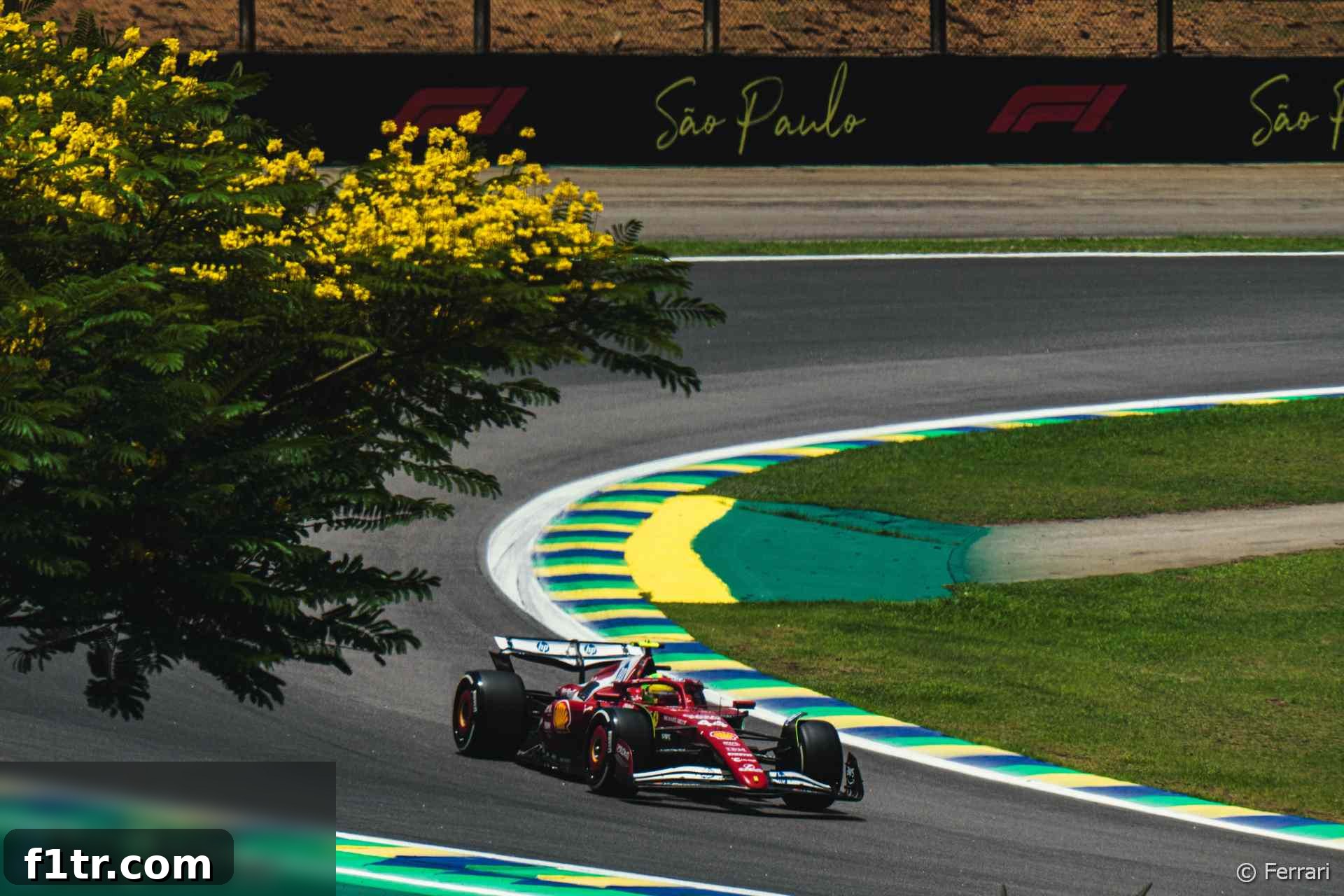
Lewis Hamilton
Lewis Hamilton Receives Penalty Points Following Brazilian Grand Prix Collision
The highly anticipated Brazilian Grand Prix, a staple in the Formula 1 calendar known for its dramatic races, once again delivered its fair share of controversy and on-track incidents. At the heart of the discussion was seven-time world champion Lewis Hamilton, who received penalty points – his second such sanction this year – after a collision with Alpine driver Franco Colapinto. This incident cast a shadow over Hamilton’s race, leading to significant car damage and ultimately, his retirement, prompting widespread debate among fans and within the F1 paddock.
An Unfortunate Encounter on Track: Hamilton vs. Colapinto
The critical moment unfolded early in the race, specifically during the second lap as drivers navigated the challenging Turn 15. Lewis Hamilton, behind the wheel of his Mercedes-AMG Petronas F1 W14, was attempting to close the gap and potentially overtake Franco Colapinto, driving for the Alpine F1 Team. In the intensity of the battle for position, contact was made: Hamilton’s right front tyre connected with Colapinto’s left rear tyre. While Colapinto’s car appeared to escape immediate, noticeable consequences, the impact was unfortunately detrimental to Hamilton’s machine.
The collision resulted in considerable damage to the front wing of Hamilton’s Mercedes. Compounding the problem, the detached or fractured front wing then folded underneath the car’s floor. This critical structural failure not only compromised the intricate aerodynamics of the W14 but also posed a risk of further internal damage, fundamentally altering the car’s balance and performance. Such incidents are a stark reminder of the delicate engineering involved in Formula 1 cars, where even a seemingly minor touch can have cascade effects on race performance and safety.
The Stewards’ Analysis: Responsibility and Mitigating Factors
Following the incident, the race stewards launched an immediate and thorough investigation. Their process involved careful review of multiple angles of video footage, telemetry data from both cars, and listening to the radio communications and statements from the drivers and teams involved. After meticulous deliberation, the stewards determined that Lewis Hamilton (Car 44) was “wholly responsible for the incident.” This classification is standard for cases where one driver’s actions are deemed to be the primary cause of a collision.
However, the stewards also identified several “mitigating factors” that played a crucial role in determining the final penalty. They clarified that although the contact led to mechanical damage to Hamilton’s car, thus categorizing it as a collision, the interaction itself was “minor” and occurred at a “low speed differential.” Crucially, they noted that the incident “did not have an immediate and obvious sporting consequence for the other car” – meaning Colapinto’s race was not significantly disrupted at that very moment. Based on these considerations, the standard 10-second time penalty typically issued for such collisions was reduced to a 5-second time penalty. In addition to the time penalty, Hamilton also accrued penalty points on his Super Licence, bringing his running total for the season to three. This nuanced approach by the stewards often sparks debate among F1 followers, highlighting the subjective nature of judging racing incidents under immense pressure.
Hamilton’s Ordeal: Driving a Damaged Machine
The impact of the collision on Lewis Hamilton’s race was immediate and profound. Despite his best efforts to continue, the damage to his front wing severely compromised the performance of his Mercedes W14. Hamilton described the experience candidly, stating that the car became “extremely difficult to drive” in the aftermath of the contact. Initially, there was uncertainty about the exact nature of the damage. “After the hit it felt like the rear suspension was broken,” he recounted to the official Formula 1 channel, adding, “But they said that it seemed to be alright. [It] could be cross weight or something like that.”
The primary issue, however, turned out to be a critical loss of downforce. Hamilton elaborated on the severity, explaining, “The loss of downforce, I think we were losing 30 or 40 points of downforce, so when you were going through the high-speed the thing was snapping.” This substantial reduction in aerodynamic grip meant the car was unstable and unpredictable, particularly during high-speed sections of the track. Driving a Formula 1 car already demands peak physical and mental concentration, but with such a significant loss of performance, Hamilton found himself battling the machine rather than his competitors. He candidly admitted the futility of his efforts, stating, “I was giving everything to try and keep up with even the guys that were right ahead of me, and I had no chance.” Ultimately, the compromised performance proved insurmountable, and Hamilton was forced to retire his car on lap 38, marking a disappointing end to what had become an uphill battle.
A Challenging Weekend for Mercedes and Ferrari
The Brazilian Grand Prix proved to be a weekend to forget, not just for Lewis Hamilton, but for his Mercedes team and indeed for other major contenders like Ferrari. Hamilton’s retirement meant a critical loss of championship points for Mercedes, a significant setback in their ongoing constructors’ battle. Adding to the overall disappointment of the weekend, Ferrari also failed to score points, as Charles Leclerc, driving for the Scuderia, was forced to retire from the race due to an unrelated incident. This dual retirement underscored the brutal and often unpredictable nature of Formula 1, where even the most dominant teams can face unforeseen challenges.
Hamilton’s emotional reflections captured the sentiment of the entire Mercedes garage. “This is definitely a weekend to forget,” he acknowledged, his words resonating with the collective effort invested by his team. His personal affection for the Brazilian circuit and the fervent support from the local fans only intensified the disappointment of the outcome. “It’s a shame because I love Brazil and also everyone in the team, every single person in the team, they turn up every week and give it their absolute best and to come away with nothing, to not finish a race, second time in the year, it’s really devastating,” he expressed, highlighting the profound impact a DNF has on morale.
In a display of true sportsmanship and leadership, Hamilton also took personal responsibility for aspects of the weekend’s performance, specifically his qualifying session. “I feel terrible for the team. I’m sorry for my part in qualifying, I put myself in that position. We’ll get back up tomorrow and just give it another go,” he stated. This commitment to move forward and learn from setbacks is a hallmark of champions and is vital for teams operating at the pinnacle of motorsport.
Understanding Formula 1 Penalty Points: The System Explained
The Formula 1 penalty points system is a crucial regulatory mechanism designed to promote safe driving and ensure fair competition. Introduced to deter reckless or consistently infringing behavior, these points are allocated by the race stewards for various offenses, ranging from causing collisions and dangerous driving to exceeding track limits or ignoring flag signals. Each driver holds an FIA Super Licence, which is essentially their permit to compete in Formula 1. Penalty points are accumulated against this licence over a rolling 12-month period. The stakes are significant: if a driver accrues a total of 12 penalty points within this one-year timeframe, they face an automatic one-race ban. This means they are prohibited from participating in the next Grand Prix, a severe consequence that can significantly impact their championship aspirations and team’s performance.
Hamilton’s current tally of three penalty points, while not immediately threatening a ban, serves as a constant reminder for drivers to exercise caution and precision. It underscores the fine line between aggressive, championship-winning driving and infringing upon the strict rules designed to maintain order and safety on the track. For fans, understanding this system adds another layer of intrigue to race weekends, as the potential for drivers to reach critical penalty point totals can add an extra dimension of drama to their performance and conduct.
Public Perception: A Divided Verdict on the Penalty
The Penalty Box: Fan Reactions and Debates
The decision by the race stewards to penalize Lewis Hamilton with a 5-second time penalty and additional penalty points immediately ignited passionate discussions among the global Formula 1 fanbase. Stewarding decisions are often a hot topic, with fans frequently divided on whether justice has been served, considering the complexities of racing incidents, driver reputations, and historical precedents. To gauge public sentiment, a poll was conducted, offering a clear snapshot of how F1 enthusiasts perceived the penalty. The results underscored a varied yet discernible pattern of opinion:
Hamilton’s penalty for colliding with Colapinto was:
- No opinion (4%)
- Far too lenient (1%)
- Slightly too lenient (7%)
- Correct (35%)
- Slightly too harsh (21%)
- Far too harsh (32%)
Total Voters: 75
The poll results revealed a fascinating division. While a significant plurality of 35% of voters deemed the penalty “Correct,” suggesting an agreement with the stewards’ balanced judgment, a combined 53% of participants felt the penalty was too severe. This included 21% who considered it “Slightly too harsh” and a substantial 32% who believed it was “Far too harsh.” Conversely, only a small minority, a combined 8%, thought the penalty was “Too lenient” (1% “Far too lenient” and 7% “Slightly too lenient”). This data clearly illustrates the diverse and often emotionally charged opinions within the F1 community, where factors such as driver allegiance, perceived historical biases, and personal interpretations of racing rules all contribute to public sentiment.
Moving Forward: Redemption on the Horizon
Despite the setbacks and the disappointment from the Brazilian Grand Prix, both Lewis Hamilton and the Mercedes-AMG Petronas F1 Team are renowned for their resilience and ability to bounce back. Formula 1 is a sport that constantly demands innovation, adaptation, and an unwavering drive for improvement. Every race incident, while frustrating in the moment, serves as a valuable learning opportunity for both the driver in refining their race craft and for the team in analyzing car dynamics and strategy. For Hamilton, the accumulation of penalty points acts as a pertinent reminder of the stringent regulations governing on-track conduct, requiring a delicate balance between aggressive, winning maneuvers and adherence to safety protocols. With the unwavering support of his dedicated team and his own unparalleled determination, Hamilton will undoubtedly channel this experience into renewed focus, aiming for redemption and stronger performances in the forthcoming races of the season. The journey through a Formula 1 season is a marathon, not a sprint, and every challenge is an opportunity to showcase resilience and skill.
Stay at the forefront of Formula 1 news and analysis by ensuring you never miss an update. Subscribe to our daily email newsletter to receive all our latest stories directly in your inbox. Experience pure F1 content without any marketing, ads, or distractions.
Related Articles: 2025 Brazilian Grand Prix
- 2026 rules will stop F1 teams making “strategic” engine changes for performance
- Tsunoda admits he could have “easily” scored points in Brazil
- Top 10: Most controversial penalty calls during a Formula 1 title fight
- Verstappen is eighth F1 driver to race from pits to podium: Brazilian GP stats
- Verstappen’s latest setback makes this season look even more like a 2007 repeat
Browse all 2025 Brazilian Grand Prix articles