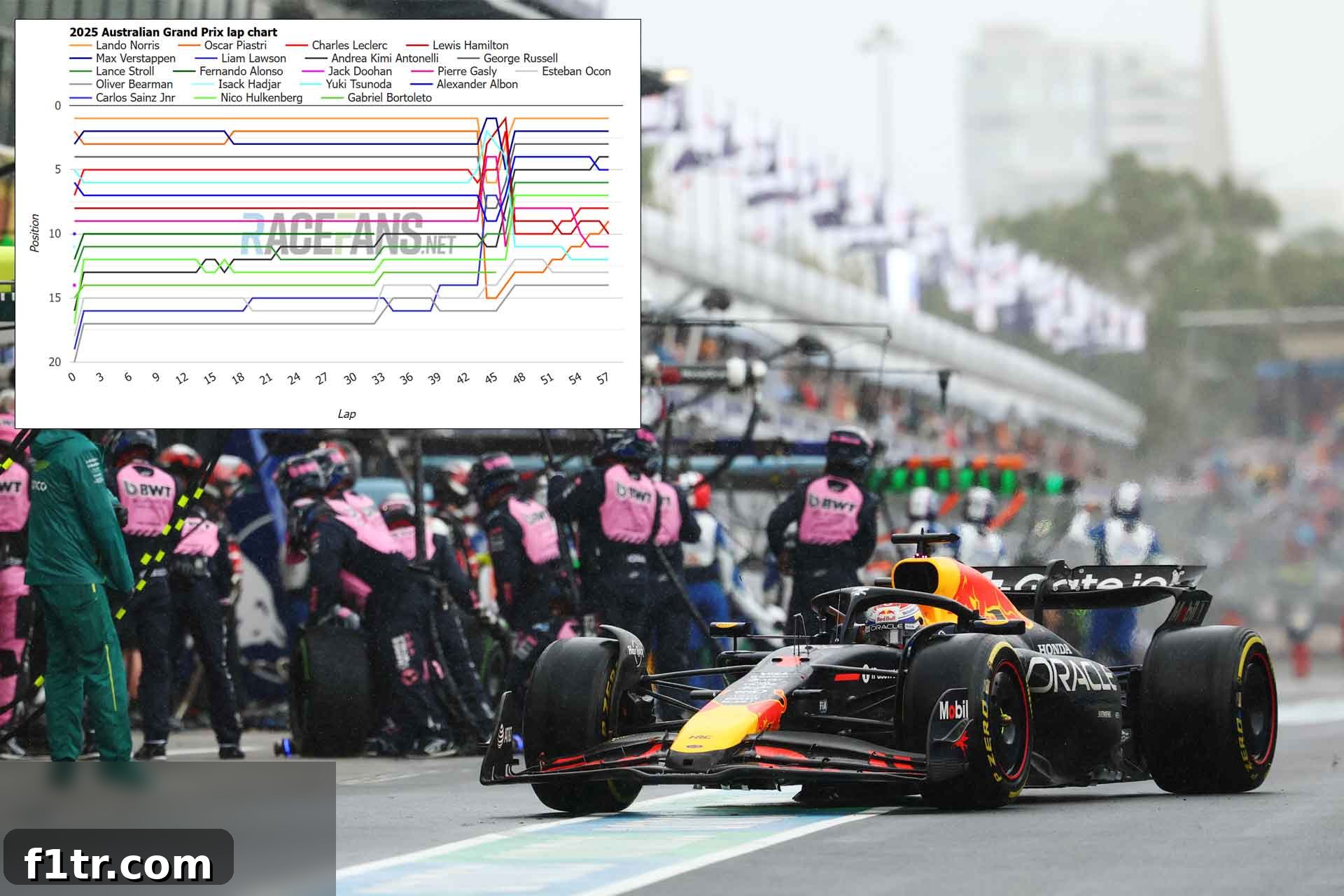
The 2025 Australian Grand Prix delivered an unforgettable spectacle of Formula 1 racing, underscored by a dramatic shift in weather that transformed the strategic landscape. Lap 44 proved to be the absolute pivotal moment of the race, as a sudden, torrential shower descended upon the Albert Park circuit. This unforeseen downpour ignited a frantic flurry of pit stops across the grid, instantly separating those who reacted with precision and speed from those who hesitated. In the high-stakes world of F1, such moments are often the difference between victory and defeat, or a podium finish and a slide down the order.
Lando Norris, then leading the race, was among the first to experience the full force of the cloudburst, which had been anticipated by teams but struck with surprising intensity near the end of the lap. As rain began to lash down, both Norris and his pursuing McLaren teammate, Oscar Piastri, ran wide at Turn 12. While Norris skillfully gathered his car up with remarkable speed, Piastri unfortunately skidded onto a patch of sodden, grip-less grass, momentarily losing control and precious seconds.
Norris’s response was immediate and decisive. Without a moment’s hesitation, he peeled off into the pit lane, signaling a critical change in strategy. Piastri, after carefully extricating his car from the run-off area, mirrored his teammate’s action and followed him into the pits for intermediate tires. However, Max Verstappen, who was running in third position at the time, made a bolder decision: he pressed on, opting to stay out for at least another lap. This crucial divergence set the stage for an intense strategic battle, as drivers and teams weighed the risks and rewards of their choices in rapidly evolving conditions.
The decisions made by the remaining drivers on the track had a significant and lasting bearing on the ultimate outcome of their races. George Russell, running comfortably in fourth place, made a shrewd call to pit for intermediates. This timely stop immediately put him on course for a strong podium finish, showcasing excellent situational awareness from the Mercedes garage. In stark contrast, Charles Leclerc and Yuki Tsunoda both chose to remain on track, a decision that proved costly. Leclerc even spun during this period, highlighting the treacherous nature of the track. Both drivers subsequently lost the top-six positions they had meticulously held, demonstrating the severe penalty for misjudging the conditions.
Lap chart
Gaps chart
Lap times
Tyre strategies
Alexander Albon, initially in seventh place, came into the pits on the expert advice of his Williams team, a call perhaps influenced by insights from Carlos Sainz Jnr (who had previously displayed exceptional judgment in wet conditions at Silverstone). His pit stop was executed flawlessly and positioned him advantageously in the chaos. Meanwhile, Lewis Hamilton, driving car 44, found himself in a difficult situation. His team’s decision to stay out for far too long on slick tires proved detrimental, causing him to plummet to the bottom of the top 10, highlighting the razor-thin margins and instantaneous consequences of F1 strategy in changing weather. The Ferrari pit wall’s delayed reaction in bringing Hamilton in proved to be one of the race’s most discussed strategic missteps.
While Hamilton’s Ferrari team didn’t capitalize on the critical opportunity presented by Lap 44, several other drivers behind him seized the moment, and their swift actions allowed them to leapfrog the struggling Ferrari. Young talent Andrea Kimi Antonelli, alongside Lance Stroll and Nico Hulkenberg, who were running in 10th, 11th, and 12th positions respectively, all opted for early intermediate tire changes. This bold strategic gamble paid off handsomely, rewarding them with valuable middle-order points finishes and demonstrating the foresight required to capitalize on unpredictable race conditions. Their ability to react faster than their competitors fundamentally altered their race trajectory.
The drivers who elected not to pit on Lap 44, including Verstappen, stubbornly stuck by their decision for another lap, gambling that the rain would not intensify further or that their current tires could still manage the damp sections. It wasn’t until Lap 46, when the rain unequivocally intensified across the circuit, that they eventually headed into the pit lane. This delay raised a pertinent question: could anyone have gained more by pitting on Lap 45 instead of Lap 44 or Lap 46? The track was indeed still substantially dry in many sections when the first wave of drivers, like Norris and Albon, came in. Some, including Albon himself, admitted to feeling they were taking a significant risk by pitting so early, but it was a risk that ultimately paid off.
Verstappen, ever confident in his team’s calls and his own judgment, insisted that Red Bull did not miss an opportunity to pit him earlier and get him back out before Norris could potentially catch up. A key factor in his willingness to risk the damp conditions for longer than Norris was the tire compound he was running. His Red Bull was on the more resilient medium rubber, providing slightly better grip and durability in mixed conditions compared to Norris’s hard tires. This subtle difference in tire choice played a crucial role in his strategic assessment.
“I saw them go off in front of me, kept it clean, and when I saw Oscar rejoining, I thought, ‘let’s stay out,’ because it was only those three corners,” Verstappen explained after the race, detailing his thought process during that critical lap. “The rest was still dry. When I continued, basically, the first two sectors were fine – it was just [about whether] I could survive the final sector.” His quick assessment of the track conditions was critical to his decision-making.
He continued, “I think that lap I did was okay. If there wasn’t much more rain coming, I thought it could work. You also have to factor in that even if they caught me on an inter, they’d have to [pit] again for slicks, if it’s not going to rain anymore. So, it was fine.” This insight reveals his strategic thinking beyond just one lap, considering the potential for the track to dry again and the need for a subsequent tire change. It was a calculated risk, not a blind gamble.
“I thought, ‘Yeah, we’ll do another lap,’ but then, unfortunately, on that lap, the first sector was still okay-ish, but then in sector two, it started to rain a bit too much and we had to box,” Verstappen elaborated, acknowledging the moment his gamble no longer held. “But in hindsight, it wouldn’t have mattered. If I’d [pitted] with Lando, it would have been P2. If I’d [pitted] the next lap, it would have been P2. And the lap that I did [pit], I was also P2. So, we tried something else, it might have worked. In a way, it didn’t work, but we didn’t lose any position, so it’s fine.” His calm assessment underscores that while the strategy didn’t gain him a position, it crucially didn’t lose him one either, proving the robustness of Red Bull’s contingency planning.
Verstappen’s confident claim is demonstrably backed up by his sector times from Lap 45. While he was only a few hundredths of a second quicker than Norris through the middle sector of the lap, the final sector told a different story. Here, Verstappen was over three-and-a-half seconds slower, clearly indicating the escalating wetness and the diminishing returns of staying on slicks. This data confirms that while the margin for error was slim, Red Bull’s decision to wait one extra lap was a calculated one that, as Verstappen noted, ultimately did not cost him a position. It wasn’t a missed opportunity in terms of the final result, but rather a strategic play that, though risky, held its ground.
2025 Australian Grand Prix Lap Chart: Race Positions Through Every Lap
Gain a visual understanding of how each driver’s position evolved throughout the 2025 Australian Grand Prix. Click on a driver’s name to highlight their trajectory, or right-click to reset the view. Use the controls below to toggle specific drivers on or off for focused analysis. This chart offers crucial insights into race progression and strategic impacts.
2025 Australian Grand Prix Gaps Chart: Tracking Performance Relative to the Leader
Analyze the gaps between each driver and the race leader’s average lap time across every lap of the 2025 Australian Grand Prix. This chart provides a clear picture of relative performance and strategic effectiveness, with very large gaps omitted for clarity. Scroll to zoom, drag to pan, and right-click to reset the view. Use the controls below to toggle drivers for a personalized perspective.
2025 Australian Grand Prix Lap Times: A Detailed Breakdown of Pace
Explore the individual lap times for all drivers (in seconds, excluding unusually slow laps due to incidents or pit stops) during the 2025 Australian Grand Prix. This comprehensive data highlights driver performance and track evolution. Scroll to zoom, drag to pan, and toggle specific drivers using the control below to delve deeper into the race pace.
2025 Australian Grand Prix Fastest Laps: Who Set the Pace?
Discover which drivers recorded the quickest laps at the 2025 Australian Grand Prix. This table showcases each driver’s best lap time, their gap to the fastest, average speed, and the lap number on which it was achieved, reflecting their peak performance during the race.
| Rank | # | Driver | Car | Lap time | Gap | Avg. speed (kph) | Lap no. |
|---|---|---|---|---|---|---|---|
| 1 | 4 | Lando Norris | McLaren-Mercedes | 1’22.167 | 231.25 | 43 | |
| 2 | 30 | Liam Lawson | Red Bull-Honda RBPT | 1’22.970 | 0.803 | 229.01 | 43 |
| 3 | 1 | Max Verstappen | Red Bull-Honda RBPT | 1’23.081 | 0.914 | 228.7 | 43 |
| 4 | 81 | Oscar Piastri | McLaren-Mercedes | 1’23.242 | 1.075 | 228.26 | 43 |
| 5 | 5 | Gabriel Bortoleto | Sauber-Ferrari | 1’24.192 | 2.025 | 225.68 | 43 |
| 6 | 22 | Yuki Tsunoda | Racing Bulls-Honda RBPT | 1’24.194 | 2.027 | 225.68 | 43 |
| 7 | 44 | Lewis Hamilton | Ferrari | 1’24.218 | 2.051 | 225.61 | 43 |
| 8 | 23 | Alexander Albon | Williams-Mercedes | 1’24.597 | 2.430 | 224.6 | 43 |
| 9 | 12 | Andrea Kimi Antonelli | Mercedes | 1’24.901 | 2.734 | 223.8 | 43 |
| 10 | 10 | Pierre Gasly | Alpine-Renault | 1’25.020 | 2.853 | 223.49 | 43 |
| 11 | 63 | George Russell | Mercedes | 1’25.065 | 2.898 | 223.37 | 43 |
| 12 | 27 | Nico Hulkenberg | Sauber-Ferrari | 1’25.243 | 3.076 | 222.9 | 43 |
| 13 | 16 | Charles Leclerc | Ferrari | 1’25.271 | 3.104 | 222.83 | 43 |
| 14 | 18 | Lance Stroll | Aston Martin-Mercedes | 1’25.538 | 3.371 | 222.13 | 43 |
| 15 | 31 | Esteban Ocon | Haas-Ferrari | 1’26.764 | 4.597 | 218.99 | 42 |
| 16 | 87 | Oliver Bearman | Haas-Ferrari | 1’27.603 | 5.436 | 216.9 | 42 |
| 17 | 14 | Fernando Alonso | Aston Martin-Mercedes | 1’28.819 | 6.652 | 213.93 | 32 |
2025 Australian Grand Prix Tyre Strategies: An Overview of Each Team’s Choices
Delve into the comprehensive tyre strategies employed by each driver during the 2025 Australian Grand Prix. This interactive chart illustrates the compounds used, pit stop timings, and the tactical decisions that played a pivotal role in their race performance. Understanding these choices is key to appreciating the strategic depth of F1.
2025 Australian Grand Prix Pit Stop Times: Analyzing Efficiency in the Pits
Review the efficiency of each team’s pit stop operations at the 2025 Australian Grand Prix. This table details how long each driver’s pit stops took, the gap to the fastest stop, the stop number, and the lap on which it occurred. Pit stop speed is often as crucial as on-track pace in modern Formula 1.
| Rank | # | Driver | Team | Complete stop time (s) | Gap to best (s) | Stop no. | Lap no. |
|---|---|---|---|---|---|---|---|
| 1 | 4 | Lando Norris | McLaren | 18.031 | 2 | 44 | |
| 2 | 16 | Charles Leclerc | Ferrari | 18.154 | 0.123 | 1 | 34 |
| 3 | 4 | Lando Norris | McLaren | 18.464 | 0.433 | 1 | 34 |
| 4 | 44 | Lewis Hamilton | Ferrari | 18.526 | 0.495 | 1 | 33 |
| 5 | 23 | Alexander Albon | Williams | 18.573 | 0.542 | 1 | 33 |
| 6 | 1 | Max Verstappen | Red Bull | 18.7 | 0.669 | 1 | 34 |
| 7 | 1 | Max Verstappen | Red Bull | 18.721 | 0.69 | 2 | 46 |
| 8 | 31 | Esteban Ocon | Haas | 18.778 | 0.747 | 2 | 39 |
| 9 | 18 | Lance Stroll | Aston Martin | 18.802 | 0.771 | 1 | 33 |
| 10 | 30 | Liam Lawson | Red Bull | 18.88 | 0.849 | 1 | 4 |
| 11 | 18 | Lance Stroll | Aston Martin | 18.901 | 0.87 | 2 | 44 |
| 12 | 12 | Andrea Kimi Antonelli | Mercedes | 18.912 | 0.881 | 1 | 33 |
| 13 | 23 | Alexander Albon | Williams | 18.952 | 0.921 | 2 | 44 |
| 14 | 22 | Yuki Tsunoda | Racing Bulls | 18.997 | 0.966 | 1 | 33 |
| 15 | 63 | George Russell | Mercedes | 19.125 | 1.094 | 1 | 34 |
| 16 | 22 | Yuki Tsunoda | Racing Bulls | 19.312 | 1.281 | 2 | 47 |
| 17 | 87 | Oliver Bearman | Haas | 19.37 | 1.339 | 3 | 44 |
| 18 | 63 | George Russell | Mercedes | 19.378 | 1.347 | 2 | 44 |
| 19 | 10 | Pierre Gasly | Alpine | 19.482 | 1.451 | 2 | 46 |
| 20 | 10 | Pierre Gasly | Alpine | 19.589 | 1.558 | 1 | 33 |
| 21 | 31 | Esteban Ocon | Haas | 19.649 | 1.618 | 1 | 4 |
| 22 | 81 | Oscar Piastri | McLaren | 19.719 | 1.688 | 1 | 34 |
| 23 | 81 | Oscar Piastri | McLaren | 19.85 | 1.819 | 2 | 44 |
| 24 | 31 | Esteban Ocon | Haas | 19.858 | 1.827 | 3 | 46 |
| 25 | 30 | Liam Lawson | Red Bull | 20.067 | 2.036 | 2 | 33 |
| 26 | 27 | Nico Hulkenberg | Sauber | 20.209 | 2.178 | 2 | 44 |
| 27 | 44 | Lewis Hamilton | Ferrari | 20.802 | 2.771 | 2 | 47 |
| 28 | 27 | Nico Hulkenberg | Sauber | 21.123 | 3.092 | 1 | 33 |
| 29 | 12 | Andrea Kimi Antonelli | Mercedes | 21.946 | 3.915 | 2 | 44 |
| 30 | 87 | Oliver Bearman | Haas | 22.441 | 4.41 | 2 | 39 |
| 31 | 87 | Oliver Bearman | Haas | 22.494 | 4.463 | 1 | 4 |
| 32 | 5 | Gabriel Bortoleto | Sauber | 24.073 | 6.042 | 1 | 33 |
| 33 | 16 | Charles Leclerc | Ferrari | 24.528 | 6.497 | 2 | 47 |
| 34 | 5 | Gabriel Bortoleto | Sauber | 26.214 | 8.183 | 2 | 44 |
More from the 2025 Australian Grand Prix
- F1 rules change to prevent repeat of Verstappen-Bearman Australian GP confusion
- Contact with team mate may have led to Bortoleto’s Australian GP crash
- Hamilton dismisses ‘negativity’ over his radio calls. ‘Other drivers are almost abusive’
- Antonelli “got really scared” when he made “big save” on first lap of Australian GP
- Williams explain role played by car’s systems in Sainz’s race-ending crash
Browse all 2025 Australian Grand Prix articles