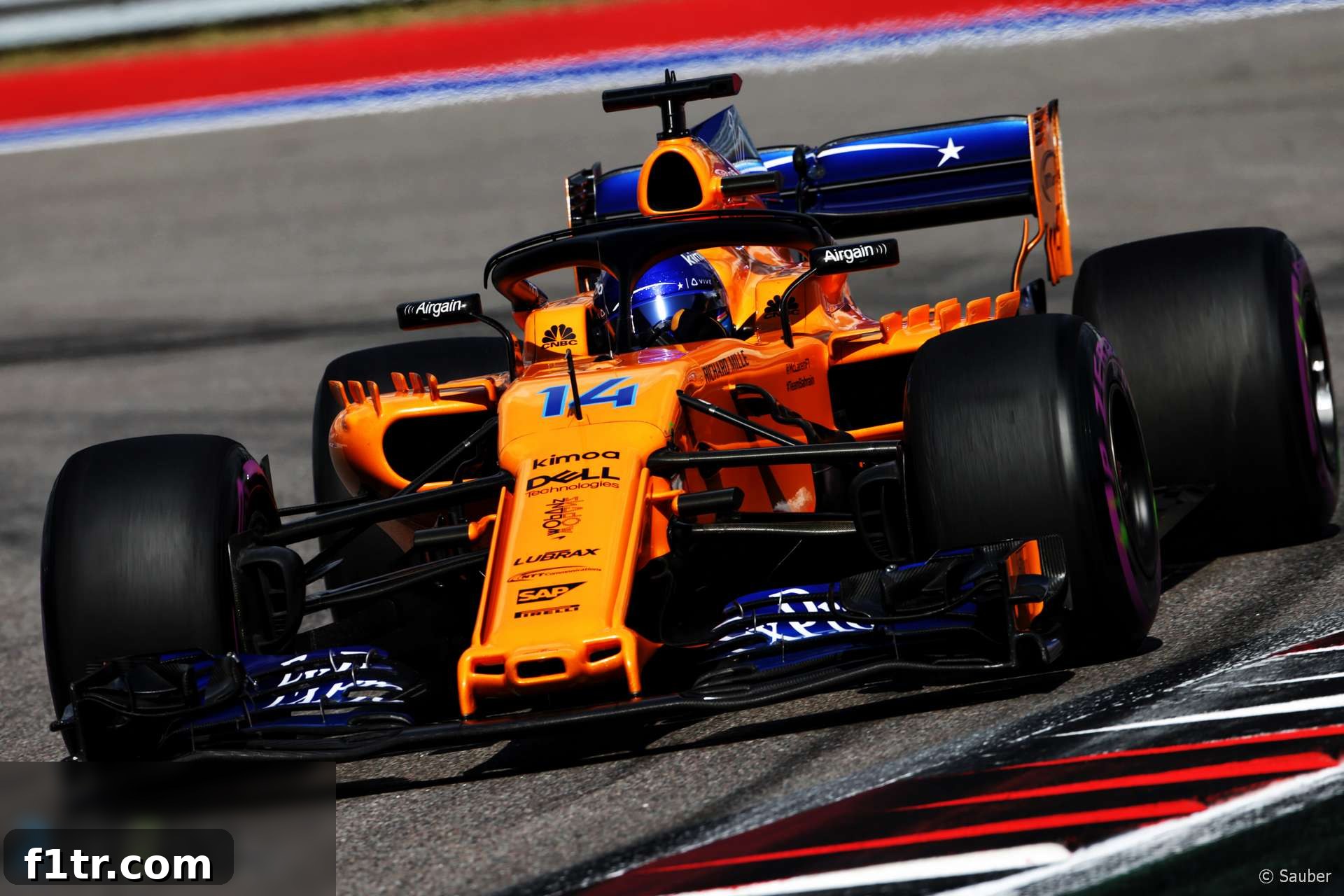
McLaren’s Strategic Play: Alonso’s Qualifying Sacrifice to Aid Vandoorne Amidst Grid Penalties
In a strategic move characteristic of Formula 1’s intricate chess game, Fernando Alonso revealed McLaren’s calculated approach during a qualifying session, where his primary mission was not to set a blistering lap time for himself but rather to provide a crucial advantage for his teammate, Stoffel Vandoorne. This unique tactic aimed to propel Vandoorne into Q2, particularly significant given the fluctuating grid penalties impacting many teams.
Advert | Become a Supporter & go ad-free
The decision stemmed from a fundamental challenge McLaren faced: power unit changes. With numerous teams grappling with reliability issues and the necessity for component replacements beyond the allocated limits, grid penalties became a common feature of the 2018 Formula 1 season. In this particular instance, Vandoorne was the only McLaren driver unaffected by such a penalty, making his qualifying performance paramount for securing the best possible starting position for the team. McLaren, therefore, opted to leverage Alonso’s car tactically, specifically utilizing the slipstream – often referred to as a ‘tow’ – to boost Vandoorne’s straight-line speed during his hot laps.
Alonso, a two-time world champion renowned for his racing acumen and adaptability, readily embraced this team-first strategy. He explained his approach unequivocally, stating he “didn’t attempt any performance run” during the qualifying session. Instead, his focus was entirely on facilitating his teammate. “I just ran in a safe mode on the straights and tried to help Stoffel,” Alonso elaborated, highlighting a rare instance where a driver of his caliber deliberately held back from pushing the limits of his car in a qualifying scenario.
Alonso’s Dual Mission: Beyond Personal Glory
Alonso detailed his objectives with precision, outlining two critical missions he was tasked with completing for the team. “I had two missions,” he explained. “One to set a lap inside 107% [to ensure he would be allowed to start] and the second mission was to help Stoffel with the tow in the straights.” The 107% rule is a fundamental regulation in Formula 1 qualifying, dictating that a driver must set a lap time within 107% of the fastest driver’s Q1 time to be permitted to start the race. For Alonso, with his car often struggling for ultimate pace, ensuring he met this threshold was a basic but necessary requirement, allowing him to then fully focus on the strategic tow for Vandoorne.
The concept of a slipstream, or ‘tow’, is a well-established tactic in motorsport, particularly beneficial on tracks with long straights. By following closely behind another car, a driver can benefit from reduced aerodynamic drag, effectively “sucking” along and gaining a few crucial tenths of a second in straight-line speed. For McLaren, struggling to extract raw pace from their package, every tiny advantage counted. Alonso’s role was to provide this aerodynamic boost to Vandoorne, optimizing his teammate’s run and maximizing his chances of progressing deeper into qualifying.
Alonso expressed confidence that both objectives were successfully met. “I think we did both and obviously a lot of the focus has been on the race pace this weekend. Hopefully tomorrow we see some nice results on the chequered flag,” he concluded, shifting the team’s immediate focus to the race day, where different strategies and car characteristics often come into play, especially when starting from compromised grid positions due to penalties.
Vandoorne’s Outcome: A Disappointing Result Despite Team Effort
Despite Alonso’s dedicated efforts and the strategic sacrifice, the outcome for Stoffel Vandoorne in qualifying was ultimately disappointing. He failed to progress to Q2, ending the session 19th quickest. The gap between him and his strategically assisted teammate, Alonso, was four-tenths of a second. This result underscored the inherent performance limitations of the McLaren package at that particular circuit, suggesting that even with a significant team effort like a slipstream, the raw pace simply wasn’t enough to overcome the competitive midfield.
Vandoorne himself acknowledged the difficult reality facing the team. “It was always going to be hard for us this weekend,” he conceded, painting a clear picture of the struggles McLaren was enduring during that period. “I think this morning we saw that the pace of the car was not very good at all.” His honesty highlighted the significant performance deficit they were attempting to mitigate with tactics. The Belgian driver’s target for the qualifying session was modest but realistic: “Going into the qualifying session the target was to try and be ahead of the Williamses.” This aspiration reflected the intense battle within the midfield pack, where every position gained against direct rivals was considered a small victory.
Vandoorne did manage to beat one Williams driver, a testament to his own driving and perhaps some benefit from the strategic tow, however minor. Yet, the overall picture remained challenging. “I don’t know exactly what happens with all the penalties,” he added, alluding to the convoluted nature of grid positions after numerous power unit penalties were applied across the field. This uncertainty further complicated the team’s race day preparations and expectations.
Advert | Become a RaceFans supporter andgo ad-free
The Broader Context of McLaren’s 2018 Season
The 2018 Formula 1 season was a period of significant transition and challenge for McLaren. Having parted ways with Honda power after three difficult years, the Woking-based team switched to Renault engines, hoping for a resurgence in competitiveness. While the initial optimism was high, the reality on track proved to be tougher than anticipated. The McLaren MCL33, despite its new power unit, struggled with aerodynamic inefficiencies and overall balance, often finding itself locked in the midfield battle, unable to consistently challenge the top teams. This context makes the strategic decision in qualifying all the more understandable – it was an attempt to eke out every possible advantage in a fiercely competitive environment.
The constant threat of grid penalties due to power unit component limits added another layer of complexity. Teams like McLaren, often pushing the development envelope or struggling with reliability, frequently incurred penalties, forcing them to start races from the back of the grid. This necessitated innovative strategies, such as the one employed with Alonso and Vandoorne, to maximize the chances of at least one car starting in a more advantageous position.
Evaluating the Effectiveness of the Strategy
From a purely objective standpoint, Alonso successfully completed his two missions: he set a legal lap time and provided a slipstream for Vandoorne. However, the ultimate goal of getting Vandoorne into Q2 was not achieved. This outcome raises questions about the sheer deficit in car performance that even clever tactics couldn’t fully overcome. It highlights a common dilemma in Formula 1: while strategy can optimize performance, it cannot fundamentally transform an uncompetitive car into a front-runner.
Nevertheless, the strategy showcased the unity and dedication within the McLaren team. Alonso, a driver of immense pedigree, demonstrated unwavering commitment to the team’s broader objectives, even when it meant sacrificing his own individual qualifying performance. This spirit of cooperation is vital in Formula 1, where points are won by the team, not just individual drivers. For Vandoorne, receiving such support from a world champion teammate, despite the result, would have been a morale booster, knowing the team was doing everything it could to assist him.
Looking Ahead: Race Day Implications
With Alonso likely facing a back-of-the-grid start due to his own power unit penalties, and Vandoorne starting from 19th, McLaren’s focus would indeed shift entirely to race pace and managing the race for potential points. In Formula 1, a strong race strategy, excellent pit stops, and opportunistic driving can often mitigate a poor qualifying performance, especially with the variable conditions and safety car interventions that frequently occur. Alonso’s comment about hoping for “nice results on the chequered flag” reflected this reality. For McLaren in 2018, “nice results” likely meant scoring points, an achievement that often required both luck and flawless execution from these challenging starting positions.
The tactical qualifying play by McLaren, though not yielding the desired Q2 slot for Vandoorne, serves as a compelling example of the intricate strategic decisions and selfless teamwork that underpin the world of Formula 1. In a sport where fractions of a second and grid positions can dictate fortunes, every possible advantage, no matter how small, is pursued with meticulous planning and execution.
2018 F1 season
- F1 feared “death knell” for Drive to Survive after Ferrari and Mercedes snub
- McLaren staff told us we were “totally crazy” to take Honda engines in 2018 – Tost
- ‘It doesn’t matter if we start last’: How Red Bull’s junior team aided Honda’s leap forward
- Honda’s jet division helped F1 engineers solve power unit problem
- McLaren Racing losses rise after Honda split
Browse all 2018 F1 season articles